

The way dual-applicant couples shape residency programs is one of the least talked-about, most powerful forces in modern GME. Program directors will not say this on Zoom open houses, but couples can absolutely alter call schedules, shift culture, and even how rank lists are built. And I’ve watched it happen. Repeatedly.
Let me walk you through what actually goes on behind the closed doors of resident scheduling meetings and ranking committees when a strong couple lands in the middle of a program.
Why Programs Quietly Care So Much About “Power Couples”
Every program director knows this: a good dual-applicant couple can stabilize a residency. A bad one can fracture it.
They’ll never word it that bluntly on their website. Publicly, they talk about “supporting couples” and “work–life balance.” In the conference room, the language is different:
- “If we take her, we really want him too. They’ll be anchors for that class.”
- “If they both match here, we have to be careful they don’t become a political bloc.”
- “Losing one of them mid-residency would be a disaster; keep them happy.”
A “power couple” in this context doesn’t just mean two people who are dating and applying. I’m talking about pairs who are:
- Competitive applicants (strong scores, letters, interviews)
- Vocal, organized, and respected by peers
- Willing to push for schedule changes, culture improvements, or policy shifts
That combination makes program leadership both excited and slightly nervous.
They know:
- You’re more likely to rank them high together because of location needs.
- If you’re happy, you’ll often be the ones leading QI projects, wellness committees, or resident council.
- If you’re unhappy, you’ll be the ones quietly organizing your class against unfair call or exploitative policies.
So yes, couples have leverage. And it bleeds directly into scheduling and culture.
What Actually Happens During Rank Meetings for Couples
Let me tell you how those conversations go, because you’ll never hear this from a PD on the record.
On the whiteboard is the rank list. Next to certain names: little marks, codes, or initials.
Those marks often mean “couple.”
Program directors and coordinators will frequently keep a side spreadsheet with pairings:
- Applicant #23 (IM) ↔ Applicant #77 (EM)
- Applicant #12 (Surgery) ↔ Applicant #45 (Anesthesiology)
I have literally seen PDs leave a note on a CV: “Partner applying peds here. Would take both.” Or: “Partner in derm at [other institution]; risk of attrition?”
Couples influence rank decisions in a few key ways:
Bundled value judgment.
If both are strong, the program feels like it’s getting two “high-yield” residents for the price of one recruitment push. They’ll often nudge both of you a little higher on the list to maximize the chance you match there together.Risk management.
Programs fear early attrition. If your partner matches somewhere else far away, the PD in the room is thinking: “What are the odds this person tries to transfer out after PGY-1?” That can push you down the list if your partner is committed elsewhere.Strategic ties.
When a program really likes both members of a couple, I’ve watched them “burn” a higher rank position than they normally would just to pull in the pair and stabilize a class or service that’s been high-turnover.
Here’s the part nobody tells you: some PDs see power couples as mini-leadership pods.
Built-in support system. Less burnout risk. More resilience.
Others see them as potential sources of “factionalism”: if the couple doesn’t like something, they may sway half the class with them.
Both beliefs affect how you’re ranked.
How Your Relationship Status Ends Up in Scheduling Meetings
You think your dating life is private. It’s not. Not inside a program.
Once match lists are out and classes are set, there’s a second, quieter phase that matters just as much for your day-to-day life: schedule planning.
There’s the public scheduler who sends you your block schedule and the “we try to respect everyone’s needs.” Then there’s the actual behind-the-scenes meeting where your name is circled with another person’s and the negotiation begins.
I’ve been in those meetings. Here’s what really happens.
The chief residents and program coordinator sit with:
- A massive Excel file or scheduling platform
- Call quotas per block
- Vacation rules
- Service coverage requirements
And then they layer on all the “constraints”:
- Religious holidays
- Pregnancy / parental leave
- Visa issues
- Conference presentations
- Couples
This is where being a dual-applicant couple can completely change your life for the next three years.
The Specific Ways Couples Change Call Schedules
Programs won’t advertise this, but they bend more for couples than for almost anyone else—if the couple is high-value to them.
Here are the main levers they pull.
1. Synchronous Days Off and Weekends
I’ve watched chiefs redo an entire call grid just to align two residents’ golden weekends.
Nobody gets that kind of preferential treatment as consistently as couples who are:
- Vocal but respectful
- Reliable clinically
- Seen as “good for the program”
You’ll hear comments like:
- “We can move her call from Saturday to Friday, then he’ll be off Sat/Sun too.”
- “If we swap this ICU block with that one, they’ll overlap on nights and then be off together.”
It doesn’t always work, but the attempt happens a lot more for couples than single residents. If you’re considered a power couple, this becomes almost a standing assumption: “Let’s at least try to align them.”
2. Call Burden Perception
Funny truth: couples get watched on call distribution.
If both of you are on heavy services, other residents start saying, “They’re getting crushed.” Chiefs and PDs hear that. Some programs then overcorrect and start protecting you a bit to avoid burnout and relationship strain, because they know if one of you flames out, the other might follow.
I’ve seen this scenario at a large IM program:
- She’s on MICU, brutal Q4 call.
- He’s on trauma nights in surgery.
- They come to the chiefs and say, “We don’t see each other for 6 weeks.”
Chiefs rerun the grid the following year so that couples are never both on maximum-intensity rotations at the same time.
Who drove that policy shift? One couple that spoke up, and a PD who realized losing both would blow a hole in their staffing.
3. Vacation Block Manipulation
Vacation is where couples often successfully pull strings.
Official policy: “We can’t guarantee overlapping vacations.”
Real life: if the chiefs like you and you ask early and clearly, they will often:
- Backfill your calls with moonlighters or prelims
- Stack your vacations on adjacent blocks
- Quietly swap you with a more flexible classmate
And yes, people grumble. When a couple gets a two-week stretch together around a wedding or trip, others notice. But leadership often accepts the short-term friction because:
- Couples are retention-sensitive.
- Happy couples are less likely to quit, go part-time, or transfer.
This is the calculus.
How Power Couples Shift Program Culture Over Time
Now let’s talk about the part people under-appreciate: the cultural shift.
One committed, well-connected couple, over three to five years, can fundamentally change the vibe of a residency.
1. Normalizing Asking for Accommodation
In older-school programs, you did not ask for special treatment. Ever. You sucked it up and worked the schedule.
Couples break that silence.
They ask for:
- Aligned weekends
- Flex on nights
- Support around family events
When program leadership repeatedly says yes—or even partly yes—other residents learn something: the rules are negotiable.
Suddenly, you see more people asking for:
- Protected time for therapy
- Regular clinic days maintained
- Religious observances respected
That’s how culture changes: not from policy documents, but from somebody asking and not getting punished for it.
Dual-applicant couples are often the first to push this because their life logistics are simply more fragile.
2. Creating Micro-Communities
Power couples tend to be social hubs. They host dinners. They coordinate group events. They become the connective tissue between specialties if they’re in different departments (IM + EM, Anesthesia + Surgery, etc.).
Program directors love this—when it works.
It builds:
- Cross-specialty friendships
- Informal consult favors
- A positive social environment
I know one IM–Peds couple who basically ran the unofficial “PGY-2 support group” at their institution. People would show up at their apartment on post-call days, vent, share notes. The chiefs found out and essentially used them as a barometer for class morale.
That’s power.
3. Driving Policy Changes with PDs
The highest-impact couples end up on:
- Residency councils
- Wellness committees
- Recruitment panels
Because PDs trust them and because they often present as “stable, reasonable, invested.”
From there they push for things like:
- More predictable golden weekends
- Couples-aware scheduling policies
- Clear rules around co-parenting residents
These changes often get codified after one or two intense years when leadership is trying to retain or recruit strong couples.
I’ve seen specific policies literally named after one couple in private: “the [LastName] rule” about aligning ICU and L&D nights, for example.
The Dark Side: Resentment, Factions, and Quiet Pushback
You will not hear this on interview day, but there’s a cost.
When a couple is seen as getting “too much” accommodation, resentment builds. Quickly.
Comments you’ll never hear to your face:
- “Of course they got that weekend, they’re the golden couple.”
- “We all had to work, but they got switched off AGAIN.”
- “If I had a spouse in the program, maybe I’d get that too.”
If chiefs and PDs aren’t careful, the couple becomes a symbol of inequity.
Perception matters more than the actual number of switched calls.
Power couples can inadvertently create:
Scheduling inequity narratives.
Even if, on paper, you do your fair share, a few high-visibility accommodations can burn your political capital with peers.Cliques.
When a couple + their closest friends start appearing like an inner circle, others feel excluded. Especially if you’re heavily involved in recruitment or resident council.Backlash on future couples.
I’ve heard PDs say, “We bent over backwards for that last couple and got nothing but drama; I’m not doing that again.” That means the next couple gets less support because the last one blew up the goodwill.
If you’re entering as a couple, you need to understand this dynamic. Your choices don’t happen in a vacuum. They shape how leadership views all couples after you.
How to Use Your Influence Without Burning Bridges
Here’s the practical part nobody teaches you: how to be a power couple without becoming “that couple” everyone quietly hates.
1. Pick Your Battles
If you ask for schedule favors every block, you’ll lose moral authority fast.
Save your asks for:
- Truly important events (weddings, family crises, major life logistics)
- Brutal back-to-back high-intensity blocks where you both would be destroyed
- Long stretches with literally zero overlap in days off
And when you ask, offer solutions, not just problems:
- “I’ve already talked to X and Y, they’re willing to swap calls with us if approved.”
- “We’re fine doing an extra jeopardy shift next month to make this work.”
Chiefs love couples who come with pre-arranged swaps.
2. Protect Your Reputation Early
Your first year sets your label.
If you’re known as:
- Hardworking
- Low-complaint
- Reliable on call
Your later schedule requests are read as “reasonable asks from solid residents.”
If you start off as:
- Frequently late
- Quick to push back on standard expectations
- Always angling for a better deal
Every future ask is read as manipulation, even if it’s legitimate.
I’ve seen one couple in a surgical department who were objectively overworked yet couldn’t get any support. Why? They had torched their reputations with entitled behavior PGY-1. The chiefs simply had no interest in fighting for them.
3. Be Transparent About What You Need
This is where people screw up: they’re vague.
You should be explicit with the chiefs and PD:
- “We’re fine being on nights at the same time sometimes. We just need one stretch per month where we can have at least one full day off together.”
- “Holidays aren’t important to us if we can get one aligned week in the summer.”
They can’t read your mind. And if you don’t define what “support” looks like, you’ll end up disappointed and resentful while they think they’ve been generous.
How Programs Quietly Use Couples in Recruitment and Optics
Programs absolutely leverage strong couples as marketing tools. Again, no one says this out loud on the website, but it’s routine.
They’ll:
- Put you on interview day panels: “We support couples, look at them, they’re thriving here.”
- Pair you with dual-applicant interviewees to sell the program’s “family feel.”
- Highlight you in slide decks about wellness or work–life integration.
Behind the scenes, PDs think:
“If this couple is happy, they’re our best proof of concept.”
The irony is that the accommodations they give you so you look happy are exactly what attract more couples, which in turn forces the program to evolve its policies more permanently. It’s a feedback loop.
So yes, your relationship becomes part of the program’s brand whether you intend it or not.
How This Plays Out Across Different Specialties
Not all specialties handle couples the same way. Think of it as a spectrum from rigid to flexible.
| Specialty | Typical Flexibility for Couples |
|---|---|
| General Surgery | Low–Moderate |
| Internal Med | Moderate–High |
| Pediatrics | High |
| Emergency Med | High |
| Anesthesiology | Moderate–High |
This isn’t absolute, but as a rule:
- Procedural fields with heavy call (surgery, OB) have less slack in the system. Less room for aligned vacation and call.
- Shift-based fields (EM, anesthesia in some settings) can often align schedules more easily.
- Primary care–leaning specialties (peds, IM) usually have more cultural openness to couples’ needs.
What matters more than specialty, though, is program leadership attitude. I’ve seen very “hardcore” surgery programs do more for couples than cushy community IM programs, purely because the PD believed in retention through accommodation.
Visual: How Couples Requests Actually Show Up Over a Year
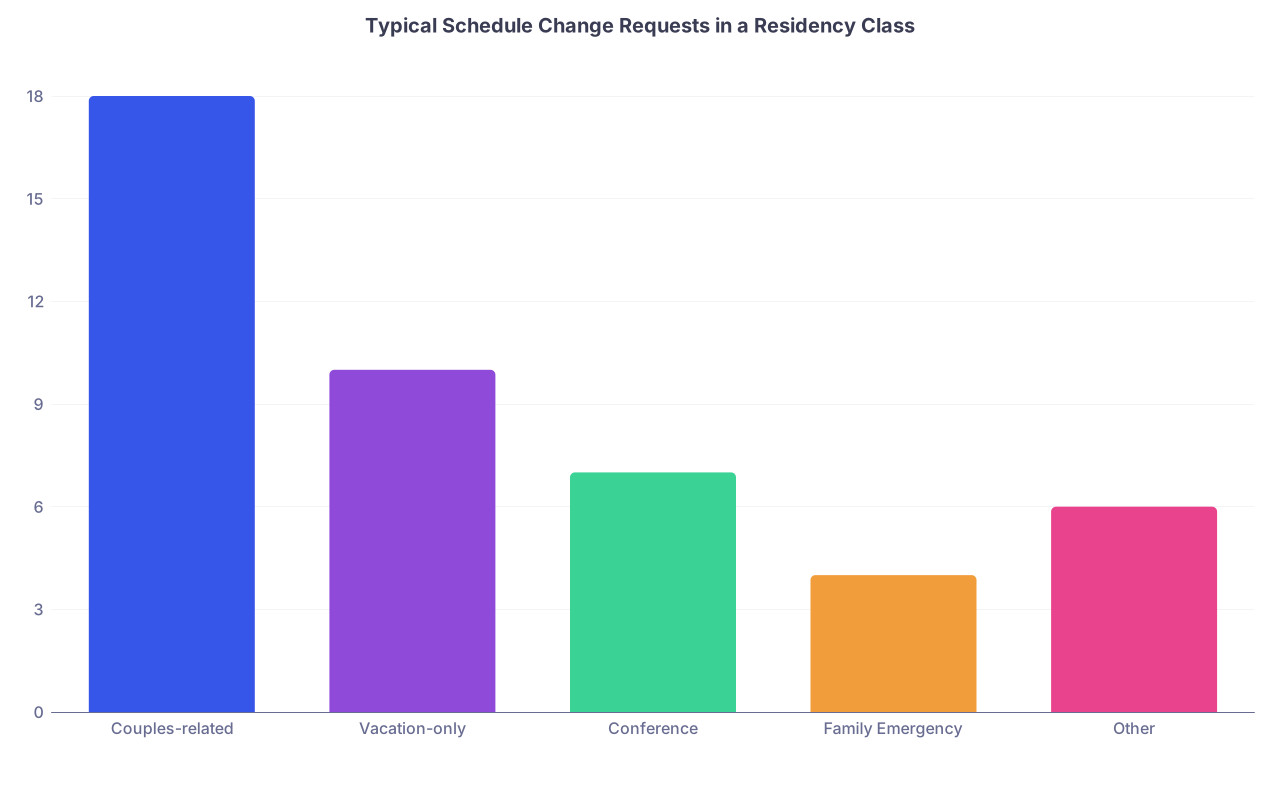
| Category | Value |
|---|---|
| Couples-related | 18 |
| Vacation-only | 10 |
| Conference | 7 |
| Family Emergency | 4 |
| Other | 6 |
In one mid-sized program I worked with, chief residents tracked request types for a year. Couples accounted for the largest category of complex schedule change requests. That’s not an anomaly. It’s normal.
And leadership designs policies accordingly, whether you see the memos or not.
The Long Game: How Your Relationship Affects Your Trajectory
One more uncomfortable truth: PDs and faculty project forward.
They think:
- “Is this couple going to stay academic?”
- “Are they likely to stay in this city long term?”
- “Will they be our future faculty pipeline?”
If you present as a solid, stable, power couple, programs often invest more in you:
- Leadership roles earlier
- Research or QI opportunities
- Letters and connections for fellowship
Because from their view, helping one of you helps both. And if they believe you’re “keeping each other in the game,” they see you as lower burnout risk.
But if your relationship looks volatile, dramatic, or boundary-less (fighting in hallways, oversharing with staff, messy breakups)? You can absolutely lose opportunities. People remember.
Process View: Where Couples Influence the System

| Step | Description |
|---|---|
| Step 1 | ERAS Submitted |
| Step 2 | Interview Season |
| Step 3 | PD Rank Meeting |
| Step 4 | Match Results |
| Step 5 | Schedule Planning |
| Step 6 | Culture & Policy Changes |
| Step 7 | Future Recruitment Messaging |
Your influence is not just at Match. It echoes through scheduling, culture, and future classes.
FAQ (Exactly 3 Questions)
1. Do programs ever rank one partner higher just to attract the other?
Yes. I’ve seen it more than once. If a program is lukewarm on one partner but very excited about the other, they may still keep both reasonably high to maximize the chance they come as a pair—especially if the program is in a less desirable location or struggling with recruitment. It’s a calculated risk: they accept a “good enough” resident to lock in an “excellent” one and gain a stable couple who might stay long term.
2. Will asking for couples-based schedule accommodations hurt us politically?
It can, if you’re careless. If you’ve built a reputation for reliability and you choose your requests carefully, chiefs and PDs usually see it as reasonable and supportive. If you’re constantly asking for swaps, holidays, and special treatment, resentment grows fast—from both leadership and co-residents. The trick is to be strategic: ask early, offer solutions, and don’t nickel-and-dime them every month.
3. Should we bring up our need for aligned schedules during interviews?
Briefly and intelligently, yes. The wrong way is: “We’ll need all our weekends together.” The right way sounds like: “We’re a couples match and we know scheduling is complex. We don’t expect perfection, but we do value having some shared time off to stay sane. How has your program supported couples in the past?” You’re signaling that you’re realistic, not demanding, but that this matters to you—and you’ll get a lot of information from how honestly they answer.
Two things to keep in your head as you go through this:
Power couples really do change programs—from rank lists to call schedules to culture.
And programs are absolutely making moves behind the scenes to keep, shape, or sometimes quietly limit that power.
If you understand that, you’ll stop acting like a passive recipient of the match and start playing the same long game your program is already playing with you.


