The way couples sit together on interview day has killed more matches than a bad Step 2 score.
I’m not exaggerating. I’ve sat in the conference room at 6 p.m., reading faculty feedback, listening to a program director say: “They seem locked in a bubble. I’m not ranking them high; they’ll be a problem as a couple.” That whole judgment was built off eight seconds in a waiting room and a few odd moments during breaks.
You think you’re just sitting next to your partner to calm each other’s nerves. Program directors, coordinators, and faculty are reading a lot more into it than you realize.
Let me walk you through what’s actually happening behind the scenes when couples show up together on interview day.
The Unspoken Attending Question: “Are They Going to Be a Headache?”
Every PD who’s been through a few Couples Matches has the same quiet calculation:
“Is this a solid, low-drama, adult couple we can trust… or are they going to bring emotional entropy into my residency?”
They’ll never say that in public. But they do say it in rank meeting rooms.
They watch you from three angles:
- How you behave together (waiting room, breaks, pre-brief, social)
- How you behave apart (in individual interviews, on the tour, at dinner)
- What others say about you (residents, coordinator, faculty you never realized were watching)
And sitting together is one of the first and easiest signals they get.
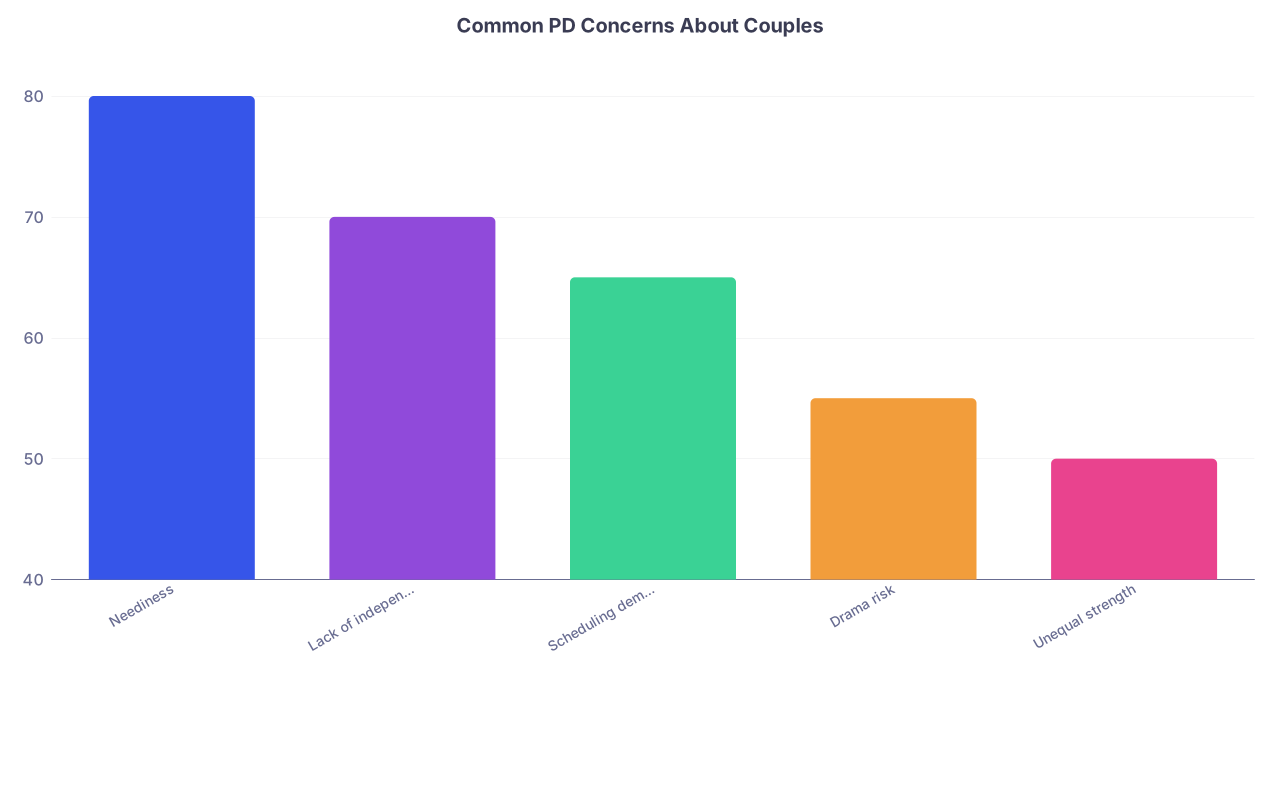
| Category | Value |
|---|---|
| Neediness | 80 |
| Lack of independence | 70 |
| Scheduling demands | 65 |
| Drama risk | 55 |
| Unequal strength | 50 |
The body language, how much you talk to each other vs. others, whether you look like a unit or two professionals who happen to be together—PDs notice all of it.
Because from their perspective, they’re not just evaluating you as individuals. They’re evaluating whether adding you as a pair will destabilize or strengthen their class.
What PDs Actually See When Couples Sit Together
Let me be direct: sitting together is not inherently bad. The problem is what often comes with it.
Here’s what program directors and faculty silently clock in the first 15–20 minutes of the day.
The “Bubble Couple”
This is the most common mistake.
You sit down together. You whisper. You share nervous jokes. You scroll on your phones. You occasionally glance at the room but never really enter it. On breaks, you gravitate back to each other like magnets.
Residents and faculty walking through see this and label it almost instantly: “They’re in their own world.”
What that translates to in PD-brain:
- They may not integrate as well with co-residents.
- They’ll probably default to each other socially instead of spreading out.
- If one of them hates the program, both may become a flight risk.
I’ve seen written comments like:
“Seemed very focused on each other, didn’t interact much with others.”
That one line, if echoed by two or three people, is enough to drop you a tier on the rank list.
The “Attached at the Hip” Signal
When couples:
- Follow each other to get coffee instead of mingling
- End up together at every break, every conversation cluster, every tour group
- Sit together at lunch and stick to each other at the pre-interview dinner
Faculty read it as a lack of independence.
PD thought process:
“If they can’t even be separate for a few hours of an interview day, what’s this going to look like on night float, ICU, or away rotations?”
They don’t want to worry that if one of you struggles, the other will emotionally derail.
The Over-Performing Couple
There’s a more subtle version too.
You sit together, but you’re “trying too hard” to compensate. Laughing a bit too loudly. Over-engaging with residents as a pair. Tag-teaming answers during group moments in a way that feels rehearsed.
Residents can smell that. The comment you’ll see behind closed doors:
“Nice, but a little performative. Felt like they were always ‘on’ as a duo.”
Again, that’s not a deal-breaker. But when PDs are ranking fifty people for eight spots, any odd vibe can bump you down.
Where Sitting Together Helps You (Because It Can)
Now, the part almost nobody tells you: there are moments when sitting together actually helps.
The key is this: you must look like two strong, independent adults who happen to have a healthy, low-drama partnership.
Here’s what PDs and residents quietly like to see:
- You sit near each other initially, then each naturally engages with others.
- You’re warm to each other, but not fused at the shoulder.
- When residents ask about the Couples Match, you’re on the same page, calm, and not defensive.
In debrief, the comments sound like this:
- “They seem like a really solid couple.”
- “Both were strong individually and seemed flexible.”
- “Not high-maintenance.”
That phrase—“not high-maintenance”—is gold. Because PDs have scars from couples who were the opposite.
Coordinators Are Watching More Closely Than You Think
You know who notices couples immediately? The program coordinator.
They see who walks in together. Who registers together. Who whispers and checks on each other between sessions. Then they carry those impressions straight into the PD’s office.
I’ve heard this exact exchange:
Coordinator: “Those two are Couples Match.”
PD: “How do they seem?”
Coordinator: “Nice. She’s more talkative. He looks anxious, but they separate easily and talk to others.”
PD: “Ok, good. No drama vibe?”
Coordinator: “No, seems fine.”
Another time:
Coordinator: “They’re glued together. Didn’t say much to the others.”
PD: “Hmm. Let’s see what the residents say, but that’s a yellow flag.”
No one writes “sat together” as a formal evaluation point. But “dynamic as a couple” absolutely does come up.
The Social Events: Where Couples Really Get Exposed
If interview day is your first impression, the pre-interview dinner (or virtual social) is where your couple dynamic gets put under a microscope.
And your seating/standing choices matter there too.
Classic red flags PDs hear from residents
Residents have far less filter when they’re debriefing:
- “They stayed side-by-side the entire dinner.”
- “She did all the talking. He barely said anything.”
- “He kept correcting her when she answered questions.”
- “They looked uncomfortable when we asked about being ranked separately.”
Those lines get summarized into: “We’re not excited about them as a couple.”
If the residents say that in unison, your odds nosedive.

| Step | Description |
|---|---|
| Step 1 | Interview Day & Dinner |
| Step 2 | Residents Observe Couple |
| Step 3 | Tell PD: Strong Couple |
| Step 4 | Minimal Comment |
| Step 5 | Flag Concerns |
| Step 6 | PD Lowers Rank Tier |
| Step 7 | Positive, Neutral, Negative? |
The couples who do this right
The strongest couples I’ve seen handle the dinner like this:
They arrive together. They do not cling together.
They:
- Sit at different spots at a long table (or at least not shoulder-to-shoulder).
- Talk about each other positively but not saccharine.
- Show they each like the program for their own reasons, in their own words.
- Answer Couples Match questions clearly, with the same story.
Residents come back and say:
“Honestly, I’d be happy to match with both of them.”
That’s the goal.
Exactly What PDs Worry About With Couples
Let me put the PD mindset on the table, without the usual polite gloss.
What PDs are really thinking when they see couples sit together all day:
- “If one of them is good and one is mediocre, are we stuck taking both?”
- “If they break up PGY-1, how messy will this get?”
- “Will they demand special scheduling privileges constantly?”
- “Will they pull away from their co-residents and only hang out with each other?”
- “If one fails, will the other implode emotionally?”
So when they watch you interact, they’re looking for evidence for or against those fears.
| Behavior They See | How PDs Often Interpret It |
|---|---|
| Sitting very close, whispering | Emotionally fused, possibly needy |
| Always together at breaks | Low independence |
| Limited interaction with others | Poor integration risk |
| Warm but separate at times | Healthy, stable partnership |
| Confident alone in conversations | Low-drama, resilient as individuals |
If you look comfortable together and comfortable apart, they relax. If you look like you can’t function without constant micro-check-ins, they tense up.
How to Sit Together Without Hurting Your Rank
Let’s get tactical. You’re a real couple. You’re going through this together. You don’t need to pretend you’re strangers.
Here’s how to play it like someone who actually understands how PDs think.
1. First 10 minutes: controlled visibility
When you first walk into the waiting area, it’s fine to sit down together. You are together. No sane PD expects otherwise.
But:
- Don’t physically huddle. A normal space between chairs is enough.
- Make eye contact and say hello to others around you.
- If there’s group small talk, one of you shouldn’t dominate.
What residents and faculty notice here is: Do you immediately disappear into your own couple-bubble, or do you join the room?
2. The first natural split: take it
The moment there’s a natural chance to be in different micro-groups—coffee line, restroom break, pre-interview checklist—use it.
If you both cling to each other at every gap, it screams dependency.
If you naturally drift into separate conversations, it says: “We’re secure enough that we don’t have to be tethered.”
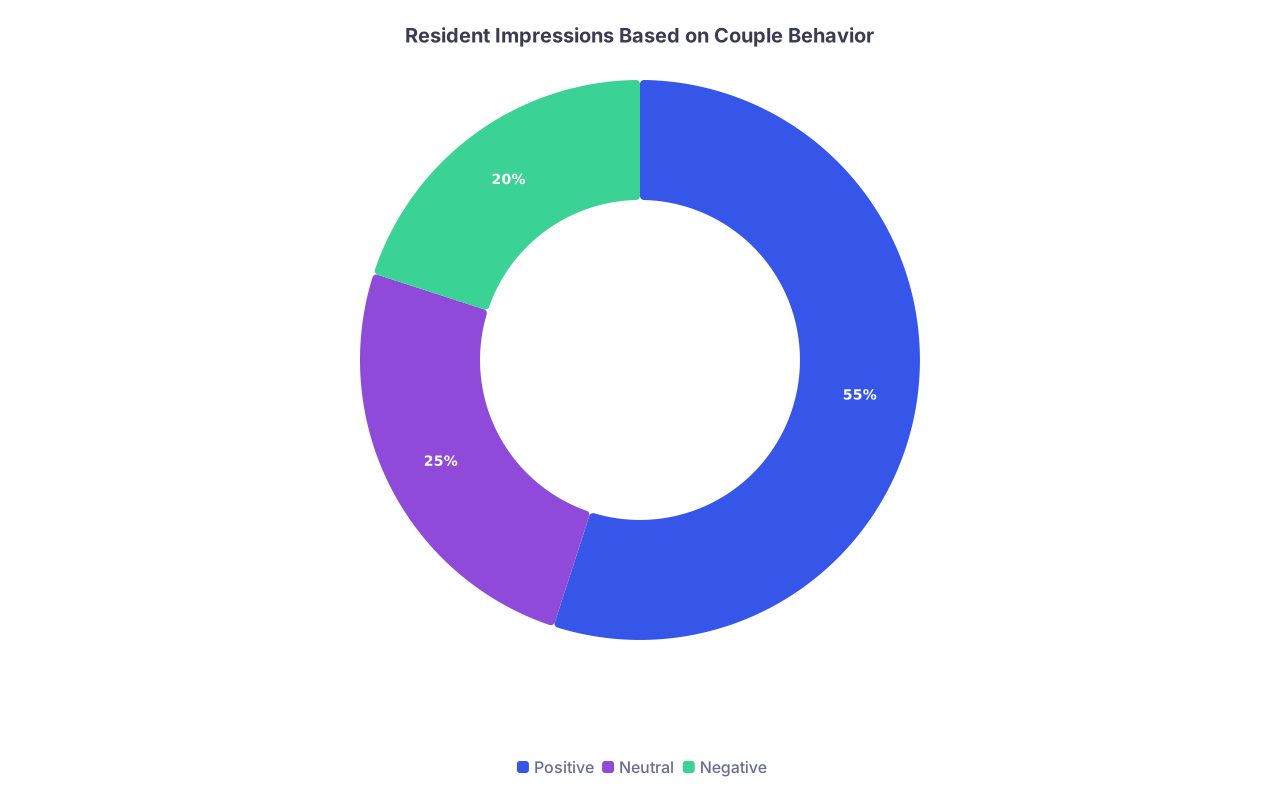
| Category | Value |
|---|---|
| Positive | 55 |
| Neutral | 25 |
| Negative | 20 |
The positive impressions nearly always come from couples who can separate and rejoin without drama.
3. During transitions and tours
On the tour, this is a classic mistake: couples walking side-by-side, talking mainly to each other.
Walk near each other if you want, but talk to:
- The resident guiding you
- The applicants around you
- Individual staff you meet
You want residents to quietly think: “They both fit in here, even when they’re not side-by-side.”
4. At lunch or breaks
If it’s a large table or room, this is where strong couples get strategic.
A high-skill move: you don’t sit directly next to each other.
Or, if the table is smaller and that’s awkward, you sit next to each other but angle yourselves toward other people, not inward toward your own private circle.
You’re signaling: “We’re a couple, but we’re also colleagues, and we can operate like regular professionals.”
What To Say When People Bring Up the Couples Match
Someone will ask. A resident at dinner. A faculty in a 1:1. Sometimes even the PD directly.
You should have a shared, clean, low-drama answer that both of you know by heart.
The bad answers sound like this:
- “We’re really hoping to be together… we’re really scared about being split.”
- “We ranked a lot of programs just based on geography.”
- “We’re not sure what we’ll do if we don’t match together.”
Those trigger the “high-risk, high-maintenance” alarm.
The good answers hit three points:
- You each genuinely like this program and can articulate why as individuals.
- You’ve thought through the match strategy rationally.
- You’re committed to each other, but not catastrophizing.
Something like:
“We’re Couples Matching in IM and EM. We built a list that has strong options where one or both of us would be happy. We’d obviously love to be together, but we also made sure that any program on our list is somewhere we’d both feel we can grow as physicians. Here, specifically, I like X and Y, and my partner really connected with Z.”
That sounds adult. That sounds safe.
What Happens in the Rank Meeting When You’re a Couple
Let me show you the part of the process you never see.
After interview season, there’s a ranking meeting. Your name comes up. If you’re Couples Matching, someone will say it right away:
“She’s Couples Match with [Partner Name], EM.”
“He’s Couples Match with [Partner Name], IM.”
Then the questions:
- “How strong is each of them independently?”
- “Any concerns about them as a couple?”
- “Did residents like them?”
- “Are they going to be drama?”
If people in the room say:
- “Both good.”
- “Seemed low-key as a couple.”
- “Residents liked them.”
You’re safe. The details of where they place you on the list become mostly about your individual merit.
If, however, someone says:
- “They were glued together.”
- “Kind of intense as a couple.”
- “Didn’t mix much with others.”
Now PDs start thinking in contingencies. They might lower both of you just to avoid future chaos.
You never see that. You just see a match result that feels “unlucky.”
But often, that “bad luck” started with you sitting silently in a corner together all day.
Simple Rules That Keep You Out of Trouble
If you remember nothing else, remember this:
You’re being evaluated as two separate residents who happen to be in one relationship.
Your goal on interview day is to reinforce that separation while showing the relationship is stable, not fragile.
So:
- Sit together at times. But don’t act like you can’t handle being apart.
- Be warm with each other. But be warmer to the program—residents, faculty, staff.
- Talk about each other with respect. Not teasing that sounds like resentment.
- Show you each love the program for real reasons, not just zip code proximity.

If you do that, sitting together won’t hurt you. In some cases, it even helps—because PDs like stable, mature couples who reduce drama instead of creating it.