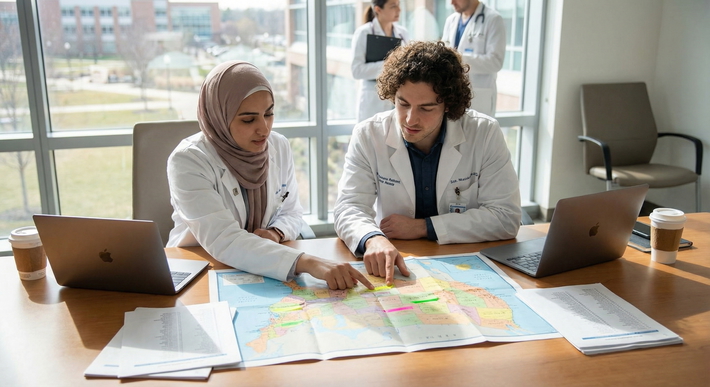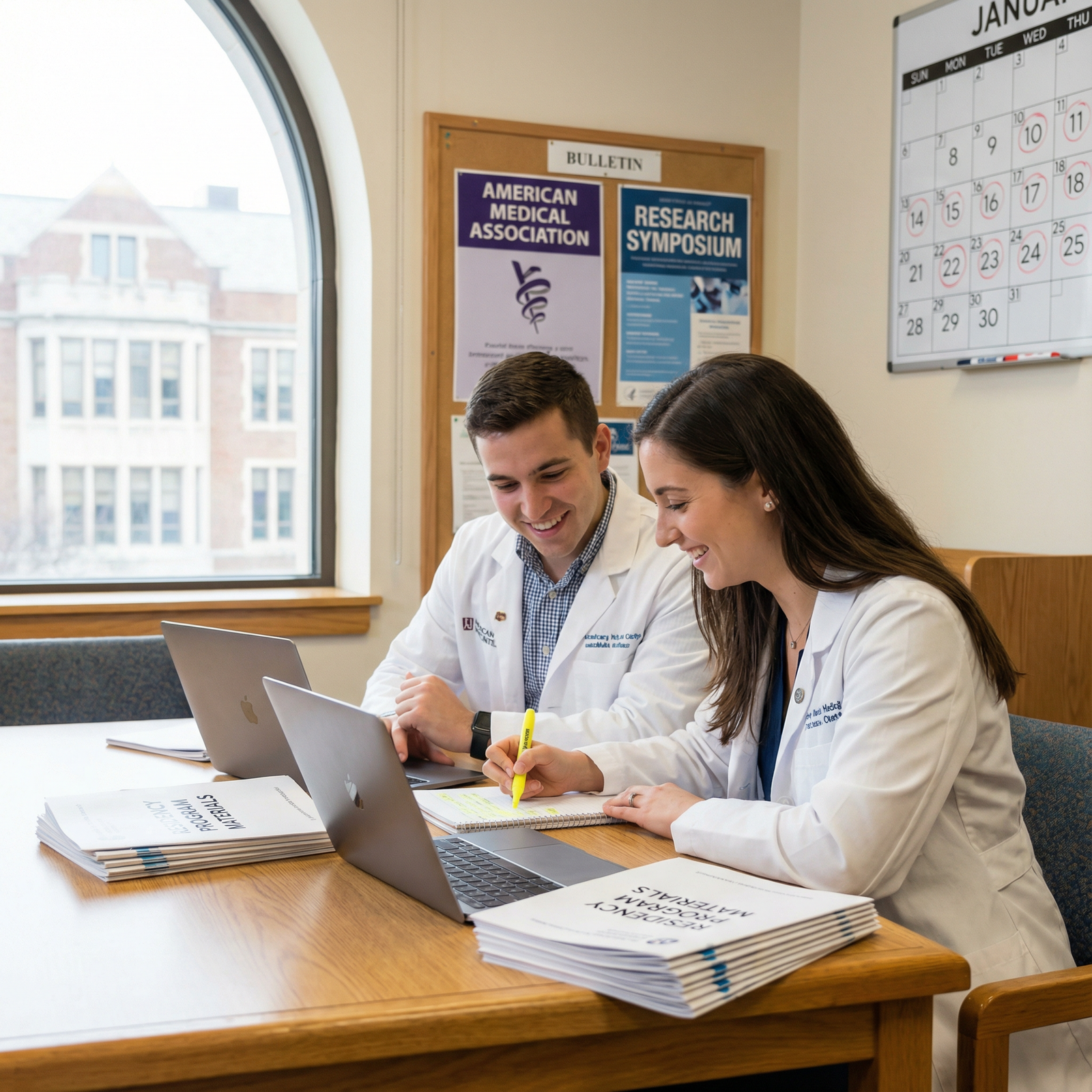
Embarking on Residency Interviews as a Couple: How to Stand Out Together
Navigating Residency Interviews as a couple brings an added layer of complexity to an already demanding process. You’re not only trying to secure the right Medical Residency positions for yourselves individually—you’re also trying to honor your relationship, long-term goals, and wellbeing as a team.
Couples in Medicine often juggle questions like:
- How do we talk about our relationship professionally?
- Should we always apply to the same programs?
- How can we show that we are both strong, independent applicants and a resilient pair?
- How do we coordinate interview schedules, flights, and finances without burning out?
With thoughtful planning, clear communication, and smart Interview Strategies, you can turn the “couples match” challenge into a powerful advantage. This guide walks you through the full arc of the process—from preparing your applications to reflecting after interviews and building a unified rank list—so you can truly stand out together.
Understanding the Residency Interview Landscape for Couples
Residency Interviews are more than a formal conversation; they’re a high-stakes fit assessment. For couples in medicine, that assessment happens at two levels: individually and as a unit.
What Programs Look for in Every Applicant
Regardless of whether you’re in the Couples Match, programs consistently evaluate:
Clinical competence and readiness
How well you’ve performed in clerkships, sub-internships, and away rotations; your letters; and your ability to handle clinical scenarios.Professionalism and communication
Your reliability, maturity, and how you interact with staff, residents, and co-applicants during interview day.Motivation and fit
Why you chose the specialty and that specific program, and how your long-term goals align with their training environment and mission.Teamwork in Healthcare
Your ability to collaborate, resolve conflict, and contribute positively to the residency team culture.
What Changes When You’re a Couple in Medicine
For couples, programs are also quietly asking:
- Will each partner fit our program (if both are applying here)?
- Are they each strong enough applicants on their own?
- If we match one, will the other be unhappy or likely to leave?
- How might their relationship impact scheduling, wellness, or retention?
This is where having a clear, consistent narrative helps. You want to present yourselves as:
- Independent, competitive applicants with distinct strengths, interests, and career paths.
- A stable, supportive partnership that enhances your resilience, not a liability or source of drama.
- Flexible and realistic planners who have thought through various match outcomes, including distance or different hospitals in the same city.
Preparing as a Couple: Building a Shared Strategy
Thoughtful preparation is your greatest advantage. The more organized you are up front, the less emotional strain and miscommunication you’ll face during crunch time.
Step 1: Align on Values, Priorities, and Constraints
Before you start sending out ERAS applications or scheduling Residency Interviews, sit down for a structured conversation:
Ask yourselves:
Top 3 priorities for each of you
Examples: specific specialty; geographic region; program reputation; proximity to family; cost of living; research focus; work-life balance.Non-negotiables vs. preferences
- Non-negotiables: “Must be in the same city,” “Must be within 1 hr of a major airport,” “Must be in a program with strong global health opportunities.”
- Preferences: “Would prefer the West Coast,” “Would like a large academic center,” etc.
Realistic competitiveness
Be honest about board scores, evaluations, research, and red flags. Couple planning only works if you’re realistic about where each of you is likely to be considered.
This clarity will guide how you build your program list and how aggressively you cast a wider net in certain regions.
Step 2: Create a Shared Logistics System
Good teamwork in healthcare starts with good teamwork at home. For couples in medicine preparing for interviews:
Use a shared digital calendar (Google Calendar, Outlook, Notion)
- Color-code interview dates, travel dates, and important deadlines.
- Add reminders for RSVP deadlines, second-look days, and follow-up emails.
- Block time for joint planning and debriefs.
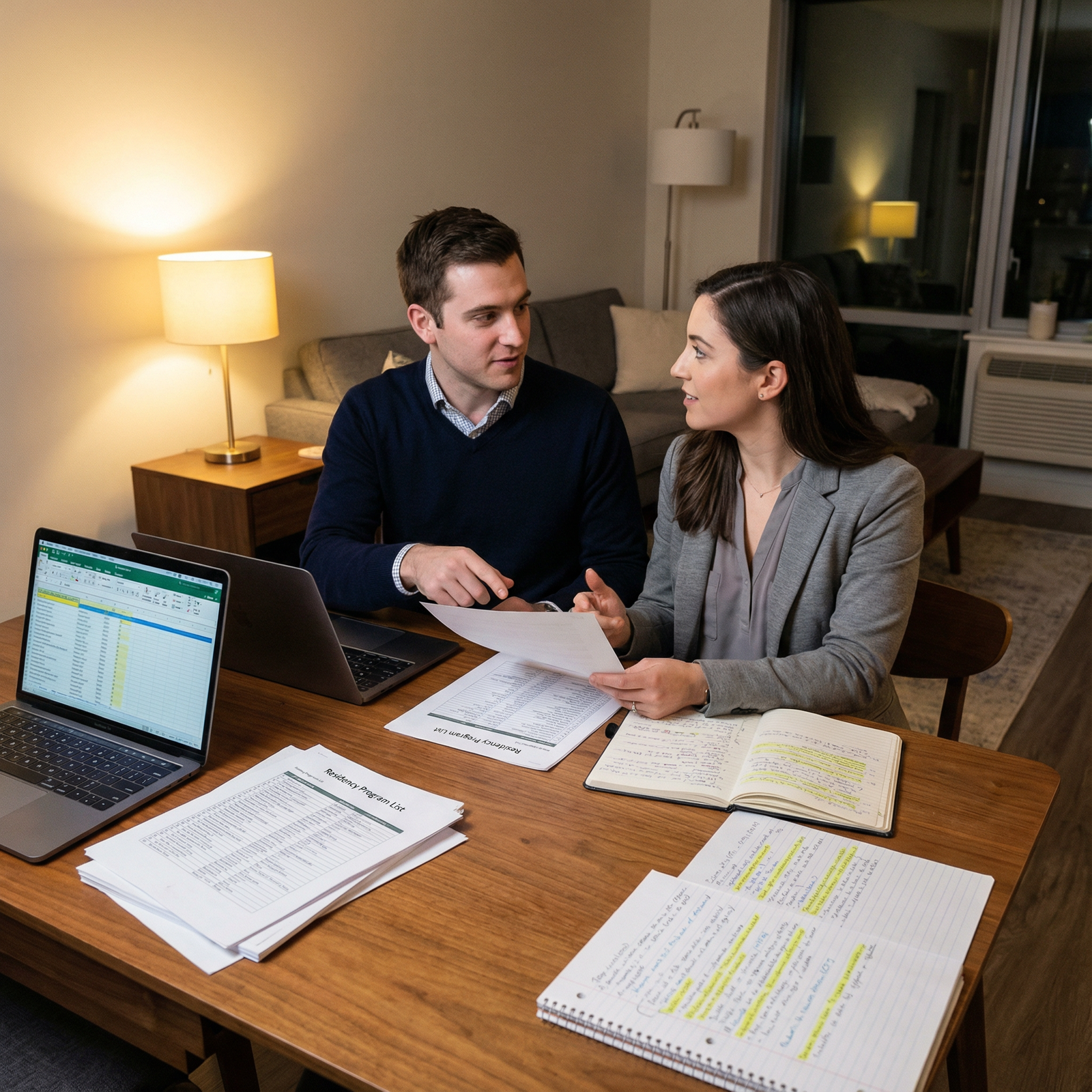
Spreadsheets or shared documents for program tracking
Consider including:- Program name, city, specialty, and institution.
- Which partner applied where.
- Interview invitations and dates.
- Perceived “fit,” academic strength, wellness culture.
- Notes on how couple-friendly each program seems (e.g., “Multiple couples in current residents,” “PD specifically mentioned being supportive of couples match”).
Budget planning together
Decide on:- A shared interview budget (travel, hotels, food, attire).
- When virtual interviews vs. in-person visits are worth the cost.
- Whether to share rooms, bundle trips to nearby programs, or extend stays to explore a city.
Step 3: Joint Interview Preparation
Preparing together should make you both stronger, not blur your identities.
Conduct mock interviews as a pair and individually
- Practice common and challenging questions:
- “Tell me about yourself.”
- “Why this specialty?”
- “How do you handle conflict on a team?”
- “Tell me about a time you failed and what you learned.”
- Then add couple-specific questions:
- “How are you navigating the Couples Match?”
- “What will you do if you don’t match in the same city?”
- “How does your partnership influence your work as physicians?”
- Practice common and challenging questions:
Practice describing your relationship professionally
- Avoid oversharing personal details.
- Emphasize shared values, mutual support, and growth.
- Show that your partnership models healthy teamwork in healthcare.
Create a shared but flexible narrative You don’t need a scripted story, but your core message should align:
- Your origin story (if asked): how you met in medical school, on a team, etc.
- Shared priorities: e.g., dedication to underserved populations, academic careers, or primary care access.
- Evidence of resilience: how you’ve supported each other through exams, rotations, or personal challenges.

Strengthening Individual Preparation: Standing Out on Your Own
Even as you plan together, your individual performance remains crucial. Programs rarely “take a couple” if they are uncertain about one of you as a standalone resident.
Crafting Distinct, Compelling Personal Statements
Avoid writing identical or overly synchronized personal statements:
Highlight your unique journey and motivations
What experiences specifically shaped your interest in your specialty? What skills and strengths define you?Briefly and strategically mention your partner (if appropriate)
A single sentence can suffice, such as:
“My partner and I are participating in the Couples Match and hope to continue supporting one another’s growth while training in the same region.”Don’t make your entire narrative about the relationship
Programs want to understand who you are professionally.
Curating and Owning Your Achievements
Make lists of:
- Key clinical experiences or rotations that influenced your career choice.
- High-impact projects: research, QI, leadership, curriculum design.
- Unique skills: language fluency, prior careers, teaching, informatics.
- Specific examples of teamwork in healthcare—especially where you took initiative, resolved conflict, or supported others.
Practice turning these into concise stories using a simple structure:
- Situation – Task – Action – Result (STAR method)
This keeps your answers focused, concrete, and memorable.
Building Confidence Through Multiple Mock Interviews
Don’t rely only on your partner for feedback:
- Ask residents, attendings, or advisors to conduct formal mock interviews.
- Record virtual mock sessions and review:
- Eye contact, tone, speed.
- Filler words (“um,” “like”).
- Whether you actually answered the question.
The more practiced you are individually, the less pressure you place on your partner to “carry” anything during couples-focused conversations.
During the Interview: Presenting as a Strong Couple and Strong Individuals
Interview day (virtual or in-person) is where your preparation and teamwork truly show.
General Interview Strategies for Both of You
Arrive prepared and early
Test technology for virtual interviews; for in-person days, plan extra transit time, and know your schedule.Project professionalism consistently
Every interaction—from emails with the coordinator to small talk with residents—is part of your evaluation.Ask thoughtful, program-specific questions
Use your prior research to ask about:- Resident mentoring.
- Wellness initiatives.
- Research or global health support.
- Couples or family support (if appropriate).
How and When to Talk About Being a Couple
You do not need to open every conversation with “We’re a couple,” but you also shouldn’t hide it if you’re in the Couples Match.
Consider these guidelines:
When it naturally fits the question
- If asked about geography:
“One of the reasons I’m particularly drawn to this region is that my partner, who is also in the Couples Match, is very interested in programs nearby.” - If asked directly:
“Yes, we’re participating in the Couples Match. We’ve thought carefully about different match scenarios and are committed to being flexible while supporting both of our career goals.”
- If asked about geography:
Frame the relationship as a strength
- Emphasize:
- Long-term stability and mutual support.
- Shared values around patient care and education.
- Demonstrated resilience through medical school or training challenges.
- Emphasize:
Avoid sounding demanding or entitled Phrases to avoid:
- “We must be in the same program.”
- “We expect you to accommodate us as a couple.”
Instead focus on:
- “We would be thrilled to train in the same city and are applying broadly to maximize that possibility.”
Demonstrating Healthy Teamwork Without Overshadowing Each Other
You might interview separately for the majority of the day, but you may encounter:
- Joint interviews.
- Informal settings where both of you and a faculty member are present.
- Social events (resident dinners, virtual meet-and-greets).
Tips:
Let each person speak for themselves
If a question is directed at your partner, resist the urge to answer or interject unless invited.Show appreciation without dependence
For example:
“My partner has always been incredibly supportive, but I’ve also intentionally sought experiences that challenge me to grow independently.”Use professional, concise examples of collaboration
For example:
“During our medicine clerkship, we were on different teams but both volunteered for a student-run clinic. We would debrief difficult patient encounters together, which helped us process emotions and improve our communication.”
Reflecting After Interviews and Adjusting Your Strategy
Residency Interviews are emotionally exhausting, especially when you’re balancing two schedules and two sets of impressions. Reflection as a couple can keep you grounded.
Structured Post-Interview Debriefs
Aim to debrief within 24–48 hours while details are still fresh:
Individually jot down:
- What you liked about the program (people, culture, training style).
- Any concerns or red flags.
- How they responded to questions about couples or flexibility.
- How you’d feel ranking this program purely based on your own goals.
Then discuss together:
- Did we both feel comfortable and welcomed?
- Did the program seem open to couples in medicine?
- How does this program fit relative to others in the same city/region?
Capture these in your shared spreadsheet to guide your rank list later.
Follow-Up Communication and Thank-You Notes
Thoughtful follow-up shows professionalism and interest.
Send individualized thank-you emails within a few days
- Reference specific conversations or topics.
- If you discussed being a couple, you might mention:
“I especially appreciated your openness to discussing how the program has supported residents with partners in medicine.”
Avoid sending identical copy-paste emails from both partners Programs can usually tell.
Stay honest and measured with ‘interest’ signals Don’t promise a program they’re your “top choice” unless it’s true and you’ve discussed it thoroughly as a couple.
Navigating the Match: Coordinating Offers, Ranks, and Realistic Outcomes
The Match process for couples in medicine is both a logistical puzzle and an emotional tightrope. Strategic planning can reduce stress and improve outcomes.
Understanding How the Couples Match Works (Briefly)
If you formally enroll in the NRMP Couples Match:
- You and your partner create paired rank lists.
- Each line on the rank list is a combination:
(Program A for Partner 1, Program X for Partner 2)
(Program B for Partner 1, Program Y for Partner 2), etc. - The algorithm tries to match you to the highest pair you both can obtain, based on program lists and your combined ranking.
This means:
- You can rank “same program / same institution” combinations.
- You can rank “same city / different institutions.”
- You can include “one matches / one goes unmatched” combinations if you choose—but discuss this deeply before doing so.
Collaborative Rank List Strategy
When building your final list:
Start with individual preference lists
Each partner separately ranks programs based solely on their own experience and goals.Overlay geographic and couple considerations
Identify:- Cities where you both interviewed.
- Regions with multiple programs in your specialties.
- “Anchor” locations where at least one partner has a very strong preference.
Prioritize tiers of combinations Examples:
- Tier 1: Same program, same hospital (if applicable).
- Tier 2: Same city, different hospitals.
- Tier 3: Neighboring cities within commuting or easy travel range.
- Tier 4: Strong individual fit where one partner might be temporarily at a distance.
Be honest about risk tolerance Some couples prioritize guaranteed proximity; others prioritize the best individual training even if it risks distance. Neither is “right” or “wrong,” but you should be aligned as a team.
Preparing Emotionally for All Outcomes
Even with perfect planning, the Match can be unpredictable:
Discuss in advance what you’ll do if:
- You end up in the same program.
- You are in the same city but different programs.
- You’re in different cities or states.
- One of you doesn’t match.
If distance becomes a reality:
- Create a concrete plan for:
- Frequency of visits.
- Daily or weekly communication routines.
- How you’ll share emotional and logistical burdens (travel, finances, time zones).
- Remember that many couples in medicine successfully endure short-term distance and build stronger resilience as a result.
- Create a concrete plan for:
Frequently Asked Questions About Residency Interviews as a Couple
1. Should we always apply to the same residency programs as a couple?
Not necessarily. It depends on your specialties, competitiveness, and priorities.
When it makes sense to overlap heavily:
- You’re in the same specialty and similar competitiveness ranges.
- You strongly prefer certain cities or regions.
- You’re set on staying together geographically.
When diversity is helpful:
- Different specialties with very different program distributions.
- One partner is significantly more competitive and can serve as an “anchor” in a region.
- You want multiple options in the same area (e.g., one at an academic center, the other at a community program).
Applying to a mix of overlapping and non-overlapping programs often maximizes both flexibility and proximity options.
2. How honest should we be about being in the Couples Match during interviews?
You should not hide it, especially from programs where both of you are applying. Transparency allows:
- Programs to understand your geographic constraints.
- More informed discussions about fit and realistic options.
- Honest assessment of whether they can support couples in medicine.
However, you also don’t need to center every conversation on your relationship. Bring it up naturally when asked about geography, long-term plans, or directly about the Couples Match.
3. What if one of us gets significantly more interview invitations than the other?
This is common and emotionally challenging.
Steps to consider:
Analyze the pattern together
Is it specialty competitiveness, geographic targeting, or application elements (scores, letters, research) driving the difference?Adjust strategy mid-season if possible
One partner might expand their geographic range, add more community-based or mid-tier programs, or consider supplemental ERAS applications.Support each other emotionally
Avoid comparison. Remember you are on the same team, and the Match algorithm will consider both of your rank lists together if you are formally couples matching.
4. Is it appropriate to ask programs directly about their support for couples or family life?
Yes—if you ask professionally and tactfully.
Examples of questions:
- “Do you currently have residents who are in the Couples Match or have partners in medicine?”
- “How flexible is the program with scheduling around major life events (e.g., weddings, childbirth)?”
- “Are there particular challenges you’ve seen with couples in medicine, and how has the program supported them?”
These questions show that you are thinking ahead, value wellness, and are trying to anticipate real-life challenges.
5. How can we keep our relationship healthy during the stressful interview and Match process?
Intentional communication and boundaries are key:
Set aside non-interview time
Schedule “no residency talk” evenings or activities to protect your relationship from becoming purely logistical.Check in on emotional wellbeing, not just schedules
Ask, “How are you feeling about everything?” not only “Where did you get interviews?”Divide and conquer
Split tasks (e.g., one manages travel bookings, the other updates the program spreadsheet) to reduce overload.Seek mentorship from other couples in medicine
Ask upper-year residents or faculty how they navigated the process and what they wish they’d done differently.
Navigating Residency Interviews as a couple is demanding, but it’s also an opportunity to deepen your partnership, clarify your shared values, and practice the kind of communication and teamwork that will serve you throughout your careers. By preparing strategically, presenting yourselves authentically, and staying flexible in your expectations, you can stand out—not just as two strong applicants, but as a resilient medical couple ready to contribute meaningfully to any healthcare team.