

It’s late January. You and your partner are sitting on the floor with laptops open, half-eaten takeout on the coffee table, and a spreadsheet that looks like a war crime. Fifty‑plus possible combinations. Twenty cities. Three different spreadsheets because your partner “likes color coding” and you “like logic.”
You keep hearing this vague thing from advisors: “Programs don’t really adjust for couples… they just rank each of you individually.”
Let me tell you what actually happens.
Behind closed doors, your names do come up together. Sometimes in a good way. Sometimes not. And sometimes in ways that would make you rethink how you’re building that couples list.
This is the stuff program directors do not put on their “How the Match Works” slide deck on interview day.
First Truth: The Algorithm Does Not Care About Your Relationship. Humans Do.
Let’s clear one big misunderstanding.
The couples algorithm itself is cold. Mechanical. It doesn’t “help” you as a couple. It just takes two separate rank lists and tries to honor the pairings you gave it. If there are no two spots that fit your chosen combo at a given position, it moves down. That’s it.
But that’s not where the real story is.
The real story is what happens a month earlier, in conference rooms and Zoom meetings, when programs decide where to put you on their lists—knowing:
- You’re couples matching
- With whom
- In what specialty
- And sometimes, roughly how strong that partner is
This is where your fate gets shaped. Quietly.
The Four Kinds of Programs You’re Dealing With
I’ve sat in and heard the same archetypes over and over. You are up against four basic mindsets.
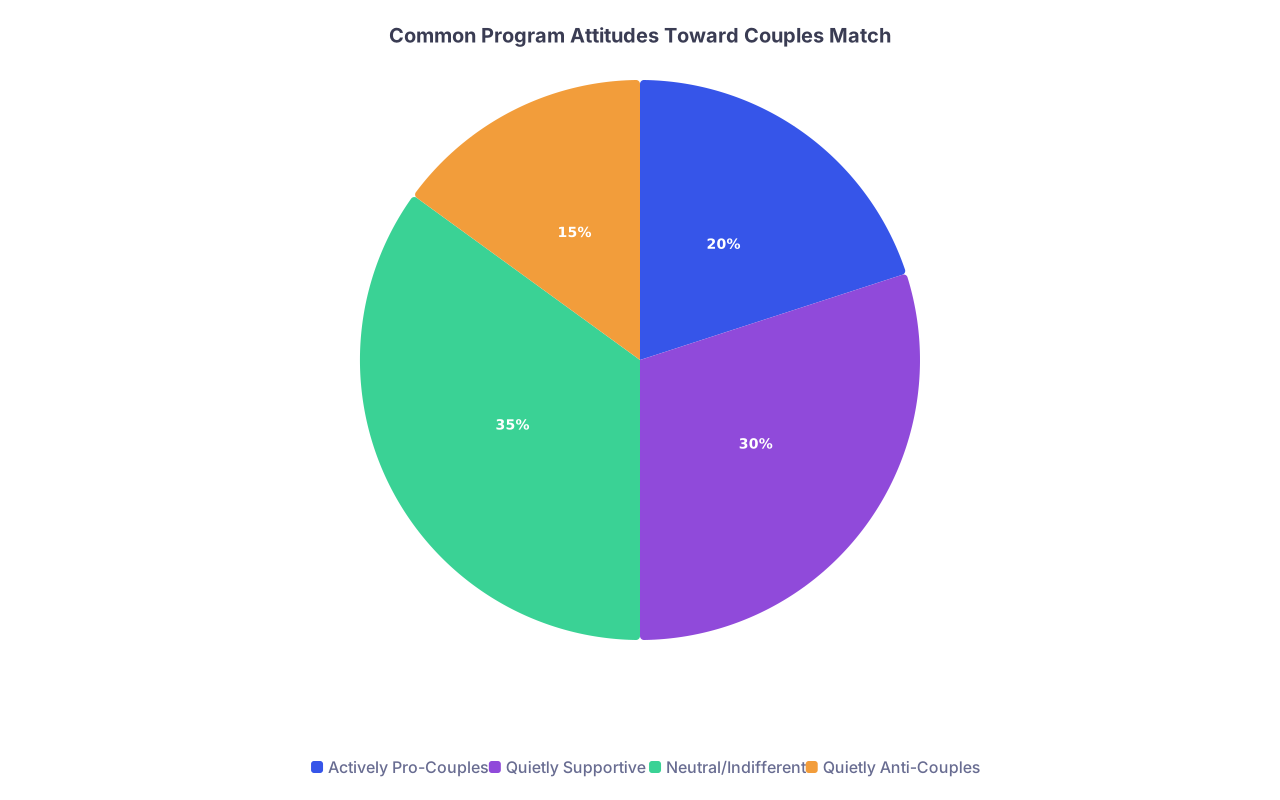
| Category | Value |
|---|---|
| Actively Pro-Couples | 20 |
| Quietly Supportive | 30 |
| Neutral/Indifferent | 35 |
| Quietly Anti-Couples | 15 |
1. The Actively Pro‑Couples Program
These programs love couples. They say it out loud. They bring it up on interview day. They’ll mention “we’re very couples‑friendly” in the pre‑interview social.
What this actually means behind the scenes:
They will intentionally bump you up or down their rank list based on your partner and their institution’s other departments.
Example I’ve seen:
- You’re applying IM at Big Academic Hospital
- Your partner is applying Anesthesia at the same place
- Anesthesia PD emails IM PD: “We love [Partner]. If they match here, we’d be thrilled to also get [You].”
Result: you get nudged up a tier. Not from 70 to 5, but from 70 to 30, or from 25 to 15. Enough to change the math.
These places coordinate: medicine + peds + anesthesia + EM might all quietly compare notes on couples. They don’t hold a formal “couples committee,” but there are emails. Sidebar conversations. “Hey, this is a strong couple. Let’s try to land them both.”
If you’re a strong dyad applying to a place like this, you’re in good shape.
2. The Quietly Supportive Program
They won’t market themselves as couples‑friendly, but the culture is tolerant and practical. What actually happens:
- If they like you already, couples status is a small bonus
- If your partner is in the same institution and is solid, also a bonus
- If your partner is clearly much stronger, they will lean in to ride that wave
These are the programs where you’ll hear in rank meeting:
“She’s couples matching with that derm applicant we loved. If derm gets them, I’d be happy to have her here. Let’s keep that in mind when we group her.”
They don’t warp the list around you. But you’re a positive tiebreaker. That matters near the middle of the list where the real action is.
3. The Neutral / Indifferent Program
This is very common, especially at community or smaller university programs.
Thought process is basically: “We rank them on their own merits. The algorithm will figure the rest out.”
They’ll record your couples status in ERAS, maybe mention it in passing at the table, and then ignore it. If you and your partner both independently land in reasonable positions on your respective lists, great. If not, too bad.
Here’s the subtle piece no one tells you: “Neutral” programs can screw couples unintentionally, because they slightly underestimate how fragile couples outcomes are. They aren’t malicious. Just naive about how easily one partner falling a few places changes everything.
4. The Quietly Anti‑Couples Program
They will never say this publicly.
But I’ve heard the exact phrases in rank meetings:
- “I don’t want someone who’s going to be miserable here because their partner is in another state.”
- “If they’re only interested if their partner is here too, pass.”
- “We are not bending our list around this.”
The logic they tell themselves:
- Couples add emotional volatility
- More likely to ask for transfers
- More likely to be distracted or burned out if the partner doesn’t match close
- If they only want us because of their partner across the street, they’re not really committed
In practice, what happens is subtle. They don’t drop you 50 spots. They might just use couples status as a negative tiebreaker:
“We’ve got 3 candidates we’re deciding between at the 30–32 slots. She’s couples matching, the others aren’t. Let’s put her at 32.”
Small stuff. But in a competitive specialty, three to five spots can be the difference between matching as a couple or not.
How You Get Discussed in Rank Meetings (Yes, They Say This Stuff)
Picture a typical rank meeting at a mid‑size academic IM program.
You are Candidate #47 on the spreadsheet. Notes column: “Strong interviews. Partner in Neuro at same institution. Couples match.”
Some version of this conversation happens:
PD: “Remind me—this is the one couples matching with Neuro?”
Chief: “Yeah. Neuro liked the partner. They’re ranking them in their top 15.”
Associate PD: “We have room to bump them up if we want. We’re pretty set on the top 25 anyway.”
PD: “Do we like them enough that we’d be happy if they stay all 3 years? Any red flags?”
Faculty: “No red flags. Nice, solid. I could see them fitting in.”
PD: “Alright, move them up a bit. Put them with that group in the low 30s.”
That’s you getting quietly upgraded because you’re a low‑risk, couples‑friendly add.
Flip side. You mailed your interview. Or your application is paper‑thin for that tier.
PD: “This one is couples matching, but I was not impressed on interview day.”
Faculty: “Same. I’d rather take any of the solo strong candidates over them.”
PD: “Then couples status does not save them. Put them where they belong or drop a bit; I don’t want to feel pressured.”
Here’s the unvarnished rule:
Couples status almost never rescues a weak candidate. It sometimes boosts a solid one. It often amplifies existing impressions—positive or negative.
How “Package Deals” Really Work (and How They Don’t)
You’ve heard rumors: “If one partner is a rockstar, the other can ride their coattails.”
That’s partially true. With limits.

Scenario 1: One is a star, one is average. Same institution, different departments.
Say your partner is top‑shelf Anesthesia at a major academic program. 260+ Step 2, AOA, glowing letters. You’re solid but not that shiny in IM or Peds.
What happens:
- Anesthesia ranks your partner very high
- They tell Medicine/Peds: “We really want this person, and their partner is applying to you”
- Medicine looks at you with a friendlier lens:
“We like them fine. And matching both would be great for recruitment and stability.”
In many places, that gets you a modest bump. Maybe from mid‑list to upper‑mid. Enough to matter.
Scenario 2: One is strong, one is weak for that program
This is where people get delusional.
If you’re way below their usual bar—weak scores, poor letters, underwhelming interview—programs do not sacrifice quality just to make a couple happen. There’s too much risk.
Behind the scenes comment you’ll never hear:
“We’re not taking a clearly weaker resident just to land a star. That will cause more trouble in the long run.”
What they might do instead:
- Still rank the weak partner, but lower down
- Hope the algorithm finds a way to land the star partner even if the couple separates or picks another combo city
The “package deal” myth dies right there. Strong partner helps a bit. Doesn’t erase deficits.
How Different Specialties Play the Game
Not all departments handle couples the same way, even at the same institution.
| Department | General Couples Attitude | Coordination With Other Depts |
|---|---|---|
| Internal Medicine | Moderately supportive | High at academic centers |
| Pediatrics | Very couples-friendly | High, esp. with IM/OB |
| General Surgery | Mixed to negative | Low to moderate |
| EM | Generally supportive | Moderate |
| Anesthesia | Often highly supportive | High |
| Competitive Derm/Ortho/ENT | Pragmatic, score-focused | Low |
Broad strokes I’ve consistently seen:
- Medicine and Peds are often the most flexible. They think about retention, wellness, and long‑term culture. Couples help with that.
- Anesthesia and EM can be very couples‑aware, especially in big academic shops.
- Surgery, ortho, ENT, neurosurgery are the least impressed by couples stories. They are laser‑focused on who will operate well and survive their training environment. Romantic logistics rank low.
- Hyper‑competitive fields (Derm, Ortho, ENT, Ophtho, PRS) will not handicap their list for couples. If you’re good enough for them, you stand on your own. If not, couples status doesn’t fix it.
So if one of you is in a “softer” department (Peds, IM) and one is in a “hard” department (Surgery, Derm), do not assume symmetrical couples generosity. Usually the softer side flexes more.
The Thing Almost No One Tells You: Geography vs. Prestige Tradeoffs
This is where couples sabotage themselves: they build a fantasy list where both get a dream‑tier program in the same city and refuse to think harder.
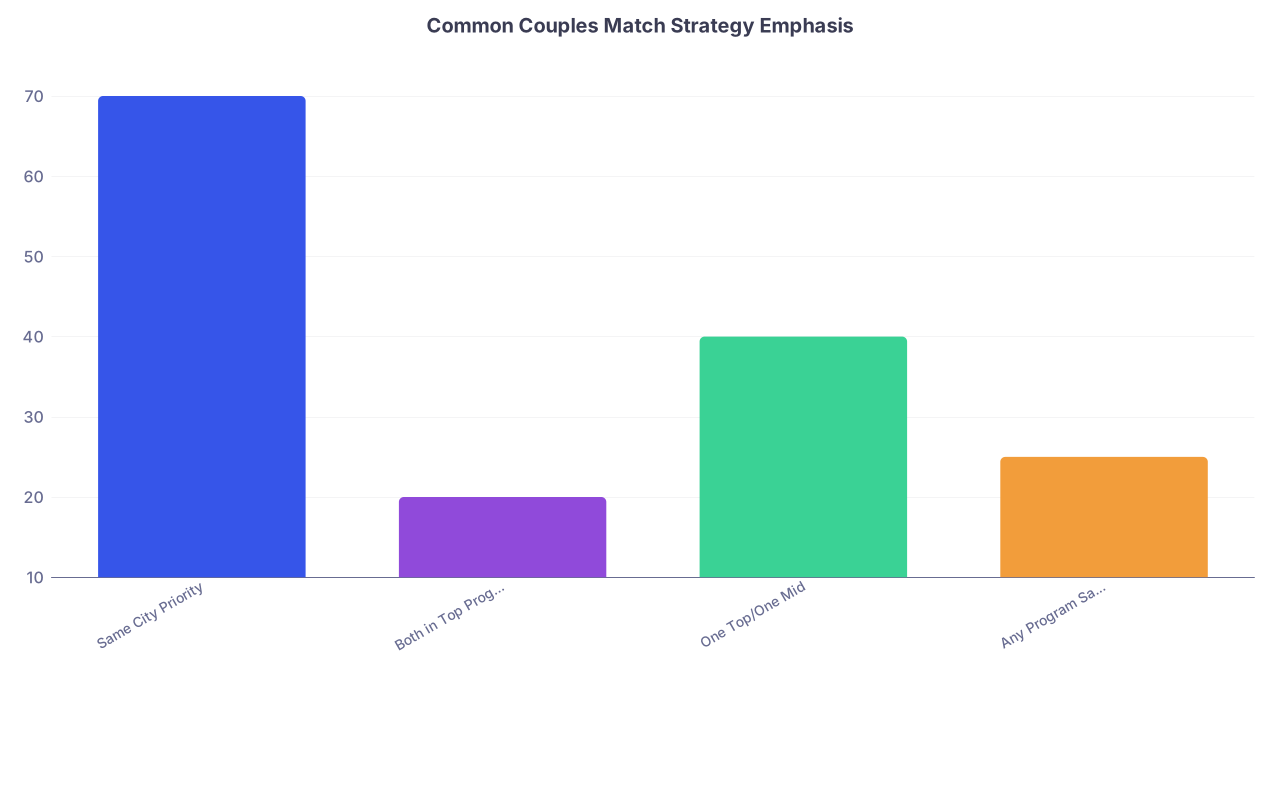
| Category | Value |
|---|---|
| Same City Priority | 70 |
| Both in Top Programs | 20 |
| One Top/One Mid | 40 |
| Any Program Same City | 25 |
Backroom conversations often sound like this:
“They told us same‑city is more important than prestige. But their list doesn’t reflect that.”
Program directors do look at how you ranked them in context of other programs in that city and region—especially smaller specialties.
Here’s the subtle dynamic:
- If you loudly say “Our top priority is being near each other”
- And then your rank list shows you put their program way below far‑away big‑name places
- They assume you were just saying what they wanted to hear
The couples who do best are brutally honest with themselves early:
- “If we can be in the same city, we are okay with one of us at the ‘name’ program and one at the ‘solid, less famous’ program.”
- “We are willing for one person’s career to take a small prestige hit to keep proximity.”
Programs are more willing to flex when they sense you’re realistic. They hate being one piece in your fantasy puzzle where everything must align perfectly or you’ll be miserable.
What Signals Actually Matter To Programs About Couples
You can’t control what happens in their conference room. But some signals change how they feel about taking a chance on you as a pair.

| Step | Description |
|---|---|
| Step 1 | Couples Status Seen |
| Step 2 | Potential Positive Bump |
| Step 3 | Rank Individually |
| Step 4 | Inter-department Emails |
| Step 5 | Small List Adjustment |
| Step 6 | No Couples Boost |
| Step 7 | Neutral Handling |
| Step 8 | Both Strong? |
| Step 9 | Same Institution Interest? |
| Step 10 | One Clearly Weak? |
The things that make PDs more comfortable bumping you:
- Your story is coherent. You can actually explain how you’ll handle it if you don’t match together. Mature, concrete answer.
- You don’t sound like you’ll resent them if you end up split.
- Both of you are at least in the “we’d be happy to have them” bucket, not red flags.
- You rank them in a way that shows sincere interest. Not just as a backup if your partner’s dream program comes through.
What doesn’t sway them as much as you think:
- Long “we met in anatomy lab” stories in your PS
- Trying too hard to sell the relationship as part of your fitness for the specialty
- Dramatic “we’ll do anything to stay together” speeches in the interview
They want stability, not melodrama.
The Darker Side: When Couples Status Hurts You
I’m going to be blunt: sometimes being a couple is a liability.
I’ve seen programs say yes to an individual and no to a couple with that same person simply because of the added complexity.
Three quiet penalties I see:
Fear of flight risk:
“If their partner matches across the country, are they going to be checked out and resentful? Start looking for transfers?”Perceived emotional instability:
If you present as very fused—everything is “we,” no separate identity, no sense of individual goals—that can read as fragile. Programs have seen couples implode mid‑intern year. It’s ugly.Time/energy cost:
PDs worry (sometimes unfairly) that couples bring more scheduling drama. Leave requests to visit each other. More administrative noise.
So if you interview like your entire existence depends on both of you being at the same hospital or bust, some PDs quietly move you down a notch.
You want to project: “We strongly hope to be together, but each of us is independently committed and will function well even if split.”
That makes them more willing to take you as you, not as a hostage negotiation.
How Your Rank List Design Plays Into Backroom Decisions
You don’t submit your list until after interviews. But programs often get a feel for how you’re likely to rank.
At pre‑rank huddles, they’ll say:
“They told us we’re their top choice in this city if their partner also matches here.”
“They said if they get X across town, they’d gladly be here instead of the same hospital.”
Those statements are remembered.

The smart couples do three things consistently:
Use honest, specific language on interview day:
“We’re couples matching. In this city, if my partner lands at either [Program A] or [Program B], this would be my top choice.”
That’s a clear signal without overpromising.Avoid lying about rank intentions.
PDs talk. Less than you think, but enough. If you tell two competing programs they’re each your “unequivocal #1,” it occasionally comes back around. Faculty move, residents cross‑train, emails get forwarded.Align what you say with your final list.
Don’t spend all interview day gushing about how “this city is our dream” and then rank six other cities above any combination involving that city. It’s not that they see your list—they don’t. But your behavior and follow‑up communications bleed through.
Specific Mistakes I See Couples Make Over and Over
Let’s be concrete. These are self‑inflicted wounds.
Treating both careers as equally competitive when they’re not.
If one of you is borderline for your specialty, that person should prioritize more programs and more geographic flexibility. The other adjusts around that reality. Denying the asymmetry is how couples don’t match.Under‑ranking “off‑balance” combos.
One of you at prestige, the other at solid mid‑tier in the same city is often your best realistic outcome. Couples who chase both‑prestige same‑hospital for 30 ranks and barely include mixed options are playing a dangerous game.Not talking early with both PDs when already at the same institution as students/rotators.
If you’ve been at that hospital for med school or did strong away rotations, those internal advocates can and will talk. But only if they understand your situation clearly and early.Over‑sharing the drama.
You don’t need to tell PDs about every stress conversation you and your partner have had. The more unsteady you sound, the riskier you look.Assuming programs will “just figure it out” because you’re nice people in love.
The match doesn’t care. The algorithm doesn’t care. Programs care up to the point it hurts their own interests. Then they don’t.
What You Should Be Doing Now To Influence Those Backroom Conversations
No magic script. But there are moves that help.

Clarify your own priorities privately before you speak publicly.
Same city vs same hospital vs prestige vs specialty fit. Actually rank those with each other. If you two are incoherent between yourselves, that confusion leaks out in interviews.Use faculty mentors strategically.
If one of you has a strong advocate—someone respected at an institution you’re both targeting—let them know clearly:
“We’re couples matching. We would be thrilled if both of us could land at [X institution / Y city].”
Mentors often are the ones who do the quiet email to the other department: “By the way, the partner is also strong.”Project individual stability.
When PDs ask about couples match, your answer should sound like:
“We’re committed to our relationship and to our careers. We’d love to be together, and we built our lists to maximize that. But we’ve also thought carefully about what we’ll do and how we’ll function if we’re not in the same place.”
That’s the line that makes them relax.Accept asymmetry where it exists.
If one of you is realistically less competitive, you both own that and build your lists accordingly. Programs can smell denial.
The Bottom Line: How You Actually Get Ranked as a Couple
Behind the curtain, it works like this:
- You are ranked first as individuals based on your own merits.
- Then, if a program is couples‑aware/friendly and knows who your partner is, they sometimes tweak your position slightly up or down based on:
- How much they like your partner’s department
- How realistic they think your joint interest is
- How much trouble they think you’re going to be if you end up split
- Hyper‑competitive specialties rarely bend. Broad specialties bend a little.
- Weak candidates do not get rescued by strong partners. Solid candidates sometimes get polished by them.
You are not a package the way you think you are. You are two separate decisions with some faint gravitational pull between them.
If you build your couples list like that’s the reality—two individuals who are trying hard to overlap, not one fused unit that must be taken or left together—you give those backroom conversations something to work with.
And when the emails start flying in February, with PDs asking, “Hey, did you rank that partner high? We really liked them,” you’ll have put yourselves in the bucket of couples people actually want to help.
With that understanding, you’re finally seeing the same board the program directors see. The next step is executing: building a couples rank list that doesn’t implode under the real‑world constraints. But that’s a story for another night on the floor with spreadsheets.
FAQ: Couples Match Ranking, Behind the Scenes
1. Do programs actually see that we’re couples matching and with whom?
Yes. ERAS flags you as couples matching, and most PDs will at least see that status. If your partner is applying to the same institution (even different department), there’s a good chance the PD or coordinator knows who they are. At minimum, your couples status is on the spreadsheet in front of them in rank meetings.
2. Can I email programs and ask them to coordinate with my partner’s program?
You can—but it’s usually more effective if that comes from a faculty advocate, not from you directly. A PD is more likely to respond to, “We really like this couple, can we try to land both?” from a trusted colleague than from a student cold‑emailing, “Please talk to my partner’s PD.” If you do email, keep it short, factual, and non‑demanding.
3. How much can my stronger partner’s application help me?
If you’re already within the acceptable range for that program, a strong partner can bump you modestly higher on the list, especially in couples‑friendly departments. If you’re truly below their bar—bad exam scores, concerning letters, weak interview—your partner’s strength won’t override that. Think “small bump,” not “lifeline.”
4. Should we tell programs they’re our top choice to try to get a higher rank?
Only if it’s actually true in context. PDs absolutely remember when applicants tell them, “You’re my top choice,” and some will use that as a tiebreaker when clustering candidates. But if you spray that line at multiple programs, it occasionally gets back to them and you lose credibility. Be specific and honest: “You’re our top choice in this city if my partner matches here” is both believable and useful.
5. If we don’t match together, will programs help us transfer to be closer?
Sometimes, but you cannot bank on it. A few PDs are proactive about helping split couples find PGY‑2 spots closer together, especially in IM, Peds, EM, and Anesthesia. Others consider it your problem. Transfers depend on: open spots, your performance, your reputation, and how much your PD is willing to advocate. Your best move is to build a realistic couples rank list that minimizes the chance you need a transfer at all.


