

You’re sitting in a cramped faculty office. The door is half‑closed, your CV is printed in a too‑thick folder, and you’ve rehearsed this line three times in your head:
“…and we’re planning to couples match.”
Your mentor leans back. They pause just a little too long. You start talking faster to fill the silence.
This is the moment you’re worried about. Not the step scores, not the personal statement. This. Will they really go to bat for you as a couple? Or will they quietly decide you’re “too complicated” to fully endorse?
Let me tell you how that decision actually gets made on the other side of the desk. Because it’s not what gets said on panels or in the dean’s info sessions. Faculty mentors have their own mental algorithms, and some of you accidentally trigger the “proceed with caution” flag without realizing it.
The First Filter: Are You a “Safe Bet” Individually?
Faculty do not start by thinking about you as a couple. They start by asking one question, silently:
“Would I support this person strongly even if they were applying solo?”
If the answer is anything less than a confident yes, your couples match just became a liability in their mind.
Here’s what I’ve watched faculty do over and over:
They pull up your ERAS draft. They glance at Step scores, class percentile, narrative comments, and the vague “professionalism” reputation you’ve built. They already have you in one of three buckets:
| Bucket | Translation in Their Head |
|---|---|
| Green Light | I can push them anywhere; they’ll match |
| Yellow Light | Solid, but not invincible |
| Red Light | At risk; support must be strategic |
If you’re Green Light, couples match doesn’t scare them much. It’s just another variable to manage.
If you’re Yellow, couples matching turns from “interesting challenge” into “possible disaster I’ll be blamed for.”
If you’re Red, most faculty mentors — especially program-facing ones — will politely support you, but mentally they’re already planning how to limit risk: fewer reach programs, stronger geographic clustering, extra explanation in letters.
Here’s the part no one tells you: if one of you is Green and the other is Red, a lot of faculty default to protecting the Green. Not out loud. Not in writing. But in how hard they push, how honest they are with PDs, how much they encourage or discourage aggressive couples strategies.
I’ve sat in meetings where someone said, about a couple:
“She’s a lock at any mid‑tier IM; he’s borderline. We need to be realistic or we’re going to sink them both.”
That’s the calculus.
The Real Question: Are You an Asset or a Problem for Programs?
Faculty who’ve been around the Match long enough think like program directors, even if they never say it directly. They ask themselves:
“If I call my friend who’s a PD and say, ‘These two are couples matching, can you look at them together?’ — does that make their life easier, or harder?”
Programs like couples when:
- Both applicants are strong or at least mid‑solid.
- The specialties are compatible with local capacity (IM + Peds at a big academic center? Fine. Ortho + Derm in a small city? Nightmare.)
- Your geographic ask is reasonable.
Programs hate couples when:
- One of you is clearly above their usual range and the other is clearly below.
- You’re asking them to coordinate across institutions that do not cooperate.
- You appear inflexible or entitled in your communication.
Your faculty mentor is doing that risk–benefit math in their head. They’re not just deciding whether they “support couples matching in principle.” They’re deciding whether your particular combination is something they can put their name on without screwing their relationship with PDs.
That’s the part students miss. Your mentor is not just your advocate. They’re also a repeat player in a small ecosystem. If they get burned once by pushing a wildly unrealistic couples plan, they become more conservative for the next five years.
The Hidden Variables They Check Before Committing
Faculty won’t spell this out, but there are a handful of things they quietly evaluate the moment you say, “We’re couples matching.”
1. Specialty combination: Do you make sense together?
Let’s be blunt: some couples combinations are faculty-friendly. Some are not.
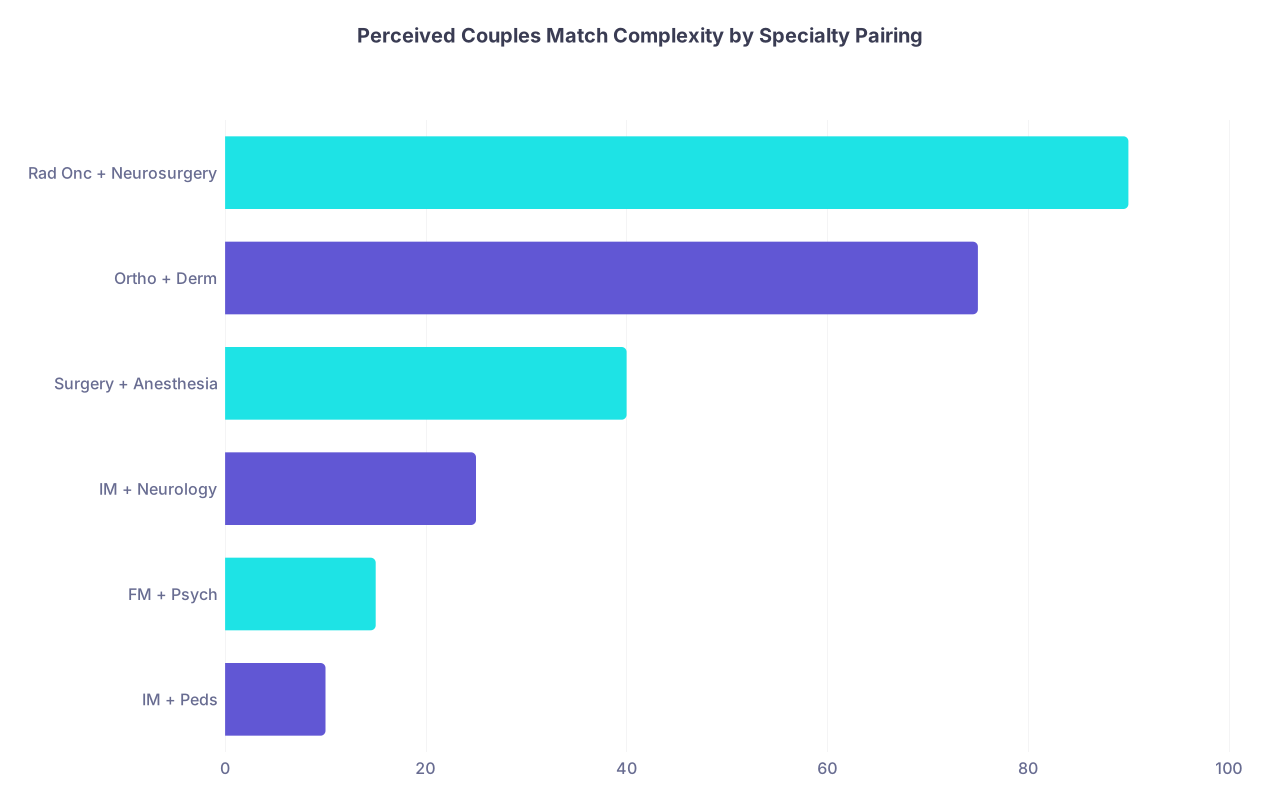
Here’s how they really think about it:
| Category | Value |
|---|---|
| IM + Peds | 10 |
| FM + Psych | 15 |
| IM + Neurology | 25 |
| Surgery + Anesthesia | 40 |
| Ortho + Derm | 75 |
| Rad Onc + Neurosurgery | 90 |
Low‑complexity pairs (IM + Peds, FM + Psych) relax mentors. They know there’s a huge number of programs in those specialties and usually multiple institutions per region. They feel comfortable saying, “Yes, couples match. We can make this work.”
Moderate‑complexity pairs (IM + Neuro, Anesthesia + EM, Surgery + Anesthesia) trigger more detailed questioning: “Which regions? How competitive are you individually? How flexible will you be on prestige?”
High‑complexity pairs (Derm anything, Ortho + competitive anything, ENT, Neurosurg, Rad Onc) make some faculty visibly tense. Not because they don’t want you to be happy, but because they know the math. There are not enough spots in enough places to smoothly accommodate demands like “We both want top‑20 academic programs in the same city.”
I’ve heard versions of this behind closed doors:
“They’re both strong but she wants Derm, he wants Ortho, and they swear they’ll ‘go anywhere’ but also they both keep saying ‘coastal.’ This is going to end badly unless someone recalibrates them.”
If you’re in a high‑complexity pair, whether they really back you depends entirely on whether you seem grounded about just how narrow your options are.
2. Geographic expectations: Are you realistic or delusional?
Every faculty mentor has been burned by a couple who said, “We’re flexible on location” and then later freaked out about leaving one metro area.
Mentors listen very closely to how you talk about geography.
If you say something like:
“We’d be happy anywhere with decent training; we’re prioritizing matching together, not prestige or specific cities. Broadly: Midwest and South are both open, and we’ll include some coasts for reach.”
That sounds like a couple they can help.
But if you say:
“Honestly, we’d really like to stay in [major coastal city] or at least within 2–3 hours. We both have family there.”
They immediately remember the cluster of previous couples who torpedoed their match with the same mindset.
Here’s the internal translation they make:
- “We’re flexible”: I will believe this when I see your final program list.
- “Family nearby is important”: You will secretly prioritize one metro area and resent any suggestion otherwise.
- “We’re open to anywhere with strong academic programs”: You’re still prestige‑driven; you just put “anywhere” in the sentence.
Faculty who’ve been through it will sometimes test you.
They’ll say: “Would you seriously consider training in, say, St. Louis? Or Iowa City? Or Birmingham?”
If you hesitate, they register that. And it directly affects how aggressively they’re willing to call favors on your behalf. No one wants to spend relational capital pushing a couple to programs they secretly won’t rank highly.
How Your Relationship Dynamic Affects Their Support
Here’s the part nobody puts in writing, but every experienced advisor pays attention to: how you talk about each other.
I’ve seen faculty switch from enthusiastic to wary in under five minutes based on this alone.
If the conversation goes like:
“We’ve talked through worst‑case scenarios. If one of us matches and the other SOAPs or rematches later, we’re prepared for that. We’ve built our lists around shared safety programs. We understand one person may have to compromise more than the other.”
That signals maturity. Emotional realism. Planning.
But when it sounds like:
“We absolutely have to end up in the same city. It would be devastating to be apart. We’re ranking based on being together — that’s our top priority.”
Faculty hear: potential meltdown if reality doesn’t cooperate. And they’ve seen it: couples blaming advisors, accusing the school of “not supporting us enough,” or demanding to know why they weren’t warned.
They’re also quietly watching for:
- Whether one of you dominates the conversation.
- Whether you undermine each other subtly (“Well, my scores are higher, so…”).
- Whether you’ve actually looked at program lists together, or you’re just in the fantasy phase.
One very specific thing: mentors notice if you come together vs separately to discuss couples matching. Not for every conversation — that would be weird. But at least once.
Couples who never appear together but claim to be fully aligned make faculty uneasy. It makes them wonder how much of this is coordinated planning versus one partner dragging the other into their plan.
The Silent Risk Calculation: Reputation and Blame
Here’s the inside baseball: faculty are not just balancing your outcome. They’re balancing their own reputation with residency programs and the dean’s office.
When they agree to “really support” a couples match, they know they’re:
- Potentially calling PDs and APDs to ask them to consider you as a package.
- Explaining your couples strategy in MSPEs or in emails.
- Standing behind your judgment if things go sideways.
Every time they do that, they’re taking a reputational risk. If you match poorly and get upset? They’re in the splash zone. If a PD feels pressured to take a marginal partner who then struggles? That PD remembers who pushed for that couple.
So they quietly tier couples into two mental categories:
Low‑risk couples
Thoughtful, realistic, strong or solid applicants, reasonable geography, backed by prior examples of success. These couples get real advocacy. Names get dropped in PD calls. Emails say things like, “I strongly endorse them as a pair.”High‑risk couples
Overconfident, misaligned with reality, fragile when given feedback, or with one significantly weaker partner. These couples get polite support and vague language. “They are couples matching and would like to be considered together when possible.” Translation: we’re not staking our necks on this.
No one will say this to your face. But that’s exactly what’s happening.
The Conversations Faculty Have Without You
You should understand what gets said in the back rooms.
Resident selection committees at your school, specialty advisors, and PD‑adjacent faculty talk about couples every fall. I’ve heard versions of these exact lines:
“Are we really going to tell them this is okay? He’s applying Ortho with a 238. She’s going OB with average letters. And they only want West Coast.”
“I like them both, but I’m not calling my friends at [prestige program] to ask them to bend over backward for a couple that’s this borderline.”
“They say they’re open to the Midwest, but every time I suggest specific programs they pivot back to [major coastal city]. I don’t trust their stated flexibility.”
And then occasionally:
“These two are exactly the kind of couple that does well — solid, grounded, smart about their lists. I’ll absolutely call my contacts for them.”
Your job is to be that last couple.
What You Can Do to Trigger a “Yes, I’ll Back You” Decision
You can’t control your Step score or your entire application history. But you have a lot more influence over faculty support than you think.
The couples who get real backing do a few things differently.
Show you understand the risk–reward tradeoff
Faculty relax a lot when you say things like:
“We understand couples matching slightly increases the chance of one or both of us ending up at a less competitive program than we might get individually. We’ve talked through that and we’re okay with the trade.”
That one sentence signals you’re not going to come back and accuse them of “underselling” you when you don’t both land at your dream brand‑name.
Bring data, not vibes
When you show up having already built a draft program list, grouped by city or region, with realistic tiers, faculty shift from skeptical to collaborative. They go from “Is this wise?” to “Okay, let’s refine this.”
Bring something like:
- A spreadsheet with columns: Program, City/Region, Specialty A tier (reach/target/safety), Specialty B tier (reach/target/safety), Couples viability (good/iffy/unlikely).
- Evidence you’ve looked at past match data from your school, not just Reddit noise.
You think this is overkill. It is not. It’s what instantly distinguishes serious, grounded couples from the magical thinkers.
Present a unified, flexible front
When you and your partner present clearly aligned priorities — and backup plans — faculty feel safer endorsing you.
I’ve seen advising sessions transformed when a couple calmly says:
“We both value training quality, but if we have to choose between one person ‘trading down’ slightly in competitiveness vs living apart, we’d rather trade down. Here are three cities where we think our combined competitiveness actually fits well.”
You’d be surprised how rarely students state it that clearly.
What Makes Faculty Pull Back (Even While Smiling and Nodding)
You also need to know what kills enthusiasm, even if nobody tells you.
A few patterns that reliably make mentors decide, silently, “I’ll support them, but I’m not putting myself on the line for this”:
- You argue with reality. They show you prior match data; you insist “But we’re different.” Maybe you are. Most couples who say that are not.
- You badmouth other couples. Yes, faculty remember when you say, “Well, they couples matched and both ended up at terrible programs.” That signals a lack of insight about the process and what “terrible” even means.
- You flinch at any mention of separation. If you shut down emotionally the moment someone mentions the possibility of not matching together, faculty clock that as fragility, not devotion. They want you to have planned for that, not to deny it exists.
- You ignore their first round of feedback. If they suggest adjusting your list and two weeks later you come back with the exact same list, expect their investment to drop fast.
Most mentors are not going to fight you. They’re busy. If you seem determined to learn the hard way, they will quietly step back and let the Match teach you.
When Faculty Become Your Best Allies
When you handle this well, though, you can turn your mentors into real partners in your couples strategy.
That looks like:
- A specialty advisor emailing a PD: “I want to flag this couple — both strong, thoughtful, and realistic. They’re ranking you highly and would be excellent additions to your programs.”
- An MSPE writer explicitly and positively acknowledging your couples plan in a way that frames it as mature and well‑considered, not reckless.
- A mentor in your partner’s specialty reinforcing the same message, independently, to their contacts.
I’ve seen couples with decent, not spectacular, stats get coordinated interview offers because two faculty advocates decided, “This is a pair I want to help land well.”
That doesn’t happen for everyone. It happens for couples who convince mentors they’ll reflect well on them, both in the match outcome and in how they handle whatever comes.
The Quiet Truth: Faculty Are Not Gatekeepers, They’re Amplifiers
Here’s the perspective you need to keep.
Faculty mentors do not control whether couples matching is “allowed” or “a good idea.” That ship sailed years ago. You’re going to do it or not, regardless of their official stance.
What they really control is how much amplification your application gets behind the scenes:
- How candidly they warn you about risk.
- How strategically they shape your list.
- How strongly they speak about you in calls and letters.
- How much relational capital they spend pairing your names in PDs’ minds.
They’re deciding: Do I treat this as just another application? Or do I treat this as a project I’m willing to attach my name to?
If you understand that, you stop trying to “get permission” to couples match. Instead, you start trying to become the kind of couple a seasoned mentor looks at and thinks:
“These two get it. I can put my weight behind them without regretting it in March.”
Years from now, you won’t remember the precise wording of your advisor’s “support” email. You’ll remember whether you walked into those meetings naive and defensive, or clear‑eyed and prepared — and whether you turned faculty from cautious observers into actual allies in your couples match gamble.


