

The most common couples match mistake is not ranking too few programs. It is spreading yourselves across too many cities and quietly destroying your chances.
Everyone is terrified of “not ranking enough.” So they overcorrect. Fifty cities. Eighty programs each. A spreadsheet that looks impressive and strategic but is actually just panic dressed up as planning.
Let me be very clear: the overspread trap is real. I have watched smart, capable couples walk straight into it and pay for it with worse matches, avoidable breakups, and brutal PGY-1 years in cities neither of them actually liked.
You are not just two individual applicants. You are a system now. Systems fail when you dilute focus.
Let’s walk through what goes wrong and how to avoid it.
The Seduction of “More Cities = More Safety”
The logic sounds airtight at first:
“If we apply to more cities, we increase the number of combinations where at least one of us matches, and therefore the chance we both match.”
On paper, sure. In real life, that logic hides several nasty problems:
- You cannot research 15–20 cities and 100+ programs in any meaningful way.
- You cannot interview well in a dozen geographically scattered regions without burning out or wasting money.
- You will end up ranking programs you barely understand, in cities you barely know, in combinations that make zero sense for your actual life.
Programs also see through the “apply everywhere” approach. Faculty reviewers are not stupid. When your application screams “I’d go literally anywhere,” competitive places often assume you will not be serious about them. Or worse, that you are desperate.
The couples match multiplies that risk. Not just one person looking scattered. Two.
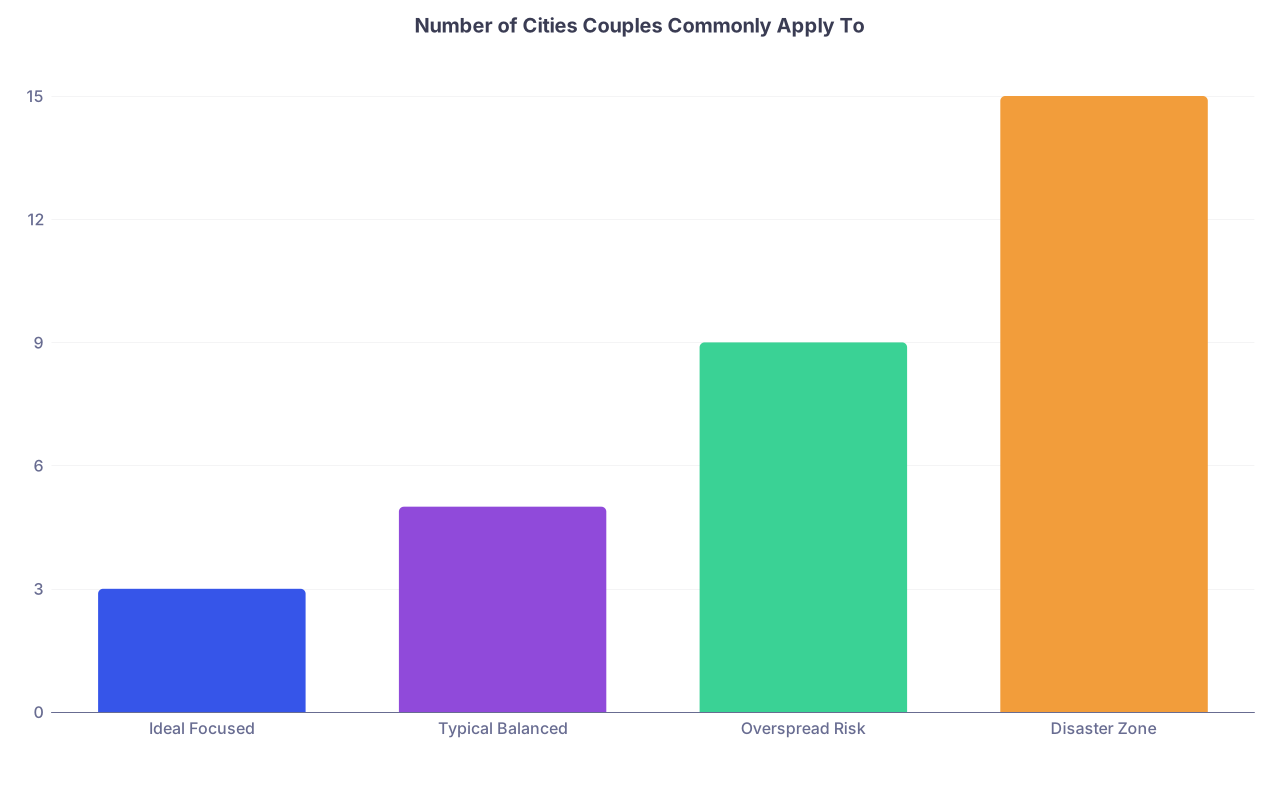
| Category | Value |
|---|---|
| Ideal Focused | 3 |
| Typical Balanced | 5 |
| Overspread Risk | 9 |
| Disaster Zone | 15 |
Here is the rough pattern I keep seeing:
- 3–4 metro areas: focused, strategic, realistic planning
- 5–7: still workable but starting to stretch
- 8–10: overspread red zone
- 10+: you are not strategic anymore; you are just afraid
The mistake is thinking the match algorithm rewards volume of cities. It does not. It rewards coherent, honest preference lists where you have actually done the work.
Why Overspreading Hurts Couples Specifically
1. You dilute your best combinations
As a couple, your match strength is not “Partner A’s rank list” plus “Partner B’s rank list.” It is the overlap of the two. The set of combinations where:
- You both would be happy enough.
- Both programs are realistic based on your stats and profiles.
- The geography works for living together without ridiculous commutes.
When you blast your lists across 10 or more cities each, you massively increase:
- Weird, low-value combinations (one of you at a safety in City X, the other at a safety 90 minutes away in City Y).
- Combinations where one of you secretly hopes you do not land there, but you rank it anyway “just in case.”
You end up with a long rank list that is mathematically dense and emotionally hollow.
I have seen couples with 70–90 combinations on their final list, but when you actually ask, “Which 10 would you be genuinely happy with?” they only name 6–8 real ones. The rest are fear-based filler.
The match algorithm will not distinguish your “real” choices from your “we panicked and added this” choices. It will just process the sequence you gave it.
2. You make interviews worse, not better
Overspreading means you:
- Apply to dozens of programs you barely researched.
- Get an unpredictable scatter of interview invites.
- Say yes to too many interviews in too many places because you are terrified to turn anything down.
Result: superficial, generic interview performance in a lot of rooms where you needed to be sharp and specific.
Program directors talk. I have sat in meetings where someone says, “They could not really explain why they liked our city; I think we are just one of twenty ‘big coastal city’ options for them.” That applicant did not move up the rank list.
You need depth, not breadth, in at least your top 2–4 cities. That means:
- Knowing neighborhoods where you might live.
- Having concrete reasons you like the city beyond “good training” and “diverse patient population.”
- Being clear on how both your careers fit there.
You cannot do that at scale for ten different metro areas. Not well.
3. You wreck your logistics and your mental health
The overspread couples I know end up:
- Flying back and forth across the country every 3–4 days.
- Doing Zoom interviews from hotels at 11 PM local time because of time zones.
- Trying to coordinate schedules where one person is interviewing on the East Coast and the other on the West the same week.
People start snapping at each other. Sleep drops. The conversations shift from “What do we want?” to “What can we survive?”
And here is the worst part: all this pain is usually for low-yield cities that were never going to be top choices anyway.
The Red Flags You’re Falling Into the Overspread Trap
Let me be blunt. If these apply to you, you are on the edge of the trap already.
- You cannot list, from memory, your top 3 cities and why.
- Either partner is using phrases like:
- “We should throw in a few more Midwest cities just as backup.”
- “I applied there because it was cheap to add on ERAS.”
- “We can always rank it low; it does not hurt.”
- You are relying on a massive spreadsheet with 15+ cities because you cannot remember what you decided about half of them.
- One or both of you keeps discovering “Oh yeah, I applied there too” during planning talks.
- Your preliminary rank list is already more than 60–70 couples combinations and you are not even done interviewing.
If you recognize yourselves in that, stop. You do not need more cities. You need to clean up.
How Many Cities Is Actually Reasonable?
There is no magic number, but there are sensible ranges.
For most couples:
- 3–5 primary metro areas is ideal.
- 6–7 is the upper bound before you lose seriousness in at least some.
- Beyond 7, you are making tradeoffs that hurt more than they help.
The number depends on:
- Competitiveness of each specialty (Derm + Ortho is not the same as IM + FM).
- Your application strength (borderline applicants might need an extra city, not ten).
- Whether you are willing to live separately for a year (most couples say “maybe” now and then regret even listing those options).
Here is a rough benchmark to sanity-check yourselves:
| Situation | Recommended Cities | Notes |
|---|---|---|
| Both moderately competitive fields | 3–4 | Focus on overlap |
| One highly competitive, one not | 4–5 | Add 1 extra region |
| Both very competitive | 5–6 | Still avoid scattershot |
| One has major geography limits | 3–4 | Deep not wide |
The Right Order: Decide Cities Before Programs
Most couples do this backward. They:
- Both make individual program lists.
- Realize they are spread across half the country.
- Try to reverse-engineer “overlap” at the end.
That is how you end up with 10+ cities and chaos.
Do it in this order instead:

| Step | Description |
|---|---|
| Step 1 | Start Couples Planning |
| Step 2 | Define Dealbreaker Regions |
| Step 3 | Choose 3-5 Core Cities |
| Step 4 | Identify Satellite/Commute Options |
| Step 5 | Apply to Programs in Core/Satellite Areas Only |
| Step 6 | Adjust Only if Interview Volume is Low |
Key step most people skip: explicitly decide where you are NOT willing to live.
If either partner says, “I would be miserable in [region],” you have to treat that like a clinical contraindication, not a suggestion. Do not apply there “just in case the algorithm forces us.” You are the ones giving it that power.
Your process should look more like this:
- Each person privately lists:
- Top 3 dream cities.
- 3–5 acceptable backup regions.
- 2–3 hard “no” regions.
- You compare lists and carve out:
- 2–3 shared top cities.
- 1–3 shared realistic backups.
- You commit:
“These are the only geographies we will apply to unless we both explicitly agree to expand later if interview volume is dangerously low.”
That last clause is your safety valve. You can expand thoughtfully if the data demand it. But you are not starting from sprawl.
How Overspreading Warps Your Rank List
The couples rank list is already complicated. Multiplying every program on Partner A’s list by every program on Partner B’s list creates this big grid of options.
Overspreading turns that grid into nonsense.
Here is what I see over and over:
- 3–4 truly desirable combinations in City A.
- 3–4 solid combinations in City B.
- 2–3 workable combinations in City C.
- Then 50+ garbage combinations scattered across Cities D–M where:
- The commute between hospitals is over an hour.
- Cost of living makes no sense on a resident salary.
- One person is in a strong program and the other is in a program they actively dislike, but “we ranked it anyway.”
You tell yourselves, “We will just rank them low so they are unlikely.” The match algorithm does not care about “unlikely.” It cares about order. If your more desirable combinations are off the table for any reason (programs not ranking you high enough, competition, etc.), the algorithm keeps sliding down your list.
If your list is packed with locations you never truly considered, your outcome becomes random.
You handed the computer a loaded gun and said, “I mean, probably do not fire these last 40 rounds, but they are there if you need them.”
The Money And Time You Are Quietly Wasting
No one likes talking about the financial side, but you ignore it at your own risk.
More cities = more:
- ERAS fees for extra programs in extra regions.
- Flights, hotels, Ubers.
- Extra days off rotations for travel.
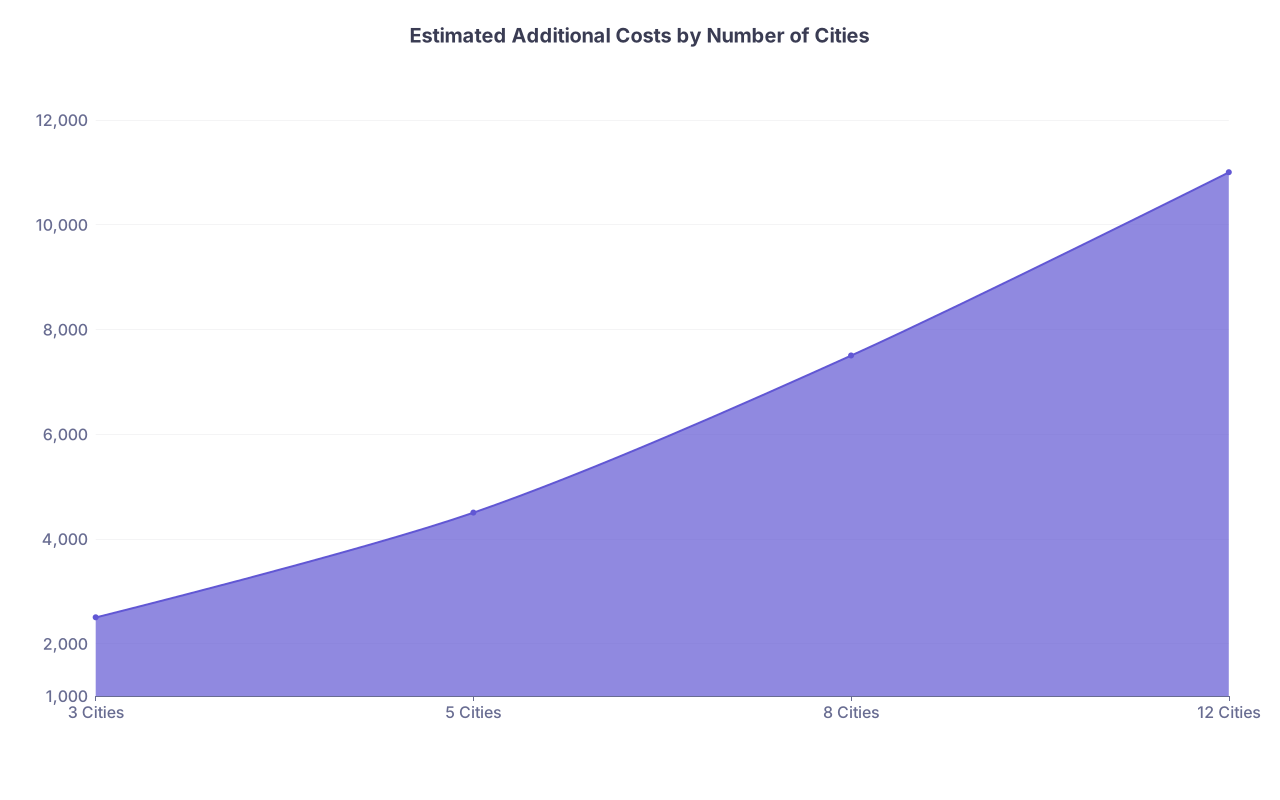
| Category | Value |
|---|---|
| 3 Cities | 2500 |
| 5 Cities | 4500 |
| 8 Cities | 7500 |
| 12 Cities | 11000 |
I have watched couples burn $10,000–$12,000 in one season because they “kept options open” in far-flung cities that never even made their serious rank list.
Worse, they burned political capital with their home program by repeatedly asking for days off for interviews they did not actually care about. That stuff is not invisible. Chiefs notice. PDs notice.
There is an opportunity cost to everything you add.
That week flying to an interview in a marginal city? You could have:
- Taken an extra day to rest and actually think through your rankings.
- Used the money to visit one of your top cities and look at neighborhoods in person.
- Preserved goodwill with your current team by not vanishing again.
How To Protect Yourselves From Overspreading
You avoid the overspread trap the same way you avoid most disasters in medicine: by creating constraints early and respecting them.
1. Set a hard city cap before you apply
Literally write it down together:
- “We will not apply to more than 5 metro areas unless interview volume is dangerously low.”
Not a suggestion. A cap.
If one of you wants to add another city “just to be safe,” that is a conversation, not a solo decision at midnight with ERAS open.
2. Create a “no-fly list”
Regions or cities that are out for either of you. Non-negotiable.
Common reasons I have seen:
- One partner has a medical condition that needs care only available in certain regions.
- Family obligations require being within driving distance of a parent or child.
- Serious climate or cultural mismatch that would genuinely affect mental health.
You are allowed to care about lifestyle. Residency is hard enough without adding “I hate everything about this place” to the list.
3. Rank values, not just programs
You need to be on the same page about what matters:
- Be close to family vs. be in an academic powerhouse.
- Affordable housing vs. big-name coastal city.
- Weather, safety, commute times.
If your values are not aligned, your city choices will reflect two separate strategies smashed together. That is how you get 10 cities “because we each had our own top 5.”
4. Use a simple, ruthless filter
For every potential city, ask:
- Can we name at least 2–3 programs each where we would be genuinely okay training?
- Can we both picture living there for 3–7 years without resentment?
- Do we have even a modest personal connection, interest, or reason for that city?
If you cannot answer yes to all three, it should fall off the list.
A Better Way To Expand If You Truly Must
Sometimes the data do force your hand. You aimed for 4 cities, interviewed in 3, and the numbers are making you sweat.
There is a smart way and a dumb way to expand.
Dumb way (what most people do):
- Panic in January.
- Apply late to a bunch of extra prelims, small community programs, and random cities.
- Add 2–3 more metro regions, none of which you have thought deeply about.
Smart way:
- Expand within your existing regions first: add more programs in your top 3–4 cities or nearby satellite towns.
- Only add a new city if:
- Both of you are willing to rank it mid-list (not only as absolute bottom backup).
- You can still secure at least 1–2 interviews each there before rank lists are due.
- Keep to your city cap +1. Not cap +6.

| Step | Description |
|---|---|
| Step 1 | Initial 3-5 Cities |
| Step 2 | Stay with Current Cities |
| Step 3 | Add Programs Within Current Cities |
| Step 4 | Add 1 New City Only |
| Step 5 | Interview Volume Adequate? |
| Step 6 | Still Low? |
Controlled expansion is boring. That is the point. Drama is expensive.
The Emotional Reality No One Warns You About
Here is what people do not talk about enough: overspreading makes it much easier to blame each other later.
- “You are the one who insisted on adding that city.”
- “I never even wanted to interview there.”
- “We only matched there because you kept pushing to ‘keep options open.’”
I have heard some version of those lines more times than I care to count.
If you constrain your city list together, intentionally, you own the outcome together. Whatever happens on Match Day is “ours,” not “yours” or “mine.” That matters when the stress hits.
You cannot eliminate uncertainty. You can eliminate chaos that you created yourselves.
The Bottom Line
If you remember nothing else, remember this:
- Spreading your couples match across too many cities does not make you safer. It makes your rank list incoherent and your interviews weaker.
- Decide your geography together, early. Cap your cities, respect your hard “no” regions, and expand only if the data clearly demand it.
- The match algorithm is not your enemy. Indecisive, fear-based applying is. Give the algorithm a list of cities and combinations you can actually live with, not a dumping ground of panic options.
Be deliberate now so you are not standing on Match Day staring at an envelope that represents a choice you barely even remember making.


