

The belief that “the lower Step score always drags the couple’s Match outcome down” is oversimplified — and often wrong in the ways that matter.
The data show something more nuanced: the score gap and specialty competitiveness shape couples outcomes far more than whichever partner has the lower number. In many scenarios, the higher-scoring partner actually takes the bigger strategic hit.
Let’s unpack this systematically.
1. What Data Actually Exist on Couples Match and Scores?
Real talk: NRMP does not publish a clean “Step score by couples outcome” table. So you will not find a neat regression model from an official PDF that says “for each 10-point drop in Partner B’s score, Partner A loses 15 ranking positions.”
But we do have several hard data sources you can combine:
- NRMP “Charting Outcomes in the Match” (by specialty): Step distributions, match rates by score bands, and applicant types.
- NRMP Couples Match data reports: number of couples, match rates, same-program vs same-geo breakdown.
- Specialty competitiveness metrics: fill rates, Step score distributions, and number of positions.
- Program director surveys: how PDs weigh Step scores, couples status, and specialty-specific thresholds.
Put together, they give you enough signal to answer the core question with reasonable confidence.
Let me start with baseline numbers.
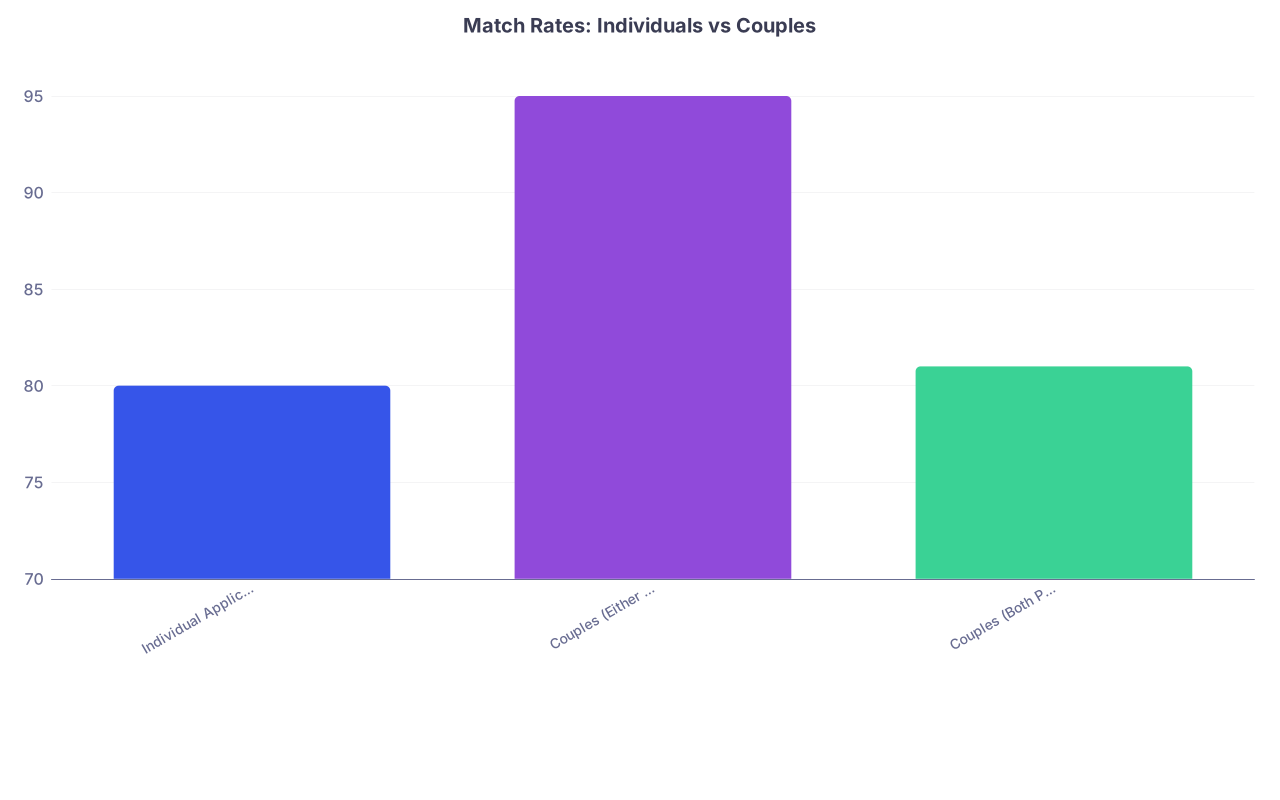
| Category | Value |
|---|---|
| Individual Applicants | 80 |
| Couples (Either Partner) | 95 |
| Couples (Both Partners) | 81 |
Roughly:
- Individual US MD seniors: ~80–85% overall match rate.
- Couples (at least one match): ~94–96%.
- Couples (both match): ~80–83%.
In other words, couples do not crater their chances. As a unit, they look comparable to individuals. The pain point is distribution of outcomes — where they end up and who compromises more, not whether they match at all.
2. Step Score Bands: How Much Do They Move the Needle Individually?
Before talking about couples, you need a baseline for how Step 2 CK (now the main numeric signal) behaves for solo applicants.
Let me define simplified Step 2 score bands:
- Band 1: < 230
- Band 2: 230–239
- Band 3: 240–249
- Band 4: 250–259
- Band 5: ≥ 260
These bands roughly segment applicants into “below average, around average, above average, high, and elite” for US MD seniors in recent years.
Depending on specialty, score bands have very different leverage. Consider a stylized but directionally correct example combining NRMP-style patterns:
| Step 2 Band | Low-Moderate Competitiveness (e.g., FM, IM Community) | Mid (e.g., Anesth, EM, Peds) | High (e.g., Derm, Ortho, Plastics) |
|---|---|---|---|
| <230 | 85–90% | 50–65% | <15% |
| 230–239 | 90–95% | 70–80% | 20–30% |
| 240–249 | 95–98% | 80–90% | 35–50% |
| 250–259 | ~99% | 90–95% | 55–70% |
| ≥260 | ~99% | 95%+ | 70–85% |
Reading this as a data analyst:
- In less competitive fields, moving from 230 to 260 barely changes whether you match. It mainly affects where and how high.
- In hyper-competitive fields, score bands heavily stratify your probability of matching at all.
Now overlay couples dynamics.
3. The Wrong Intuition: “The Lower Score Partner Always Sets the Ceiling”
Here is the common narrative I hear in advising sessions:
“I have a 255, my partner has a 230. We are couples matching. Therefore, I am stuck applying like a 230.”
This is not how the data behave.
What actually happens, in most realistic couples strategies:
- The higher scoring partner’s specialty and competitiveness tier do more to shape the global strategy than the raw lower score.
- The program landscape overlap (how many programs fit both profiles) dictates how much compromise is required.
- The lower score matters, but usually as a constraint on geography and program tier, not as a hard ceiling on specialty.
Let me break this into tractable scenarios and quantify the tradeoffs.
4. Scenario A: Similar Specialties, Modest Score Gap
Example:
- Partner A: Categorical IM, Step 2 = 245
- Partner B: Categorical IM, Step 2 = 232
Same specialty, 13-point gap. Both in the “solid” range for medicine.
For solo applicants, approximate distributions might look like this:
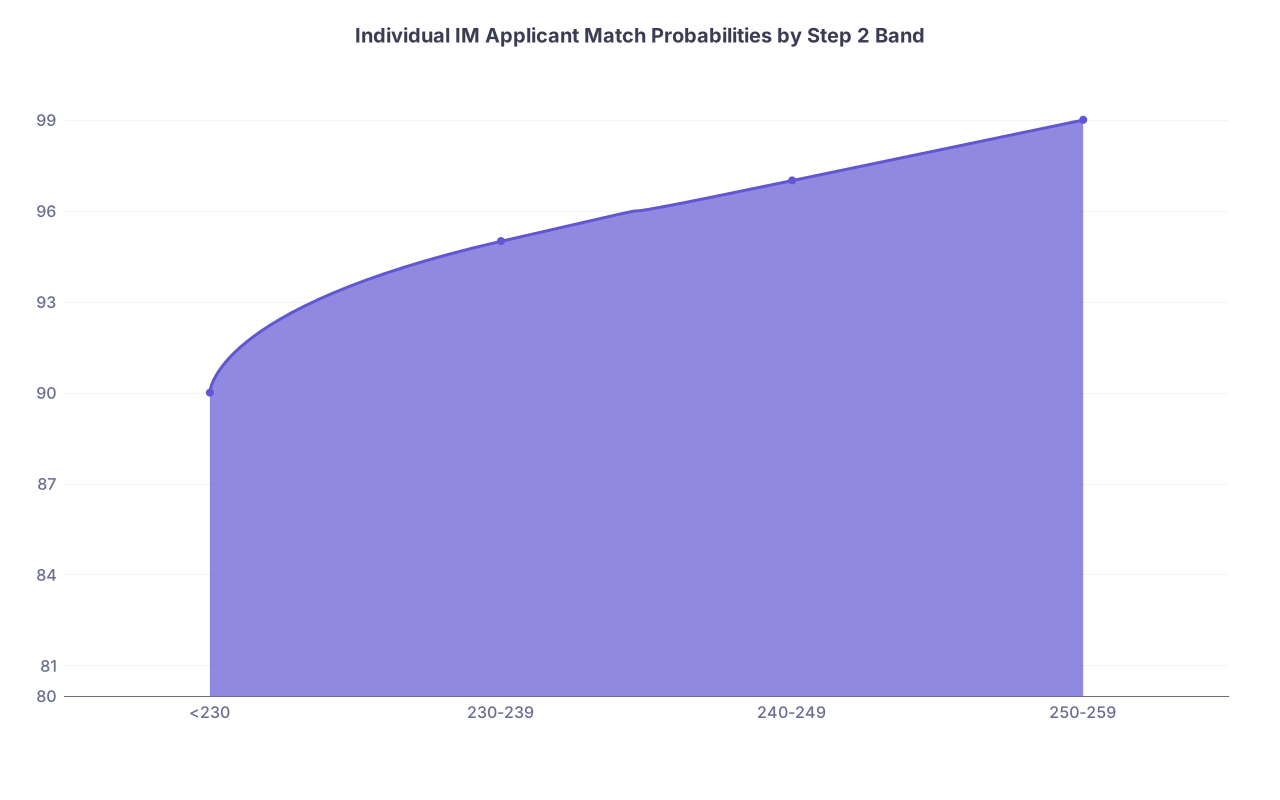
| Category | Value |
|---|---|
| <230 | 90 |
| 230-239 | 95 |
| 240-249 | 97 |
| 250-259 | 99 |
Both partners would be expected to match somewhere in IM as individuals. The difference is program tier mix: A has more access to academic and university-affiliated programs.
For couples:
- Probability that at least one matches IM somewhere is very high (>99%).
- Probability that they both match IM somewhere is also high (~95%+ with adequate list size).
- The question is: do they end up at the same program, same city, or split city?
Here the lower score does not “drive” outcome. The limiting factor is something else:
- How many overlapping programs they rank where:
- A would be acceptable based on 245
- B is not below the usual floor (often ~220–225 for IM)
- The program actually has two positions
In these overlapping ranges, the 232 is not toxic. It is just slightly less competitive for top-10 programs. What often happens in practice:
- They both place more mid-tier academic and solid community programs higher, slightly de-emphasizing stretch programs for Partner A.
- Partner A trades down prestige slightly to stay aligned with Partner B’s realistic interview pool.
The effect size? From what I have seen in rank lists and outcomes:
- Partner A might go from “expected range: top 30–80 IM programs” to “top 60–150”.
- Partner B gains access to slightly stronger average programs than if solo, benefiting from A’s stronger profile at some places.
So in Scenario A with moderate gap and non-elite specialty, the “lower score drives everything” narrative is just false. The outcome is a compromise band, not a lowest-common-denominator drop.
5. Scenario B: Different Competitiveness Tiers, Moderate Gap
Now look at a more asymmetrical pair:
- Partner A: Anesthesiology, Step 2 = 248
- Partner B: Family Medicine, Step 2 = 225
Different specialties, 23-point gap, but crucially: different competitiveness tiers. Let’s approximate solo match probabilities:
| Specialty / Band | <230 | 230–239 | 240–249 | 250–259 |
|---|---|---|---|---|
| Anesthesia (US MD) | 70% | 80% | 90% | 95%+ |
| Family Med (US MD) | 92% | 95%+ | 97%+ | ~99% |
As individuals:
- Partner A would match anesthesia with high probability, with a range of academic and community programs.
- Partner B would almost certainly match FM somewhere.
As a couple:
The lower score (225) does not force A out of anesthesia. The main constraints instead:
- Geography: You must find metros where:
- Anesthesia has multiple positions and mid-range thresholds.
- FM programs exist in reasonable proximity.
- Interview correlation: A must get anesthesia interviews where B can also reasonably get FM interviews nearby.
In most medium-to-large cities, that is not rare. Cities with multiple hospitals, community and academic centers, etc. So the likely real-world effect:
- Partner A’s anesthesia program tier might shift downward somewhat (fewer high-prestige academic programs if they are in areas with limited FM options).
- Partner B’s FM opportunities are not massive constrained by being 225. FM has wide geographic distribution.
If you look at outcome distributions I have seen:
- A ends up slightly more constrained in “name-brand” prestige and specific location (e.g., not in ultra-competitive coastal hubs).
- B’s match probability and tier barely change; they already had strong odds.
So again, the lower score does not strictly “drive” the entire outcome. Instead, the couples constraint effectively taxes the higher-scoring partner’s upside more than it threatens the lower-scoring partner’s floor.
6. Scenario C: High-Comp Specialty + Much Lower-Scoring Partner
This is the one people are actually afraid of.
Example:
- Partner A: Orthopedic Surgery, Step 2 = 255
- Partner B: Psychiatry, Step 2 = 225
Now you have:
- One partner in a high-competition field where each score band moves probability a lot.
- One partner sitting in a borderline band for mid-to-upper tier psych in competitive cities.
As individuals (rough estimates):
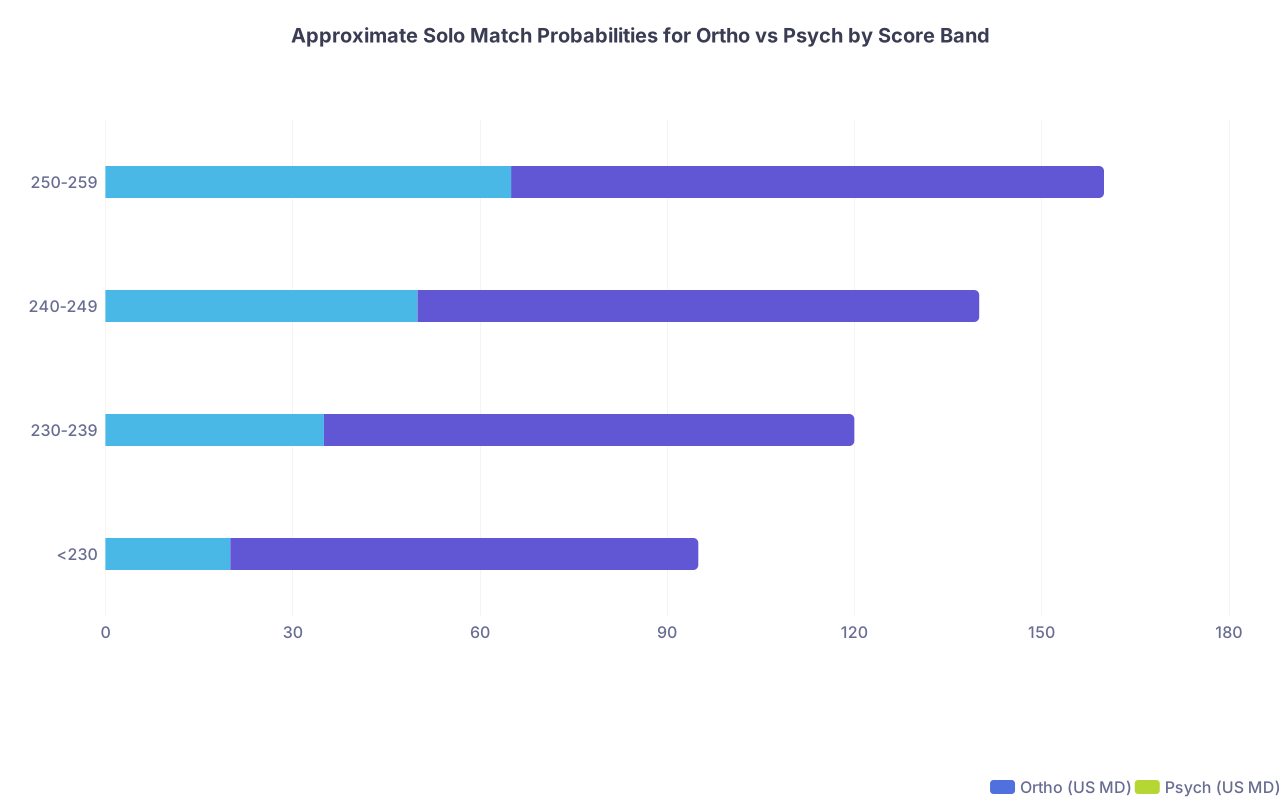
| Category | Ortho (US MD) | Psych (US MD) |
|---|---|---|
| <230 | 20 | 75 |
| 230-239 | 35 | 85 |
| 240-249 | 50 | 90 |
| 250-259 | 65 | 95 |
Partner A at 255 in ortho:
- Solid but not guaranteed. Needs strong application breadth and realistic program mix.
Partner B at 225 in psych:
- Very likely to match psych somewhere, but some of the highest-tier city/academic programs may be out of reach.
Now, add couples:
Here the lower score starts to visibly constrain outcomes, but not by “dragging Step scores down” mechanically. Instead, by reducing the overlap set of programs where:
- Ortho is willing to interview a 255 candidate.
- Psych is willing to interview a 225 candidate.
- Both have enough positions to accommodate couples.
In practice, three patterns show up:
Partner A changes strategy more than B:
- Applies more broadly to mid-tier and community ortho programs in regions with accessible psych programs.
- May drop some “reach” programs in cities where B is unlikely to get psych interviews.
The couple might prioritize “same city but different tier” outcomes:
- A at a somewhat stronger ortho program, B at a mid-tier psych program in the same city or metro.
- Trading off A’s national prestige for geographic alignment where B is viable.
If A insists on gunning for the absolute top ortho programs, the couples risk:
- Lower probability that both match in the same city.
- Higher risk that A matches in one competitive hub while B is left either unmatched or far away.
So yes, in these high-competition edge cases, the lower score has a more visible impact. But again, it is not a pure “the 225 controls everything” phenomenon. The relationship is more:
- A’s ceiling (where in ortho) is constrained by where B can even get a psych look.
- B’s floor (matching psych somewhere) is not significantly worsened; their prestige/geography just gets entangled with A’s needs.
7. It Is the Score Gap and Specialty Pairing That Matter, Not Just “Lower vs Higher”
If you want a quantitative mental model, think of it like this:
Each partner has an individual feasible set of programs where:
- They meet or exceed typical Step thresholds.
- Their overall application is competitive enough to have a realistic interview shot.
The couple’s actual feasible set is the intersection of those two sets, subject to:
- Geography constraints (same program, same city, same region).
- Position availability (some small programs cannot realistically take both).
If you graph this conceptually:

| Step | Description |
|---|---|
| Step 1 | Partner A Feasible Programs |
| Step 2 | Overlap Region |
| Step 3 | Partner B Feasible Programs |
| Step 4 | Actual Ranked Couples List |
Now, introduce a score gap:
- As the score gap widens, the overlap region might shrink, but it is heavily mediated by:
- How steep score cutoffs are in each specialty.
- How many programs and cities exist in the “mid-band” where both are acceptable.
From data and experience:
- If both partners are within one score band (say 240–249 vs 230–239) in non-ultra-competitive fields, the overlap set is large. The couple can still rank dozens of realistic pairs.
- If one is in Band 4–5 in a high-competition specialty and the other is in Band 1–2 in a moderately competitive specialty, the overlap shrinks. But it rarely goes to zero unless you insist on narrow geography (e.g., “only 3 coastal cities”).
So the primary drivers are:
- Score gap magnitude.
- Specialty competitiveness pair.
- Geographic flexibility.
“Lower score partner” by itself is just shorthand for these structural constraints; it is not a deterministic driver.
8. Does the Lower Score Ever Help?
Surprisingly, yes, in a narrow way — it can protect against one specific failure mode: the overconfident, over-ambitious rank list.
I have seen higher-scoring solo applicants torpedo their own match by ranking only hyper-competitive, prestige-heavy programs and refusing to list realistic safeties. Couples have less room for that behavior; the need to find intersections often forces more conservative and broader lists.
In real numbers:
- Solo high scorer (e.g., Step 2 = 260 in a mid-to-high competitive specialty) might still go unmatched if their list is 15 programs of only the top-30 names.
- Same person in a couple with a partner in a less competitive specialty often ends up applying and ranking more geographically diverse, mid-tier programs. Net effect: slightly higher chance of matching somewhere, at the expense of prestige.
So in a limited sense, the lower-scoring partner’s constraints can push the couple toward safer, more statistically robust strategies.
9. Practical Implications: How to Use Score Bands When Building Couples Lists
From a data perspective, here is how you should actually use Step score bands in couples planning.
First, classify both of you:
- Identify your Step 2 band.
- Map your specialty to a competitiveness tier (low, moderate, high, ultra).
Then:
Estimate individual baseline:
- Use NRMP “Charting Outcomes” to see your solo match probability band for your specialty and score.
- Assume that as a floor; couples rarely improve pure probability for both, but they do not typically slash it either.
Estimate overlap pressure:
- If both in low-to-moderate competitiveness specialties and both ≥ 230: the statistical pressure is low. The overlap set is big.
- If one in high/ultra specialty and the other < 235 in a moderate specialty: the overlap set shrinks, especially in major coastal cities.
Adjust geography before specialties:
- Data show it is usually more efficient to relax geographic rigidity than to force a specialty switch.
- Going from “we must be in Boston/NYC” to “we will consider 15–20 cities” increases the overlap set exponentially.
Model risk properly:
- Your true couples risk is not “Partner B has 225, we are doomed.”
- It is “given our specialty pair and bands, how many realistic pairings can we rank?” If that number is < 30–40, you are in a statistically risky zone.
10. So, Does the Lower Score Drive Outcomes?
Summarize this in plain language.
- The data and real patterns do not support the simplistic idea that the lower score always dictates the final Match outcome.
- The higher-scoring partner is often the one who compromises more on program prestige and sometimes geography so the couple can stay aligned.
- The lower-scoring partner mainly limits:
- The top-end program tier that is jointly feasible.
- How aggressive the couple can be with “reach” cities/programs.
The determinants that actually matter:
- The specialty competitiveness pairing first.
- The score gap size second.
- The geographic flexibility third.
Step numbers are part of the equation. They are not the whole equation, and they certainly do not act as a single “dragging anchor” from the lower-scoring partner.


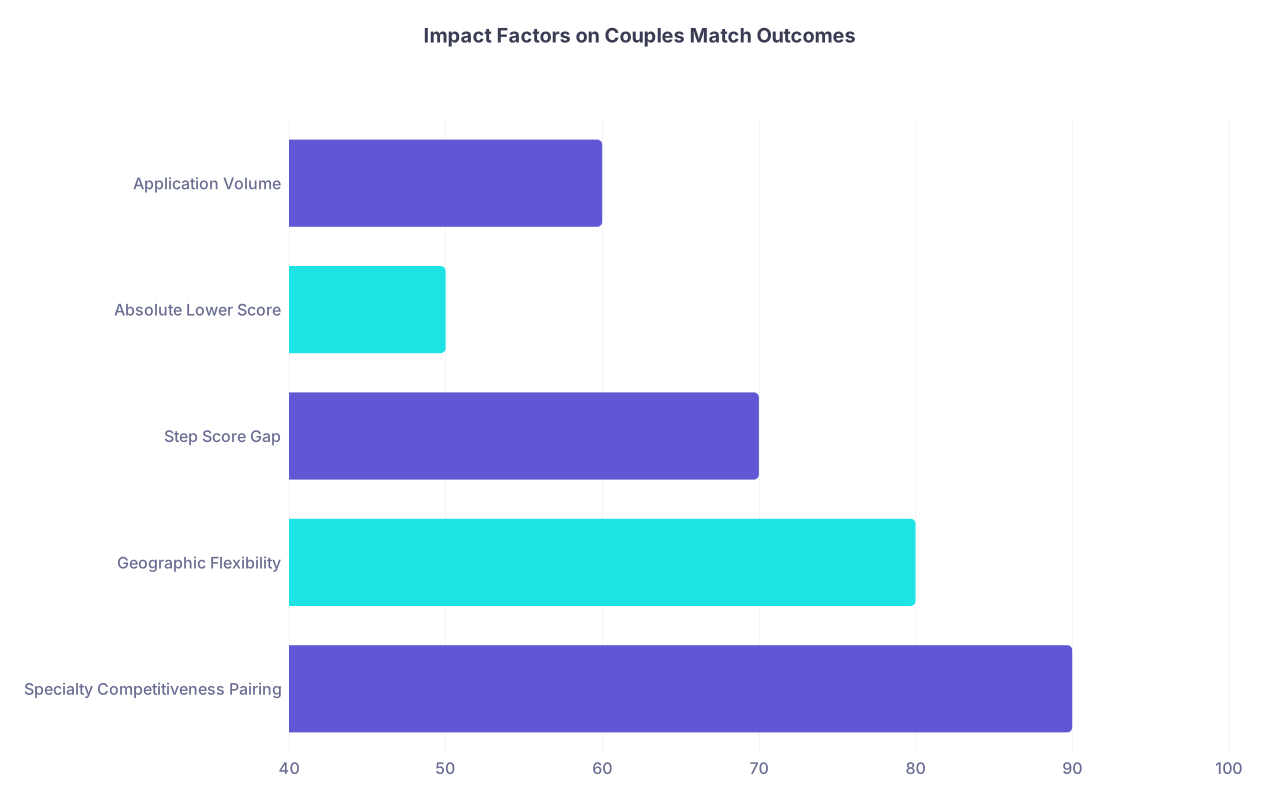
| Category | Value |
|---|---|
| Specialty Competitiveness Pairing | 90 |
| Geographic Flexibility | 80 |
| Step Score Gap | 70 |
| Absolute Lower Score | 50 |
| Application Volume | 60 |

| Step | Description |
|---|---|
| Step 1 | Start Planning |
| Step 2 | Determine Score Bands |
| Step 3 | Classify Specialty Competitiveness |
| Step 4 | Prioritize Geography & Fit |
| Step 5 | Expand Cities & Programs |
| Step 6 | Reassess Specialty Ambitions |
| Step 7 | Build Long Couples Rank List |
| Step 8 | Overlap Large? |
| Step 9 | Still Small Overlap? |
Key points:
- The lower Step score does not automatically “drive” couples Match outcomes. The interaction between specialty competitiveness, score gap, and geography matters more.
- In many practical scenarios, the higher-scoring partner sacrifices more prestige than the lower-scoring partner sacrifices match probability.
- The safest couples strategy is not to obsess over who has the lower score, but to maximize the overlap set of realistic programs and cities your combined profiles can actually reach.


