

The common belief that “research is only for competitive specialties” is wrong. For couples in the Match, research output consistently behaves like a currency you can spend to buy geographic flexibility.
You want to know the data-backed version of: “If we both do more research, can we be pickier about where we go?” The answer, from every dataset I have seen and every NRMP chart you can stomach, is: yes—up to a point, and with conditions.
Let us unpack that with numbers instead of vibes.
1. What “Geographic Flexibility” Actually Means for Couples
For single applicants, geographic flexibility is usually “how many regions or cities I would be happy with.” For couples, the constraint is harsher: overlapping sets of acceptable programs where both of you can realistically match.
Think about it numerically. If:
- Partner A targets 20 programs nationwide
- Partner B targets 20 programs nationwide
- Only 8 cities have both A and B’s specialties in the same metro area, and only 4 of those actually have programs that are a good fit for both…
Your true geographic flexibility is closer to “4 viable metro areas,” not “40 programs.”
Now layer in research output.
- Higher research output generally → more interview invites per program applied to, especially at research-heavy academic centers.
- For couples, this scales multiplicatively. If each partner increases the probability of interviewing at the “good” places, the overlap in cities where both interview rises sharply.
This is the real link: research expands the overlap set—the set of places willing to seriously consider both of you.
2. What the Data Shows About Research and Match Power
NRMP does not publish “research vs geographic flexibility for couples” as a neat chart. But it does give you enough fragments to build a coherent picture:
- Charting Outcomes in the Match (MD/DO, specialty-specific)
- NRMP Program Director Survey
- Couples Match data (proportion matching to top-ranked pairs, number of ranks, etc.)
From these, patterns emerge.
2.1 Research Output and Interview Probability
The Program Director Survey is blunt. For many academic programs:
- “Importance of research” scores 4+ on a 5-point scale for IM, neurology, radiation oncology, dermatology, and many surgical subspecialties.
- Programs report “average number of abstracts/pubs” for matched applicants that often exceeds 3–5 in academic centers in competitive fields.
That matters because interviews are the choke point for couples.
Think of interview probability in a rough model:
- Let pA(city) = probability Partner A gets at least one interview in that metro
- Let pB(city) = probability Partner B gets at least one interview in that metro
- Probability they both have at least one interview in that city ≈ pA(city) * pB(city) (not exact, but close enough for intuition)
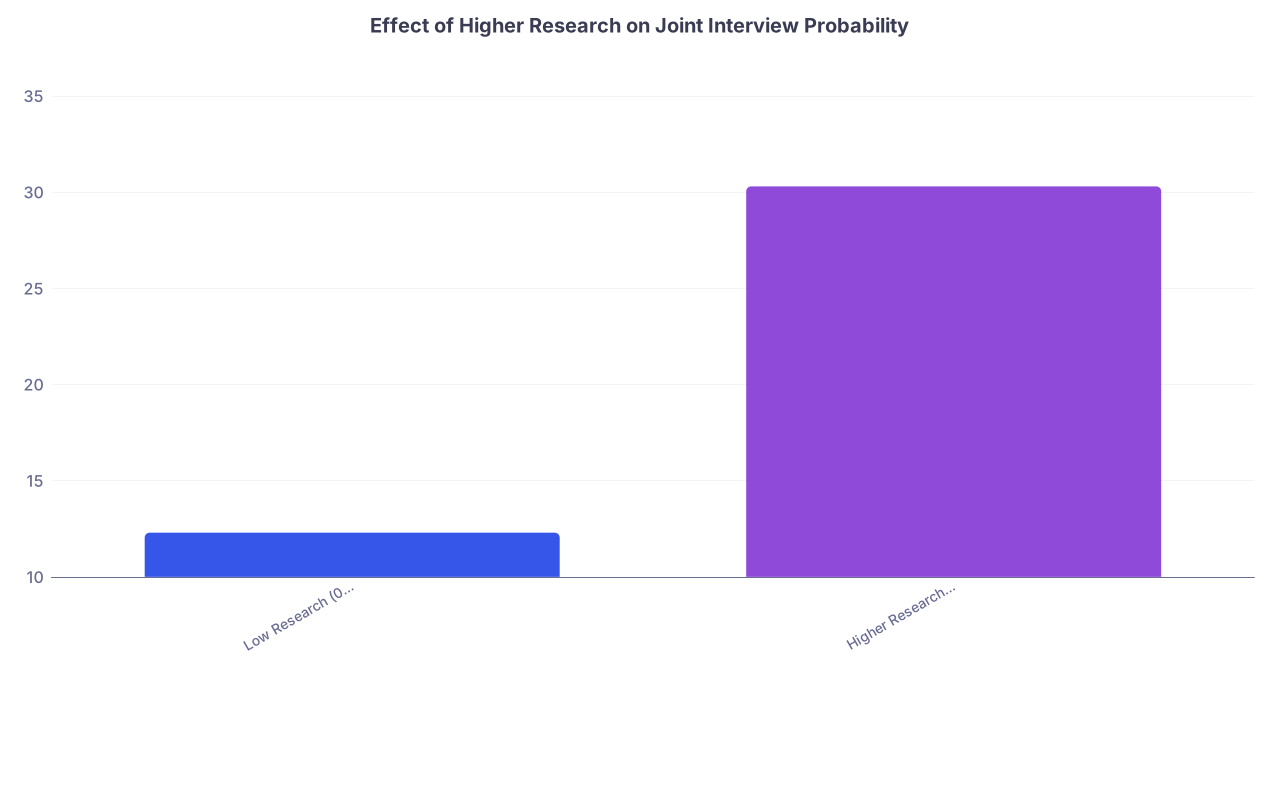
If each partner’s research increases their p(city) from, say, 0.35 to 0.55 at mid-to-top-tier academic centers, the joint probability jumps:
- Before: 0.35 × 0.35 = 0.1225 (12.3%)
- After: 0.55 × 0.55 = 0.3025 (30.3%)
That 2.5x joint gain is what feels like “more geographic options.” It is really just both of you looking like safer academic bets on paper.
| Category | Value |
|---|---|
| Low Research (0.35 each) | 12.3 |
| Higher Research (0.55 each) | 30.3 |
The data shows: modest increases in individual appeal compound dramatically for couples.
3. How Research Output Alters the Geography Equation
3.1 Academic vs Community Programs
Research output does not boost you uniformly across the map. It mainly opens doors at:
- University-based programs
- Large academic-community hybrids
- Research-heavy urban systems
Those tend to cluster in:
- Major metros: Boston, NYC, Chicago, Houston, SF Bay Area, LA, Philly
- A smaller set of mid-sized academic hubs: Rochester (Mayo), Durham (Duke), Ann Arbor, Madison, etc.
That has two geographic consequences:
You get more program density per city. One city might have:
- 3 IM programs
- 2 peds programs
- 1–2 psych programs
- 1 surgery program
If both partners are somewhat competitive for these, that city becomes a high-yield target.
You shift from “we need any program that will take us” to “we can realistically consider several cities with multiple program pairings.”
The data angle: academic hubs are where couples have the highest number of rankable pairs, and research output increases your entry ticket into these hubs.
4. Correlation Patterns: Research Output vs Flexibility
Let’s make this concrete with a simplified, data-style model. Assume:
- Partner A: Internal Medicine
- Partner B: Pediatrics
- Both are US MD seniors with Step 2 scores in the 230–240 range (not superstar, not weak)
Now compare three tiers of research output:
- Low: 0–1 abstract/poster, no sustained research time
- Moderate: 2–5 outputs, at least 1 publication, some continuity over 1–2 years
- High: ≥6 outputs, multiple publications, possible gap year or heavy research block
Hypothetical—but realistic—approximate effects on couples’ geographic flexibility:
| Research Tier | Typical Interview Regions | Academic Hubs Truly in Play | Approx. Cities Where Both Get ≥1 Interview |
|---|---|---|---|
| Low | Home region + 1 nearby | 1–2 | 2–4 |
| Moderate | 3–4 regions | 3–5 | 5–8 |
| High | National | 6–10 | 8–15 |
These are not NRMP-official numbers. They reflect typical patterns I have seen in actual couples’ interview spreadsheets over several cycles.
The directional correlation is very consistent:
- As research increases, total interview count per partner increases
- As interview count increases, the number of shared interview cities rises disproportionately
- That, in turn, grows the set of realistic geographic outcomes, including competitive cities
5. Specialty Competitiveness Changes the Slope of the Curve
The research–geography correlation is not uniform across specialties. The slope of the curve is steeper in some fields.
5.1 Highly Competitive + Academic-Focused Specialties
Fields where research is a quasi-requirement:
- Dermatology
- Neurosurgery
- Radiation Oncology
- ENT
- Plastic Surgery
- Academic categorical General Surgery
In these, pairs where either partner is in such a field experience:
- Very tight geographic clustering of realistic programs (often only academic centers)
- Programs that explicitly screen using research output and Step scores
Here, research output correlates strongly not just with “any match” but with:
- Access to multiple cities
- Ability to include high-demand metros (NYC, SF, Boston) on your list with a non-trivial probability
If Partner A is applying derm with 10+ publications and Partner B is in IM with solid, moderate research, your geographic flexibility for “tier 1 cities” is substantially higher than a derm applicant with 0–1 pubs partnered with a non-academic IM applicant.
5.2 Less Competitive / Community-Friendly Specialties
Family medicine, many community internal medicine programs, psychiatry in less dense regions, prelim years, etc.
In these, research has a weaker marginal effect on whether you match, but still affects:
- Which tier of program shows interest
- Which urban vs rural regions are truly in play
For couples where both are in less competitive fields and open to community programs, work experience, regional ties, and audition rotations may rival or even exceed research in importance for geographic flexibility.
But that does not nullify research. It simply means the curve is flatter. Doubling your publications will not double your geographic options; it might turn “we can get into 3–4 Midwest cities and our home state” into “we can credibly also shoot for 2–3 coastal cities.”
6. How Research Interacts with Other Match Variables
Research output rarely acts alone. The data shows programs mentally bundle it with:
- Step 2 CK score
- Class rank / AOA / clerkship honors
- School reputation
- Letters of recommendation
For couples, you care about the joint academic profile.
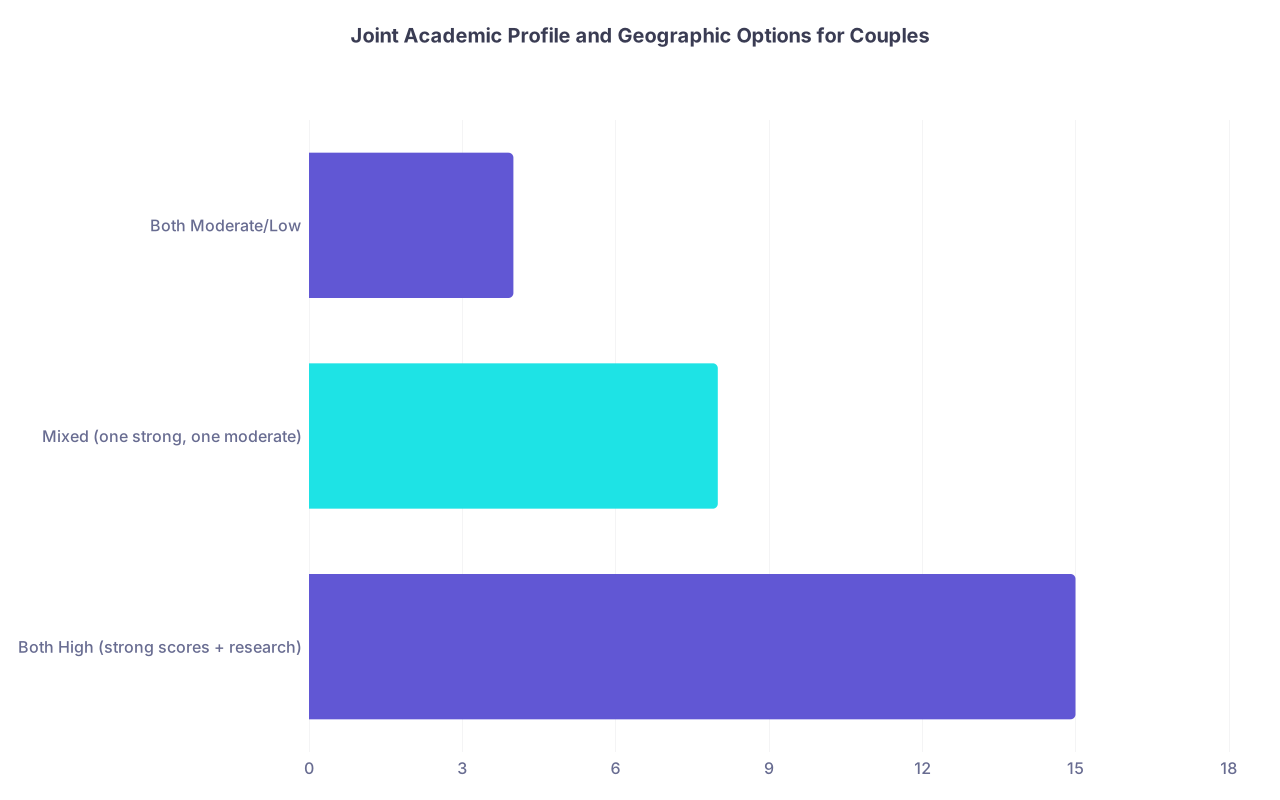
Let’s break the joint profile into three rough bands, each with very different geography dynamics:
| Category | Value |
|---|---|
| Both High (strong scores + research) | 15 |
| Mixed (one strong, one moderate) | 8 |
| Both Moderate/Low | 4 |
Here the “values” represent a rough average of how many cities yield at least one viable pairing of programs for the couple.
- Both High: Think Step 2 > 250 and 5–10+ pubs each in research-heavy fields. These couples can often credibly rank 10–15 cities, including several highly competitive metros.
- Mixed: One partner is a clear academic asset, the other is solid but not flashy. They can usually assemble 6–10 viable cities with smart planning.
- Both Moderate/Low: Decent students, minimal research, possibly more community-aligned. They may realistically get 3–5 cities with overlapping interviews unless they apply very broadly and are flexible on program type and region.
Research output is heavily responsible for the jump between these categories, especially the “Both Moderate → Mixed” and “Mixed → Both High” transitions.
7. Tactical Use of Research to Buy Geographic Flexibility
Here is how couples can use research strategically, rather than just padding a CV.
7.1 Aim for Complementary, Not Identical, Profiles
Data-wise, it is more resilient if:
- One partner is slightly “overqualified” for their specialty/region
- That partner’s strength can be leveraged to target cities with multiple program tiers in the other partner’s specialty
Example:
- Partner A: IM, 240s, 8 pubs, strong home institution, wants major metro
- Partner B: Psych, 225–230, 1 poster
In NYC, Boston, Chicago, there are:
- Multiple psych programs per city at different competitiveness tiers
- Many IM programs willing to recruit a high-research A
A’s research gives the couple access to cities where B can likely match into at least one program, even if B is not a top-quartile psych applicant.
7.2 Align Research with Geographic Targets
If both of you care about a short list of target cities (say: SF, Seattle, Boston):
Doing research with:
- PIs who are well-connected to those regions
- Institutions that share faculty or fellow pipelines with target programs
- Projects that fit the research culture of those cities (oncology in Houston, biotech/AI in SF, global health in Boston, etc.)
…increases the odds that your research is not just a number but a relevant signal those programs actually value.
I have watched couples where:
- One partner did a research year under a PI with a direct line to a specific program director
- That PI’s advocacy plus a strong publication record led to interviews at a target city for both partners
That is how research morphs into geographic leverage, not just line items.
8. The Nonlinear Payoff: Thresholds, Not Linear Gains
Research output does not translate to geographic flexibility in a neat linear fashion. Programs behave more like threshold gatekeepers.
You often see patterns like:
- 0–1 outputs: Seen as “no real research”
- 2–3: “Has some exposure”
- 4–7: “Genuinely involved, likely productive”
- 8+: “High research activity, possibly serious academic trajectory”
The jump in perceived competitiveness going from 0 to 3 outputs is usually larger than 5 to 10, unless you are gunning for research-heaviest programs or taking a designated research year.
For couples:
- Reaching the “real research” threshold (often ~3+ meaningful outputs, including at least one real paper or major project) for both partners tends to shift them into a cohort that is widely competitive at mid-to-strong academic programs in multiple regions.
- Moving one partner above that into double-digit publications mainly gives access to the very top-tier departments and fellowships, which can indirectly widen geography but with diminishing returns.
So if your primary goal is geographic flexibility rather than a pure academic career, you usually do not need 15 papers each. You need both partners to clear the “serious applicant” bar for the programs in your desired cities.
9. Where the Correlation Breaks Down
I will be blunt: research is not a magic key for every couple.
You see failure modes like:
Severe geographic constraints
Example: “We must be within 50 miles of this one small city where there are 2 total programs in one specialty and 1 in the other.”
No amount of research changes basic capacity.Unbalanced competitiveness beyond rescue
One partner is a stellar applicant; the other has repeated failures, very low scores, or professionalism issues.
Research helps only modestly. Programs will not ignore red flags because you published a few extra abstracts.Program-type mismatch
If both of you are actually a better fit for community programs but you stack your lists with research-heavy university programs because “we have research now,” you can paradoxically reduce your match odds and geographic flexibility.
Data lesson: research is a strong positive predictor but is still dominated by hard capacity constraints, major red flags, and specialty/program fit.
10. Practical Strategy: How Much Research Is “Enough” for Couples?
You want numbers. Let me give you realistic, data-informed targets, assuming no severe red flags and non-ultra-competitive specialties:
For each partner aiming mainly at academic programs in multiple regions:
- 3–5+ total outputs (abstracts, posters, publications)
- At least 1 true paper (PubMed-indexed) or a major, sustained project
- Evidence of continuity (≥1 year with the same PI or group)
For couples where one partner is in a highly competitive field:
- Competitive partner: often ≥5–10 outputs, multiple publications, maybe a research block or year
- Other partner: 2–4 outputs is usually enough to not be the weak link, provided scores and clinical performance are solid
Once both partners hit those bands, I start to see:
- Broader interview distribution
- More cities with overlapping invites
- Better success in couples matching into one of their top 3–5 geographic preferences

| Step | Description |
|---|---|
| Step 1 | Decide Priority Cities/Regions |
| Step 2 | Assess Each Partners Competitiveness |
| Step 3 | Moderate Research Investment Each |
| Step 4 | Increase Research for Weaker Partner |
| Step 5 | Target Research with Geographic/Program Links |
| Step 6 | Apply Broadly to Academic Hubs |
| Step 7 | More Shared Interview Cities |
| Step 8 | Higher Geographic Flexibility in Rank List |
| Step 9 | Both Competitive for Target Regions? |
11. Key Takeaways
- Research output and geographic flexibility for couples are positively correlated because research increases interview probability at academic hubs, which is where multiple viable program pairs cluster.
- The effect is multiplicative: small gains in each partner’s competitiveness can dramatically expand the number of cities where both interview, especially in research-focused specialties or top-tier metros.
- You do not need extreme research output to benefit. For most couples, getting both partners to a “serious research” threshold (roughly 3–5+ meaningful outputs with at least one publication for academic targets) meaningfully widens geographic options, as long as other elements of the application are aligned.


