

The biggest misconception about couples matching is that both people have to be in the NRMP Couples Match for their outcomes to be “linked.” They do not. The data show a surprisingly messy gray zone when only one partner couples matches and the other applies solo.
You are not dealing with a clean on/off switch. You are dealing with asymmetric constraints on one side and free optimization on the other. That imbalance has consequences.
What the data actually say about couples and constraints
First, anchor on the baseline numbers. The NRMP’s “Results and Data” and “Charting Outcomes” reports are repetitive, but buried in there are the key reference points you should be using.
For U.S. MD seniors (categorical + advanced positions, 2023–2024 cycle, rounded ranges):
- Solo applicants (not couples):
- Match rate: ~92–94%
- Couples (entered as a couple in NRMP):
- At least one partner matched: ~95–96%
- Both partners matched: ~81–83%
- Both partners in preferred geographic region: substantially lower; program-specific but you see clear drop-offs in survey data
- Average number of ranks:
- Solo: median ~13–14 ranks for categorical IM; 10–12 for many non-surgical specialties
- Couples: joint rank lists often exceed 20–25 paired ranks
Now overlay the critical structural rule:
- The NRMP algorithm treats a couples pair as a paired unit.
- It treats a non‑coupled applicant as a standard single unit.
- The algorithm has no concept of “informal partner” who is not enrolled as part of the couple.
So when one partner is “in” the couples algorithm and the other is not, the only entity constrained by joint outcomes is the formal couple. The non-coupled partner is mathematically identical to a stranger.
That fact drives almost everything downstream.
Scenario mapping: when one partners couples matches and the other does not
Let me be explicit about the cases, because people routinely mix them up.
Case 1: Both in the Match, one couples, one solo
Example:
- Partner A: couples matches with classmate C (formal couple: A+C).
- Partner B: applies solo, not in a couple in NRMP’s eyes.
From the algorithm’s perspective:
- A and C submit a paired rank list: (A program 1, C program 1), (A2, C4), (A3, SOAP), etc.
- B submits a standard individual list: B1, B2, B3, … Bn.
There is no linkage between A and B. The constraint is:
- A’s outcome is coupled to C.
- B’s outcome is optimized independently.
What happens empirically in this asymmetric situation?
Based on NRMP couples vs solo statistics and standard match dynamics, you see three consistent patterns:
The couples pair (A+C) usually takes the hit on competitiveness, not the solo partner (B). When there is friction—geography, program tier mismatch, or specialty competitiveness—the algorithm preserves B’s solo optimal outcome and forces the couple to slide down their rank list until both can be placed together.
The solo partner’s match rate is similar to comparable solo applicants with the same stats. The algorithm rarely “sacrifices” a solo applicant to accommodate a couples pair. Solo applicants are easier to place.
The geographic alignment between A and B becomes purely a function of:
- How high B chose to rank programs near A’s most likely outcomes.
- Whether those programs wanted B.
There is no “credit” in the system for being partners unless programs voluntarily coordinate.
Case 2: One in the Match, one out (research year, prelim only, etc.)
Example:
- Partner A: in NRMP Match (IM categorical).
- Partner B: taking a research year, not matching at all.
Here the statistics are actually simpler:
- A behaves like a solo applicant.
- The couples matching mechanism is irrelevant, because B is not in the algorithm at all.
Every constraint is self‑imposed: A’s rank list choices to stay close to B or not.
Case 3: One couples with someone else, the other tries to “shadow” geographically
This is the one that causes the most regret.
Example:
- Partner A: couples matches with C into, say, anesthesiology + preliminary medicine.
- Partner B: solo applicant in emergency medicine, tries to shadow A’s paired list by weighting programs in the same cities.
Now you get three interacting forces:
Couples penalty: The data are clear. Entering as a couple reduces your probability of matching your “top choice region + program level” even if the overall probability that both partners match somewhere stays relatively high. You see this in NRMP survey responses and in the falloff in “matched within top 3 choices” among couples.
Solo optimization: B’s EM application is optimized city-by-city. B can rank every relevant EM program in A’s top cities, then fan out. The algorithm will maximize B’s interests within those preferences.
Misalignment risk: If A+C end up sliding down to a less competitive city or backup region that B did not adequately rank or did not receive interviews from, you can end up with:
- A+C in City X
- B in City Y
- Or worse, B unmatched while A+C land somewhere marginal.
From a probability perspective, if you want all three to end up in the same metro area when only two are formally coupled, you are fighting against:
- The couples penalty on A+C staying high on their list, and
- B’s independent probability landscape in that specialty.
That is not impossible. It is just over-optimistic in how often it works out.
How the algorithm treats mixed-constraint situations
Strip the emotions away and look at the mechanics.
The NRMP algorithm:
- Tries to match each applicant (or couple) to the highest‑ranked choice where there is mutual interest and available positions.
- Couples are treated as a single unit that must be placed using paired ranks.
- Solo applicants are placed one by one, without consideration of informal relationships.
This creates a clear hierarchy of flexibility:
- Solo applicant: 100 percent flexible; can fill any single slot where they are ranked.
- Couples pair: Less flexible; must find two compatible openings at paired programs.
So if A is in a formal couple and B is not, the model is:
- B is easy to place if programs like their file.
- A is harder to place, especially if C has a narrower or more competitive specialty.
The data show that the algorithm does not “bend” to keep informal partners together. It prioritizes satisfying each independent applicant or couple based on their own rank orders and program rank orders. Emotional ties not entered into the system do not exist mathematically.
Quantifying the trade‑offs when only one partner couples
Let me put numbers to the trade‑offs because vague language like “slightly reduced flexibility” hides the reality.
Say you have this configuration:
- Partner A: couples matches into IM with C (A+C).
- Partner B: solo applicant in pediatrics.
Assumptions using NRMP‑aligned numbers for U.S. MD seniors:
- Baseline solo match rates:
- IM (A): ~96–98% for competitive applicant
- Peds (B): ~96–98%
- As a couple (A+C):
- Both match somewhere: ~82%
- A’s personal probability of landing in top‑3 city choices: drops compared to solo, often by 10–20 percentage points based on survey data and simulation studies.
Now add a geographic constraint informally:
- B wants to be in the same metro area as A.
- B ranks 12 programs:
- 8 of them in cities where A has strong interview density.
- 4 backup locations.
You can conceptualize the joint outcome probability in three buckets:
All three (A, B, C) in same metro:
- Dependent on:
- A+C securing a paired position in City set {X, Y, Z}, and
- B matching at any peds program in the same cities.
If independently:
- P(A+C in {X,Y,Z}) ≈ 0.55
- P(B in {X,Y,Z}) ≈ 0.70
Then “all three in same city set” ≈ 0.55 × 0.70 = 0.385, or ~39%.
That is already lower than what many couples assume.
- Dependent on:
A+C together, B elsewhere:
- P(A+C in {X,Y,Z}) × P(B not in {X,Y,Z}) ≈ 0.55 × 0.30 = 0.165, ~17%.
- Plus P(A+C in backup cities where B did not rank or was not ranked.
B near A, C unmatched or far:
- Another set of tails, but usually smaller given couples’ “both match somewhere” rate.
The precise numbers will vary by specialty competitiveness, number of interviews, and rank list structure, but the pattern is consistent: once you require geographic co-location across a formal couple and a solo applicant, joint success probability starts dropping into the 30–40% range for ideal “everyone together” outcomes unless the list is aggressively engineered for redundancy.
Data-based strategies when only one partners couples
Now to the practical part. If one partner is going to be in a couples match and the other is not, you need to treat this like an optimization problem with clear constraints, not a hope-and-pray situation.
1. Decide who is actually constrained
There are three realistic configurations if you are a three-person situation (A, B, C):
- A couples with B, C solo.
- A couples with C, B solo.
- No one couples; all rank independently but coordinate lists.
From every NRMP analysis I have seen and from talking to PDs:
- The party with the narrowest specialty (or the least geographically flexible) should generally be the one placed into a formal couple, because their constraints are already high.
- The higher‑flexibility partner gains more by remaining solo and shadowing lists geographically.
So if C is going into something like ortho, derm, or ENT, and B is in IM or psych, it often makes more statistical sense for A to couple with C and have B behave like a geographic chaser.
But that is only true if everyone is honest about priorities: is co-location with which partner truly more important?
2. Use actual interview data to build lists, not feelings
Once interviews are in hand, you can move from vibes to numbers.
You need a joint matrix of options. For a simple two‑partner situation (one couples, one solo), you can structure it like this:
| City / Region | Partner A Interviews | Partner C Interviews | Partner B Interviews |
|---|---|---|---|
| City X | 3 | 2 | 4 |
| City Y | 2 | 1 | 2 |
| City Z | 1 | 1 | 3 |
| City W | 2 | 0 | 3 |
The data-driven move is:
- Push couples paired ranks to heavily favor cities where both members of the formal couple have multiple options (City X and Y above).
- Have the solo partner (B) load their rank list similarly, prioritizing cities where they have ≥2 programs and the couple has realistic options.
Shocking number of people never do this explicitly. They just say “we’d like to be in the Northeast” and then act surprised when the tails of the distribution hit.
3. Model “acceptable but not ideal” outcomes intentionally
You should have distinct tiers defined before rank submission:
- Tier 1: All partners in same metro.
- Tier 2: Same region; easy travel (90–120 min).
- Tier 3: Different regions, but all in programs that advance long-term career goals.
Your rank lists should be engineered to:
- Over‑weight Tier 1 and Tier 2 cities that are feasible given interviews.
- Accept Tier 3 outcomes explicitly rather than pretending they “won’t happen.”
This is where data matters. If:
- B has 2 interviews near A’s top city cluster and 8 elsewhere,
- A+C have 3 realistic paired cities total,
you are structurally exposed. Hoping for perfect alignment is ignoring the baseline match rates and geographic fragmentation the NRMP reports document every year.
4. Understand specialty-specific risk
Risk is not symmetric across specialties.
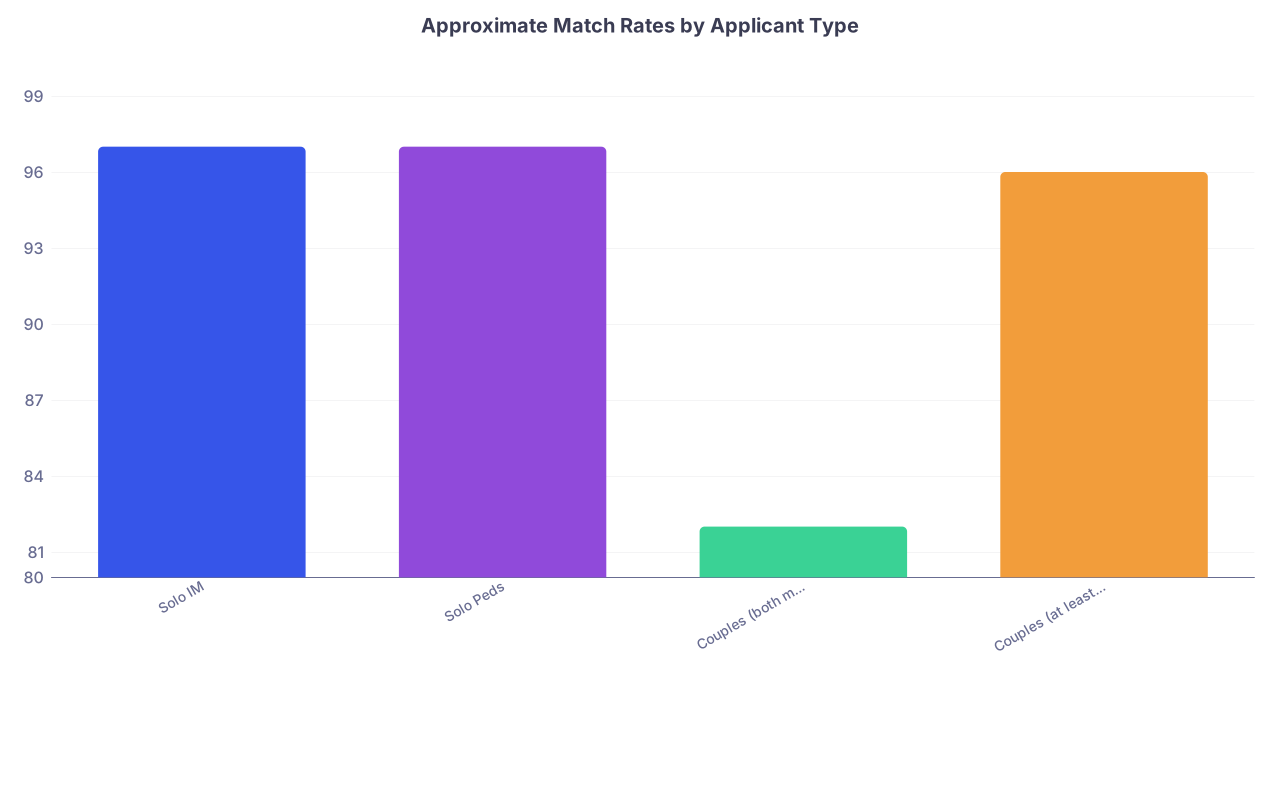
| Category | Value |
|---|---|
| Solo IM | 97 |
| Solo Peds | 97 |
| Couples (both match) | 82 |
| Couples (at least one) | 96 |
These are coarse but directionally accurate U.S. MD senior numbers:
- Solo IM and Peds: ~97% match rate.
- Couples, both match: ~82%.
- Couples, at least one matches: ~96%.
So if:
- A is in a moderate competitiveness specialty with limited geographic spread (radiation oncology, ENT, etc.), and
- B is in a broad specialty (FM, IM, psych),
there is a strong statistical argument that the more constrained specialty should be the anchor in the formal couple (if you choose to couple at all), with the broad specialty partner remaining solo and aggressively targeting overlapping metros.
When only one partners couples and the other does not, and the less constrained specialty is the solo one, that actually reduces overall risk. The system can “slide” the broad specialty applicant around to land near, but not perfectly aligned with, the paired couple.
5. Do not assume programs will “take you as a package” informally
I keep seeing the same anecdote:
- “We told the PDs we were partners, so surely they will coordinate.”
Sometimes they do. Many times they do not. And the algorithm does not see those informal deals unless:
- Programs intentionally adjust their rank lists to place both individuals high in compatible positions.
Even then, the NRMP has many other applicants to place. Your informal arrangement competes with dozens of other constraints.
If only one partner couples matches, you should treat any informal coordination for the solo partner as bonus, not as a primary plan.
Visualizing the interaction over time
The sequence of decisions actually matters more than people think.

| Step | Description |
|---|---|
| Step 1 | ERAS Submitted |
| Step 2 | Interview Offers |
| Step 3 | Build Paired Rank List |
| Step 4 | Build Solo Lists |
| Step 5 | Inform Solo Partner & Programs |
| Step 6 | Submit Rank Lists |
| Step 7 | NRMP Algorithm Runs |
| Step 8 | Match Results |
| Step 9 | Plan Joint Transition |
| Step 10 | Reassess Long-distance, Transfers |
| Step 11 | Decide Formal Couple? |
| Step 12 | Geographic Alignment? |
Once you submit rank lists, all of your flexibility disappears into that algorithm. There is no post‑hoc optimization. So the heavy lifting—how you structure paired vs solo lists, which cities you overweight, which compromises you are willing to make—has to be done while you still have control.
FAQs
1. Does couples matching with someone else hurt my solo partner’s chances?
Not directly. The data show that the algorithm treats your solo partner like any other individual applicant. Their match rate is determined by their specialty, profile, and rank list, not by your choice to couples match with someone else. The indirect risk is geographic: your formal couple may be pushed into a city your solo partner did not sufficiently rank or was not competitive for.
2. If one of us couples matches and the other applies solo, is it easier or harder to end up in the same city?
On average, harder than if you both were in a formal couples match with each other and built a coherent paired list. When only one partner couples matches, the algorithm guarantees co-location only within the formal couple. The solo partner’s co-location depends entirely on independent program choices and how aggressively they rank overlapping cities.
3. Should we all just apply solo and not use the couples match at all?
Sometimes yes. If both of you (or all involved) are in broad specialties with high match rates and you have wide geographic flexibility, applying solo and tightly coordinating your rank lists by city can produce excellent alignment without incurring the couples penalty. But if one partner is in a very competitive or geographically sparse specialty, a formal couples match can provide more control over not ending up on completely different sides of the country.
4. Can we “game” the system by telling programs we are partners even if only one of us is couples matching?
You can inform programs, and some will try to accommodate you, particularly in smaller markets or less saturated specialties. But you are not gaming the algorithm; you are relying on program directors to manually move you on their rank lists. Sometimes this helps. Often nothing changes. Statistically, you should treat it as a secondary tactic, not your core strategy.
5. What is the biggest mistake people make when only one partner couples matches?
They build rank lists as if the match will “figure out” their relationship for them. The biggest error is failing to map out concrete overlapping cities, failing to quantify backup scenarios, and assuming that “we told them we are partners” is equivalent to structural linkage in the algorithm. It is not. If you do not explicitly shape all rank lists—paired and solo—around realistic joint outcomes, the algorithm will happily send you wherever you individually fit best, together or not.
Two key takeaways. The algorithm only respects formal couples, not informal relationships, so a solo partner is always optimized independently. And if one partner couples matches while another does not, you are managing a probability problem, not a romantic narrative—run the numbers on cities, specialties, and rank positions, then decide if your current configuration truly maximizes the outcomes you care about most.


