

The standard Couples Match advice falls apart the moment you add a school‑age kid.
Most people giving you advice are talking like you’re two flexible 20‑somethings who can happily move to “wherever is best for training.” That’s not your life. Your life is: bus stop times, IEP meetings, aftercare waitlists, and a Match algorithm that does not care if your 8‑year‑old just settled into a good therapy routine.
So let’s talk about how to handle Couples Match when you’re both physicians and you already have a child (or children) in school.
You’re not just matching two careers. You’re matching four things at once:
Two residencies + one school system + one family life that doesn’t implode.
Here’s how to actually do that.
Step 1: Decide What Matters More: Geography, School Stability, or Training Quality
You cannot optimize everything. If you try, you’ll build a rank list that looks impressive and feels safe but collapses once real priorities show up.
You have to decide your hierarchy. Not in theory. On paper.
For dual-physician parents with kids in school, I see three common “center of gravity” models:
Training-first families:
You prioritize the best possible programs / fellowships, and accept more disruption for the kids (moves, school changes, smaller support network).Geography-first families:
You tightly limit where you’ll live so your kid can stay in a solid school system and you can build real community support. You accept that one or both of you may land at mid-tier programs.Stability-first families:
You prioritize predictable schedules, commute lengths, and childcare feasibility over prestige or even location glamour. Think “I’ll take a strong but less ‘fancy’ IM program 10 minutes from home over the ‘top’ name 50 minutes away.”
You need to say out loud, together, which one you are.
Write a one-sentence rule you can check every decision against, like:
- “We will not move our 5th grader again after this move unless absolutely forced.”
- “One of us can compromise more on program prestige; we won’t both compromise.”
- “We’ll choose the metro area first, then sort programs within it.”
If you skip this step, every choice will feel like a fresh emotional battle.
Step 2: Draw Your Realistic Geography Box (Not the Fantasy One)
The geography list you’d make as a single, child‑free applicant is not the one you should use now.
You need a real geography box defined by:
- Where you have childcare backup (if anywhere).
- Where public schools are at least acceptable (or private is financially realistic).
- Where cost of living won’t make two residents with a kid completely miserable.
- Where both specialties actually have enough programs to give you a shot as a couple.
| Filter Type | Examples |
|---|---|
| Family support | Within 1 hour of grandparents |
| School quality | GreatSchools ≥ 6, stable funding |
| Program density | ≥ 3 programs per specialty nearby |
| Cost of living | Rent ≤ 40% of combined income |
Now actually cut. Hard.
If you’re both doing less-common specialties, you may have to pick 1–3 metro areas that are dense in programs (think: Boston, NYC, Chicago, Philly, Houston, Dallas, LA, SF Bay, etc.) and accept you’re not ranking 10 different states.
If one of you is in a high-density specialty (IM, Peds, FM) and the other is more niche (Derm, ENT, Ortho, Rad Onc), the niche partner dictates geography — but the core specialty partner dictates program viability within that geography.
You’re looking for overlap between:
- Enough programs for BOTH of you
- Livable cost with a child
- Decent schools
- Some kind of backup support, even if just friends
If you end up with 2–3 metro areas that make sense? Good. Depth in a few places beats scattering applications across 15 random cities your kid will never adjust to.
Step 3: Timing Reality Check – When Your Kid Will Be Changing Schools
You’re not just matching for July 1. You’re matching for the next 3–7 years of your child’s life.
Match → Move → Start residency → School transitions. These will collide.
Let’s lay out the typical path:
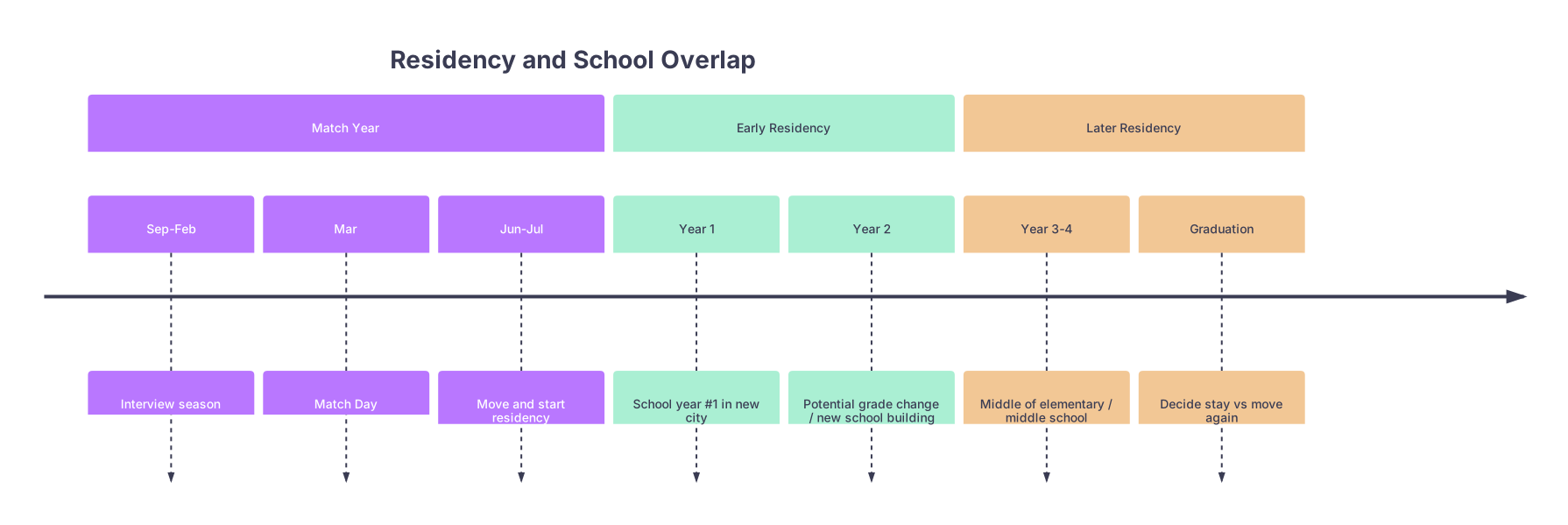
| Period | Event |
|---|---|
| Match Year - Sep-Feb | Interview season |
| Match Year - Mar | Match Day |
| Match Year - Jun-Jul | Move and start residency |
| Early Residency - Year 1 | School year #1 in new city |
| Early Residency - Year 2 | Potential grade change / new school building |
| Later Residency - Year 3-4 | Middle of elementary / middle school |
| Later Residency - Graduation | Decide stay vs move again |
Key questions:
Is your child about to start kindergarten, middle school, or high school right as you match?
Those are pivot points. If you can align a move with a natural school transition, the disruption lands softer.Are you planning fellowship after residency?
That probably means another move in 3–4 years. Sometimes the smarter long‑term play is:
“Let’s pick a big metro with good schools and broad fellowship options so we don’t move again.”
If you don’t want two giant moves during school years, consider:
- Large academic centers where both residency and fellowship can happen in the same city.
- Metro areas with multiple hospital systems so at least one of you can stay put for the second stage.
Step 4: Build a Childcare and Commute Plan Before You Rank Anything
Most couples screw this up. They assume they’ll “figure it out” once they match. With a kid, that’s how you end up with 4 a.m. wakeups, terrified neighbors doing emergency daycare, and one partner quietly resenting the other’s “better” program.
Before ranking, for each serious city/region on your list, answer:
Childcare coverage:
- School hours vs clinic hours vs call expectations.
- Aftercare availability at local schools (and waitlists).
- Backup plan for snow days, illness, and call nights.
Commutes:
Both of you. In rush hour. In bad weather.
If you pick a house 5 minutes from one program and 55 from the other, you’re choosing whose life is harder. Own that.Call structure:
- Q4 in-house with no night float + small child = pain.
- Night float with predictable blocks might actually be easier to build childcare around than random 28-hour calls.
Do a rough weekly model:
- School: 8:30–3:00
- Aftercare: until 5:30 or 6:00
- You: leave house at 6:15, home 6–7 some days, later on call
- Partner: similar or slightly better/worse
You’re looking for obvious red flags where:
- Neither of you is free for pickup consistently.
- Aftercare doesn’t exist or is full.
- Every viable rental is 40–60 minutes from both hospitals.
If a city fails this test, it doesn’t matter how shiny the programs are. Drop it or demote it.
Step 5: Strategy for Interview Season with a Kid in School
Couples Match interviews are already chaos. Adding a kid multiplies the moving parts.
You need a plan for:
Childcare during travel:
Decide early: will you stagger interviews, use grandparents, trusted sitter, or one parent stays home more and accepts fewer interviews?Grouping interviews geographically:
Try to pair your interviews in the same city/week. Hard, but not impossible if you’re proactive about scheduling.
When you email to request alternate dates, mention you’re Couples Matching and both in medicine. Some coordinators will genuinely try to help.School absences and logistics:
If your child is younger, you can often move them to grandparents for 1–2 weeks during peak interview chaos.
If older, keep them in school and rotate who travels vs. who stays home.
Here’s the balance:
The partner in the more competitive specialty may need to travel more. The other may deliberately keep a slightly “safer” list and fewer interviews to maintain child stability. That’s not weakness. That’s strategy.
Step 6: Talking to Programs About Being Dual-Physician Parents
This part makes people nervous. They think saying “we have a kid” will tank them. In most programs, that’s outdated paranoia.
Here’s how to handle it:
You do NOT lead with: “We need special accommodations because we have a child.”
You DO say things like:
- “We’re Couples Matching and have a school-age child, so we’re really prioritizing programs in X region where we can settle for multiple years.”
- “One of the reasons I like this program is the strong, predictable didactic schedule; that matters a lot for my family.”
- “Can you tell me about residents with kids here? What do they typically do for childcare?”
You’re signaling three things:
- You’re serious about the region (programs love this).
- You’re not expecting them to bend the universe.
- You understand what residency with a kid actually looks like.
Occasionally, PDs will go out of their way to coordinate with your partner’s program, especially in the same hospital system. They cannot guarantee both of you match there. But I’ve seen them quietly help move your file higher if they want you and see a chance for a “package deal.”
You can be honest, but strategic. No complaining. No “will I be able to leave early for pickup every day?” Residency is still residency.
Step 7: Building a Rank List that Protects Your Kid and Your Marriage
This is where families blow themselves up. They rank “dream-dream” combinations high, then sprinkle disaster combinations in the middle because “statistically unlikely.” And then they land one.
You need rules for “we will not do this to ourselves.”
First, understand how the Couples Match works:
You rank combinations (Partner A Program 1 + Partner B Program 1, etc.), and the algorithm looks for the highest combination where both can match.
So you must agree:
- What combinations you’d rather go unmatched than accept.
- Who’s allowed to match alone (if at all) and in what scenarios.
For dual-physician parents with kids in school, I usually recommend:
Very few (or zero) long-distance combinations.
If you’re going to do long-distance, set HARD constraints (e.g., max 1–2 hours driving, only for one year like a prelim).Group combinations by city/region first, then by program strength.
Example:
All “Boston + Boston-area” combos above any “Boston + random city 4 hours away” combos.Decide a “floor” for program quality and support for each of you.
There’s a point where being together in a very toxic or unsafe program is worse for your family than being apart for a year.
Quick Example of Thoughtful Couples Rank Logic
Let’s say:
- Partner A: Pediatrics
- Partner B: Internal Medicine
- Child: entering 2nd grade
You’ve picked two main cities: City X (near grandparents, strong schools), City Y (big academic center, slightly weaker schools, no family nearby).
Your top combinations might look like:
- A: Peds Program 1 (City X) + B: IM Program 1 (City X)
- A: Peds Program 2 (City X) + B: IM Program 1 (City X)
- A: Peds Program 1 (City X) + B: IM Program 2 (City X)
- A: Peds Program 3 (City X) + B: IM Program 1 (City X)
- A: Peds Program 1 (City Y) + B: IM Program 1 (City Y)
- A: Peds Program 2 (City Y) + B: IM Program 1 (City Y)
…and so on.
Only after you’ve exhausted the “same city, reasonable commute, livable schools” combos do you even consider:
- Nearby satellite combinations
- Prelim one place + advanced another, if absolutely necessary
Bad idea: randomly putting in “A: Peds City X + B: IM City Z (6 hours away)” because “it’s unlikely but you never know.” If you’d hate living that reality, don’t rank it.
Step 8: Money, Housing, and School Applications – Get Boring and Specific
This is where your future sanity lives.
Residency pay x2 sounds decent until you add:
- Childcare (aftercare + summer camps or nanny)
- Rent in a “good school” zone
- Loans
- Transport for three people, possibly two cars
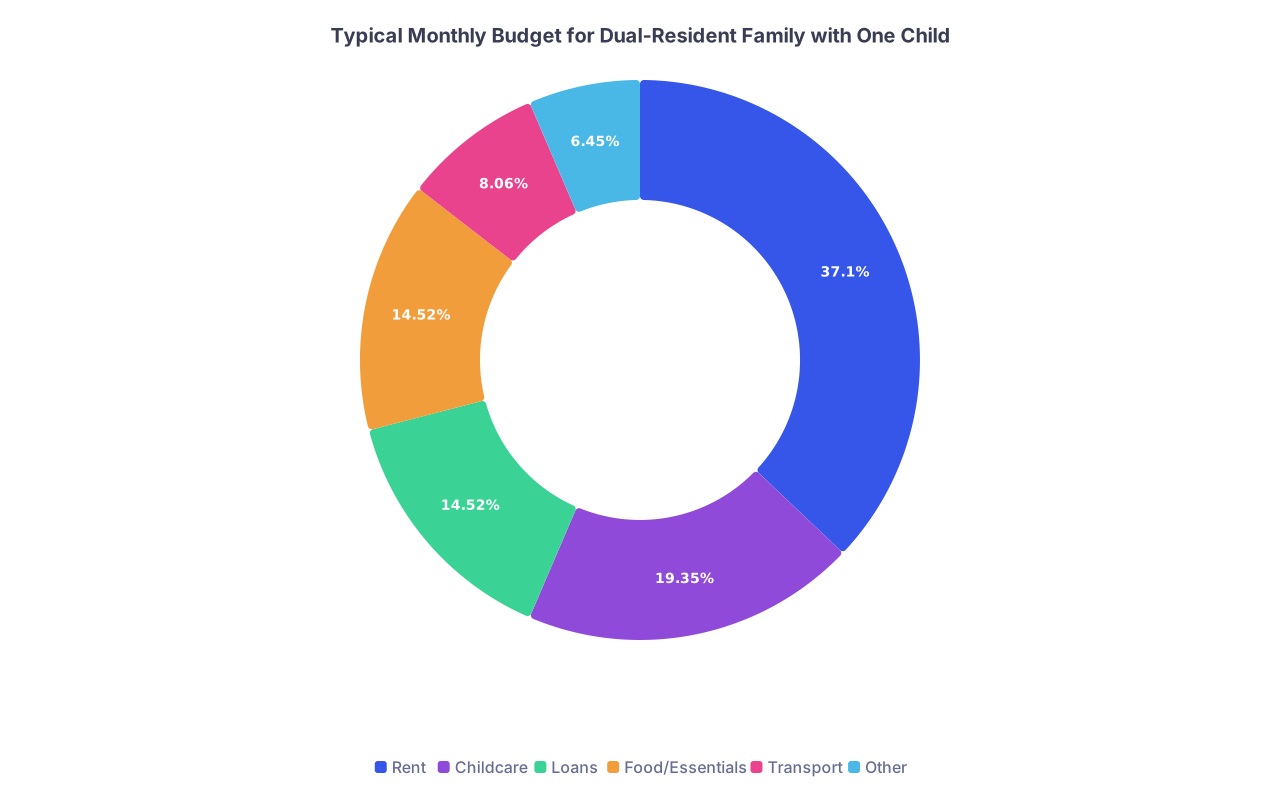
| Category | Value |
|---|---|
| Rent | 2300 |
| Childcare | 1200 |
| Loans | 900 |
| Food/Essentials | 900 |
| Transport | 500 |
| Other | 400 |
Run numbers before you romanticize big coastal cities. Some combinations that look exciting professionally will absolutely crush you financially as a family.
Also:
- Check school district enrollment dates and rules for every serious city. Some require proof of residency months in advance, others allow mid-year enrollment more easily.
- Look up aftercare and bus route realities. If aftercare is lottery-based, assume you won’t get in and have a backup.
You’re not just matching into a hospital. You’re matching into:
- A school district
- A zoning map
- A commute pattern
- A childcare ecosystem
Do the unsexy homework now so you’re not panic-Googling “emergency after-school care” post-Match.
Step 9: Emotional Boundaries – Protect Your Kid from the Match Rollercoaster
One more layer no one talks about: how much you tell your child.
You don’t want to load your kid with adult uncertainty for 12–18 months. But you also don’t want Match Day to be a total shock.
My rule of thumb:
- During application/interview season: keep it vague — “Mom and Dad are looking at jobs in different cities; we’ll know more in the spring.”
- Around rank list time: gently introduce the idea of the main city options you’re seriously considering.
- After Match: be clear, concrete, and positive about where you’re going, while giving space for sadness about leaving friends.
You and your partner also need ground rules for how much anxiety about Match you’re going to perform in front of your child. You’re scared; that’s real. But your 7-year-old doesn’t need to hear your “what if we don’t match together” debate.
Have those conversations in the car, on walks, or after bedtime.
Step 10: Contingency Planning if the Match Goes Sideways
You need a “break glass” plan:
- What if one of you matches and the other doesn’t?
- What if you both match but in different cities?
- What if you both match in the same city but one program is clearly terrible by November PGY1?
Write down:
- Who’s more willing to scramble into SOAP for a less ideal program to preserve geography.
- Whether you’d do long-distance with kid staying primarily with one parent vs split custody vs move later.
- Whether one of you would consider a research year or prelim year to align to the next cycle.
You hope you never use this. But talking it through now prevents nuclear fights later.
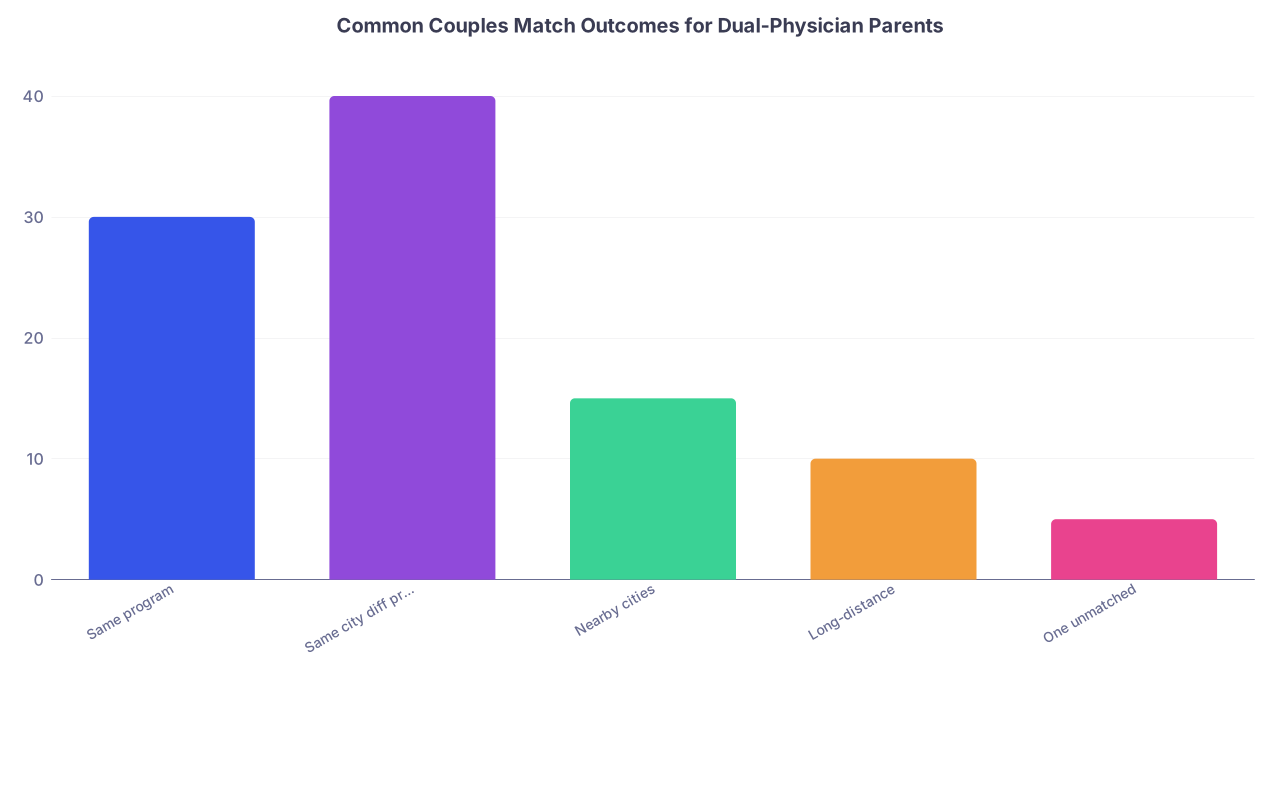
| Category | Value |
|---|---|
| Same program | 30 |
| Same city diff programs | 40 |
| Nearby cities | 15 |
| Long-distance | 10 |
| One unmatched | 5 |
(The numbers above are illustrative, but the point stands: there are multiple ways this can land. Don’t only plan for the perfect one.)
FAQ (Exactly 5 Questions)
1. Should we avoid applying to highly competitive programs because we have a child and need stability?
No, you should not automatically downshift your entire career because you’re a parent. What you should do is be strategic. If one of you is in a very competitive specialty, let that person aim high while the other intentionally builds a broad, safety-heavy list in the same regions. The mistake is when both of you go all‑in on top‑tier, geographically scattered programs and then act surprised when there’s no overlap that works for a family.
2. Is it a good idea to live halfway between our two programs to “split the commute”?
Sometimes. But often this looks good on paper and is brutal in practice. With a kid, you want at least one parent with a short, predictable commute. Someone needs to be able to make a school call, a pickup, a quick sick visit. It’s usually better for one partner to have a 10–15 minute commute and the other to take the longer one, especially if the short‑commute partner has more ICU/call time. Decide that consciously rather than defaulting to “fairness.”
3. How much should “school quality” really matter during residency if it’s only 3–4 years?
For kindergarten or early elementary, school quality matters a bit less academically and more for basic safety, support, and services (speech, OT, special ed if needed). For older kids, yes, school quality starts to matter more. But I’ve watched people obsess over GreatSchools ratings and then get destroyed by childcare logistics and call schedules. Decent, stable, non-chaotic school + survivable daily life usually beats chasing the “best” district while you’re never home.
4. Do programs view having kids as a negative in the Match?
Some individual attendings still carry old‑school bias, but as a whole, no — not in any consistent, systematic way. Many PDs actually respect residents who clearly care about their families and have thought about logistics. The red flag is not “I have a child.” The red flag is “I clearly have no idea how hard residency is going to be and I’m asking for special exceptions before I’ve even started.” Present yourself as a grown adult who has planned ahead. That plays well almost everywhere.
5. Is it ever reasonable for one of us not to Couples Match to protect our child’s stability?
Yes. That’s a legitimate choice, not a failure. For some pairs — especially when one partner has a very niche specialty with few spots — it makes more sense for the competitive partner to apply normally and the other to target the same region independently or one year offset. You lose the algorithm’s built‑in coupling, but you gain flexibility and avoid being dragged into unsafe or miserable combinations. If the Couples Match constraints are forcing you toward options you’d never accept as a parent, that’s a sign you should consider decoupling the process.
Key points to leave with:
- You are not just matching two people, you’re matching an entire ecosystem: kid, schools, childcare, commutes, money, marriage. Rank lists that ignore that reality are dangerous.
- Decide your hierarchy — geography, stability, or training — and build everything (applications, interviews, rank list) ruthlessly around it.
- Do the boring homework now: school districts, aftercare, commutes, budgets. That’s what will actually determine whether your family survives residency, not the line on your CV.


