

When One Partner Is in a Categorical Spot and the Other Needs a Prelim Year
What do you actually do when one of you already has a categorical spot lined up… and the other is staring down the barrel of a prelim-only year and a second Match?
This is one of those situations people don’t talk about enough. I’ve watched couples silently melt down over exactly this: one person feels “set,” the other feels like the disposable appendage rotating through random hospitals. On top of that, you’re trying to keep a relationship intact, plan a life, and not end up living three hours apart.
Let’s walk through how to handle it without blowing up your relationship or your careers.
Step 1: Get Real About Your Actual Constraints
Before you start talking programs and rank lists, you need to be brutally clear about what’s non-negotiable and what’s preference.
At minimum, answer these honestly together:
- Is living together in the same city a hard requirement or a “strongly prefer”?
- How far apart (in minutes/hours) is actually acceptable if you do not match in the same city?
- Is one partner’s specialty realistically more geographically flexible than the other?
- How much financial cushion do you have if one of you ends up in a more expensive city alone?
- Are there family or visa issues that limit locations?
Do this first, not after you fall in love with specific programs.
Here’s the reality: when one of you is applying categorical (say, Psych, FM, IM, Peds, Neuro) and the other is applying prelim (Surg prelim, TY, prelim IM), your leverage is asymmetric. The categorical partner usually has:
- More stable multi‑year training plan
- Clearer institutional “home”
- Often more interview invites / geographic options
The prelim partner is often:
- Considered “one and done” by programs
- Less of a priority in the rank list
- Planning a second Match in a year or two
So the question becomes: whose geography drives the bus?
Most of the time, the smart move is: the categorical spot sets the anchor city, and the prelim partner maximizes options around that anchor.
But that’s not always what couples actually do. I’ve seen people sacrifice a great categorical fit to chase “easier” prelim options, then regret it when PGY‑2+ spots are a nightmare to find. Do not casually throw away a great categorical training situation unless you both fully understand the cost.
Step 2: Understand the Prelim Landscape in Your Anchor Area
If you already know the likely categorical city (or a small region), the prelim partner needs to map out the prelim ecosystem there. This should be done before rank list submission, ideally before even finalizing your application list.
You’re looking for:
- How many prelim IM / TY / prelim surgery spots are in that city/region?
- Are they all linked to the same big academic center, or spread across multiple community programs?
- What’s their historical fill rate and reputation? (Ask upperclassmen, look at NRMP data, talk to recent grads.)
- Are there programs known to frequently “feed” PGY‑2 spots to their prelims?
Here’s a simple comparison layout you should basically have in your notes:
| Program | Type | Distance | Notes |
|---|---|---|---|
| University Hospital | Prelim IM | Same site | Heavy workload, decent name |
| City Community Hospital | TY | 20 min | Lighter schedule, weaker name |
| County Medical Center | Prelim IM | 35 min | Rough hours, lots of autonomy |
| Suburban Med Center | TY | 45 min | Very cush, limited ICU exposure |
This is the stuff that actually matters:
- Commute tolerance (20–30 min vs 60+)
- Call/schedule brutality (especially for surgery prelims)
- Will you be treated like disposable labor vs a human they might want to keep?
Do not just blindly “rank all prelims in the same city first.” Some of them are meat grinders with zero pipeline to PGY‑2 positions. I’ve watched prelims at those programs desperately cold-email 200+ PDs in December of their prelim year because their own institution had no interest in promoting them.
Step 3: Strategy for the Categorical Partner
If you’re the partner applying categorical, you have to carry more of the strategic weight here. That’s just reality.
Here’s what you do:
Apply broadly in clusters, not randomly.
Example: instead of 1 program in Boston, 1 in NYC, 1 in Chicago, 1 in Denver, consider 4–6 in one metro (or nearby) where prelim options are dense. That increases the odds of both of you landing in the same region.Be honest with programs (selectively) about your situation.
In interviews or communication, you can say:
“My partner is applying for a preliminary year in [field]. We’re hoping to be in the same area. Are there affiliated prelim programs you tend to coordinate with?”I’ve seen PDs explicitly say, “We can’t promise anything, but we often take couples and help them find nearby prelim spots.”
Rank realistically, not just aspirationally.
Yes, that shiny “Top 5” program three time zones away looks great. But if your partner has almost no prelim options anywhere near it, you’re building a long-distance year (or longer) into your relationship by design.Sometimes you choose the slightly “lower-tier” but still strong program in a big metro area where your partner has 5+ prelim options over the elite place in a prelim desert.
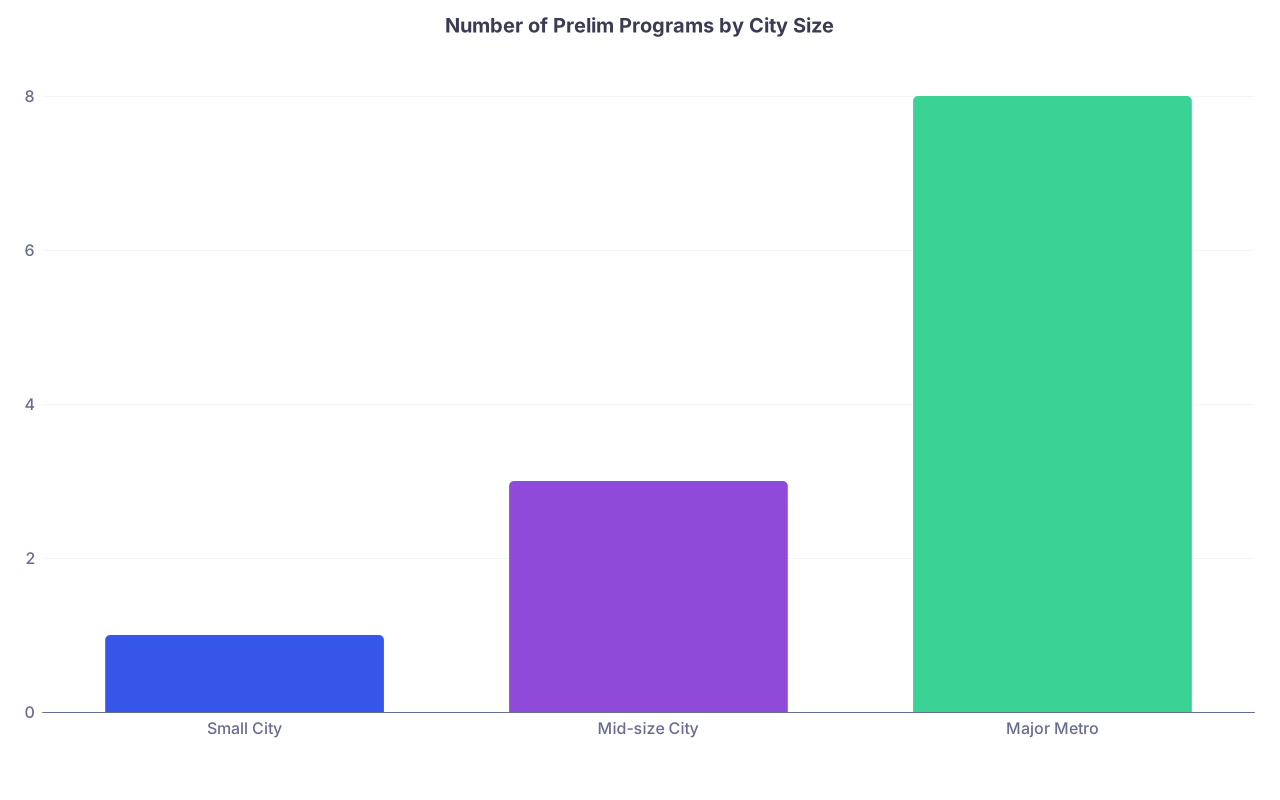
| Category | Value |
|---|---|
| Small City | 1 |
| Mid-size City | 3 |
| Major Metro | 8 |
That’s why big metros often win for couples in this situation.
Step 4: Strategy for the Prelim Partner
This is where people mess up. A lot.
If you’re the prelim partner, your job is not just to “get any prelim.” Your job is to:
- Stay geographically as close as possible to your partner’s categorical program.
- Maximize your chances of landing a PGY‑2+ spot in your desired specialty.
- Not burn yourself out so hard you cannot function in year two.
Here’s what that looks like in practice:
Build three tiers of prelim options
Tier 1: Same institution as partner’s categorical program
Best-case scenario. Same hospital, overlapping colleagues, easier shared life. This can be particularly nice if:
- You’re doing prelim IM and your partner is categorical IM or subspecialty at the same place.
- You’re a surgery prelim and your partner is categorical at the same center; sometimes they internally promote prelims.
Tier 2: Same city / metro, different institution
Very solid. Commute is annoying but doable, call schedules differ, but you at least live together.
Tier 3: Same region (within 1–2 hours), strong training, decent shot at PGY‑2
This is the “break glass if necessary” option. Think: you live halfway or one of you commutes more; you see each other on golden weekends and post‑call. Not ideal, but survivable for one year.
Do not build a rank list that’s all Tier 3 and below unless you literally have no other option.
Ask programs direct, un-fluffy questions
During interviews, you ask:
- “How many of your prelims in the last 3 years secured PGY‑2+ positions in [specialty]?”
- “Do your prelims usually find PGY‑2 roles within this institution, or elsewhere?”
- “Are there any unfilled categorical or PGY‑2 spots historically that prelims have stepped into?”
- “Do you support prelims with letters, timing off for interviews, and guidance during their search?”
If they dodge or give vague answers, that’s a red flag. Good prelim programs brag about where their prelims end up.
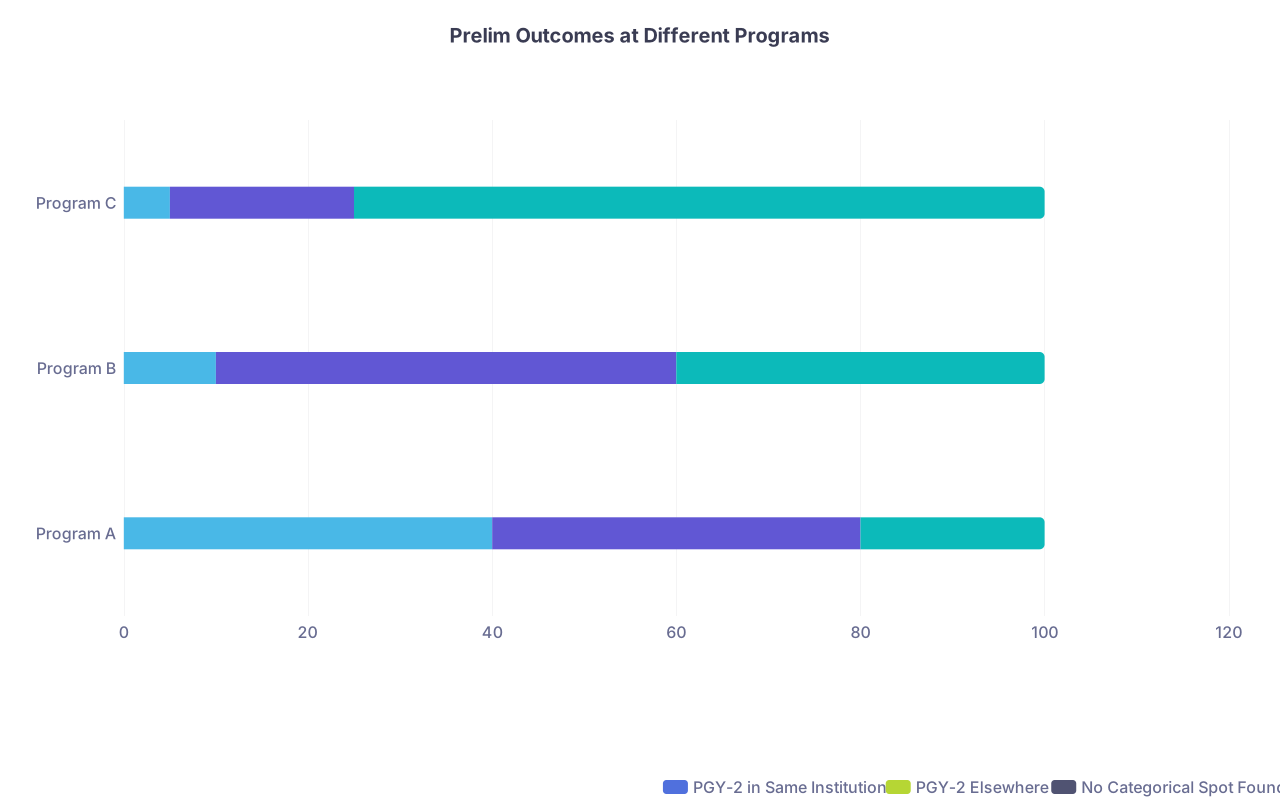
| Category | PGY-2 in Same Institution | PGY-2 Elsewhere | No Categorical Spot Found |
|---|---|---|---|
| Program A | 40 | 40 | 20 |
| Program B | 10 | 50 | 40 |
| Program C | 5 | 20 | 75 |
You’re aiming for something like Program A or B. Program C is where prelim dreams go to die.
Step 5: How to Actually Couples Match This Combo
If you’re officially Couples Matching (which you should), the mechanics get more complicated but also more controllable.
Classic setup:
- Partner A: Categorical program lists (e.g., IM categorical, Psych categorical).
- Partner B: Prelim lists (TY, prelim IM, prelim surg).
You’ll create combinations like:
A: University Hospital IM categorical
B: University Hospital prelim IMA: University Hospital IM categorical
B: City Community TYA: University Hospital IM categorical
B: County prelim IMA: City Med Center IM categorical
B: City Med Center prelim IM
And so on.
Key principle: You’re ranking pairs, not single programs. That forces you to explicitly answer: “Would we rather be at X vs Y as a couple?”
Some specific scenarios to think through:
- Put your ideal same‑hospital pairings at the top.
- Next, list same‑city / metro pairings.
- Then, “same region but different city, still acceptable.”
- Only after that do you list combinations that put you far apart (if at all).
This is where some couples screw themselves: they rank a coveted categorical alone at the very top, paired with weak prelim options far away, and then are surprised by a year of forced long-distance.
If being together matters, your list has to reflect that. Not just your wishes.
Step 6: Planning for the Second Match (Prelim → Categorical)
You cannot treat the prelim year as “just survive and worry about PGY‑2 later.” That’s how people end up unmatched twice.
Assume the following timeline:
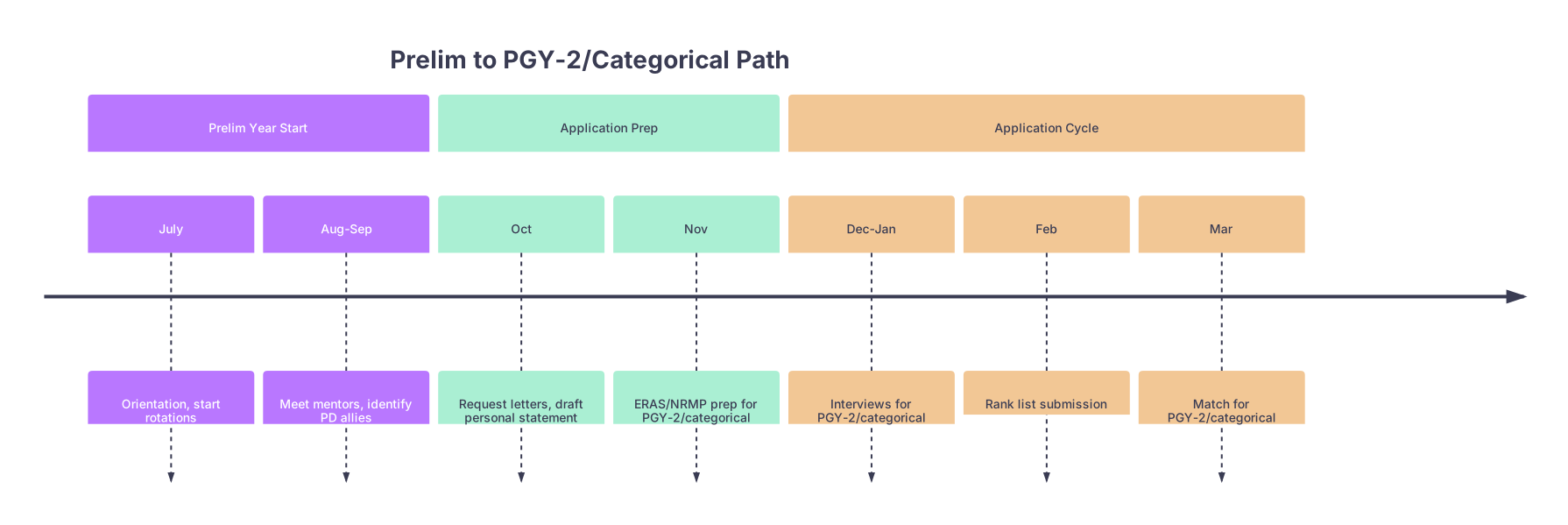
| Period | Event |
|---|---|
| Prelim Year Start - July | Orientation, start rotations |
| Prelim Year Start - Aug-Sep | Meet mentors, identify PD allies |
| Application Prep - Oct | Request letters, draft personal statement |
| Application Prep - Nov | ERAS/NRMP prep for PGY-2/categorical |
| Application Cycle - Dec-Jan | Interviews for PGY-2/categorical |
| Application Cycle - Feb | Rank list submission |
| Application Cycle - Mar | Match for PGY-2/categorical |
So by October of your prelim year, you’re moving on letters and applications. That means:
- You need attendings early who actually know you and will advocate.
- You must keep your record clean—no professionalism issues, minimal unexplained absences.
- You can’t completely tank your mental and physical health to the point you’re barely functioning.
On top of that, you’re trying to stay aligned with your partner’s program city for PGY‑2.
That’s why you pick prelims in institutions or regions that:
- Have your specialty and routinely take their own prelims or
- Are close to other centers with frequent PGY‑2 openings
Ask early in the year: “Do you anticipate any upcoming PGY‑2 or off-cycle positions in [specialty]?” Good PDs will at least be honest.
Step 7: Relationship Reality Check
Someone always says this part out loud on call at 2 a.m.: “Is this even worth it?”
Here’s the hard truth. This setup will strain you:
- Misaligned schedules mean missed evenings, offset days off.
- One of you may feel “behind” career-wise and resent it.
- The partner in the cushier schedule can feel guilty; the other can feel abandoned.
So you plan for that. Not in a fluffy “we’ll communicate!” way, but concretely.
Things I’ve seen work for couples in this exact situation:
Protected time rule.
For example: “We will reserve one evening every 2 weeks where we both do zero extra work if humanly possible. Phone off. No moonlighting. Just us.” Sounds small. It’s huge.Commuter fairness.
If one of you has a 45‑minute drive to the periferal prelim hospital while the other walks to work, you acknowledge that imbalance and offer compensations—picking up more home admin, chores, or carpooling.No unannounced major career decisions.
The prelim partner should not suddenly decide to switch specialties without a serious joint conversation. Same for the categorical partner casually deciding to do a fellowship three states away when the other is about to reapply.
You’re both under pressure. Assume lower emotional bandwidth and be explicit about expectations.
Step 8: If the Match Goes “Wrong” Anyway
Sometimes you do everything right and still:
- Categorical partner matches in City A
- Prelim partner matches in City B
- Commute between them is 2–3 hours or requires a flight
It happens. So what then?
First: do not immediately blow up the plan. One bad result does not mean “we should both SOAP, scramble, or resign.”
Your options:
Accept 1 year of long-distance and double down on making year 2 aligned.
This is often the least career-damaging option.Explore transfer possibilities early
Once you settle into your prelim, you can send professional, non-desperate emails to PDs in your partner’s city asking about potential PGY‑2 openings or unfilled prelim spots (if you’re willing to switch).Reassess non-essential preferences
Sometimes the categorical partner can switch planned fellowships, research years, or electives to better align timing with you later.
I have seen couples survive far worse than one year apart with clear end dates and honest planning. The couples that fall apart are usually the ones that never actually sat down and said, “What’s our line in the sand? What’s our 1‑year, 3‑year plan?”
Visual: How Your Priorities Might Shift
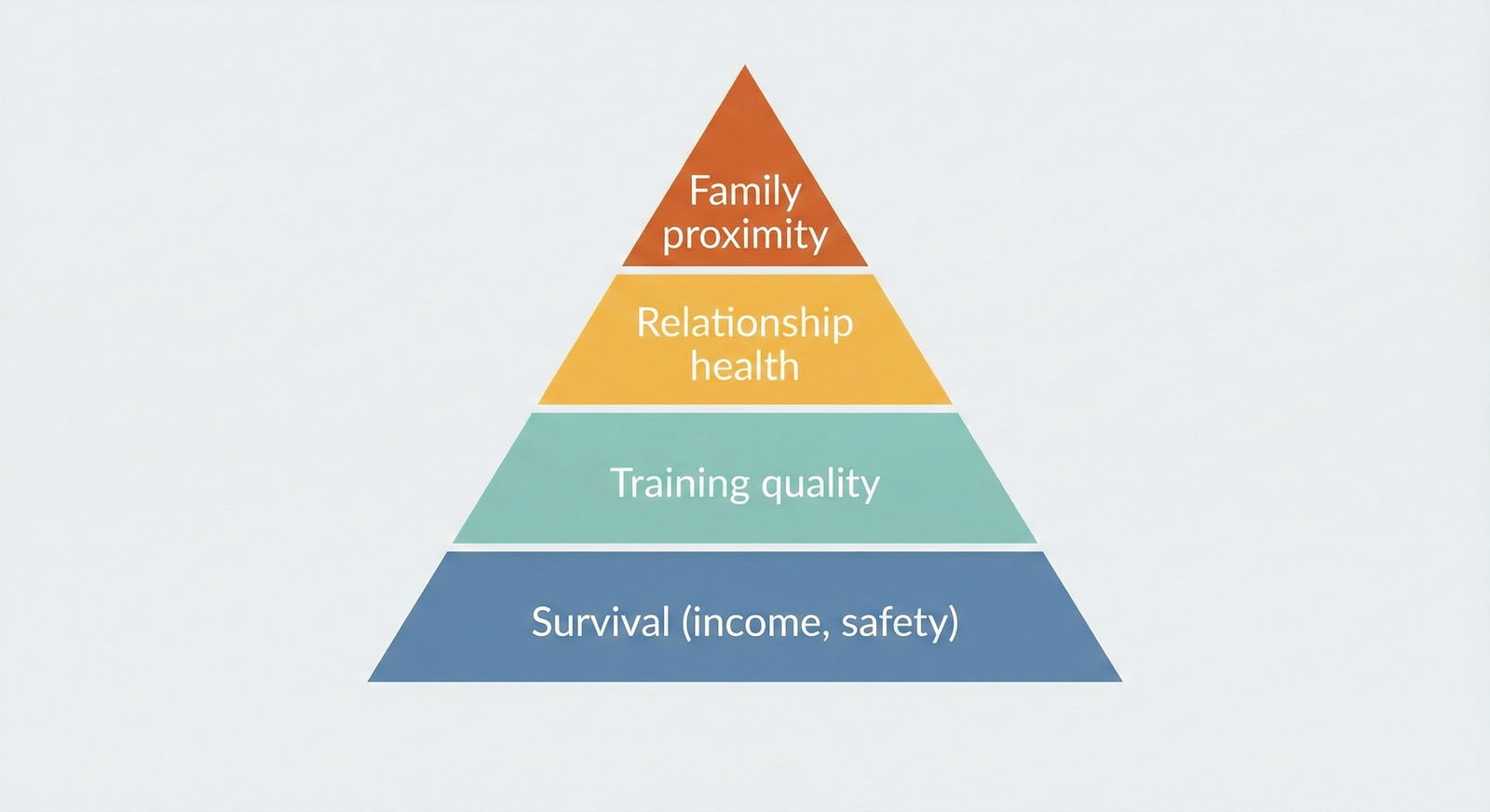
And a quick way to think about tradeoffs of different setups:
| Setup | Togetherness | Career Strength | Stress Level |
|---|---|---|---|
| Same institution | High | High (if good) | Moderate |
| Same city, different institutions | High | High | Moderate-High |
| Same region (1–2 hrs apart) | Medium | Variable | High |
| Different cities/regions | Low | Variable | Very High |
None of these is inherently “wrong,” but you should knowingly choose your pain.
A Few Situations and How I’d Handle Them
Scenario 1: Categorical partner has one dream academic in City X; prelim partner has tons of options in City Y, almost none in X.
If long-distance will wreck you, I’d prioritize a solid (not necessarily “dream”) academic in City Y where you both can land. Better to both be in a good-but-not-elite city together than for one to be at “the best” and the other unsupported and alone.
Scenario 2: Prelim partner is surgery, categorical is IM in medium city with just one brutal surg prelim and no TYs.
I’d strongly consider prelim IM or TY in a neighboring city over a notorious malignant surg prelim that might burn you out before you even apply categorical. You can still gun for categorical surgery later; being alive and functioning matters.
Scenario 3: Categorical partner is locked in (already matched advanced spot), prelim partner is about to apply.
Anchor is set. Prelim partner should:
- Apply to every prelim/TY within reasonable driving radius of that advanced program.
- Email PDs explicitly noting the partner’s existing match.
- Be flexible on prelim specialty (IM vs TY vs surg prelim) if their ultimate specialty allows it.

FAQ (Exactly 3 Questions)
1. Should the categorical partner ever rank a weaker program just to be in the same city as better prelim options?
Sometimes, yes. If the “weaker” program is still solid, and the alternative is a top-tier place with your partner stranded in a prelim desert, I would absolutely consider the slightly lower-tier categorical to preserve both your relationship and your partner’s actual chance at landing a good prelim and subsequent categorical spot. Prestige fades fast when you’re doing a long-distance specialist relationship across time zones.
2. Is it safer for the prelim partner to choose a transitional year (TY) instead of a prelim IM or prelim surgery?
Safer for lifestyle, not always safer for long-term goals. TYs can be great if your ultimate specialty doesn’t require heavy IM or surgery exposure. But if you’re going for something that values strong IM or surgical foundations, a solid prelim IM or surg spot that advocates for its interns may serve you better. The tie-breaker is: where have graduates actually matched for PGY‑2? If the TY has a strong track record in your field, that’s a big plus.
3. Should we still Couples Match if one is categorical and the other is prelim?
Yes. You absolutely should. Couples Match lets you explicitly rank combinations and force the algorithm to consider you as a unit. Without it, you’re at the mercy of random chance and separate algorithms. Just understand: your list-building work is harder. You need to painstakingly pair combinations, think through geography, and be honest about which tradeoffs you’re willing to live with.
Key points to walk away with:
- Let the categorical spot set the anchor city, and build a strategic, not desperate, prelim plan around it.
- Ask blunt questions about prelim outcomes and PGY‑2 pipelines, and plan your second Match starting month 1 of prelim.
- Decide, together and in writing if you have to, how much distance you can tolerate and what you’re willing to sacrifice for being in the same place.


