

When One Partner Is an MS4 and the Other Is an MS3: Are You About to Blow Your Best Shot at Matching Together?
You’re an MS4 applying this year. Your partner is an MS3, applying next year. You want to end up in the same city for residency.
Everyone around you keeps saying, “Just couples match!”
Yeah. Except… you literally cannot. You’re not in the same application cycle.
So what do you actually do?
This is the staggered couples plan: when one of you matches now, and the other has to “chase” the next year. Done well, it works. Done badly, you lock yourself into a city your partner cannot realistically match into, or you pick a program that works for you and quietly wrecks their options.
Let’s go step by step and get tactical.
Step 1: Get Very Clear on Your Constraints (Not Your Dreams)
Before you open ERAS, before you color-code a Google Sheet, you and your partner need a blunt conversation.
Not “where would be fun to live?”
“Where can we both realistically match, given our stats, specialties, and timing?”
You’re not designing your fantasy life. You’re designing two match lists that have to be compatible, one year apart.
Here’s what you sit down and answer together, out loud, with numbers in front of you.
What are both of your specialties?
- Example: You’re applying EM, they’re leaning FM.
- Or: You’re applying Derm, they’re leaning Ortho. Very different problem.
How competitive are each of you on paper?
- Step/Level scores or Pass/Fail plus shelves.
- Clerkship grades patterns (HP/P? Any fails?).
- Research for competitive fields.
- Red flags (LOA, remediation, failed Step).
What geographic realities do you have?
- Ties: family, kids, visas, military obligations.
- Dealbreakers: “I will not live in the Deep South,” or “I must be within 3 hours of my parents for caregiving.”
Who is less flexible?
Sometimes it’s obvious:- Partner on a visa.
- Partner in a hyper-competitive specialty.
- Partner with significant academic red flags. That person’s options dictate the map. Pretending otherwise is how couples get burned.
Now put this into something visual.
| Factor | Partner A (MS4) – EM | Partner B (MS3) – IM |
|---|---|---|
| Exam profile | Avg, no fails | Slightly below avg |
| Specialty compet. | Moderate | Low–moderate |
| Geography | Wants coasts | Must be near family |
| Visa status | US citizen | J-1 |
| Flexibility | Higher | Lower |
Who is driving the bus here? Partner B. Any city Partner A chooses must have realistic IM programs that will consider a J-1 with slightly below-average metrics.
If you’re the MS4 and you ignore this, don’t be surprised when your partner spends an absolutely miserable year applying to 120 programs and gets 2 interviews in your new city.
Step 2: Decide Your Staggered Strategy Type
There are basically three viable staggered-couple strategies. Everything else is a fantasy.
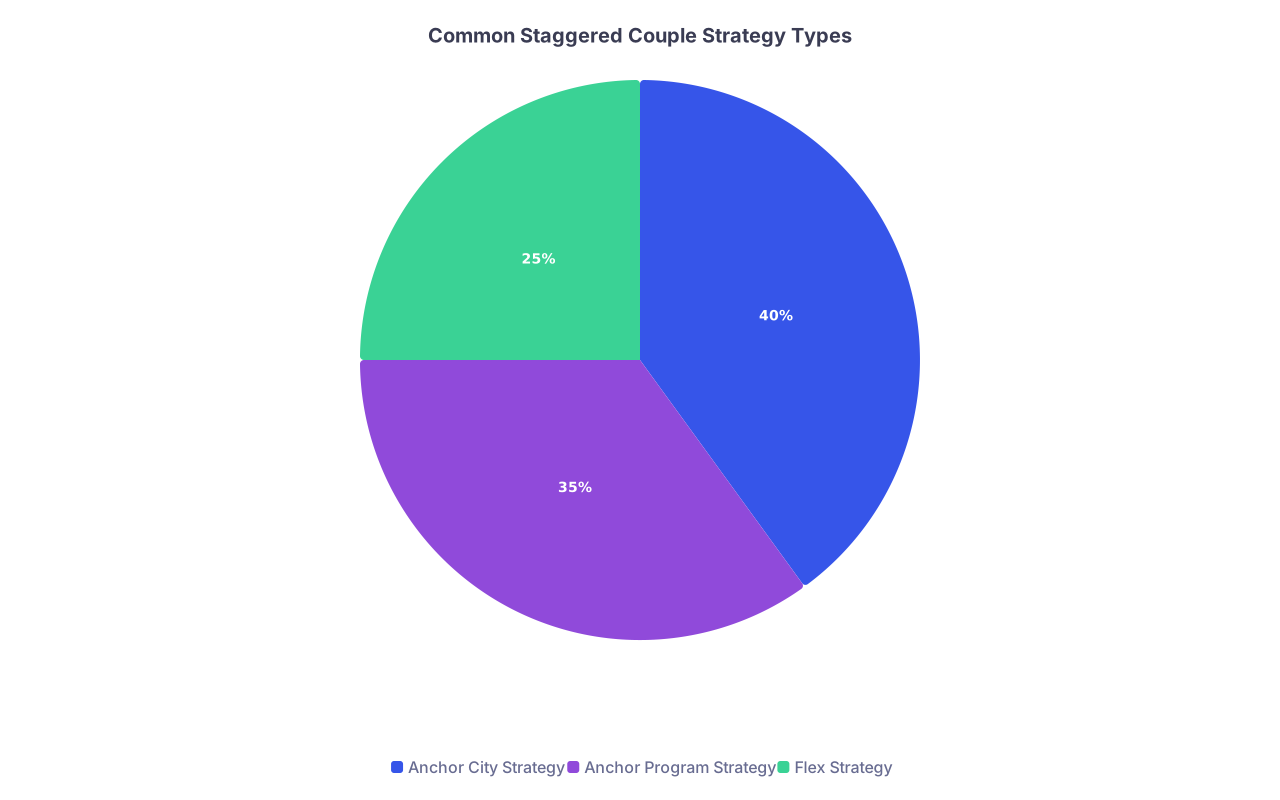
| Category | Value |
|---|---|
| Anchor City Strategy | 40 |
| Anchor Program Strategy | 35 |
| Flex Strategy | 25 |
1. Anchor City Strategy
You (MS4) aim to match anywhere in a short list of cities, not a specific program. Next year, your partner applies broadly to that city and region.
Best when:
- Both specialties are reasonably matchable in many programs (FM, IM, Peds, Psych, EM depending on region).
- Neither of you is targeting ultra-competitive fields at elite academic centers.
- Lifestyle and geography matter more than brand prestige.
How it looks in practice:
- You pick, say, 4–6 anchor metros: e.g., Chicago, St. Louis, Milwaukee, Minneapolis, plus “Midwest anywhere.”
- You as MS4 rank all decent programs in those metros relatively high, even if one is not your absolute “dream name brand.”
- Partner’s application next year is designed with that city list as the core target.
2. Anchor Program Strategy
You, as MS4, aim to match in a large health system or academic center with multiple residency programs and lots of affiliated hospitals. Your partner then targets that exact institution/hospital or close satellites.
Best when:
- One or both of you is in a moderately competitive field.
- You’re okay sacrificing location flexibility for institutional stability.
- Big systems are in play (UTSW, UPMC, Mayo, OHSU, big Kaiser sites, etc).
How this works:
- You prioritize training at big academic centers or large community systems with:
- Multiple residency programs.
- A track record of taking couples, J-1s, or DOs if that applies to you.
- Partner aims at that same system’s program in their specialty next year.
3. Flex Strategy
You (MS4) apply broadly, rank for your best fit, and accept that next year your partner may:
- Couples match with someone else (yes, that happens: people match with a same-year friend).
- Do a prelim/TY in your city then reapply.
- Take a research year in your new city.
- Or you both accept a long-distance period.
This is more “we’ll figure it out later” and less of a real plan. It’s not wrong, but be honest if this is what you’re actually doing.
Step 3: Program List Design for the MS4 — With the MS3’s Data in Mind
Most MS4s in staggered couples screw up here: they build a list only around their own competitiveness and taste, then later try to retrofit their partner into that location.
Do it in the correct order:
Build a realistic map for the MS3 first.
- Look at where people with their stats and specialty commonly match.
- Ask advisors: “If I have a partner in X specialty with Y metrics, which cities/systems would be best for both of us next year?”
- Identify “green” cities (MS3 has tons of realistic programs), “yellow” (some options), and “red” (essentially no realistic programs).
Filter your program list (MS4) by those green and yellow locations.
- Any program in a red city drops down your rank list, no matter how shiny the name.
- Green cities with multiple residencies in both specialties go toward the top if the training is at least solid.
Talk to PDs and residents strategically.
- On interviews, when appropriate, say: “My partner is an MS3 interested in [specialty] and will be applying next year—do your programs often have partners here in different specialties?”
- You’re not asking them to promise anything. You’re checking if this place even thinks about couples.
If you’re going for something like Derm, Ortho, ENT, or Plastics, you need to be even more ruthless. Matching into a hyper-competitive program in a small, saturated city might feel like a win this year and a landmine next year.
Step 4: MS3’s Job This Year – Set Up the Chase Year Intentionally
If you’re the MS3, the worst thing you can do is “wait and see where they match, then I’ll figure it out.”
You need to start acting as if you’re already applying to the locations and systems they’re targeting.
Concretely:
Shape your electives.
- Pick aways/sub-Is in the states/regions your partner is ranking highest.
- Try to rotate at the same institution or system they’re targeting, if your school allows it.
- If not, at least in the same city.
Build letters with geographic and institutional alignment.
- Ask attendings in that region: “If I end up applying here as my primary region next year, would you feel comfortable highlighting my strong tie to this area in your letter?”
- Letters that say “This student is committed to the Pacific Northwest and would be a great fit here” matter.
Talk to advisors this year, not next.
- Tell them: “My partner will likely match in X region this March; I need to plan a list where my chances are best in that area. Where do students like me match in that region?”
Decide now what you will and will not do.
- Are you willing to do a prelim year in your partner’s city then reapply?
- Are you willing to expand specialty choice (e.g., gas vs IM vs FM) for geographic flexibility?
- Or is your specialty non-negotiable, even if it means distance?
Write this down. Do not treat it as an abstract idea.
Step 5: Timeline Reality – How Your Next Two Years Actually Play Out
Here’s how the staggered couple timeline usually looks when done intentionally.
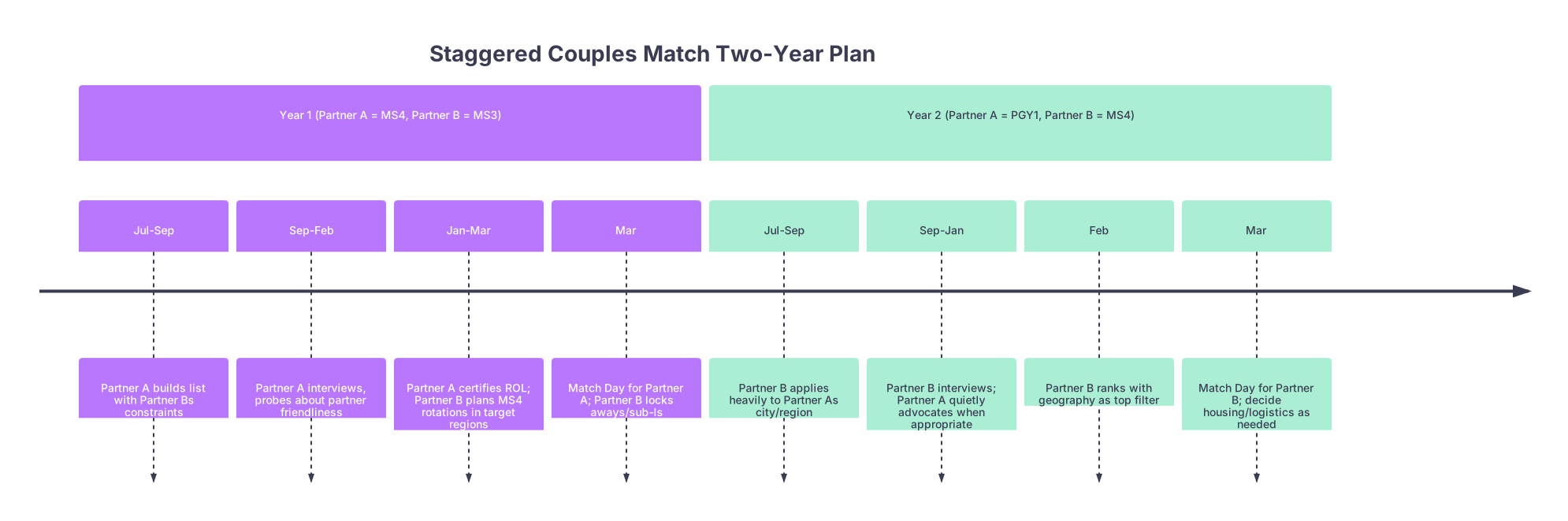
| Period | Event |
|---|---|
| Year 1 (Partner A = MS4, Partner B = MS3) - Jul-Sep | Partner A builds list with Partner Bs constraints |
| Year 1 (Partner A = MS4, Partner B = MS3) - Sep-Feb | Partner A interviews, probes about partner friendliness |
| Year 1 (Partner A = MS4, Partner B = MS3) - Jan-Mar | Partner A certifies ROL; Partner B plans MS4 rotations in target regions |
| Year 1 (Partner A = MS4, Partner B = MS3) - Mar | Match Day for Partner A; Partner B locks aways/sub-Is |
| Year 2 (Partner A = PGY1, Partner B = MS4) - Jul-Sep | Partner B applies heavily to Partner As city/region |
| Year 2 (Partner A = PGY1, Partner B = MS4) - Sep-Jan | Partner B interviews; Partner A quietly advocates when appropriate |
| Year 2 (Partner A = PGY1, Partner B = MS4) - Feb | Partner B ranks with geography as top filter |
| Year 2 (Partner A = PGY1, Partner B = MS4) - Mar | Match Day for Partner B; decide housing/logistics as needed |
The key thing: by the time you (MS4) are ranking, your partner’s MS4 year is mostly programmable. You know what electives they can schedule, what region their letters can support, and where they can realistically apply.
Step 6: Program Signaling and Quiet Advocacy (Without Being Annoying)
You can not “force” a program to take your partner next year. But you can make it easier for them to see your partner’s application and care about it.
If you’re the MS4 matching first:
During interviews:
- Ask residents and chiefs: “Do you ever have situations where one partner matches one year and the other follows the next? How has that gone here?”
- Notice their body language. If they roll their eyes, that’s data.
After you match:
Once your partner has their ERAS submitted next year and has officially applied to that program/system, you can:
Send a short, professional email to your PD or APD:
- “I wanted to let you know my partner, [Name], applied to our [specialty] program. They’re very interested in training here, and I’d be happy to answer any questions about their background or interest in [Institution/City].”
Or tell your chief/residents you trust:
- “My partner applied to [specialty] here and loves the city. If you see their application, they’d be thrilled for a serious look.”
Do not:
- Ask for special treatment.
- Ask them to guarantee an interview.
- Bring it up repeatedly.
You’re putting your partner’s name into the noise, nothing more. But that alone can bump you from pile three to pile two, and sometimes that’s the difference between no interview and one interview.
Step 7: Specialty-Specific Pitfalls
Some combinations are simple. EM + IM in a big metro? Fine.
Some are a minefield.
Watch out for:
Ultra-competitive + Ultra-competitive in small academic hubs
Example: Derm (you) + ENT (them) both hoping for the same 3 cities.Reality: There may be exactly 1–2 programs per specialty per city. Missing once can blow up the plan. You need backup cities and backup life plans.
Niche specialty + visa limitations
If one of you needs J-1/H-1B sponsorship and is in a more niche specialty (e.g., Rad Onc), city options shrink fast. You, as MS4, cannot be cavalier about location.Primary care in saturated desirable cities
Your partner wants FM or IM in Boston, SF, NYC, or Seattle, where hundreds of very strong AMGs and IMGs will apply. If you match there first, they’re going up against a stacked deck. Not impossible. But the odds are worse than people think.
For sanity, map specialty competitiveness vs. cities you’re considering.
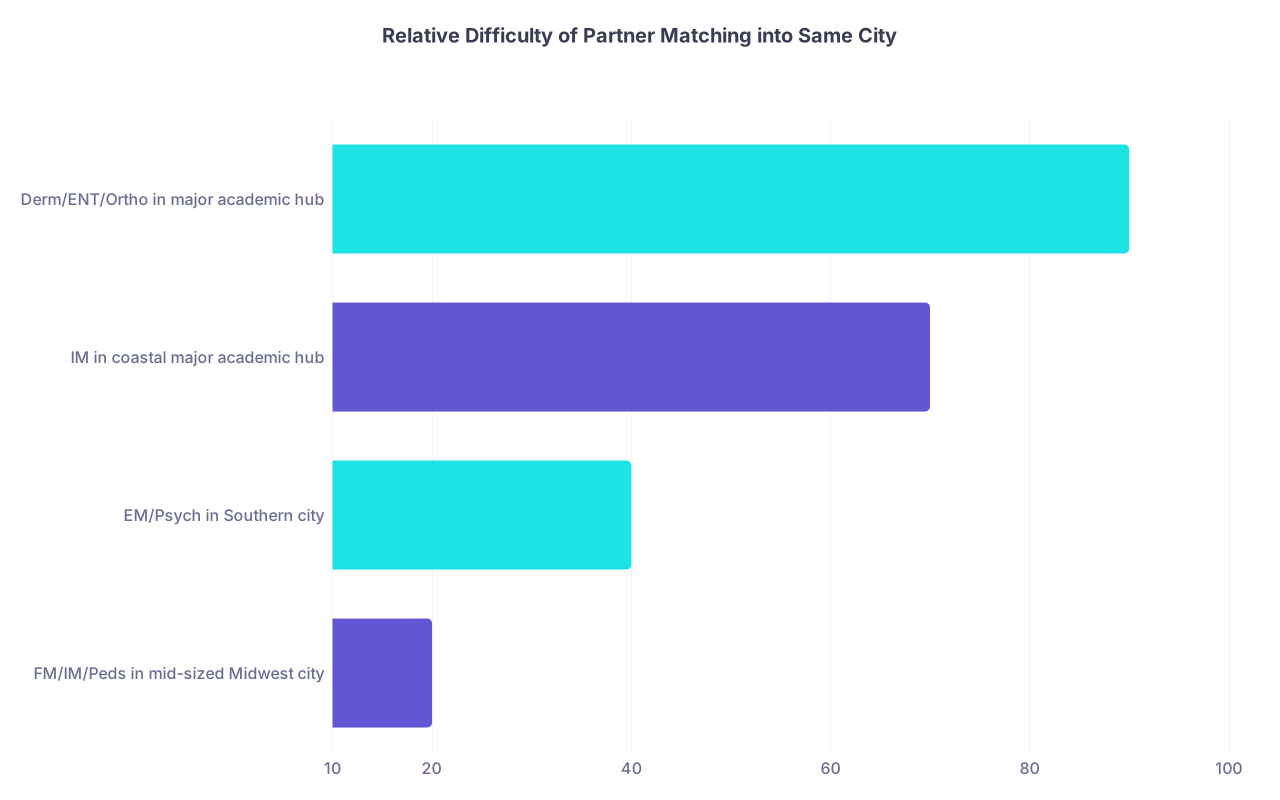
| Category | Value |
|---|---|
| FM/IM/Peds in mid-sized Midwest city | 20 |
| EM/Psych in Southern city | 40 |
| IM in coastal major academic hub | 70 |
| Derm/ENT/Ortho in major academic hub | 90 |
The higher the number, the harder it is for Partner B to land there after you.
Step 8: Money, Distance, and Worst-Case Scenarios
You two also need a “what if this doesn’t work?” plan. Before Match, not after.
Talk bluntly about:
Money:
- If your partner has to apply to 100+ programs in a single city/region, can you afford it?
- If they need a prelim year and reapplication, who is covering extra rent, costs?
Distance:
- Are you willing to do 1–2 years long distance if the plan fails?
- Is anyone actually prepared to say yes to that? Or is that a polite lie?
Specialty compromise:
- Will either of you switch specialties to have more geographic flexibility?
- Example: someone open to IM instead of Cards-driven FM, or Peds instead of Med-Peds.
You don’t need a full legal contract. But if the only plan you have is “we’ll figure it out,” you’re not planning. You’re hoping.
Long distance isn’t the end of the world. But it hits harder when you pretended for 18 months that it could never happen.
Step 9: Things People in Your Exact Situation Typically Regret
I’ve watched enough staggered couples to know the pattern of regret. A few you should actively avoid:
“I ranked my dream program #1 even though it’s in a city with nothing for them.”
Translation: you chose brand over the actual relationship. That may be fine, but own it.“We didn’t talk seriously about which one of us was actually more constrained.”
So you both pretended you had equal leverage. You didn’t.“We didn’t involve faculty early enough.”
Advisors can tell you stuff like: “That city is brutal for IMGs,” or “That program almost never takes spouses.” Use them.“We assumed a big city = lots of options.”
Not always. Some big cities are over-saturated and weirdly harder for your partner’s profile than mid-sized cities would have been.
Quick Reality Check: Are You on a Realistic Path?
Ask yourselves these questions tonight:
Can each of you name:
- Your top 3 realistic cities?
- Your top 3 realistic institutions/systems?
- And do they overlap?
Have you talked to:
- At least one advisor each about this as a staggered couple, not just as individuals?
Does your MS4 rank list:
- Put some weight (not all) on where your partner can match next year?
If you’re answering “no” to those, then you’re still in the “vibes and hope” stage, not the “plan” stage.
One Concrete Step to Take Today
Open a blank document and, together, write down:
- Your specialties
- Your realistic competitiveness (not your fantasy)
- A list of 5 cities in three columns:
- Great for Partner A
- Great for Partner B
- Great for both
Then highlight only what’s in column 3.
Those column-3 cities are where your real life as a couple can actually exist. Now the MS4’s job is to make sure their rank list keeps those cities in play. The MS3’s job is to make sure their fourth year is engineered to maximize their chances in those same places.
Do that today, and you’ve just upgraded from “we’ll see what happens” to an actual staggered couples plan.


