

Most couples screw up fellowship planning because they treat residency and fellowship as two separate games. They’re not. It is one long, combined, multi-year couples match.
You and your partner both want subspecialties. You are couples matching. That combination is absolutely workable. But it is not forgiving if you improvise your way through it.
Let me break this down specifically, the way I’ve seen actual couples—two heme/onc hopefuls, a cards + GI pair, PICU + MFM, EM → CCM + anesthesia CCM—either thread the needle or crash and burn.
Step 1: Define the Real Problem You’re Solving
The problem is not just “matching into residency together.”
The real problem is:
How do two subspecialty‑driven people end up, 6–9 years from now, with compatible fellowships in the same metro area, without having destroyed their relationship or their sanity in the process?
That question forces you to think on three layers at once:
Residency-level realities
Where can you both realistically match now, as a couple, given your stats, backgrounds, and application strategy?Fellowship ecosystem
From those residency cities, how many and what kind of fellowship options will be available later for both of you?Timeline synchronization
Will your fellowship application years line up? Who’s prelim vs categorical? 3‑year vs 4‑year vs 5‑year residencies? Research years?
If you ignore any one of those layers, you’re trusting luck. And luck is not a plan. Especially not for two future subspecialists.
Step 2: Map Out Your Two Training Paths in Detail
You cannot plan this as “we’re both going into IM and then doing something, probably cards or GI” or “one is peds, one is OB, we’ll sort it out later.”
You need explicit training timelines.
Do this first, on paper
Sit down with a sheet of paper (or spreadsheet) and write:
- Partner A:
- Target residency specialty
- Programs tiers you can realistically hit
- Length of residency
- Likely fellowship(s) you care about, ranked
- Competitiveness of those fellowships
- Partner B: same.
Then build a year‑by‑year map:
- PGY‑1: both in X city? Or prelim vs categorical?
- PGY‑2–3: are you both still in training at same time?
- Which exact academic year will each of you apply for fellowship?
- Will anyone be in a gap year between residency and fellowship?
That last point is huge. Plenty of couples get burned by ignoring it.
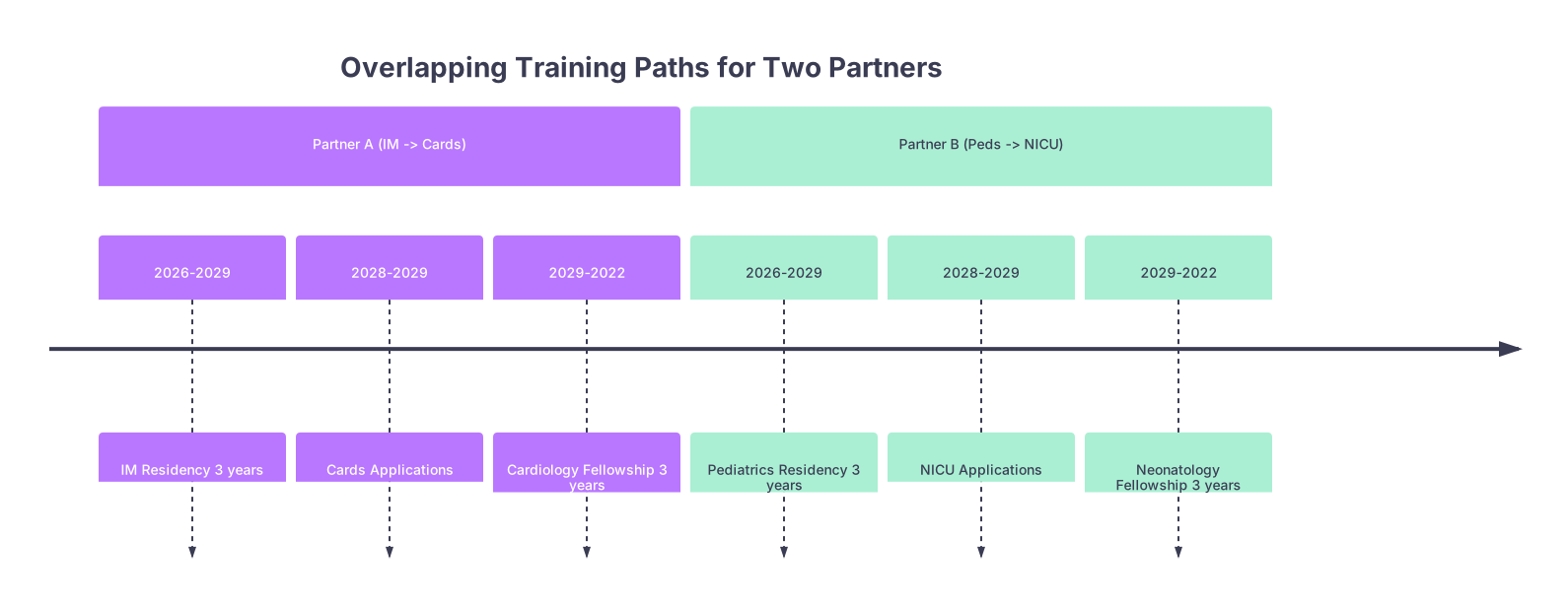
| Period | Event |
|---|---|
| Partner A (IM -> Cards) - 2026-2029 | IM Residency 3 years |
| Partner A (IM -> Cards) - 2028-2029 | Cards Applications |
| Partner A (IM -> Cards) - 2029-2022 | Cardiology Fellowship 3 years |
| Partner B (Peds -> NICU) - 2026-2029 | Pediatrics Residency 3 years |
| Partner B (Peds -> NICU) - 2028-2029 | NICU Applications |
| Partner B (Peds -> NICU) - 2029-2022 | Neonatology Fellowship 3 years |
If both of you are on a classic 3+3 path (IM → subspecialty, peds → subspecialty), you may be aligned. If one of you is EM (3–4 years) and the other is anesthesia (4 years) or gen surg (5+), you need to see—in writing—who will still be in residency while the other is already in fellowship. That affects income, location options, and how aggressive you can be with fellowship moves.
Step 3: Understand “Fellowship Density” Before You Rank
I do not care how perfect a residency feels on interview day if that metro area is a fellowship desert for one of you.
Think about fellowship density: how many realistic fellowship programs in your intended fields exist within a commuting radius of your residency city. Not theoretically nationwide. Within one metro or a tight region.
| Metro Area | IM Subspecialty Fellowships (Cards, GI, Heme/Onc, Pulm/CC, ID, Renal) | Peds Subspecialties (NICU, PICU, Peds Cards, Peds GI) |
|---|---|---|
| Boston | 5+ academic centers | 3–4 academic centers |
| NYC | 6+ academic centers | 4–5 academic centers |
| Midwest Medium City | 1–2 programs | 0–1 programs |
| Small City (single academic center) | 1 program | 0–1 programs |
If you both want competitive fellowships, large academic hubs are your friend:
- Boston
- NYC
- Philly
- Chicago
- Houston
- Dallas
- LA / SF Bay
- Big systems like Mayo, Cleveland, Hopkins metro region
In those places, you often have:
- Multiple IM subspecialty fellowships
- Multiple peds subspecialties
- Often more than one hospital system (university + big community)
That gives you flexibility later to couples match again at fellowship level—either formally (in subspecialties that use NRMP match) or informally by parallel interview and rank strategies.
Two common traps
Falling in love with a single‑institution city
Looks great now. Nice PD, supportive vibe. But five years later you discover:- One of you can do your dream fellowship there.
- The other has one local program in their field, and it is malignant or ultra‑competitive.
- Now you are debating long‑distance fellowship or one person giving up their preferred subspecialty.
Ignoring private/community programs with strong fellowship pipelines
Some community-heavy residencies in big metros have excellent fellowship placement (e.g., solid IM programs feeding into nearby university GI / cards / heme-onc). Do not dismiss them out of hand if you see consistent fellowship match lists in your target fields.
Step 4: Rank Cities, Not Just Programs
Couples Match is brutally city‑dependent. When both of you want fellowships, you need to go one level higher.
First, you and your partner should each independently rank:
- Top 5–7 cities or regions where you would be willing to do:
- Residency
- Fellowship
- Possibly first attending job
Then compare lists. You want:
- 2–3 cities that both of you consider high priority
- 1–2 “backup” regions where both would be willing, even if not ideal
Then within each city, figure out which combinations are:
- High fellowship density
- Realistic for you given your application strength
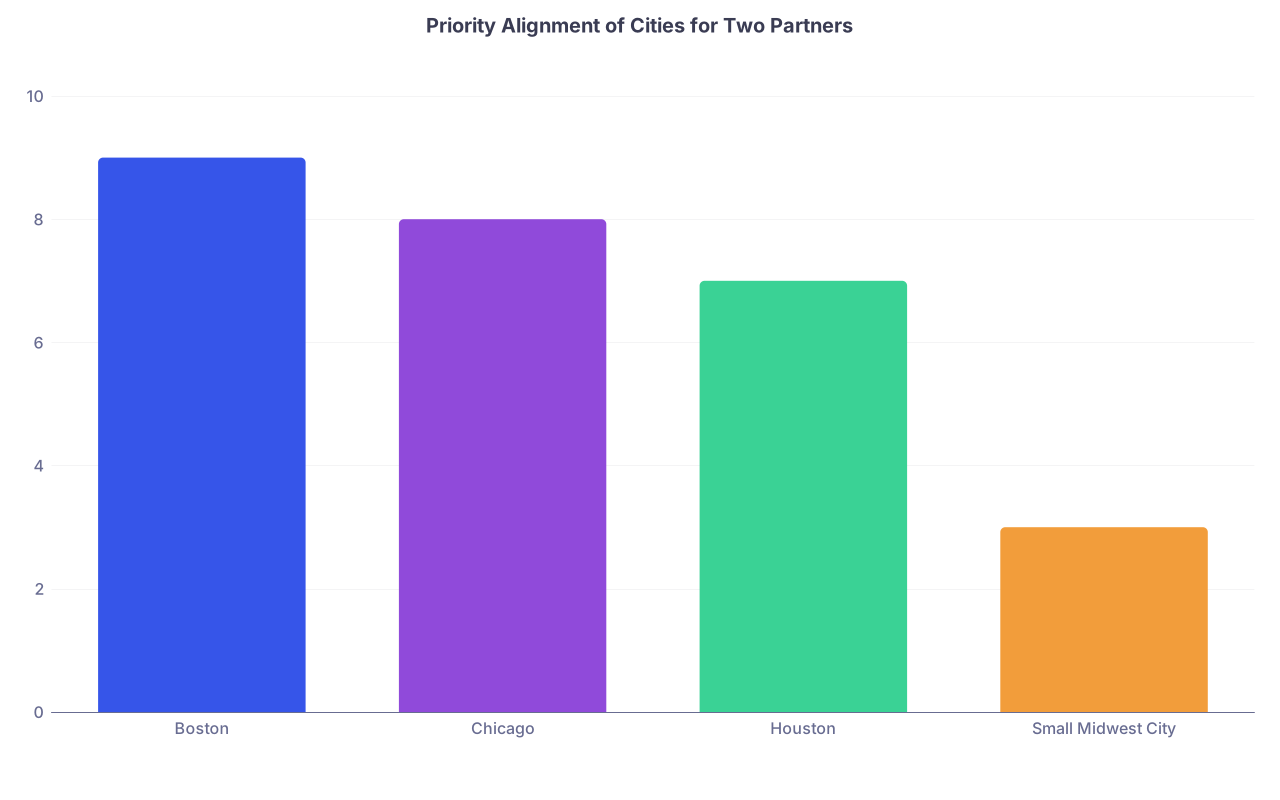
| Category | Value |
|---|---|
| Boston | 9 |
| Chicago | 8 |
| Houston | 7 |
| Small Midwest City | 3 |
You’re not just trying to match somewhere together. You’re trying to spend residency in a place that does not box one of you out of fellowship options later.
I’ve watched couples regret ranking a small, idyllic college town first because “we loved the feel,” then discover only one cards program in a 4‑hour radius and zero advanced peds options. Romantic now. Problematic later.
Step 5: Assess Your Fellowship Competitiveness—Honestly
You need a cold, unsentimental assessment of where you stand now, because that will predict how hard you have to work in residency to get the fellowships you want.
If both of you are aiming for top‑tier competitive subspecialties (cards, GI, heme/onc, advanced GI, MFM, REI, NICU at elite programs, etc.), then:
- You want residency programs that:
- Have strong fellowship placement specifically in your fields
- Provide research mentors in those subspecialties
- Have name recognition at least within your future region
If one of you is going for hyper‑competitive (e.g., interventional cards at top‑20, REI, peds cards at CHOP/Boston/Seattle) and the other is aiming for something relatively less competitive, you need to acknowledge that asymmetry. Your rank list may need to bias slightly toward the career that is more fragile on the market.
You are not required to have fully fixed fellowship plans as MS4s, but there is a massive difference between:
- “I am leaning strongly toward cards or GI”
- “I have no idea, maybe rheum? Maybe ID? Maybe hospitalist?”
The first case demands deliberate positioning now. The second can be more flexible but still should prioritize large academic centers.
Step 6: Decide on Your Couples Match Aggressiveness
Every couples match strategy lives somewhere on a spectrum:
Maximize getting together, anywhere
You heavily prioritize matching together over program prestige, academic heft, or fellowship positioning.Balance relationship and career
You target cities/programs that are reasonably strong while still keeping you together.Maximize long‑term career positioning
You are both okay being somewhat more geographically constrained and possibly risk being apart temporarily if it dramatically improves long‑term prospects.
Most people say they want “balance” but then build rank lists that are actually “together at any cost.” Be honest about where you really are.
Two subspecialty‑driven people usually cannot afford the most extreme “anywhere together” strategy without sacrificing someone’s future fellowship options.
Step 7: Design Your Rank List Like a Multi‑Year Chess Game
The Couples Match algorithm is unforgivingly literal: it takes your ordered pairs of programs and does not care about your story, your relationship, or your fellowship dreams.
So you need to feed it a rank list that encodes your long‑term plan.
Think in structured tiers
You can think in tiers of combinations. Example for an IM (future cards) + Peds (future NICU) couple:
Tier 1 (ideal long‑term ecosystems)
Pairs like:
- (Big Academic IM – City A, Big Academic Peds – City A)
- (Big Academic IM – City B, Big Academic Peds – City B)
These are large fellowship‑dense metros where both of your eventual subspecialties exist in multiple institutions.
Tier 2 (good but not perfect ecosystems)
- (Solid IM with strong cards pipeline – City C, Solid Peds with NICU – City C)
- (Academic IM – City D, Community‑heavy Peds but strong tertiary NICU – City D)
Tier 3 (safety cities with at least some fellowship options)
- (Mid‑tier IM – City E, Only Peds program – City E)
- (Community IM with send‑outs to academic center – City F, Peds at same center – City F)
Tier 4 (last‑ditch together‑at‑all‑costs)
- (Lower‑tier IM – City G, Lower‑tier Peds – City G)
- (IM Program X – City H, Peds Program Y – City H)
Then you weave in the “one matches, one unmatched” pairs at the very bottom only if you absolutely agree that this is better than both going unmatched.
Step 8: Use Residency to Set Up Fellowship—Deliberately
Once you match, your job is not done. You have just started Part 2 of this multi‑year couples plan.
In residency, each of you must:
Identify fellowship mentors early
Within the first 6–9 months, both of you need to know:- Who are the big names in your subspecialty at this institution?
- Who consistently gets residents into strong fellowships?
- Who is willing to write real letters, not lukewarm half‑paragraph ones?
Align research with your specific fellowship goals
- Future cards: do cardiology‑relevant projects, not generic QI on sepsis.
- Future NICU: neonatal outcomes, prematurity, etc., not random general peds projects.
Coordinate timing
Example: one of you wants an extra research year before fellowship; the other does not. That changes whether you will be applying the same cycle. Talk to chiefs and PDs early if staggering fellowship application years will make or break living together.Leverage your location
If you trained in a city with multiple fellowship programs:- Network across institutions.
- Moonlight or rotate at neighbor hospitals when possible.
- Attend joint conferences. People talk. LOR writers move.
Step 9: Plan for the Fellowship “Mini-Couples Match”
You will be doing a second couples‑style alignment, whether the match is formal (NRMP for many fellowships) or informal (email‑based offers, as in some EM/CCM, pain, etc.).
Here is how couples blow this stage:
- They apply blindly national, without city clustering, and then end up with:
- One person’s best option in Seattle.
- The other’s best in Boston.
- And no strong pairs in any single city.
Instead, you do for fellowship what you did for residency:
- Identify 3–5 priority cities/regions where both of you could train.
- Within those, identify 2–4 programs each that you would be genuinely happy with.
- Strongly consider slightly “lower‑tier” programs if they allow both of you to be in the same metro with solid training.
I watched a couple where one partner got a prestigious heme/onc fellowship in a city with zero advanced peds options. The other settled for a very weak pediatric hospitalist job because “at least we’re together.” That is not inherently wrong. But they hadn’t even applied aggressively to cities that would support both careers. They just chased name brand for one person.
Step 10: Have the Hard Conversations Now, Not in PGY‑3
You cannot optimize for everything. Someone will bend more, or earlier, or later. If you do not speak that out loud before you rank, resentment grows.
Concrete questions you should answer before submission:
If we have to choose between:
- A top‑tier fellowship pathway for one of us vs
- Both of us getting good‑enough fellowships in the same city
…which do we pick?
Are either of us willing to:
- Take a less competitive subspecialty (e.g., switch from GI to renal)
- Do a research year or extra chief year to stay in sync?
- Do one or two years of long‑distance if fellowship alignment fails?
Who has less geographic flexibility because of family, visas, financial constraints?
That person’s constraints are real and should shape the couple’s strategy.
I have seen couples nearly break up in PGY‑3 because they discovered, during fellowship applications, that one person assumed “we’ll go where my match is best,” while the other assumed, “we’ll only rank cities where we both have options.” That mismatch is predictable and preventable.
Common Scenarios and How I’d Approach Them
Let me walk through a few archetypes I see repeatedly.
Scenario 1: IM + IM, both want competitive subspecialties
Example: both want cards / GI / heme/onc.
My advice:
- You must prioritize academic centers in large cities with:
- Multiple fellowship programs in your fields
- History of sending residents to those fellowships
- For rank lists:
- Top load with combinations in cities like Boston, Chicago, Houston, etc.
- Be wary of small standalone IM programs far from academic hubs, unless their fellowship pipeline is clearly documented.
Scenario 2: IM (cards) + Peds (NICU)
Here, your anchor points are large adult + children’s hospitals.
- Think of places with:
- Strong adult IM subspecialty fellowships
- Well‑known children’s hospitals (standalone or part of same system)
- Caution: some cities have robust adult medicine but mediocre peds subspecialties, or vice versa. Dig into actual fellowship lists, not branding.
Scenario 3: EM (CCM) + Anesthesia (CCM or Cards)
Now you have timeline and competitiveness issues.
- EM to CCM has fewer fellowship spots nationally and depends on institutional culture.
- Anesthesia CCM / cards is its own ecosystem.
I would:
- Prioritize centers with:
- Combined critical care infrastructure
- History of taking EM and anesthesia residents into CCM
- Expect that one of you might end up in a different institution within the same city for fellowship.
Scenario 4: One hyper‑competitive fellowship, one more flexible
Example: REI + hospitalist‑bound IM.
Here, you should admit that the REI trajectory is fragile and requires maximum support:
- Rank list likely leans toward cities with strong OB/GYN, MFM, and REI infrastructure.
- The IM partner keeps as much flexibility as possible:
- Pick an IM residency that has decent fellowship options but does not need absolute top tier name.
- Be willing to compromise on career “prestige” for geographic alignment, if you both agree to that.
Summary: The Three Moves That Actually Matter
Let me distill the noise.
Pick cities, not just programs.
You are not just matching a residency. You are choosing a fellowship ecosystem for both of you. Large, fellowship‑dense metros give you options. Single‑center towns usually do not.Align timelines and expectations in writing.
Build an explicit training timeline for both partners. Decide now whose career gets priority in which scenarios and what compromises are on the table. Do not wait until PGY‑3 panic.Use residency as an intentional launchpad, not a holding pattern.
Find subspecialty mentors early. Do focused research. Network locally and regionally. Treat fellowship applications like a second couples match and plan accordingly.
You can absolutely both subspecialize and stay together. Plenty of couples do it. The difference is that the successful ones recognize they are playing a single, multi‑step game from MS4 to first attending job—and they plan like it.


