

The hardest couples match problem is not “coastal vs Midwest.” It is “family med vs neurosurgery.”
When one partner wants broad primary care and the other wants a hyper‑niche subspecialty, you are not dealing with a simple geography puzzle. You are dealing with fundamentally different program densities, competitiveness profiles, and interview patterns. If you handle it like a normal couples match, you will get burned.
Let me break this down specifically.
1. The Structural Problem: Asymmetric Markets
You cannot plan well until you understand why this pairing is uniquely tricky.
Primary care specialties (FM, IM, peds, psych to a degree) exist everywhere:
- Community hospitals
- State systems
- Mid-tier academic centers
- Rural tracks
- VA systems
Niche tracks cluster:
- Big academic centers
- Regional referral hubs
- A few elite community programs with a subspecialty focus
So you have:
- Partner A (primary care): 10–30 viable programs in almost every metro
- Partner B (narrow niche): maybe 1–4 realistic programs per region, sometimes only one in an entire state
Where people get in trouble is pretending those are equal. They are not.
Typical configurations I see
- FM + Derm
- IM + IR (integrated)
- Peds + Peds Neuro / Peds Cards
- Psych + Child Psych (if trying to stack locations and fellowships early)
- IM + GI/CC planning with strong research
- Any primary care + ENT, Ortho, Neurosurgery, Plastics, Urology, Rad Onc, etc.
You can mentally group these as:
- “Everywhere” specialties vs
- “Few centers with high cutoffs and weird politics”
That asymmetry dictates everything: where you apply, how large your list must be, and how honest you must be with each other about risk.
2. Map the Constraint: Who Is the Bottleneck?
In couples match, the “bottleneck” is the partner whose specialty and competitiveness most constrains your geographic options.
Most of the time in this scenario:
- Bottleneck = niche partner
- Flexible partner = primary care partner
If the niche partner is aiming for something like neurosurgery or derm, the geographic map is not: “Where do we want to live?” It is: “Where do neurosurgery or derm programs exist that I am realistically competitive for?”
Only then do you layer: “Which of those places also have FM/IM/peds/psych programs with enough volume and diversity to give my partner options?”
Here is how I usually structure that conversation with couples:
List every program in the niche specialty where the narrow partner is realistically competitive (not dreaming—realistic):
- Use Step 1/2 (or pre-clinical performance where relevant)
- Class rank
- Letters and research
- Away rotations and insider advocacy
Mark:
- Green: strong shot (realistic interview and rank)
- Yellow: stretch but plausible
- Red: fantasy / name-chasing with no meaningful tie or merit
Now look at each city/region on that map:
- How many primary care programs within commuting distance?
- Academic vs community mix?
- Any programs obviously misaligned with the primary-care partner’s CV (e.g., malignant, overly research focused, or they hate DOs/IMGs)?
Accept the conclusion:
- Your world is basically the set of metro areas that overlap those two maps
- Some regions will obviously be “anchor cities” (e.g., Boston, Chicago, Houston)
- Others will be single-program gambles (one neurosurgery program in the city; if that fails, the whole region collapses for couples purposes)
That is the constraint. Debate it emotionally if you want, but the NRMP algorithm does not care.
3. Competitiveness Reality Check: Honest or Delusional?
If the niche partner is even slightly below average for that field, you must change the strategy. Not the other way around.
Let me give you a rough sense of the dynamic using a simple table. Numbers are illustrative, not exact, but this is roughly how it feels in practice:
| Factor | Primary Care (FM/IM/Peds/Psych) | Niche (Derm/Neurosurg/ENT/etc.) |
|---|---|---|
| Programs per metro | 3–15 | 0–3 |
| Interview invites needed | 10–12 | 12–18 |
| Rank list length typical | 10–20 | 15–25+ |
| Realistic cities w/ jobs | Many | Few |
The primary-care partner usually has more slack:
- Lower bar for interview
- More programs desperate to fill
- More geographic spread
The niche partner usually has:
- Highly variable “vibe” by program
- Severe Step/clinical grade cutoffs
- Heavy weight on letters from known faculty
So your planning question is not: “How do we both maximize?”
The real question: “How much risk are we willing to put on the niche partner’s dream vs both matching in the same region vs just both matching?”
Sometimes the correct dance is:
- Niche partner swings for dream field but broad geography
- Primary-care partner decides whether they are willing to:
- Enter the couples match, or
- Apply solo and plan for a likely long-distance year or two
If the niche partner is borderline for that field and absolutely refuses to consider a backup specialty or prelim year, you are looking at:
- Higher unmatched risk
- Fewer couples combinations
- Higher probability of living apart initially
You should be honest about that now, not 3 days before the rank list deadline.
4. Application Strategy: How Many, Where, and in What Pattern?
Step 1: Start from the narrow partner’s viable cities
Forget program names first. Think cities.
Example: FM + Neurosurgery couple.
Neurosurgery programs (for which the applicant is actually competitive) might be in:
- City A: 2 neurosurg programs
- City B: 1 neurosurg
- City C: 1 neurosurg
- City D: 1 neurosurg associated with their home institution
- City E: 1 neurosurg “stretch” program with a strong tie (home state or research year there)
Now, for each city, the FM partner identifies:
- All FM programs in commuting distance
- Which ones are:
- Reach
- Solid
- Safety
If City A has 2 neurosurg + 6 FM programs, that is a prime anchor. City C with 1 neurosurg + 1 FM? That is a fragile city; if either one burns you, that whole location is gone.
Step 2: Volume: how many applications?
Rough ballpark (U.S. MD, reasonably competitive; adjust up for DO/IMG or weaker apps):
For the niche partner:
- Derm / Neurosurg / ENT / Ortho / Plastics / Urology:
- 50–80 programs is common
- Some go 80–100+ if borderline-tiers
For the primary-care partner:
- FM:
- 20–40 is typical
- IM:
- 25–45
- Peds:
- 20–40
- Psych:
- 25–40
If you are couples matching:
- Err slightly higher for both, but particularly for the niche partner
- But do not spam programs where you have no geographic or academic fit. PDs smell that.
Step 3: “Priority regions” vs “safety regions”
You should explicitly label your map:
- Tier 1: Highest priority cities (family, cost of living, good for kids, both happy)
- Tier 2: Acceptable cities (would live there, solid training, maybe less ideal socially)
- Tier 3: Last-resort cities (you would go, but you are not daydreaming about it)
Then:
- Ensure your couples list has plenty of Tier 2 and some Tier 3 combinations
- Not every combo on the couples list should be a “dream” location / program pairing
- You need volume
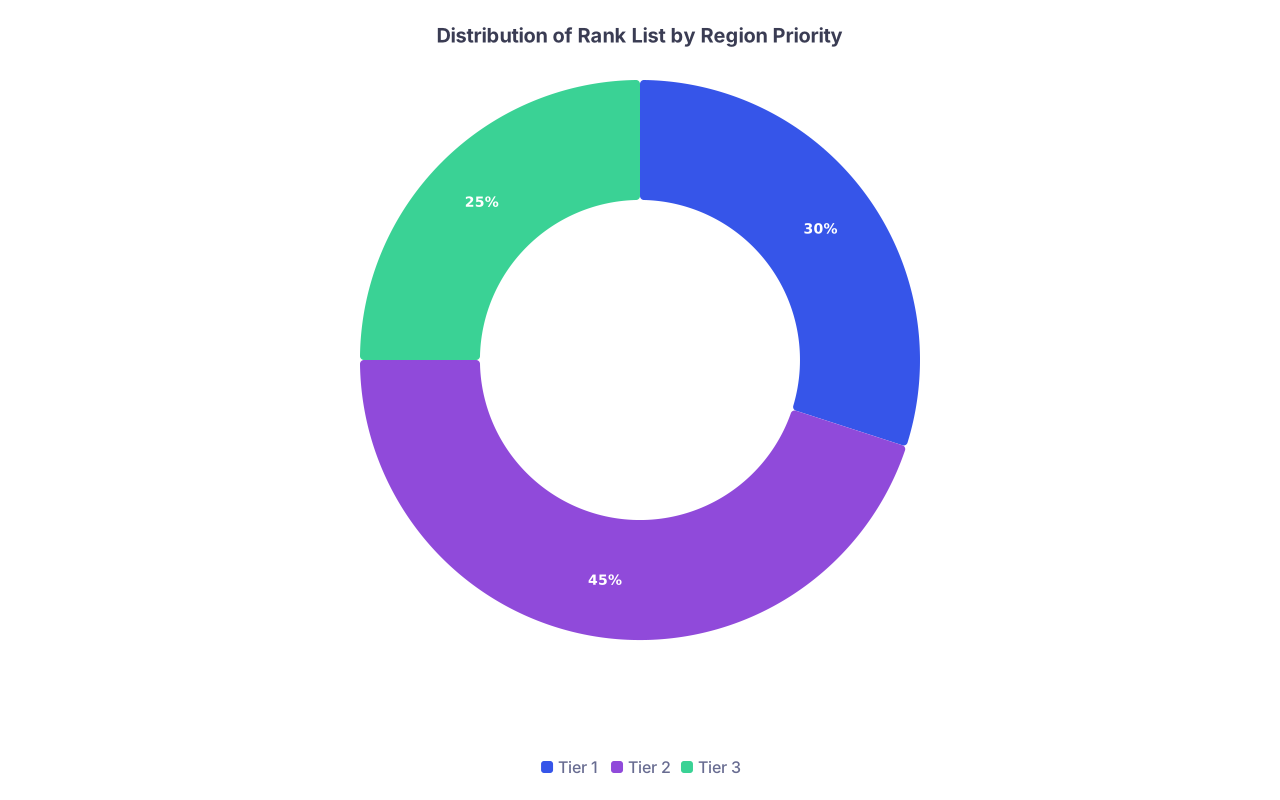
| Category | Value |
|---|---|
| Tier 1 | 30 |
| Tier 2 | 45 |
| Tier 3 | 25 |
That is what a healthy rank list feels like: a smallish group of top-priority pairs, a big middle band of “good enough,” and a smaller set of “we will live.”
5. Tactical Use of the Couples Matching Mechanism
The couples algorithm is simple and ruthless: it tries to match you to the highest ranked pair on your joint list where both sides can match.
This means two things:
- You must think in pairs, not individual programs.
- The primary-care partner’s list will be artificially inflated to create sufficient combinations.
Example pattern:
Niche partner (NP) list (simplified):
- NP1
- NP2
- NP3
- NP4
Primary-care partner (PC) programs in City of NP1: PC1, PC2, PC3
In City of NP2: PC4, PC5
In City of NP3: PC6
In City of NP4: PC7, PC8, PC9
Your couples list must enumerate these explicitly:
- (NP1, PC1)
- (NP1, PC2)
- (NP1, PC3)
- (NP2, PC4)
- (NP2, PC5)
- (NP3, PC6)
- (NP4, PC7)
- (NP4, PC8)
- (NP4, PC9)
- (NP1, No match) or (No match, PCx) if you are willing to separate or have one unmatched for a year
Primary-care partner will naturally have:
- Fewer “solo” priorities
- More “I would be fine at any of these in this city if my partner gets neurosurg here” positions
You will also need to decide:
- Are you ranking “one matches, the other does not” pairs at the bottom?
- E.g., (NP1, No match) or (No match, PC4)
- Some couples refuse to do that. Others prioritize at least one of them training somewhere over both going unmatched.
Be explicit with each other about this. Do not slip those combinations in silently.
6. Interview Season: How to Signal, Coordinate, and Not Self-Sabotage
Programs are not magically sympathetic because you are couples matching. Some are supportive; some are openly annoyed.
You need to be strategic:
6.1 Telling programs you are couples matching
You should:
- Indicate couples match in ERAS
- Briefly mention it in your personal statement or secondary communications when relevant
- Bring it up in:
- Pre-interview emails if you have overlapping interests
- Interviews—tactfully and targeted
Do not:
- Lead with: “I will only come here if my partner matches here too.” That sounds like a threat.
- Overshare drama (“We are really worried one of us won’t match…”). That makes you look unstable.
Instead:
- Phrase it as: “My partner is applying in [specialty] and will also be applying here / in this city. We are participating in the couples match and very interested in training in the same region.”
If one of you interviews somewhere without the other having an invite yet:
A short, professional email from the “missing” partner can help:
- “I am applying to [specialty] and am couples matching with my partner, [Name], who is interviewing with your [other specialty] program on [date]. I have a strong interest in your institution due to [specific reason]. I would be grateful if you would consider my application.”
Sometimes that works. Sometimes it does nothing. But it is a rational move when stakes are high.
6.2 Coordinating interviews by region
The practical nightmare: your derm partner has scattered coastal invites and your FM partner has a cluster in the Midwest.
Use 3 principles:
- Do not over-cancel early. Keep marginal invites until you see patterns.
- If a city looks like an “anchor” (both get at least one invite), prioritize completing all interviews there.
- If one partner gets no traction in a city where the other has multiple options, be realistic by January. That city may be dead for couples purposes.
I have watched couples cling to a city because one partner “fell in love” with a program there. But if the other partner never even got an interview in that metro, that emotional investment is functionally irrelevant.
7. Emotional Negotiation: Whose Dream Takes the Hit?
This is the part no one likes to talk about.
Sometimes, in these combinations, one partner must compromise more. Often it is the primary-care partner. Occasionally it is the niche partner stepping down a tier of program prestige or delaying fellowship dreams.
You need to clarify, before rank lists:
- Non-negotiables for each of you
- Acceptable sacrifices
Typical trade-offs I see:
Primary-care partner concessions:
- Chooses a less prestigious but perfectly adequate FM/IM/Peds/Psych program in the same city as the partner’s dream niche program
- Accepts more call / worse schedule / weaker research for the sake of geography
- Gives up specific “perfect fit” program in another city
Niche partner concessions:
- Trades top-5 academic powerhouse for a solid but less famous program where the primary-care partner can also train well
- Accepts that fellowship may be slightly more uphill and will require more hustle
- Broadens specialty choice (e.g., ortho vs PM&R if they were on the edge between them)
Shared concessions:
- Agree to less desirable city but strong dual-program fit
- Accept the possibility of living apart for 1–2 years if things break badly
You cannot maximize every parameter: city, program tier, specialty dreams, relationship proximity. The couples match forces you to rank those.
I have seen couples blow up their relationship because they never explicitly labeled which was more important:
- “Being in the same city no matter what”
vs - “I get my precise specialty and top-tier program”
Have that ugly conversation now. Use plain language:
- “If derm will only work for you in 4 big cities, are you willing to live apart if I cannot match primary care there?”
- “If I aim for neurosurgery only, and we end up apart, is that a dealbreaker for you?”
It is not romantic. But it will prevent resentment later.
8. Long-Distance as a Planned, Not Accidental, Outcome
Some combinations simply do not couple well in the first go:
- FM + Derm where derm partner is borderline competitive
- IM + Neurosurgery when neuro spots are ultra-limited
- Peds + Ortho with geographic constraints (kids, visas, etc.)
Let me say something unpopular:
A planned, honest long-distance arrangement for 1–2 years is often better than a forced, unanticipated one.
If you both agree that:
- Niche partner must pursue X specialty this cycle
- Primary-care partner will apply independently, not in couples match
- You will then realign later via:
- Transfer after PGY-1 or PGY-2 (rare but possible)
- Re-entering couples match as PGY-2s/PGY-3s for advanced positions or fellowship-heavy cities
Then your expectations match the market reality.
Do not rule this out just because “it feels wrong for a couple.” It might be the cleanest strategy if:
- One partner’s apps are significantly weaker
- One partner is applying as an IMG/DO in a tight specialty
- Visa constraints and timelines are severe
- The “anchor cities” for the niche are simply too limited
Put another way: sometimes the best couples match strategy is not to couples match that year.
9. Special Case: Narrow Niche Through Fellowship vs Categorical
Not all “niche” goals require a niche residency entry.
Compare two patterns:
Truly niche categorical entry:
- Derm
- Neurosurgery
- ENT
- Ortho
- Urology
- Plastics (integrated)
- IR (integrated)
Niche via fellowship after broad base:
- Cards / GI / Heme-Onc / Pulm/CC from IM
- Child Psych from Psych
- Neonatology / Peds Cards / Peds Heme-Onc from Peds
- Sports Med from FM/IM/Peds
- Palliative from FM/IM/others
This matters because:
- In category 1, residency choice largely determines long-term ecosystem and fellowship odds (especially for derm, neurosurg, ENT).
- In category 2, your immediate problem is simply co-locating for residency in programs that have at least decent fellowship pipelines.
If your “niche” partner is actually in category 2 (say, an IM applicant dreaming of GI):
- They might not need a super-elite IM program to reach that goal
- Many mid-tier academic IM programs still feed well into solid GI programs
- The couples strategy can lean more into geography and dual-solid programs rather than chasing the single biggest-name IM department
This is where nuance matters. A Peds applicant set on Peds Cardiology at a big center is not under the same geographic chokehold as a derm applicant. Treat them differently.
10. A Concrete Example: FM + Derm Couple
Let me walk you through a realistic pattern.
- Partner A: Family Medicine, mid‑to‑strong applicant (US MD, solid letters, decent Step 2, good clinical).
- Partner B: Dermatology, decent but not superstar (no fail, some research, one away rotation with strong support, but not Phi Beta Kappa / AOA, etc.)
Derm map (competitive + plausible):
- Major academic centers in 8–10 cities total where they have:
- Either home tie,
- Research connection, or
- Performance that puts them somewhat within range.
Family Med map:
- Basically anywhere with a residency program in those 8–10 cities plus surrounding suburbs.
Strategy:
- Derm partner applies broadly (60–80 programs) but mentally highlights 12–18 “realistic” ones
- FM partner applies to:
- All FM programs in those 8–10 derm cities
- A few extra FM programs in backup regions in case they decide to decouple late
Interviews:
- As derm invites trickle in, couple tracks which cities yield:
- Derm interview + at least one FM interview
- By December/early January, they identify:
- 3–4 “anchor cities” with interviews for both
- A few solo cities
Rank list:
- Couples list heavily stacks combinations in those anchor cities:
- (Derm A, FM A1), (Derm A, FM A2), (Derm B, FM B1) …
- They explicitly decide whether they will:
- Rank (Derm X, No match) or (No match, FM Y) at the bottom, or
- Stop their list at two-match pairs only
This couple’s actual risk:
- Derm may not match anywhere, even independently. It is just dermatology.
- FM probably matches somewhere. But couples constraints might pull them down to a less shiny program, which is usually still perfectly acceptable career-wise.
The critical conversation:
- Is it acceptable if:
- FM matches, derm does not, but they ranked a combination like (No match derm, FM City 3) to keep at least one person in training?
- Or do they insist on “both match or we both re-apply”?
Both choices are rational. Neither is risk-free.
11. Nuts-and-Bolts Timeline: What You Should Be Doing When
Let me anchor this with a rough timeline, because too many couples drift into chaos:
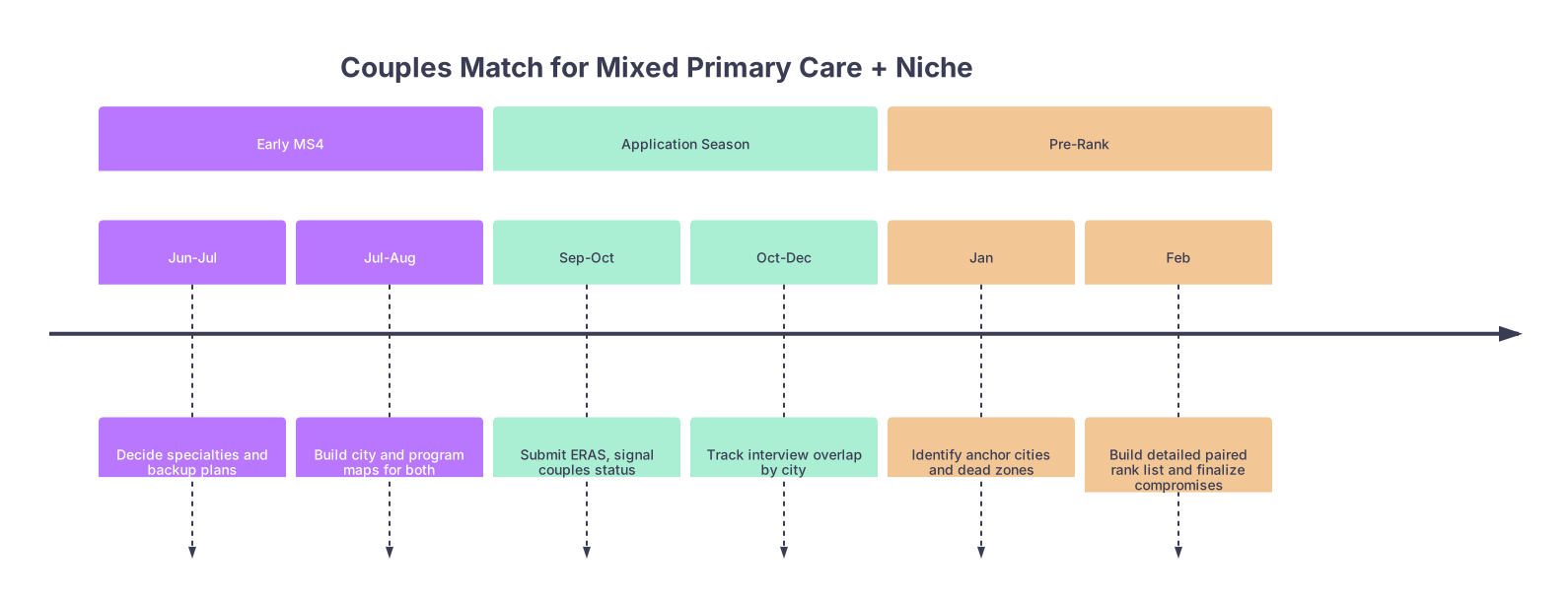
| Period | Event |
|---|---|
| Early MS4 - Jun-Jul | Decide specialties and backup plans |
| Early MS4 - Jul-Aug | Build city and program maps for both |
| Application Season - Sep-Oct | Submit ERAS, signal couples status |
| Application Season - Oct-Dec | Track interview overlap by city |
| Pre-Rank - Jan | Identify anchor cities and dead zones |
| Pre-Rank - Feb | Build detailed paired rank list and finalize compromises |
By:
- July–August:
- You should already have the “bottleneck map” done and a first-pass city list.
- October–December:
- You track where actual interviews land and re-classify cities as anchor / fragile / dead.
- January:
- You have the ugly but necessary conversations: separation tolerable or not? Program tier vs geography trade-offs?
- February:
- You build the couples rank list explicitly and sanity-check it with someone experienced (advisor, PD, or a resident who has been through couples match).
Do not leave this to the last week.
12. The Bottom Line
Let me condense the chaos.
This is an asymmetric problem. The narrow niche partner’s specialty and competitiveness define your geographic map. Everything else is commentary.
A good couples match strategy is brutally explicit about trade-offs. Program prestige vs geography. Same-city vs long-distance. Dream specialty vs guaranteed match. You cannot maximize all at once.
The primary-care partner usually has more flexibility. That does not mean they should be a martyr, but it does mean their program list and expectations must stretch more to create enough viable pairs.
If you treat this as a normal couples match, you will build a pretty but fragile rank list. If you treat it like a constrained optimization problem with emotional stakes you both acknowledge out loud, you give yourselves a real shot at ending up in the same city—without quietly sabotaging one or both careers.


