

Dual-competitive couples who wing their rank lists are gambling with a loaded gun.
If you and your partner are both applying to highly matched specialties—think ortho, derm, ENT, ophtho, neurosurgery, plastics, urology, IR, EM at top programs—you do not have the same margin for error as the average couple. The NRMP Couples Match algorithm is neutral. It will not “try to keep you together.” It will follow your list, ruthlessly, line by line.
Let me break this down specifically, because this is where very strong couples sabotage themselves: not with weak applications, but with sloppy strategy.
1. The Core Reality: Dual-Competitive ≠ Safe
Dual-competitive couples have power and risk. Both of you are attractive to programs; both of you are also in specialties where geography flexibility is low and program numbers are limited.
If one of you is applying to:
- Dermatology
- Orthopaedic surgery
- Neurosurgery
- Plastic surgery
- ENT
- Ophthalmology
- Integrated IR
- Urology (through AUA but often parallel NRMP for prelim/transitional)
and the other is applying to:
- Any of the above, or
- EM at very desirable locations,
- Categorical general surgery at big-name places,
- Prestigious IM programs (MGH, BWH, UCSF, Hopkins, Penn, etc.)
you are dual-competitive. That is different from “one competitive, one flexible.” Your failure mode is not “we end up a few hours apart.” Your failure mode is “one of us fails to match or scrambles into something we hate.”
You are optimizing in three dimensions simultaneously:
- Individual match probability for each partner.
- Geographic co-location.
- Program quality and career trajectory.
Most couples subconsciously sacrifice #1 for #2 and #3. That is backwards. If you do not both match somewhere, geography and prestige are irrelevant.
2. How the Couples Match Actually Treats You
The couples algorithm pairs your rank positions like coordinates. It does not treat you as two independent applicants. It treats you as ordered pairs:
- (Program A for Partner 1, Program X for Partner 2)
- (Program B for Partner 1, Program Y for Partner 2)
- (Program C for Partner 1, Program Z for Partner 2)
And then it goes down the list.
Once you couple, “your” rank list is not one list each. It is the Cartesian product of your options that you explicitly write down.
If you do not rank a combination, the algorithm treats it as if you would rather remain unmatched than accept that pairing.
That’s the part I see couples misunderstand every single year.

| Step | Description |
|---|---|
| Step 1 | Start Couples Rank List |
| Step 2 | Pair 1: P1-A & P2-X |
| Step 3 | Tentatively assign\nboth partners |
| Step 4 | Reject this pair |
| Step 5 | Final Match |
| Step 6 | Reassign to better pair |
| Step 7 | Move to next pair |
| Step 8 | Both programs\nwilling to rank this couple? |
| Step 9 | Is there a\nbetter pair later? |
The take-home: the algorithm is not trying to “help you compromise.” It is trying to satisfy the highest pair you wrote down that is mutually acceptable to both programs. If that list of pairs is short, narrow, or unrealistic, the algorithm will be “faithful” to your bad planning.
3. Step One: Brutally Honest Partner-by-Partner Risk Assessment
Before you talk about cities or dream programs, you both need a realistic assessment of your individual odds.
I mean something like this, on paper, not in vague hand-waving:
- Partner 1: Applying ortho. Step 2 CK 254. AOA. 4 ortho pubs. 18 interviews.
- Partner 2: Applying EM. Step 2 CK 243. No AOA. Strong SLOEs, 12 interviews, mostly mid-tier university/large community.
You must know:
- Where you are above average for your specialty (score + interviews + letters + school reputation).
- Where you are average or slightly below.
- Which programs feel like reaches versus realistic.
For each partner, you should be able to say:
- “If I were applying as a single applicant, ranking honestly, I’d be 90–95% confident I match somewhere on my list.”
- Or “I’m in the danger zone; I need breadth and backup.”
If one partner is at clear risk (borderline number of interviews, weaker letters, red flags, late CK score, Step 1 pass after difficulty), that partner’s safety must dominate the couples strategy. Not negotiable.
4. The 4 Critical Design Decisions For Dual-Competitive Couples
There are four big decisions that will shape your entire couples list. Get these right before you fuss with exact ordering.
Decision 1: Geographic Radii
Everybody starts with: “We only want to be in the same city.” That is fine if:
- You both have 15–20+ interviews in that city or region, and
- Those cities include multiple programs per specialty.
If you are dual-competitive in small fields (e.g., derm + ENT), one city may literally have only 1–2 programs in each. That is not a real safety net.
You need to define tiers of geographic acceptability:
Tier A: Same institution or neighboring hospitals in same city.
Tier B: Same metro area / easy daily commute (e.g., Bronx + Manhattan; Oakland + SF).
Tier C: Same region, 1–2 hours apart (e.g., Philly + NYC; Durham + Raleigh + Greensboro; Providence + Boston).
Tier D: Same broad region but 2–4 hours apart (e.g., Chicago + Indianapolis; Houston + San Antonio).
Tier E: Anywhere in the country where both partners have any program at all.
Your mistake will be pretending Tier A and B are the only ones that “count.” You need to grow up a bit here. A 75–90 minute drive for a year or two is better than one of you unmatched.
Decision 2: Prestige vs Security
You cannot both insist on:
- Only highly ranked / brand-name programs,
- Only top cities,
- Only tightly co-located positions,
and expect the algorithm to bail you out.
One of you will often need to be more flexible. Common patterns:
- The relatively stronger applicant shoots for higher tier programs while still ranking safe options.
- The relatively riskier applicant accepts a broader geographic and prestige range to protect the couple.
If you are both ultra-competitive (e.g., 260+ CK, multiple first-author pubs, AOA from top 20 schools), you can be somewhat more aggressive. But not delusional. There are still only so many derm spots in Boston.
Decision 3: How Many Combinations Per City
In big cities with multiple programs, you need to build depth. Example: IM + Ortho in Philadelphia.
Partner 1 (IM) interviews at: Penn, Jefferson, Temple, Drexel.
Partner 2 (Ortho) interviews at: Penn, Jefferson, Temple.
You do not rank:
- (Penn IM, Penn Ortho)
- (Jeff IM, Jeff Ortho)
and call it a day.
You systematically construct:
- (Penn IM, Penn Ortho)
- (Penn IM, Jeff Ortho)
- (Penn IM, Temple Ortho)
- (Jeff IM, Penn Ortho)
- (Jeff IM, Jeff Ortho)
- (Jeff IM, Temple Ortho)
- (Temple IM, Penn Ortho)
- …and so on.
Is it tedious? Yes. Do you want to be unmatched because you ran out of patience in January? Probably not.
Decision 4: How Far Down Do You Uncouple?
There is a hard conversation most couples avoid:
“At what point do we prioritize each person matching somewhere over being together?”
For dual-competitive couples, this decision is even more important because failure to match is catastrophic in your fields. You must decide in advance:
- Will we accept both matching in different states over one unmatched?
- Where is that line on the list?
You implement that line explicitly by:
- Building coupled pairs down to a certain region / distance.
- Then appending solo ranks below that for each partner (or leaving them uncoupled entirely, if you choose).
We will get specific about how to do that.
5. Building the Actual Rank List: A Concrete Framework
Now we get into the part almost nobody explains step-by-step. Let me walk you through a structured way dual-competitive couples can build their list without losing their minds.
Step 1: Individual Rankings First, Completely Independently
Each partner writes their solo rank list as if they were not couples matching. Completely independent. No negotiation yet.
Partner 1 (Derm example):
- UCSF
- Penn
- MGH
- Colorado
- UCSD
- Northwestern
- Emory
- UVM
- OHSU
- Any advanced prelim combos etc.
Partner 2 (ENT example):
- UCSF
- Stanford
- Penn
- MGH
- UCSD
- Colorado
- Emory
- Iowa
- Utah
- MUSC
You must each know what you actually want before you start compromising.
Step 2: Identify “Ideal Overlap Nodes”
Find cities/programs where:
- Both interviewed,
- Both would be genuinely happy,
- And both programs are reasonably likely (not just your #1 reach at each).
These are your “anchor pairs.” For instance:
- (UCSF Derm, UCSF ENT)
- (Penn Derm, Penn ENT)
- (MGH Derm, MGH ENT)
- (Colorado Derm, Colorado ENT)
- (UCSD Derm, UCSD ENT)
- (Emory Derm, Emory ENT)
Those become the backbone of the top of your couples list, in rough order of combined desirability.
Step 3: Construct Tiered City Blocks
Within each overlapping city / metro, construct blocks of combinations.
Say you both have options in Boston.
Partner 1 IM: BWH, MGH.
Partner 2 Ortho: MGH, BIDMC, Tufts.
Your Boston block might look like (from most to least desired):
- (BWH IM, MGH Ortho)
- (MGH IM, MGH Ortho)
- (BWH IM, BID Ortho)
- (MGH IM, BID Ortho)
- (BWH IM, Tufts Ortho)
- (MGH IM, Tufts Ortho)
You do not have to include every mathematical combination if some are clearly unacceptable. But most couples are too restrictive here. They rank 1–2 combos and leave 4–5 completely off, essentially preferring “no match” to a slightly less shiny pairing.
In ultra-competitive specialties, that is reckless.
Step 4: Order Across Cities by True Joint Preference
Now compare blocks across regions. You and your partner must answer this very specific type of question:
“Would we rather:
- Be at top-tier programs in different coasts,
- Or be at mid-tier programs in the same city?”
There is no algorithmic answer. This is values and risk tolerance.
For example, your early couples ranks might look like:
- (UCSF Derm, UCSF ENT)
- (Penn Derm, Penn ENT)
- (MGH Derm, MGH ENT)
- (UCSF Derm, Stanford ENT) – Bay Area, not same institution
- (MGH Derm, BID ENT) – Same city, slightly mixed prestige
- (Colorado Derm, Colorado ENT) – Slight drop in prestige, better lifestyle
- Full Boston block of combinations
- Full San Diego block
- Full Atlanta block
You layer city blocks of realistic combinations in order of how both of you, together, value the trade-offs.
Step 5: Introduce Wider-Radius Safety Nets
After your “dream coherent pairs” and dense city blocks, you expand radius.
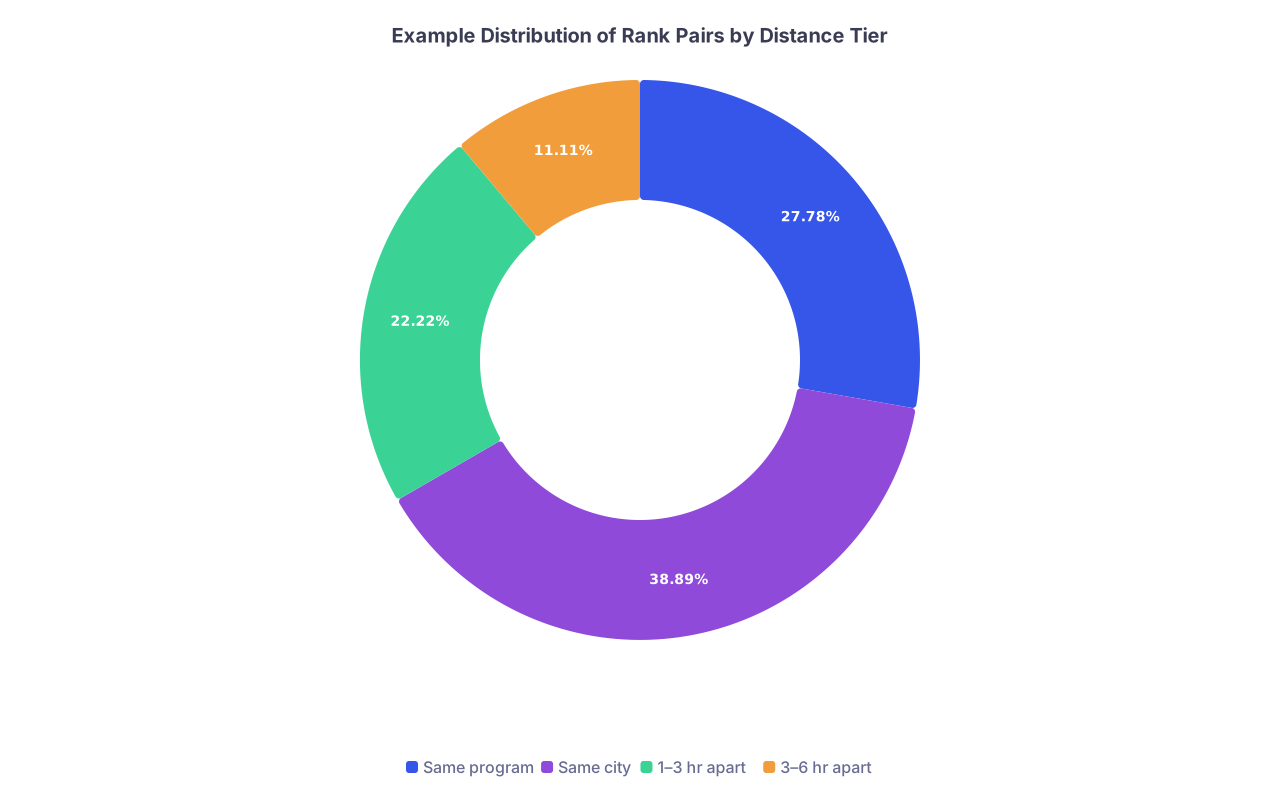
Example: 1–3 hour drive pairs.
You might create pairs like:
- (Penn Derm, Hopkins ENT) – 1.5–2 hours, Northeast corridor
- (MGH Derm, Yale ENT)
- (Colorado Derm, Utah ENT) – regional but not same city
- (Emory Derm, MUSC ENT)
You may feel like these are “concessions.” They are actually your insurance policy against catastrophic outcomes.
| Category | Value |
|---|---|
| Same program | 25 |
| Same city | 35 |
| 1–3 hr apart | 20 |
| 3–6 hr apart | 10 |
The point: a rational couples list gradually relaxes geographic constraints as you go down. Not program quality first, then geography later. Geography relaxes first.
Step 6: Decide Where to Start Uncoupling
At some point low on the list, you face the line: do we keep coupling all the way down, or do we let each person “fall back” individually?
There are three main models I see in dual-competitive couples:
Full Coupling to the End
You rank only paired combinations. If no combination works, both of you go unmatched.
This is almost always a bad idea in very competitive specialties unless you both have huge, deep interview portfolios and are in large markets.Hybrid: Coupled High, Individual Low
You rank coupled combinations down to a certain threshold of acceptability (e.g., willing to be up to 3 hours apart).
Below that, each partner also submits an “individual tail” list.
This means that if no acceptable pair can be found, one or both of you might match separately, but at least you are not unmatched.Asymmetric Safety
The riskier partner adds more uncoupled safety ranks (e.g., broad IM, prelim, categorical community), while the stronger partner keeps a shorter list or even fully coupled list.
This leads to a higher chance that both match; if anyone is sacrificed geographically, it is more likely the one with a wider range of options.
For dual-competitive couples, I strongly favor the Hybrid or Asymmetric Safety model. Full coupling all the way down is bravado. Not strategy.
6. High-Risk Specialty Pairs: Specific Nuances
Some pairings deserve special attention because their structures are weird.
| Pair Type | Main Risk Factor | Key Strategic Need |
|---|---|---|
| Derm + Ortho | Few programs per city | Dense city blocks, broad radius |
| Derm + ENT | Very limited overlap | Early geographic flexibility |
| Ortho + Neurosurgery | Small program numbers | Aggressive safety planning |
| Plastics + Derm | Prestige bias, tiny N | Strong uncoupled tails |
| Ophtho + Any | Separate match cycles | Early planning, prelim coordination |
Ophtho / Urology + Something Else
Ophthalmology and urology have separate early match processes. Often:
- Partner 1 (ophtho/uro) finds out match result before NRMP,
- Partner 2 is in NRMP.
If the early-match partner matches in City X, the NRMP partner needs to:
- Heavily weight programs near City X higher on their list, and
- Consider extreme geographic flexibility within driving / short-flight distance.
If the early-match partner fails to match, the calculus shifts again. This is not a February problem. This is an October problem. You must anticipate both branches.
Advanced + Prelim/TY Scenarios
Derm, radiology, anesthesiology, and others require either:
- Integrated categorical positions,
- Or separately matched prelim/TY years.
For couples, this introduces additional complexity:
- Do you try to match both the advanced spot and prelim in the same institution / city as your partner?
- Or is your priority aligning advanced positions and tolerating a 1-year separation for prelims?
Most dual-competitive couples underestimate how chaotic separate prelim years can be. Ideally:
- Align prelim years in the same region, even if not same hospital.
- And rank categorical or strongly coordinated advanced+prelim programs higher.
7. Evidence-Based Misconceptions That Hurt Couples
Let me address a few patterns I have seen repeatedly.
Myth 1: “We should not rank programs where one of us felt lukewarm.”
No. You should not rank programs you would rather be unmatched than attend.
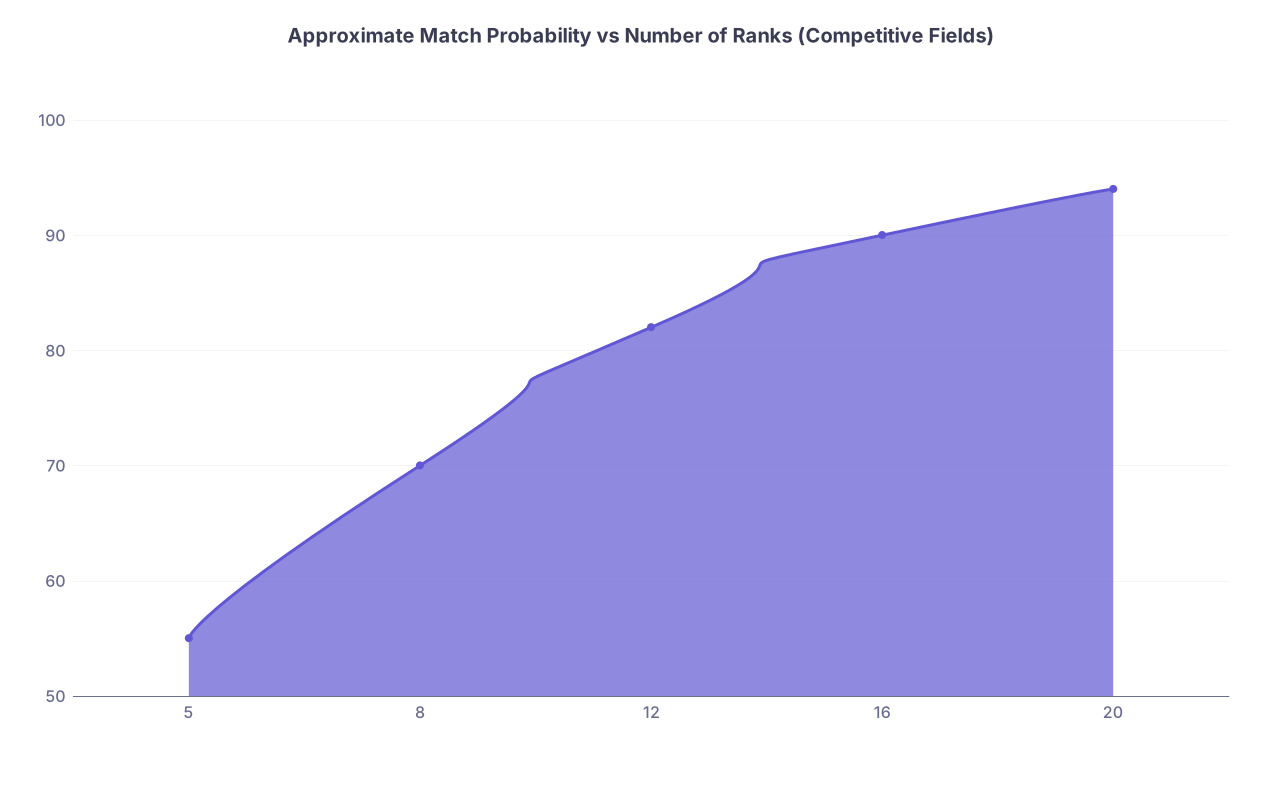
But “lukewarm” is different from “intolerable.” In a dual-competitive couples context, there is solid data showing that more ranks increase match probability:
| Category | Value |
|---|---|
| 5 | 55 |
| 8 | 70 |
| 12 | 82 |
| 16 | 90 |
| 20 | 94 |
Couples have a similar pattern. Truncating your list because “that interview felt just okay” is emotional, not strategic.
Myth 2: “If we rank few, strong combinations high, the algorithm will try harder to place us together.”
No, it will not. It will exhaust your short list quickly and then stop. There is no bonus round for “intense couples.”
Myth 3: “Programs will avoid us if we seem difficult to place.”
Yes, a small minority of PDs worry about complex couples. But if you are dual-competitive, most programs view you as assets, not burdens. You solve that by:
- Communicating clearly (a simple couples email indicating interest and geography constraints).
- Not playing games (e.g., do not threaten to rank them low if they do not guarantee to accommodate your partner).
8. Advanced Fine-Tuning: Tie-Breakers and Edge Cases
Once you have your rough structure, there are a few higher-level tie-breakers that matter when sorting within blocks.
Tie-Breaker 1: Long-Term Career Impact
Between two pair options like:
- (Top-5 program for Partner 1, mid-tier for Partner 2)
- (Mid-tier for both)
Ask honestly:
- Whose specialty is more prestige-sensitive for fellowships or academics?
- Who is more likely to be location-bound for family reasons later?
- Who already has leverage (strong CV, connections) independent of program rank?
Sometimes, it is rational to sacrifice one partner’s incremental prestige gain for the other’s baseline viability.
Tie-Breaker 2: Institutional Culture and Support
Dual-competitive couples often undervalue this. High-powered programs can be very unforgiving. Being in:
- Two malignant, hyper-demanding surgical services in the same hospital
can drive a relationship into the ground.
I have watched couples survive being 3 hours apart but collapse when both were being chewed up by toxic cultures at the same place.
Within similar-level combinations, prioritize:
- Reasonable call structures,
- Strong wellness and admin responsiveness,
- Places where the PD explicitly seemed supportive of couples / families.
Tie-Breaker 3: Backup Pathways
Pay attention to programs that:
- Have strong prelim / categorical IM / gen surg options for an unmatched spouse in future cycles,
- Or supportive departmental networks for reapplying if needed.
Choosing a program network that can absorb a later reapplication or a switch is not sexy. But it is very smart.

9. A Worked Example: Ortho + EM Couple
Let me walk you through a simplified but realistic example.
Partner 1: Ortho
- Step 2 CK 252, AOA, 15 ortho interviews (7 top academic, 8 mid-tier).
Partner 2: EM
- Step 2 CK 240, strong SLOEs, 14 EM interviews (mix of academic and community).
Shared interview cities:
- Midwest Large City (MLC): P1 at MLC Ortho, P2 at MLC EM #1 and #2.
- Northeast City (NEC): P1 at NEC Ortho #1, P2 at NEC EM.
- Southeast City (SEC): P1 at SEC Ortho, P2 at SEC EM & SEC EM Community.
- Home region Community cluster: multiple smaller programs within 2–3 hours.
They build:
Top couples ranks: 1–3: All combinations in NEC (their dream city):
- (NEC Ortho, NEC EM)
- (NEC Ortho, SEC EM) if within train distance, etc., depending on geography.
4–10: Dense block of all reasonable combinations in MLC and SEC (same city, 1–2 hr radius).
11–20: Mixed regional pairs where one is in home region cluster and the other is within 2–3 hours drive.
After #20: They introduce uncoupled tails:
- Ortho partner ranks all remaining ortho programs solo down to mid-low tier.
- EM partner ranks remaining EM programs including community, plus a short list of prelim medicine programs as extreme fallback.
This couple has:
- Optimized for strong, same-city matches high on the list,
- Built a thick middle of “reasonable” co-located or regional options,
- And protected themselves against complete catastrophe with individual tails.
Is this romantic? Not particularly. Does it work? Yes.

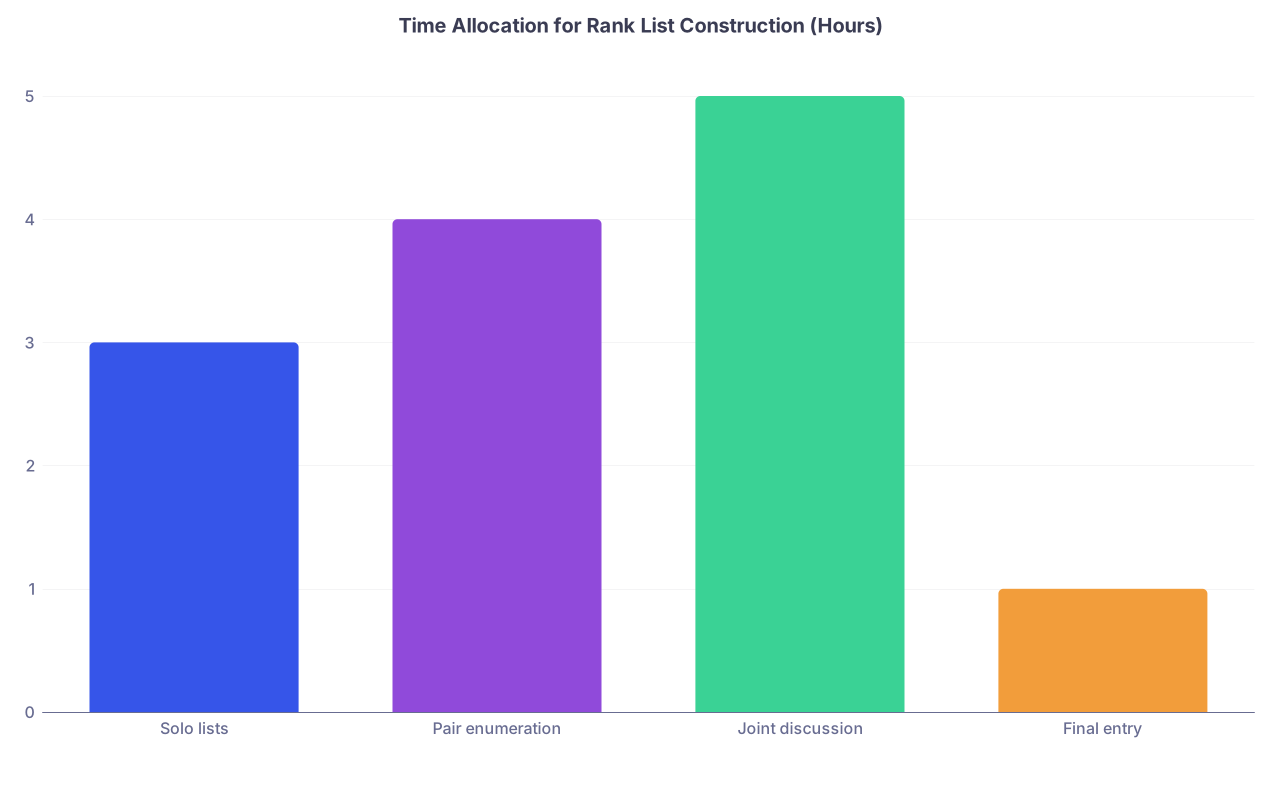
10. Practical Workflow: How to Actually Do This Without Losing Your Mind
Here is a straightforward workflow I have seen work for dual-competitive couples:
- Each partner builds their solo rank list in a spreadsheet.
- You create a joint sheet with:
- Columns for Partner 1 program, Partner 2 program, city, distance, perceived combined desirability (1–10).
- You list all feasible paired combinations (start with same institutions, then same city, then same region).
- You independently rate each combination (1–10) without debating.
- You compare ratings, discuss discrepancies, and assign a final “joint desirability” score.
- Sort by that final score, then manually adjust for:
- Geographic radius progression,
- Safety layering,
- Prelim/advanced alignment.
- Only then transfer your agreed pairs into the NRMP couples system in order.
It is work. You are not special for being tired. You are special if you actually do this rigorously.
| Category | Value |
|---|---|
| Solo lists | 3 |
| Pair enumeration | 4 |
| Joint discussion | 5 |
| Final entry | 1 |
FAQs
1. How many coupled rank pairs should dual-competitive couples aim for?
For highly competitive specialties, I like to see at least:
- 25–30 meaningful coupled pairs at minimum,
- Ideally 40–60 if you have enough interviews and geographic spread.
Less than ~20 coupled pairs in dual-competitive fields usually means you are being too picky or not exploiting all city/region combinations.
2. Should we ever rank “one matched, one unmatched” combinations?
No. The NRMP system does not allow combinations like “Program X for Partner 1, No Match for Partner 2” as an intentional choice. You can indirectly approximate “one unmatched” by having one partner keep a very short list and the other a long one, but that is almost never wise. If you value one person’s match so much that the other is expendable, you should not be couples matching.
3. Is it safer to uncouple and apply independently if we are both in ultra-competitive specialties?
Usually no. The couples algorithm does not inherently harm strong applicants. What harms them is poor list construction. If you both have solid interview numbers and are willing to be rational—not rigid—about geography and program tier, you are almost always better off couples matching. Uncoupling purely out of fear usually leads to regret when you end up in distant cities needlessly.
4. How do we handle a last-minute change, like one partner failing to match in an early match (ophtho/uro)?
You need pre-agreed contingency plans. For example:
- Branch A: Early-match partner matches at City X → NRMP partner pushes City X and region programs higher on their list.
- Branch B: Early-match partner does not match → that partner rapidly pivots to prelim/TY or SOAP strategy, and the NRMP partner does not distort their own list too aggressively trying to “preserve” geography for a future unknown.
You cannot fix early-match failures in February by blowing up the second partner’s carefully constructed NRMP list. You protect both long-term careers first, then work on geography later.


