

Most couples match problems are not about love or geography. They are about people misunderstanding how advanced and categorical positions actually pair in the algorithm.
Let me walk you through this the way I explain it to fourth‑years in October when their spreadsheets start to melt down.
You are dealing with three overlapping systems:
- Categorical positions (full 3–7 year programs)
- Advanced positions (start PGY‑2, need a separate PGY‑1)
- The couples match pairing rules (two lists locked into ordered pairs)
When you mix those three, bad assumptions become rank‑list disasters. The NRMP algorithm will do exactly what you tell it to do. If your pairs are poorly constructed, it will very calmly match you into a nightmare.
We are going to avoid that.
Core concepts: what you are actually matching
Before we mess with complex pairings, you need the vocabulary completely clean.
Categorical vs advanced vs prelim vs TY
Quick definitions, but with the consequences spelled out.
Categorical position
Complete residency from PGY‑1 through final year.
Examples: Internal Medicine categorical, General Surgery categorical, Pediatrics, OB/GYN, Psychiatry.Advanced position
Starts at PGY‑2. You must arrange a separate PGY‑1 year.
Examples: Neurology (many programs), Anesthesiology (many), Radiology, PM&R, Dermatology, Ophthalmology, Radiation Oncology.Prelim year (Preliminary Medicine/Surgery)
One‑year PGY‑1 that usually does not guarantee continuation at that institution.
Mostly IM or Surgery. Sometimes very service‑heavy. Often competitive in good locations.Transitional Year (TY)
One‑year PGY‑1 with a mix of IM, outpatient, electives, sometimes surgery.
Generally more cush. Often heavily sought after by advanced applicants.
Here is the piece most couples miss:
You are not “couples matching into Neurology.”
You are:
- Person A: matching “Adv Neurology + PGY‑1 (TY or Prelim)”
- Person B: matching “whatever their specialty is (categorical or similar advanced+PGY‑1 bundle)”
And those two independent sets have to be structured as linked rank pairs.
So every time you say, “We want to be in Boston,” what you really mean is something like:
- Partner 1: Mass General neuro advanced + some Boston TY/prelim
- Partner 2: MGH IM or BIDMC OB/GYN or Tufts Psych, etc.
If you do not represent that correctly in your rank pairs, the algorithm will not “fill in the gaps” for you. It will happily send one of you to an advanced position with no intern year secured.
How the couples match algorithm actually treats advanced slots
The algorithm is agnostic. It does not care whether a position is categorical or advanced. It only sees “program codes.”
You must internalize two rules:
Each line of your ROL is a pair of positions.
Partner A’s choice #k + Partner B’s choice #k. The algorithm moves down the list of pairs in order.Each program code is independent.
A TY in City X is a different code from an Advanced Neuro job in City X. The couples link does not magically know those “belong together” unless you explicitly rank them in paired positions.
So for an advanced specialty partner, there are actually two separate match problems:
- Matching into an advanced PGY‑2
- Matching into a PGY‑1 year (prelim or TY) that is acceptable
And those are intertwined with whatever the other partner is doing.
You cannot treat them as an afterthought.
The basic patterns: “easy cases” before the ugly ones
Let’s start with three simpler archetypes, then we will stack complexity.
Case 1: Advanced specialty + categorical in the same city
Example:
- Partner A: Diagnostic Radiology (advanced)
- Partner B: Internal Medicine (categorical)
Goal: Both in the same metro area (say, Chicago).
Partner A typically will:
- Apply to: Advanced DR programs in Chicago (e.g., UChicago, Northwestern, Rush)
- Apply to: TYs and prelim medicine/surgery in the same region
Partner B will:
- Apply to: IM categorical programs in those same big hospitals and perhaps some community spots.
The core rank‑list principle:
You rank pairs that represent real, simultaneous arrangements you would accept.
So, one of your top pairs might look like:
A: Northwestern DR (advanced) + Northwestern TY
B: Northwestern IM categoricalA: UChicago DR (advanced) + UChicago Prelim Medicine
B: UChicago IM categoricalA: UChicago DR (advanced) + NorthShore TY
B: UChicago IM categorical
Notice something important. In line 3, Radiology is at UChicago advanced, intern year at NorthShore, partner at UChicago IM. That is a single pair. The algorithm sees it as one joint scenario.
Now compare that with this disastrous style I see in real rank lists:
- Partner A: Ranks UChicago DR advanced high, but puts UChicago prelim much lower, and a random TY in another city in between.
- Partner B: Ranks UChicago IM high.
When you join their lists, you can easily create a pair where:
- Partner A: UChicago DR advanced
- Partner B: UChicago IM
- …but A has no acceptable intern year ranked high enough in Chicago.
The algorithm can match A into UChicago DR and B into UChicago IM, while A ends up doing a prelim in another city or unmatched for PGY‑1. That is the nightmare.
So in this “simpler” case:
- You group each combined scenario explicitly.
- You do not rely on “we rank everything high somewhere; the system will figure it out.”
It will not.
Case 2: Advanced + advanced in the same city
Example:
- Partner A: Anesthesiology (advanced)
- Partner B: Radiology (advanced)
Now you have four moving parts:
- A: advanced positions
- A: prelim/TY
- B: advanced positions
- B: prelim/TY
In a city like Boston, that might be:
- A advanced: MGH anesthesia, BID anesthesia, BMC anesthesia
- A PGY‑1: multiple TYs/prelims across Boston
- B advanced: MGH DR, BID DR, Tufts DR
- B PGY‑1: same set of TYs/prelims
You need to think in bundles:
“MGH anesthesia + MGH TY” is a bundle for A.
“MGH DR + MGH TY” is a bundle for B.
Then you pair bundles:
A: MGH anesthesia (Adv) + MGH TY
B: MGH DR (Adv) + MGH TYA: BID anesthesia (Adv) + BID TY
B: BID DR (Adv) + BID TYA: MGH anesthesia (Adv) + MGH TY
B: BID DR (Adv) + MGH TY
You quickly see why couples in this configuration end up with 60–100 rank pairs. That is normal. Annoying. But normal.
You cannot shortcut this with “we will just put all our advanced programs first and all the TYs below; the computer will pair them sensibly.” That is fantasy.
Case 3: Categorical + categorical (for contrast)
Just so you feel how simple life could have been.
Example:
- Partner A: Pediatrics categorical
- Partner B: OB/GYN categorical
Same city goal. Your rank detail looks like:
A: CHOP Peds
B: Penn OB/GYNA: CHOP Peds
B: Jefferson OB/GYNA: Penn State Peds
B: Penn State OB/GYN
No separate PGY‑1. No splitting of years. That is why categorical+categorical couples leave meetings looking much less stressed.
We are finished with the easy stuff. Now the real problems.
Advanced + categorical in different cities: “trade‑off” structures
This is where you earn your sanity.
Scenario:
- Partner A: Radiology (advanced) – has strong interviews in City A and City B
- Partner B: Internal Medicine (categorical) – stronger in City B and City C
- You are willing to do 1 year apart if it secures better programs overall.
The mistake couples make here:
They talk about preferences (“we would accept 1‑year apart if it means both are at top‑tier places”), then never actually encode that trade‑off into the ordered pair list.
You need to define tiers:
- Tier 1: Same city, both at top choices
- Tier 2: One partner at clearly better program, other slightly worse, same city
- Tier 3: One year apart but both at clearly higher individual programs
- Tier 4: Same city, more mid‑tier
- Tier 5: Backup combinations (less desirable geography/programs)
Then you literally write the list reflecting that.
Example pairs:
A: City B DR (top program) + City B TY
B: City B IM top programA: City A DR top + City A TY
B: City A IM midA: City B DR top + City B TY
B: City C IM top (you live apart 3+ hours)
If you truly believe that #3 is preferable to any “both of us in weak programs in same city,” you must place it above those weaker‑same‑city pairs.
Couples often say that, but emotionally cannot bring themselves to rank it correctly. Then they get “compromise programs” they secretly did not want.
The algorithm respects your written order, not your late‑night conversations.
The hidden killer: PGY‑1 year location vs PGY‑2+ location
Advanced specialties introduce a temporal problem: being in two different cities for PGY‑1 vs PGY‑2+.
There are three basic configurations for the advanced partner:
Same city for PGY‑1 and PGY‑2+
Example: UChicago DR advanced + UChicago prelim IM.Nearby cities for PGY‑1 and PGY‑2+
Example: UChicago DR advanced + Evanston TY (commutable).Completely different cities
Example: Denver DR advanced + Kansas City TY.
Most couples want #1 or #2, accept #3 only in late‑backup territory.
You have to reflect that in your pairs. Specifically:
- Good advanced + badly located prelim/TY = lower pair
- Slightly weaker advanced program + well‑located/preferable TY = often higher pair
If partner B is categorical in City X, and you put:
- A: City Y advanced + random City Z prelim
- B: City X categorical
too high, you might create a situation where for one entire year the advanced partner is separated twice: from their future department (PGY‑2 city) and from their partner (who is categorical elsewhere).
If you truly would not accept that, you cannot rank it high. Even if the names are big (MGH, Hopkins, etc.).
This is where you have to be unromantic and specific:
- “I would rather do mid‑tier DR in the same city as my partner than top‑10 DR 2 time zones away with my intern year in yet a third place.”
Once you say that out loud, the order becomes clearer.
How many rank pairs do you actually need?
Students ask this constantly. The annoying answer: enough to cover all realistic acceptable combinations, not one more.
Here is a rough comparison so you see you are not crazy:
| Couple Type | Common Range of Pairs |
|---|---|
| Both categorical, same few cities | 10–30 |
| One advanced + one categorical | 30–80 |
| Both advanced, multiple cities | 60–120 |
| “We prefer to be together no matter what” | Lower end of each range |
If you are an advanced + categorical couple, 50–70 carefully constructed rank pairs is not excessive. I have seen 100+ for radiology + derm couples trying to optimize across 4 cities.
What is excessive: 120 pairs that are random and internally inconsistent.
Step‑by‑step: constructing a complex advanced + categorical couples list
Let me give you a concrete framework. Use this. It works.
We will use a sample couple:
- Partner A: Anesthesiology (advanced)
- Partner B: Internal Medicine (categorical)
- Target cities: City 1 (home), City 2, City 3.
Step 1: Build individual program preference lists first
Individually, ignoring couples constraints:
- A ranks all anesthesia advanced programs in absolute order, across all cities. Then, separately, all TY/prelim programs in order.
- B ranks all IM categorical programs in pure preference order.
Do this on paper or a spreadsheet first, not directly in NRMP. Remove the couples variable so you see your true program preferences.
Step 2: Group programs by geography and quality bands
For each city, label:
- “Excellent,” “Good,” “Acceptable,” “Bare minimum” for each person.
Example for City 1:
- A, Anesthesia: City 1 Univ = Excellent; Community 1 = Good
- A, PGY‑1: City 1 TY = Excellent; City 1 prelim IM = Acceptable
- B, IM: City 1 Univ = Excellent; Community 2 = Good; Small hospital = Bare minimum
This matters because tying an “Excellent” for A to a “Bare minimum” for B is a real trade‑off.
Step 3: Decide your principles, explicitly
This is the part couples skip, then fight about later.
Write down 3–5 rules, for example:
- We will not live in different cities after PGY‑1.
- We would accept 1 year apart (PGY‑1 vs PGY‑2 city) if both end up in top‑tier programs we love.
- We prefer being in City 1 together in “Good” programs over being apart in “Excellent” programs.
- We will not rank any combination where one person is in “Bare minimum” unless the other person is in their absolute top 2 program.
You do not need those exact rules. But you need something this explicit.
Now your rank list is just an encoding of these principles.
Step 4: Construct “bundles” for the advanced partner
Partner A’s actual usable entries are not “MGH Anesthesia” and “MGH TY” separately. They are bundle slots:
- Bundle A1: MGH Anesthesia + MGH TY
- Bundle A2: MGH Anesthesia + BWH TY
- Bundle A3: BWH Anesthesia + MGH TY
- Bundle A4: BWH Anesthesia + BWH TY
- Bundle A5: MGH Anesthesia + generic good TY in same city
- …and so on.
You realistically do not need to consider every possible cross‑combination. Use your principle rules:
- If you know you will not commute 90 minutes for a TY, that bundle does not exist.
- If one TY is clearly worse, drop it entirely rather than ranking 20 permutations of it.
The goal is: a manageable list of “A would be happy enough with this combination of PGY‑1 + advanced”.
Step 5: Pair bundles with B’s categorical programs
Now you create the actual couples rank pairs.
Start with most desirable joint scenarios:
A: Top advanced bundle in City 1
B: Top categorical in City 1A: Second advanced bundle in City 1
B: Top categorical in City 1A: Top advanced bundle in City 1
B: Second categorical in City 1
You keep going down this “City 1” block until you reach combinations that violate your stated principles (e.g., A at Bare minimum advanced in City 1 vs B at Excellent in City 2 – and you said you would not accept that).
Then you construct the “City 2” block similarly, always comparing to where those combos should fall relative to remaining City 1 options.
The crude rule:
- Same‑city Excellent+Excellent pairs go first.
- Same‑city Excellent+Good follow.
- One‑city‑apart but individually Excellent+Excellent combos come somewhere in the middle depending on your principles.
- Same‑city Good+Good or Good+Acceptable near the middle or lower end.
- Any combo with Bare minimum anywhere belongs near the bottom if it is ranked at all.
This is not rocket science. It is ruthless honesty about trade‑offs.
The “no PGY‑1” disaster and how to avoid it
You have to keep one ugly scenario in mind all the time:
- Partner A matches to an advanced position but does not match to a PGY‑1 year.
- Partner B matches somewhere categorical.
- You now scramble for an intern year and may be in a different city, or unmatched entirely.
This tends to happen when:
- A ranks a lot of advanced spots high with limited prelim/TY options ranked; or
- A’s prelim/TY preferences are all geographically constrained and very competitive; or
- The couples pairs put advanced slots much higher than realistic PGY‑1 combinations.
To reduce this risk:
A must rank a robust, realistic list of prelim/TY programs, including some less desirable but still acceptable ones. Not just the shiny 3 TYs everyone wants.
Your couples rank pairs should include:
- High‑probability PGY‑1s bundled with mid‑range advanced positions
- Not only “top 5 advanced + top 3 TYs” fantasy bundles
If A is going DR, I want to see US grads with:
- 10–15 advanced DR programs
- 10–20 prelim/TY programs (with a mix of competitiveness)
And in the couples list, I want robust numbers of:
- Pairs where A’s advanced is in their 5–10 range but the PGY‑1 is quite safe
- Not just “MGH DR + MGH TY” and nothing more realistic.
Remember: the algorithm matches the couple pair as a unit, but A’s internal risk of not matching PGY‑1 is still very real if you do not give the system enough acceptable options.
RBW: Reality‑Based Warnings for common advanced+categorical mistakes
Let me be blunt about the most common errors I see.
Error 1: “We will fix it in SOAP if PGY‑1 does not work out”
Terrible plan.
- SOAP PGY‑1 spots vary wildly by year and region.
- Your partner’s categorical match location is fixed.
- You could end up with your advanced match in Boston, your partner in Chicago, and your only SOAP PGY‑1 in Oklahoma.
If you match an advanced position without an attached PGY‑1 from your ROL, assume that year will be chaotic. Do not design your list counting on SOAP to bail you out.
Error 2: Ranking “dream” distant programs above realistically desirable joint scenarios
Example: A wants top‑5 Derm in LA, B wants strong IM but is competitive, and your entire life is on the East Coast.
If you put:
- A: UCLA Derm + LA TY
B: UCLA IM (which is a long shot for B)
above:
- A: Very strong Derm in Philadelphia + Philly TY
B: Strong IM at Penn/Jefferson
you are telling the algorithm you prefer a low‑probability fantasy and are willing to drop down to much worse combos if that fails, instead of taking a very strong “both are happy in Philly” scenario.
Do not mistake lottery tickets for strategy.
Error 3: Not aligning the granularity of your preferences
One partner is ultra‑picky about program prestige. The other is mainly location‑focused. If you let that play out unstructured, you get weird pairs like:
- A: Top‑10 program, City 4 (where B has no interviews)
- B: Mid/low tier, City 4 (they only added it last minute for you)
Ranked surprisingly high.
Your list then implies you are happy to drag B into a low‑quality situation, in a city they never liked, just to hit A’s brand‑name wish. That may be true. Usually it is not. Talk it out. Then reflect the reality, not the Instagram version.
A visual: typical decision flow for an advanced + categorical couple

| Step | Description |
|---|---|
| Step 1 | List individual preferences |
| Step 2 | Define cities & quality tiers |
| Step 3 | Write 3-5 explicit principles |
| Step 4 | Create advanced partner bundles (PGY2+PGY1) |
| Step 5 | Pair bundles with categorical programs by city |
| Step 6 | Order pairs by principles (same city, quality) |
| Step 7 | Add realistic backup PGY1-heavy pairs |
| Step 8 | Review for PGY1 gaps & unrealistic fantasies |
Use this as a sanity checklist once you think you are “done.”
Quick example: putting it all together
Let us do a compact but concrete mock list.
- Partner A: Radiology (advanced)
- Partner B: IM categorical
- Cities: Boston (most desired), Providence (second), Hartford (backup)
Principles they agree on:
- Prefer same‑city even if programs are slightly weaker.
- Will not live in different cities after PGY‑1.
- Will accept 1‑year apart (advanced vs PGY‑1 location) only within a 1‑hour commute radius.
- Will not rank any combo where either partner is below “Acceptable” tier.
Bundles for A (simplified):
- A1: MGH DR + MGH TY (Excellent/Excellent)
- A2: MGH DR + Lahey TY (Excellent/Good, commute OK)
- A3: BID DR + BID TY (Excellent/Excellent)
- A4: Brown DR + Brown TY (Good/Good)
- A5: Hartford DR + Hartford prelim (Acceptable/Acceptable)
B’s top categorical IM:
- B1: MGH (Excellent)
- B2: BID (Excellent)
- B3: Brown (Good)
- B4: Hartford (Acceptable)
Now build pairs:
- A1 (MGH+MGH) / B1 (MGH) – both Excellent, same city, ideal
- A3 (BID+BID) / B2 (BID) – both Excellent, same city
- A2 (MGH+Lahey) / B1 (MGH) – small commute PGY‑1 for A, still Boston focused
- A4 (Brown+Brown) / B3 (Brown) – both Good, same (second‑choice) city
- A5 (Hartford+Hartford) / B4 (Hartford) – both Acceptable, same backup city
You could insert cross‑city fantasies like:
- A1 (MGH+MGH) / B3 (Brown) – A in top Boston, B in Providence
Where does that go? Based on their principles (“prefer same‑city even if programs slightly weaker”), that combination probably belongs below the Brown/Brown pair and maybe near or below Hartford/Hartford pairs.
So maybe:
- A1/B1
- A3/B2
- A2/B1
- A4/B3
- A5/B4
- A1/B3 (A in dream, B commuting or separate city; lower priority)
That ordering is where couples either get honest or self‑deluding. Be honest.
When to pull in program leadership or advisors
You do not need your dean to bless every line of your couples rank list. But you should ask for targeted help in a few scenarios:
- One of you is significantly weaker on paper (low Step, failures, red flags) while applying to a competitive advanced specialty.
- You are targeting extremely competitive metros (San Francisco, Boston, NYC) with limited geographic flexibility.
- You are trying to coordinate same‑institution TY + advanced pairs that historically do not take many couples.
Program directors will not design your list, but they can tell you, for example:
- “Matching here advanced without our TY is common / rare.”
- “Your prelim chances at this hospital are lower than you think.”
- “Your IM partner is solid for this program; your DR odds here are very slim.”
You can feed that back into your pair ordering.
One more visual: volume of rank pairs vs complexity
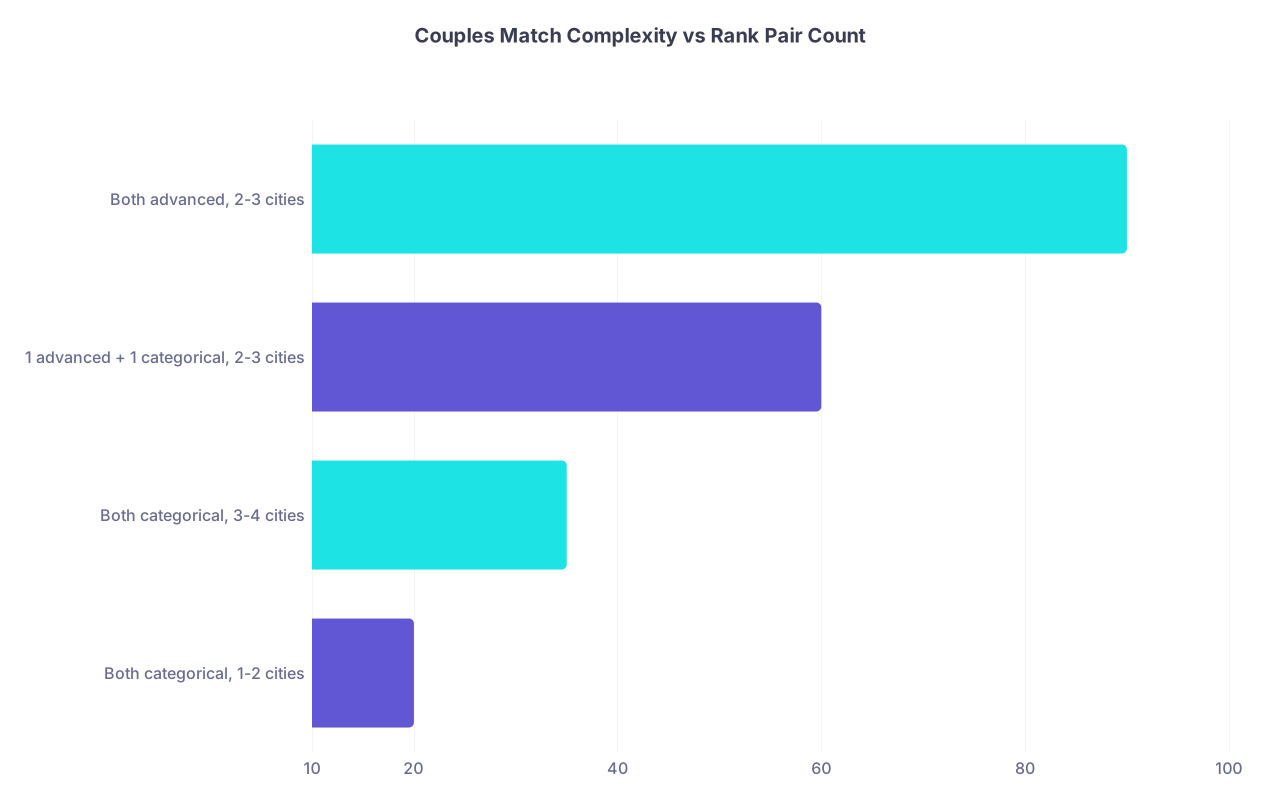
| Category | Value |
|---|---|
| Both categorical, 1-2 cities | 20 |
| Both categorical, 3-4 cities | 35 |
| 1 advanced + 1 categorical, 2-3 cities | 60 |
| Both advanced, 2-3 cities | 90 |
If you are an advanced + categorical couple with ~50–70 well‑constructed pairs, you are right where you should be.
Sanity checks before you certify
Use this quick checklist the week before the deadline. Sit together with your final list.
Take your top 10 pairs. For each, ask aloud:
“If the algorithm gives us exactly this pair, will we both be more relieved than disappointed?”
If you hesitate, that pair is probably too high.Check PGY‑1 coverage for the advanced partner:
- Do your high‑ranked advanced slots have plausible PGY‑1s bundled?
- Do you have some pairs where the PGY‑1 is safe even if the advanced is mid‑tier?
Look for obviously inconsistent patterns:
- Same exact advanced program for A with wildly different B destinations ranked backwards (e.g., A@MGH+B@mid‑tier ranked higher than A@MGH+B@top tier, without a clear reason).
Confirm you have no “deal‑breaker” pairs above “we would honestly rather go unmatched and scramble” level.
If a combination would make you feel trapped or miserable, delete it. Do not rank it just because “it seems safer than nothing.”
Two final points
The algorithm is not your advisor.
It will not “infer” that you would prefer an easier prelim nearby to a shiny TY 4 hours away. If you want that, you must rank it that way.Advanced + categorical couples do not fail the match because the system is unfair.
They fail because their rank lists are incoherent with their actual preferences, or because they underestimated how many realistic PGY‑1 options the advanced partner needed.
If you remember nothing else:
- Think in bundles for the advanced partner (PGY‑2+PGY‑1), not individual programs.
- Encode your real‑world trade‑offs into actual rank pair order, not just late‑night conversations.
- Protect the advanced partner’s PGY‑1 with enough realistic, acceptable prelim/TY options tied into your couples list.
Do that, and even very complex advanced + categorical combinations stop being mysterious and start being a structured problem you can actually solve.


