

The fastest way to torpedo a couples match is to copy‑paste your personal statements.
You will not hear that from most advisors. They will tell you to “align your narratives” and “show consistency as a couple.” Fine. Alignment is good. But lazy copying?
That is how you get flagged, dismissed, or quietly ranked at the bottom of the list.
Let me walk you through the traps I have seen couples fall into over and over. Same mistake, different names.
The Core Problem: Programs Can See The Seams
Programs are not stupid. They read hundreds of applications side by side. Same year. Same specialties. Same med school pipelines. They notice patterns.
When a couple submits:
- Identical opening anecdotes with swapped pronouns
- The same “how we met” paragraph, lightly edited
- Matching “why this specialty” logic with identical structure and phrasing
…it screams one thing: low effort and poor judgment.
And that matters a lot more than you think. Because for couples matching, programs are already asking themselves:
- Are we willing to take the logistical hit of accommodating these two?
- Are they strong enough individually to justify that effort?
- Do they seem professional, mature, and self‑aware?
A copy‑paste feel to your personal statements quietly answers #3 with “No.”
You are telling them you did not respect the process enough to write your own story.
Why Copy-Paste Statements Backfire Specifically for Couples
This is not just a writing-style problem. It directly undermines the one thing you must prove as a couple: that you are two strong, independent applicants who also happen to be together.
Copy‑paste narratives do the opposite. They make you look fused, co‑dependent, and interchangeable.
Here is how that plays out in program discussions.
1. You Look Like One Applicant in Two Bodies
I have seen this in selection meetings:
Someone pulls up two applications side by side.
“Are these… the same essay?”
Chuckles around the table.
“Are we matching them to residency or to each other?”
Once that question is in the room, you are fighting upstream.
Programs want to train physicians, not manage relationship dynamics. If your application looks more like a joint Christmas letter than two professional narratives, you confirm their fear: that residency decisions will need to revolve around your relationship rather than your work.
2. You Reduce Your Own Individual Value
For couples, the game is already more constrained. Programs ask:
- Would we take Applicant A even without Applicant B?
- Would we take Applicant B even without Applicant A?
If your personal statement reads as “I am half of a unit” instead of “I am a strong applicant who is also part of a couple,” they mentally discount you.
Copy‑pasted or parallel essays make it harder for anyone in the room to argue:
“Even if we cannot accommodate the couple, this individual is a must-have.”
You never want to make it easy for them to write off both of you together.
3. You Trigger Fit Concerns Across Two Departments
Couples match almost always spans two departments. Medicine + Pediatrics. Internal Medicine + Neurology. Psychiatry + Family Medicine. Or something more brutal like Derm + Ortho.
If both departments see nearly identical structure, tone, and even sentences in your essays, two red flags pop up:
- They wonder who actually wrote what.
- They doubt whether each of you truly understands your own specialty.
Worst case: it looks like one of you wrote both drafts, and the other just signed their name. That is a terrible look.
The Subtle Ways Programs Catch Copied Essays
You are probably thinking, “We will not literally copy-paste. We will just use similar stories and structure.”
Careful. That is how people get caught without realizing it.
Here are the patterns that stand out instantly when reviewers read both of your files.

Mirrored Openings
Both essays start with the same event:
- Same rotation
- Same patient
- Same “we stood at the bedside and realized…” framing
Even if a few adjectives change, experienced readers notice that echo. And the bigger sin is this: you just wasted the chance for each of you to show a distinct first impression.
If the most valuable real estate in your essay—your first paragraph—tells the same story twice, you are squandering differentiation.
Parallel Paragraph Structure
I see this constantly in couples:
- Paragraph 1: “My path to medicine began…”
- Paragraph 2: “I discovered my passion for [specialty] when…”
- Paragraph 3: “Working with [partner’s name] has taught me…”
- Paragraph 4: “I am drawn to your program because…”
You shuffle a few words, change the patient’s age, or swap who cried at the bedside. It does not matter. The skeleton is obviously shared.
Again, the issue is not collaboration. It is uniformity. When your statements read like templated answers, you look coached, inauthentic, and non‑reflective.
Identical Phrases and Stock Sentences
Admissions people are professional pattern recognizers. They catch:
- The same metaphor (“like the conductor of a complex orchestra”)
- The same closing line (“I hope to grow both as a clinician and as a person”)
- The same couples language (“We are committed to supporting each other’s growth and your program’s mission.”)
You might not even remember you both used the same phrase. But side-by-side, it is glaring.
Where Couples SHOULD and SHOULD NOT Overlap
You are not forbidden from referencing each other or aligning your stories. But there is a clean line between strategic alignment and lazy duplication.
Here is that line.
| Area | Healthy Alignment | Risky Copy-Paste |
|---|---|---|
| Overall theme | Similar values, different examples | Same anecdotes, same angle |
| Mentioning your partner | Brief, specific, in one paragraph max | Threading partner through entire essay |
| Program priorities | Shared geographic/family rationale | Identical “why this city / region” text |
| Structure | Same general flow, unique content | Matching paragraph-by-paragraph layout |
| Voice & tone | Both reflective, professional | Same phrasing, same clichés, same rhythm |
What SHOULD Match
A few things absolutely should align across your applications as a couple:
- Geographic priorities (e.g., both clearly committed to the same region)
- General values (teaching, underserved care, research, work-life balance)
- The fact that you are couples matching (consistently noted, same name, no surprises)
This is not copy‑paste; this is coherence.
What MUST NOT Match
You cannot share:
- The same main clinical story
- The same “origin story” for your specialty
- The same emotional climax or “turning point” moment
- The same reasons for why you chose your specialty
You and your partner did not live the exact same career, even if you shared rotations. If you write like you did, you look unoriginal. Or worse, dishonest.
The Psychological Trap: “We Want to Show We’re a United Front”
I get it. Couples feel like they need to prove they are serious, stable, and aligned. That anxiety often translates into:
“Let’s make sure our essays look like we’re totally on the same page.”
The instinct is understandable. The execution is often disastrous.
You can demonstrate that you are a united front without fusing your identities into one blended statement.
Here is the better approach:

| Step | Description |
|---|---|
| Step 1 | Decide Shared Priorities |
| Step 2 | Agree on Geography & Big Picture |
| Step 3 | Individually Draft Essays |
| Step 4 | Light Peer Feedback Only |
| Step 5 | Add Brief Couples Match Note |
| Step 6 | Have Neutral Reader Check for Overlap |
Notice the sequence: individual drafting first, then controlled overlap. Not the other way around.
The worst thing you can do is sit with one Google Doc and “build two essays” from it. That is how you manufacture similarity you did not need.
Specific Copy-Paste Mistakes I See Couples Make
Let us get concrete. These are the repeat offenders that keep showing up.

1. Sharing a Single “Couple Origin Story”
“During our third-year Internal Medicine rotation at County Hospital, we both cared for the same patient, Mr. S…”
Then each of you tries to add a different emotional nuance. One focuses on communication, one on teamwork. But it is still the same patient, same hospital, same scene.
Programs do not need the movie told from two camera angles. They want two separate films.
Fix this:
If a story is “ours,” it probably should not be used as your primary personal narrative. Reference it briefly if it is truly central, but base your main story on something you personally led, experienced, or grew from.
2. Matching “Why This Specialty” Language
“So much of Family Medicine is about longitudinal relationships…”
“In Psychiatry, what matters most is longitudinal relationships…”
You can almost hear the shared Google Doc behind it.
Even if the values overlap (and they will, you are both in medicine), you must express them from the standpoint of each specialty’s distinct philosophy and daily work.
Fix this:
Before writing, each of you should answer out loud, without notes: “Why this specialty and not the other ones I liked?” Record it. Transcribe your actual spoken words. Use that as fodder. Your spoken reasoning will naturally diverge.
3. Over-Emphasizing the Relationship Itself
If your personal statement reads like:
- 50% about your path
- 50% about your relationship and how supportive you are of each other
…you have misread the assignment.
Programs want to know that you will show up, learn, work, and not implode. They do not need a romance novella.
Fix this:
Cap explicit relationship content in the personal statement to one short paragraph. Two at most. Your shared story belongs more in your supplemental communications, not as the spine of each person’s essay.
How To Coordinate Without Cloning
You can collaborate smartly without crossing into copy‑paste territory.
Here is a sane way to do it.
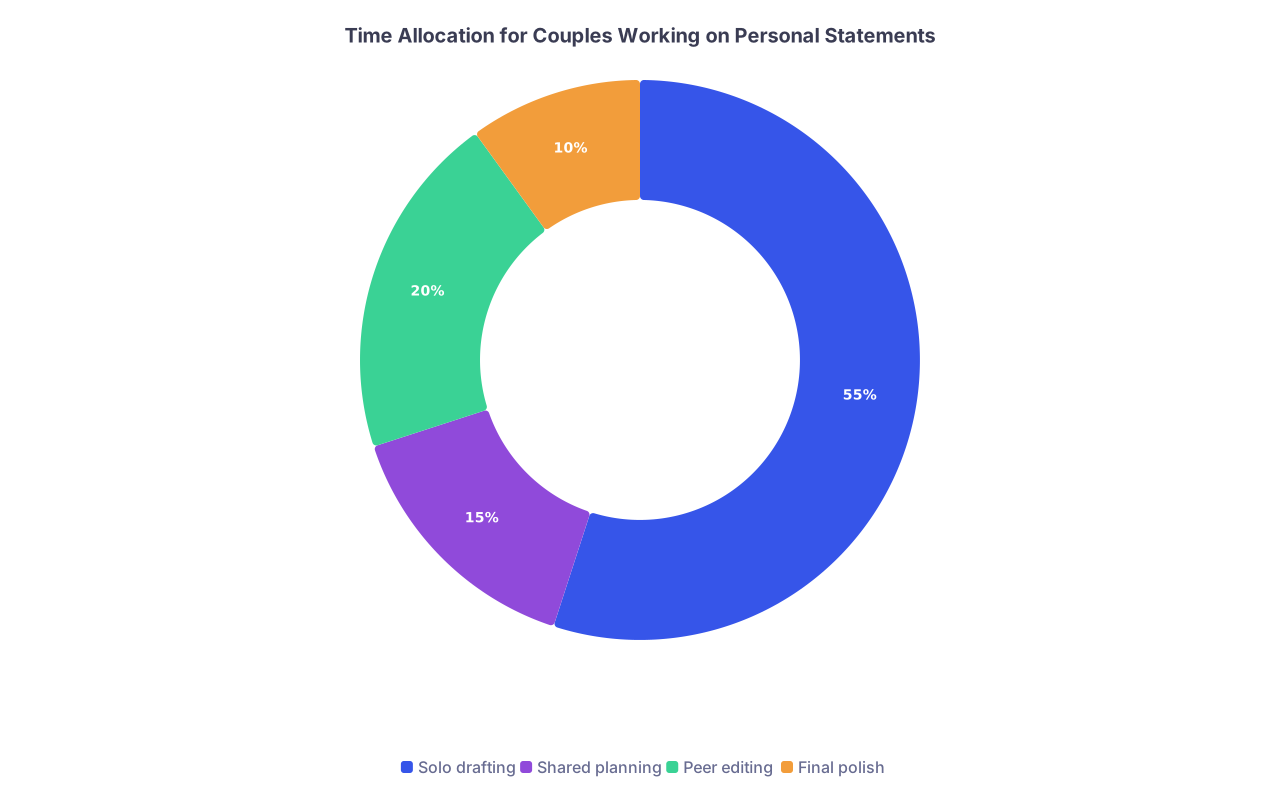
| Category | Value |
|---|---|
| Solo drafting | 55 |
| Shared planning | 15 |
| Peer editing | 20 |
| Final polish | 10 |
Step 1: Align on Facts, Not Phrasing
Sit down once. Agree on:
- How you label the relationship (married, engaged, long‑term partner)
- How long you have been together
- The geographic priorities you share
- The general plan if you do not match to the same program (yes, you should talk about that)
Then stop. Do not brainstorm sentences together. Do not write a shared “storyboard” for both essays. Agree on facts, then separate.
Step 2: Draft Completely Independently
Close the shared folder. No looking at each other’s drafts while you write your first version.
Each of you writes:
- Your own opening story
- Your own rationale for your specialty
- Your own description of career goals
If you both spontaneously choose the exact same story and same angle, that is your cue: one of you needs to change it. You are not identical people.
Step 3: Use Each Other Only as Light Editors
Once you both have full drafts, now you can swap:
- Ask: “Does anything here misrepresent us as a couple?”
- Ask: “Am I oversharing about you or our relationship?”
- Ask: “Am I too vague about our geographic or life constraints?”
What you do not ask: “Can I borrow this paragraph?” or “Can I use this same patient but change the details?”
Peer feedback is about clarity and accuracy, not sharing content.
Step 4: Explicitly Control the “Couples Content”
Decide where and how you reference the couples match:
- One short paragraph in the personal statement
- The couples box and partner’s AAMC ID in ERAS
- Possibly a short, factual email to programs closer to rank time
And that is it. Do not keep weaving the relationship through every section of the essay like a running motif. You are applying to residency, not for “Best Couple” in the yearbook.
Programs Talk. And They Remember Sloppy Couples.
If you think different departments in the same hospital never compare notes, you are kidding yourself.
I have seen this:
- Medicine thinks Applicant A is outstanding, Applicant B is weak.
- Pediatrics thinks Applicant B is fine, Applicant A is mediocre.
- Both discover the couple submitted nearly cloned essays.
- Suddenly there is much less enthusiasm on both sides.
Why? Because now they are not just weighing CVs. They are weighing your professionalism, maturity, and how much chaos your pairing could introduce into scheduling, coverage, and training.
Sloppy, copy‑paste essays send a signal:
“If this is how they handle their most important written professional document, how will they handle handoffs, notes, and communication when stressed?”
That may seem harsh. It is still the reality.
Quick Self-Check: Are Your Essays Too Similar?
Use this checklist before you hit submit.
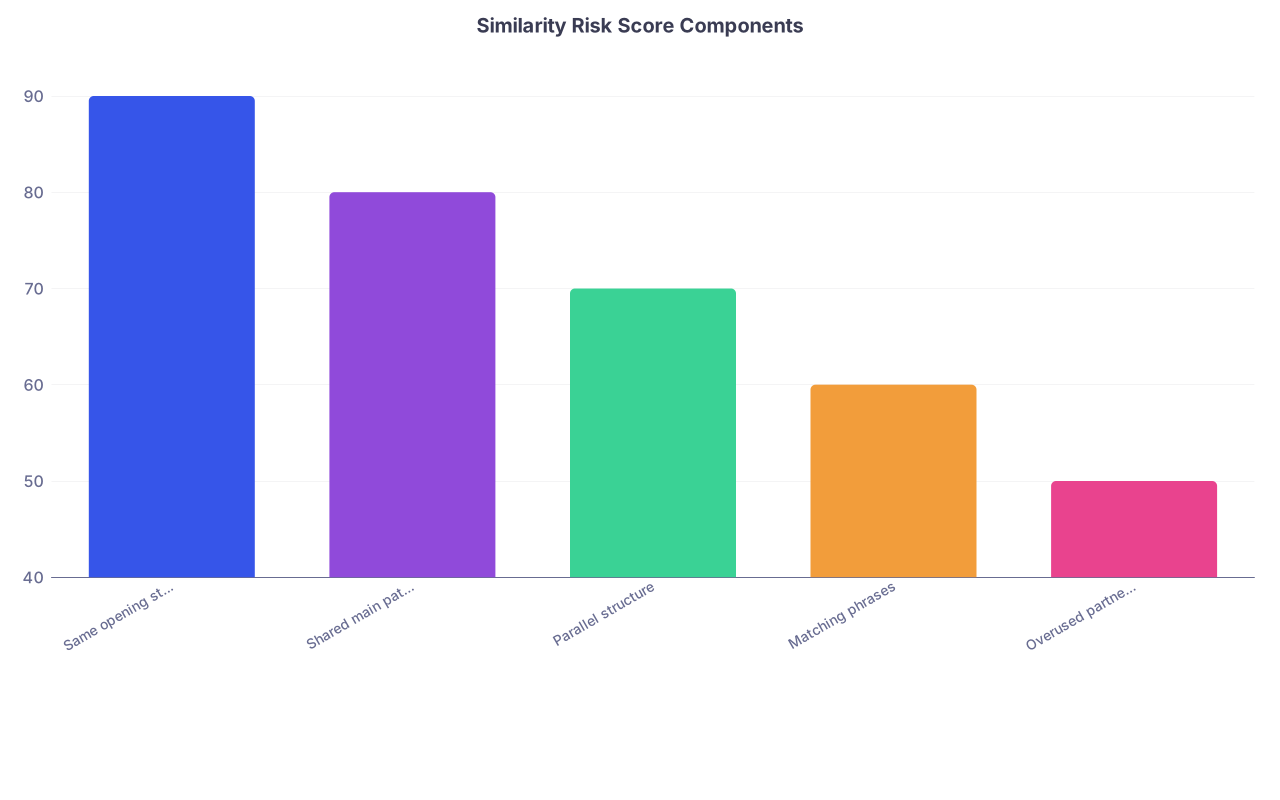
| Category | Value |
|---|---|
| Same opening story | 90 |
| Shared main patient | 80 |
| Parallel structure | 70 |
| Matching phrases | 60 |
| Overused partner focus | 50 |
If you answer “yes” to more than one of these, you have a problem:
- Do you open with the same rotation or the same patient encounter?
- Could a reviewer “overlay” your essays and predict each paragraph’s function?
- Do you share more than one anecdote explicitly referencing each other?
- Are there identical phrases or sentences between your essays?
- Does either essay spend more than 25% of its content on the relationship?
If so, one or both essays need significant revision. Not a few word swaps. A different angle.
A Better Model: Complementary, Not Cloned
The strongest couples match essays I have seen share these traits:
- Each partner has a distinct voice and narrative arc.
- The relationship is mentioned briefly, factually, and maturely.
- Their geographic and life priorities clearly align.
- Neither essay depends on the other to make sense or feel complete.
You read them separately and think, “I would rank this person even if their partner fell through.” Then you realize they are a couple and think, “Landing both would actually be a win.”
That is the goal. Two strong, self-contained applications that happen to interlock.

FAQs
1. Can we both mention the same major life event (e.g., immigration, family illness) if it affected us both?
Yes, but you should emphasize different aspects and different personal consequences. If both essays tell the same story, with the same framing, same emotions, and same “lesson learned,” it reads as duplication. Use the shared event as a backdrop, not as a mirrored centerpiece.
2. Is it ever acceptable to share a clinical story?
Only with extreme caution, and almost never as your primary anecdote. If you absolutely must reference a shared clinical moment, one of you should mention it briefly and anchor your growth in a different, clearly personal experience. Two main essays built on the same case is a classic couples mistake.
3. How much should we talk about being a couple in our personal statements versus elsewhere?
In the personal statement, one short, focused paragraph is enough: name the relationship, state you are couples matching, and connect that to your geographic commitment and stability—then move on. Use the ERAS couples checkbox and partner ID for the formal linkage, and reserve more detailed explanation for targeted emails to programs if needed. Your essays should still stand on their own as individual, compelling narratives.
Key points: do not reuse stories or structure across your statements, limit relationship content to a small, purposeful slice, and make sure each of you reads as independently strong enough that a program would fight to rank you even without your partner.


