
What actually happens to your chances when you click that terrifying little box that says “Couples Match”? Do programs quietly downgrade you the second they see that label?
Let me be blunt: most of what you hear about programs “hating” couples match applicants is second-hand anxiety, not data. There are trade-offs. But they’re not the ones people usually scream about on Reddit.
Let’s walk through what the evidence shows, what program directors actually say, and where couples really do get burned—because it’s usually not from bias, it’s from strategy mistakes.
What The Data Actually Shows About Couples Match Outcomes
First question: do couples match applicants do worse overall?
No. If anything, the opposite.
NRMP’s Couples Match data across multiple years shows a pretty consistent pattern: couples that participate in the match as a pair have a higher overall likelihood that both partners match somewhere compared to non-coupled applicants with similar profiles. Where they often “pay” is in geographic flexibility and sometimes in program prestige, not in being systematically rejected because they are a couple.
Let’s anchor this with the big-picture numbers NRMP has published:
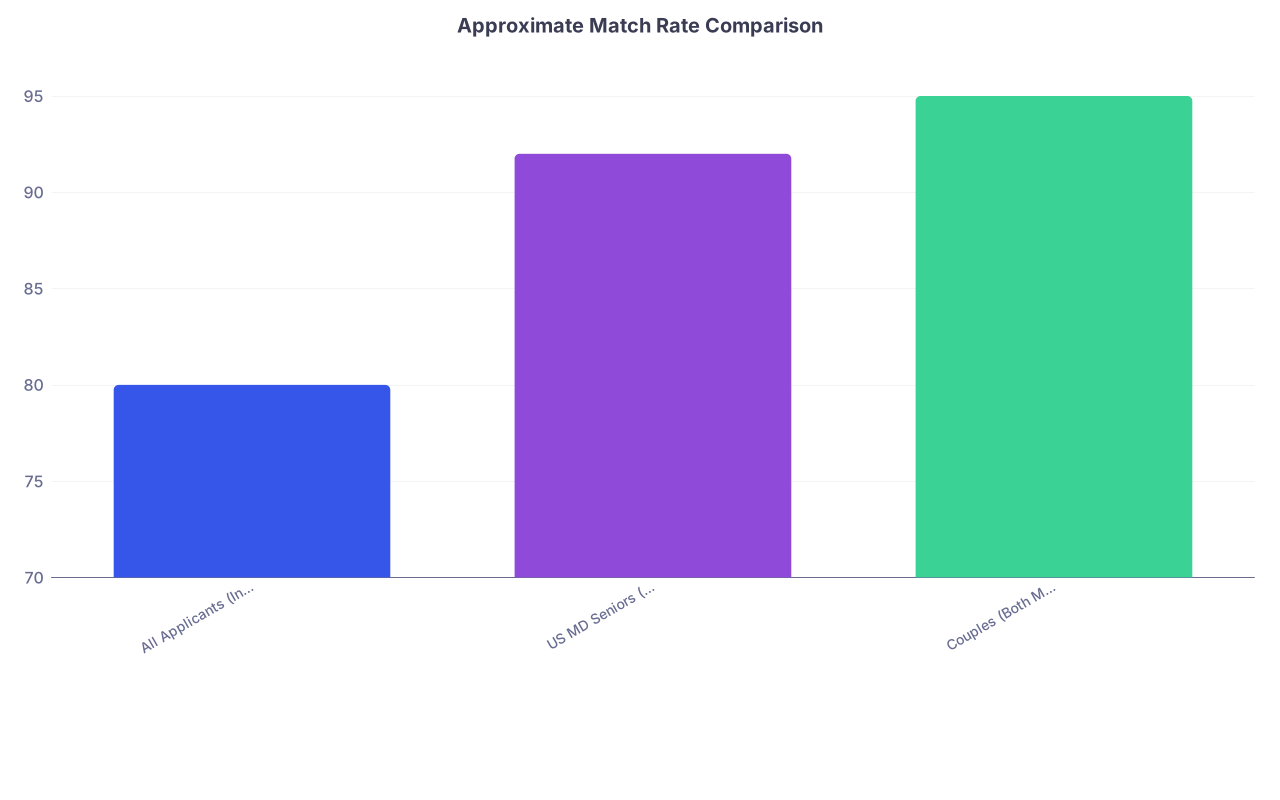
| Category | Value |
|---|---|
| All Applicants (Individual) | 80 |
| US MD Seniors (Individual) | 92 |
| Couples (Both Matched) | 95 |
These are rounded numbers for illustration based on historical trends:
- Overall match rate for all applicants: ~80%
- Match rate for US MD seniors: low 90s
- Historical rate of couples where both partners match: typically >90%, often mid-90s+
So the idea that “programs don’t like couples, so they don’t match” simply does not hold up at the macro level. The system is not anti-couple.
However, there’s a nuance people ignore:
Couples are more likely to accept less ideal outcomes to ensure they both match in the same area. That means:
- More likely to match at lower-tier or community programs than their stats alone might predict.
- More likely to match in less competitive locations than they originally wanted.
- Occasionally one partner lands a “reach” and the other takes a clear step down.
But that’s not bias. That’s math and constraints.
How Programs Actually View Couples Match Applicants
Here’s the unromantic truth from multiple PD discussions, survey data, and what I’ve heard in selection meetings: most programs don’t care that you’re couples matching. Not in the moral, emotional way students imagine.
They care about:
- Their own rank list integrity
- How likely you are to actually come
- How much extra hassle you create
None of those automatically work against you just because you checked “couples.”
Programs do see that you are in the couples match in their NRMP list system. Many PDs and coordinators have said this explicitly: they can identify couples, but they do not necessarily change their rank list because of it. For a lot of programs, you’re graded on your own merits, then your couple-status is a minor tie-breaker issue, not a primary filter.
I’ve heard three common attitudes in rank-list meetings:
- “Rank them as if they were independent; the algorithm will handle it.”
- “They’re couples matching with X specialty in our city? That might actually increase the chance they’ll come if we rank them high.”
- “If the partner’s specialty is impossible to get in this area, there’s a higher chance they won’t come—maybe nudge them slightly down if we’re on the fence.”
Are there programs that quietly dislike couples because of scheduling headaches, relocation fears, or perceived instability? Sure. But they’re not the majority, and they don’t drive the overall outcome trends.
Where Couples Actually Lose: Geography, Prestige, and Over-Optimism
The bias narrative is convenient. It makes couples feel like victims of a rigged system rather than of their own risk calculations.
The reality is closer to this:
You’re not being punished for being a couple.
You’re being constrained by insisting two people match near each other in the same year.
That constraint has consequences.
1. You trade geographic pickiness for match security
If you couples match and only rank, say, three major coastal cities because they’re your “dream locations,” your odds will crash. Not because programs hate couples, but because you slashed your option space to a fraction of what it could have been.
NRMP’s own data show that couples often submit very long rank lists. The couples who match well usually:
- Apply widely across cities and program tiers
- Include multiple geographic regions
- Don’t try to be cute with “prestige only” combined pairings
The couples who struggle usually:
- Restrict to 1–2 cities (or one region with very few programs)
- Both aim high-tier with minimal backups
- Ignore community or mid-tier options that would have made them safe
The algorithm is neutral. Your strategy is not.
2. One partner often pulls the other off their “natural” tier
This is the uncomfortable part people don’t like saying out loud.
Let’s say:
- Partner A: Step 2 254, strong research, great letters in medicine → could realistically match in big-name IM programs.
- Partner B: Step 2 229, average application in a moderately competitive specialty (say EM or OB) → realistically mid-tier or community.
If you were both applying solo, A might land an academic university program in a big city. As a couple, to land close together, one of three things often happens:
- A drops down in prestige to join B in a more achievable city/program tier.
- B overreaches in city/prestige and risks not matching or ending up far away.
- You both widen to mid-tier options in multiple regions and land somewhere “good but not fancy.”
Couples who think this through honestly and accept that someone is making a sacrifice typically do fine. Couples who insist both partners must land “top programs in top cities” because “we deserve it” are the ones who get burned.
None of that is bias. It’s just competitive reality under constraint.
What the NRMP Algorithm Does With Couples (And Why It’s Not Your Enemy)
A lot of the bias myth comes from people misunderstanding how the couples algorithm works.
Quick version:
- The NRMP algorithm tries to place each couple into the highest-ranked pair of programs on their couples rank list where both can match simultaneously.
- It’s still applicant-proposing and still favors you over programs, just like the individual match.
- It doesn’t demote you because you’re a couple; it just requires a valid pair position to place you.

| Step | Description |
|---|---|
| Step 1 | Start with Couples #1 pair |
| Step 2 | Couple tentatively placed |
| Step 3 | Move to next pair |
| Step 4 | Couple matched at that pair |
| Step 5 | Couple unmatched |
| Step 6 | Are both spots available? |
| Step 7 | Any higher-ranked applicants displace them? |
| Step 8 | Any pairs left on list? |
So what does that mean practically?
- If either partner severely over-ranks long-shot programs, you burn high positions on your list that the algorithm dutifully tries first and fails. That hurts you, but it’s not bias.
- The more realistic pairings you list (not fantasy combinations), the better the algorithm can work for you.
Programs are not given a “penalty switch” to downgrade couples. The matching engine only sees ranked positions and available slots.
Where you feel discrimination is usually where your list design is unrealistic for one or both partners.
The Few Situations Where Couples Might Be Quietly Disfavored
Now, I’m not going to pretend there’s zero friction. There are some scenarios where programs may hesitate with couples, but it’s more about risk management than prejudice.
1. Programs in locations where the partner’s specialty is nearly absent
If you’re couples matching IM + Neurosurgery in a small city with only one neurosurgery program that barely interviews your partner, that IM program may reasonably wonder: “What are the odds they actually come if the neurosurgery partner does not match here?”
In borderline rank discussions, that doubt can nudge you down a few spots. Not because they hate couples. Because they doubt their yield.
2. Small programs worried about schedule demands or attrition
Some very small programs (think 3 residents per year) get cagey about anything they perceive as raising the chance of an unexpected leave or transfer. That can include serious partner relocation issues or kids in another city.
Do they sometimes irrationally over-associate those risks with “couples matching”? Yes. I’ve seen it in offhand comments:
“If the partner doesn’t match here, this person is out. Then we’re stuck.”
Is that common enough to tank your entire odds across the country? No. It’s very program-specific and tends to be a tiebreaker, not a primary filter.
3. Certain specialties where one side is ultra-competitive
If one partner is applying to something brutal (Derm, Plastics, Ortho, ENT) and the other is in a more flexible field (IM, Peds, FM), some PDs absolutely assume the ultra-competitive specialty is the “anchor” and the other will move to accommodate them.
This can cut both ways:
- It may help the “flexible” partner in that city, if PDs think, “They’re more likely to stay if partner matches here.”
- Or hurt them if PDs think, “We’re probably just Plan B; they’ll go wherever the competitive specialty lands.”
Again, this is a local calculation, not global anti-couple bias.
Strategy Mistakes That Look Like “Bias” But Are Self-Inflicted
There are three common self-sabotage moves couples make that later get re-labeled as “programs were biased against us.”
1. Building rank lists around one partner’s ego instead of both partners’ reality
You’ll hear couples say things like:
“I could match at MGH or UCSF on my own, so I refuse to rank mid-tier programs.”
If your partner can’t even snag interviews in those cities or at that tier, your couples rank list becomes top-heavy fantasy. When you don’t match together, you blame “the system” or “bias,” instead of the obvious: you valued prestige more than probability.
2. Not applying broadly enough—especially in the weaker specialty
If one partner is in a more competitive specialty, the risk is obvious. But the real killer is when the theoretically “easier” specialty under-applies because they think they’re safe anywhere.
Then you find yourselves trying to pair a broad, realistic list on one side with a sparse, constrained list on the other. The algorithm can’t create pairs that do not exist.
3. Failing to coordinate signals, letters, and communication
Some programs in certain specialties now have limited signals or whatever version applies that year. Couples who don’t strategically align those—e.g., signaling totally different cities, or not mentioning couples matching in one specialty while emphasizing it in the other—create confusion.
That inconsistency makes it harder for PDs to read your intentions and can reduce their confidence that ranking you will actually yield you. Again: not bias. Just your mixed messaging.
When Couples Match Is Actually a Net Advantage
Here’s the part rarely admitted: in some contexts, being a couple is a selling point.
I’ve watched PDs in mid-sized cities say things like:
“They’re couples matching with Peds at our affiliate. That makes it more likely they’ll stay. Rank them a bit higher.”
Or in less “sexy” cities (Midwest, Rust Belt, southern towns away from coasts): a solid couple committed to the area can look more stable than a single hotshot who obviously wants out after residency.
Some programs like the idea of residents with built-in social support. Less burnout. Fewer mental-health disasters. Less drama.
So no, couples match is not universally seen as a burden. In the right place, it’s leverage.
What This All Actually Means For You
If you strip away the myths and Reddit-filtered catastrophes, the picture is:
- The algorithm itself is neutral and often generous to couples.
- Overall, couples have very high rates of both partners matching somewhere.
- The real cost is usually prestige or geography, not catastrophic non-matches.
- “Bias” is often couples over-reaching, under-applying, or refusing to accept trade-offs.
If you want to couples match smartly, think like this:
- Assume no one is out to get you—but no one is going to bend the universe to keep you together in one elite city either.
- Be brutally honest about which partner is more competitive and where the realistic common ground is.
- Rank exhaustively and realistically. Not for Instagram. For your actual future.

Quick Comparison: Couples vs Individuals
To make this as concrete as possible:
| Aspect | Individual Applicant | Couples Match Applicant |
|---|---|---|
| Match rate | High (varies by type) | Very high for both matching somewhere |
| Geographic flexibility | High | Lower – must co-locate |
| Prestige flexibility | Optional | Often traded down for proximity |
| List complexity | Simple | Complex paired rankings |
| Perceived bias | Minimal concern | Often perceived, rarely supported by hard data |