

17% of couples match applicants actually outperform solo applicants in matching to their top choices.
Let me translate that: the data does not show that couples are “less serious” or “less desirable.” In some ways, programs treat solid couples as more strategically valuable than random single applicants.
Let’s tear this apart properly.
What the Data Actually Shows About Couples Match
First, numbers. Not vibes. Not that one bitter senior who told you, “Programs hate couples.”
NRMP publishes detailed data on the Couples Match every year. Here’s what consistently shows up when you actually read it:
- Around 8–10% of residency applicants participate as couples each year.
- Couples do match at slightly lower rates than solo applicants overall.
- But when you control for specialty competitiveness and applicant strength, the gap shrinks a lot.
- There is zero evidence in NRMP data that couples are penalized because they’re couples.
Most couples match problems come from two things:
- Unrealistic rank strategies (shooting too high on both sides).
- One partner having significantly weaker metrics and both trying to ride the stronger partner’s tail.
Programs don’t need to invent some moral judgment about “seriousness” to explain the outcomes. The math alone explains most of it.
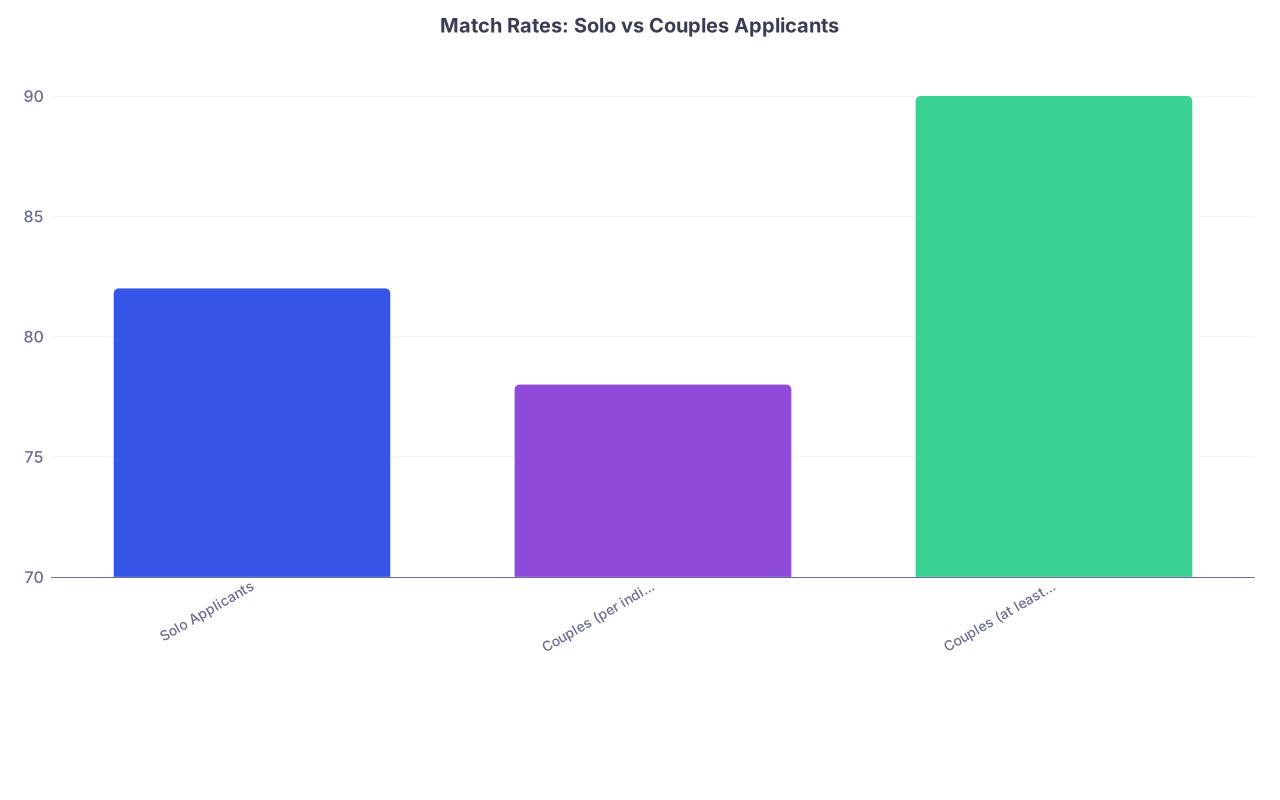
| Category | Value |
|---|---|
| Solo Applicants | 82 |
| Couples (per individual) | 78 |
| Couples (at least one partner) | 90 |
Notice the difference: slightly lower per individual, but very high chance that at least one partner matches somewhere. That’s not evidence of programs punishing couples; it’s just the complexity of having to place two people instead of one.
Now, what about the psychological piece—do PDs see you as less serious?
No. Most of them see you as a constraint problem. Not a character flaw.
How Program Directors Actually Think About Couples
I’ve sat in on rank meetings. I’ve heard the actual words come out of PDs’ mouths.
Here’s the tone you do hear:
- “They’re couples matching, so we may need to consider her if we want him.”
- “If we rank them reasonably close, we might land both.”
- “They’re a couple; our city is a big draw, odds are better they’ll stay.”
Here’s what you don’t hear:
- “He’s couples matching, so he must not be serious.”
- “She clearly cares more about her relationship than medicine.”
- “Red flag: in a relationship.”
Programs are run by adults. Many of whom are married to other physicians. Or met their partner in training. The idea that being in a committed relationship makes you “less serious” is honestly laughable once you’ve seen the number of faculty who schedule conferences around their kids’ soccer games.
What PDs really care about with couples:
- Risk: Are we going to end up with neither if the algorithm pushes them somewhere else?
- Logistics: Can we reasonably land both in our system or city?
- Fit: Are they both people we’d actually want?
They’re doing risk–benefit calculus, not moral judgment.

The Hidden Advantage of Being a Strong Couple
Here’s the part almost nobody tells you.
Good couples—meaning both partners are at least solid for their specialties—can actually become more appealing to certain programs and institutions.
Why?
- Two stable residents, likely to stay in the same system if they do fellowships.
- Lower risk of one resident being miserable and transferring because their partner is 500 miles away.
- Easier to recruit: “We can place both of you” is a huge selling point, especially for mid-tier or geographically less popular places.
I’ve watched community programs in less sexy locations specifically try to lock down a strong couple because they knew that was their best shot at getting and keeping talent.
So no, a healthy, competent couple is not a “minus.” It’s a variable. Sometimes neutral, sometimes a real plus.
The Real Reasons Some PDs Get Nervous About Couples Match
The skepticism you do see from some PDs is not about your relationship. It’s about the algorithm and your rank strategy.
Here are the actual fears behind the scenes:
They’ll rank us low.
“If we burn high rank positions on them, but we’re #10 on their list because they’re chasing a dream city, we lose.”We like one partner, not the other.
“He’s great; she’s marginal for our program. If we take both, we weaken the class. If we only take him, the couple might not land here anyway.”We don’t have enough linked spots.
“We only have 4 categorical positions. We can’t realistically plan to take a pair if it blocks us from balancing our class.”
Notice what’s missing: “They’re immature” or “They don’t love medicine enough.” That’s your anxiety talking, not the PD.
The couples situation creates perceived constraint, not moral suspicion.
Where the “Less Serious” Myth Actually Comes From
The myth mostly comes from three places—and none of them are PDs.
Upperclass gossip.
Every med school has That Guy who didn’t match his dream specialty and now has a post-hoc explanation for everything: “I couples matched, programs hate that.” No mention of Step 2 CK 222, shaky letters, and applying to derm in three states.Bad advising from people who haven’t read NRMP data since 2010.
Some older faculty remember a time when couples match was rare and poorly understood. They generalize their outdated intuition: “It complicates things; avoid it.” They’re not malicious, just lazy with the evidence.Applicants projecting their own insecurity.
People already worried they’re not competitive cling to this story: “It’s not my grades/scores/clinical performance—it’s the couples match that makes me look unserious.” That narrative is emotionally convenient but factually weak.
The real reasons couples struggle aren’t mysterious:
- Both partners aiming for hyper-competitive specialties in limited overlapping geographies.
- One partner substantially below average for their specialty, both insisting on matching in Boston/NYC/SF only.
- Rank lists that are too short or too top-heavy, because they can’t stomach the idea of “backup” cities.
That’s not programs punishing relationships. That’s math plus pride.
How Couples Actually Get Evaluated in Applications and Interviews
Do some PDs notice you’re couples matching? Yes. Because you tell them. Or because it’s on your ERAS. Or because you bring it up (often awkwardly) during your interview.
Here’s how that usually plays out when done well:
- You mention it briefly in your personal statement or supplemental: “I am participating in the couples match with my partner, who is applying in pediatrics.”
- You frame it as a stability and wellness factor, not a demand.
- You don’t make every conversation about it.
And done badly:
- You lead every answer with, “Well, because we’re couples matching…”
- You use it as a justification for red flags: weak scores, late application, etc.
- You imply that if they don’t accommodate both of you, you’re not interested.
Programs don’t like neediness or ultimatums—from any applicant. Couples or solo.
If you talk about it like a mature adult:
- “We’re trying to stay in the same city if possible, but we’ve also built robust rank lists to ensure we both match.”
- “We’re applying broadly, with overlapping regions, because we understand the constraints.”
That doesn’t read as “less serious.” It reads as you understand how the game works.

When Being a Couple Can Actually Hurt You
Let’s be blunt. There are scenarios where couples match hurts. Just not for the dramatic reasons people claim.
Here’s where programs will side-eye the situation:
One partner is clearly much weaker, and you act like it doesn’t matter.
If she has multiple Step failures and he’s a 260 rockstar applying to ortho, and you’re insisting you’ll only rank places where you both get your first-choice specialty at top programs—that reads as delusional. Programs pick up on that.You present as entitled.
“We’re a package deal” delivered with the energy of “and you owe us that.” Programs hate entitlement. Single or coupled.You’re vague, cagey, or inconsistent about your plans.
If in one interview you say, “We’re geographically flexible,” and in another you threaten to rank only one region, PDs talk. Word gets around, especially within the same city or system.
The couples match doesn’t make you look less serious. Acting like the rules don’t apply to you does.
Smart Strategies So Programs Take You Seriously (As a Couple)
You want the truth, not hand-holding, so here’s what works.
Get brutally honest about relative competitiveness.
Compare yourselves to actual NRMP specialty data, not to your group chat feelings. If one of you is below average, compensate with:- More programs
- Broader geography
- A realistic mix of program tiers
Align your geography with the weaker partner.
The more competitive partner almost always has more flexibility. If one of you is gunning for derm and the other for FM, don’t center the entire strategy around derm’s favorite three cities.Use the couples feature intelligently.
Don’t only link “perfect–perfect” pairs. Use:- Perfect–okay
- Perfect–safety
- Okay–safety
so the algorithm has more ways to place you both.
Be clear and calm when you bring it up.
“We’re couples matching, we’ve both applied in these regions, and we’ve built long, thoughtful rank lists.” That sentence signals maturity, not drama.

| Step | Description |
|---|---|
| Step 1 | Start Couples Planning |
| Step 2 | Target overlapping regions |
| Step 3 | Anchor to weaker partner |
| Step 4 | Build long joint rank list |
| Step 5 | Add more cities and tiers |
| Step 6 | Finalize couples ranks |
| Step 7 | Similar Competitiveness? |
| Step 8 | Need more options? |
What PDs Actually Remember After Your Interview
Here’s the harsh reality: PDs barely remember who’s couples matching by the time they’re deep in rank meetings.
What they do remember:
- The applicant who had clear clinical strengths and strong letters.
- The one who interviewed well and seemed teachable, not fragile.
- The one who had a coherent story: why this specialty, why this region, why this program.
“Couples match” is a line item, not your identity.
If you’re telling yourself, “They won’t rank me highly because I’m couples matching,” you’re usually covering for something else:
- Under-prepared interview
- Weak performance on rotations
- Unrealistic expectations about where you “deserve” to be
Programs care far more about whether you’ll be a reliable, non-toxic resident than whether you share an apartment with another PGY-1 across town.

Comparing Reality vs. Fear
Let’s do a quick reality check.
| Concern | What Data/Experience Shows |
|---|---|
| PDs see couples as less serious | No evidence; focus is on logistics |
| Couples are automatically penalized | Slightly lower match rate from complexity, not bias |
| Mentioning couples match is a red flag | Neutral to positive if framed maturely |
| Strong couples are a liability | Can be an asset, especially for less competitive locations |
| Couples match always hurts outcomes | Outcomes depend mostly on competitiveness and strategy |
The myth is emotional. The reality is structural.
The Bottom Line
You wanted myth-busting, not comfort, so here it is.
- Program directors do not see you as less serious because you’re couples matching; they see you as a more complex placement problem, which is very different.
- The couples match hurts people primarily when they’re unrealistic about competitiveness and geography, not because PDs are secretly judging their relationship.
- A strong, low-drama couple with a rational strategy is not a liability. In more than a few programs, you’re exactly the kind of pair they’d like to land—and keep.


