

29% of NRMP couples include at least one applicant in a highly competitive specialty.
So much for “Couples Match is just for easy fields and superstar applicants.”
Let’s take a scalpel to this myth.
Most of what you hear about the Couples Match comes from two groups:
- People who didn’t actually couples match but have Strong Opinions.
- People who couples matched poorly and now blame the mechanism instead of their strategy.
The result: a loud, persistent claim that the Couples Match is:
- Only safe if both of you are “strong” on paper, and
- Only works smoothly if you’re doing “easy” specialties like FM, peds, psych.
Both are wrong. And not just philosophically wrong—mathematically and empirically wrong.
What the Couples Match Actually Does (Not What People Say It Does)
The Couples Match does exactly one thing: it lets two rank lists be evaluated together.
You’re not linked “as a package deal.” You’re still two separate applicants. The algorithm doesn’t say, “Wow, they’re a couple, give them bonus points.” It just tries to place you in combinations of programs you’ve listed together.
Here’s the basic flow:

| Step | Description |
|---|---|
| Step 1 | Each partner makes program list |
| Step 2 | Convert to pairs of programs |
| Step 3 | Rank pairs in true preference order |
| Step 4 | NRMP algorithm evaluates pairs |
| Step 5 | Both tentatively matched |
| Step 6 | Try next pair on list |
| Step 7 | Best available pair? |
You submit a paired rank list like:
- (Partner A: Program 1, Partner B: Program X)
- (Partner A: Program 2, Partner B: Program Y)
- (Partner A: Program 3, Partner B: No Match) – as a backup
…and so on.
The key insight:
The algorithm doesn’t care if you’re competitive or not. It doesn’t care what specialties you’re in. It only cares about whether a given pair is available at the same “pass” of the algorithm.
Where things go off the rails is how couples actually build those lists.
Myth 1: “Couples Match is only safe if you’re both strong applicants”
Let me be blunt: weak applicants get destroyed by naive Couples Match strategies.
Not because the system is rigged against them, but because they act like they’re still single applicants while having less flexibility.
Here’s what the data actually shows.
From NRMP’s “Results and Data” reports, year after year:
- Couples have slightly lower match rates than individuals in aggregate. Not catastrophic—slightly.
- Among couples who rank a lot of combinations (40–60+), match rates climb back up dramatically, even for average or below-average profiles.
- The biggest crash in match rates happens in couples with:
- Very few pairings, and
- Narrow geographic preferences, and
- Minimal backup strategies.
So the issue isn’t “only strong couples can do this.” The issue is: If you’re not strong, you can’t afford a lazy couples strategy.
To make this concrete, imagine:
- Partner A: US MD, mid-tier, Step 2 CK 236, applying Internal Medicine.
- Partner B: DO, Step 2 CK 222, applying FM. No major red flags.
This is not a “power couple.” This is a very normal, middle-of-the-pack pair.
Here’s how they usually screw it up:
- Apply to 20 IM programs and 20 FM programs, mostly in one city or region.
- Construct only combinations where both are in the same metro area at “good” programs.
- Maybe 20–30 pairings total.
Then they’re shocked when they match 0/0 or 1/0.
Now, change exactly one thing: strategy.
They:
- Expand to 60 IM and 60 FM programs spread over multiple regions.
- Include pairings across neighboring cities and different tiers of programs.
- Add backup pairs where one person matches and the other lists “No Match” or SOAP plans.
Suddenly, the exact same “average” couple looks very different in the algorithm. They’ve created surface area. The match rate goes up quickly.
So no—the Couples Match is not “only safe if you’re both strong.”
What’s true is this:
- Strong couples can be sloppy and still do okay.
- Average/weak couples have to be strategic and somewhat humble (about geography and prestige) to do okay.
If you’re not strong and you treat this like a “we only want top-20 coastal programs” game, then yes, you’re going to get smoked. But that’s not the Couples Match’s fault.
Myth 2: “Couples Match only makes sense in easy non-competitive specialties”
I hear this in advising rooms constantly:
“If you’re going for something like derm, ophtho, ortho, forget the Couples Match unless your partner is in FM or something easy.”
This is lazy thinking.
Let’s line up the claims against how the algorithm actually behaves.
Competitive specialties are:
- More selective per spot
- Often in bigger academic centers already crowded with applicants
- Sometimes have fewer programs overall
So what happens if:
- Partner A applies Dermatology (competitive), and
- Partner B applies to Psychiatry (moderately competitive in some regions, easier in others)?
The myth says: “That’s suicide.”
What actually happens:
- Partner A’s chances are dominated by their own competitiveness relative to derm applicants, not the couple status.
- Partner B’s best strategy is to apply wider geographically and include more program tiers to create more viable pairs with A’s possible derm programs.
The couples mechanism doesn’t inherently penalize “derm + psych” vs “FM + psych.” It just constrains the combinations.
To put reality in numbers, imagine simplified odds:
| Applicant Type | Solo Match Chance | Couples Match (good strategy) |
|---|---|---|
| Strong + Strong | 90%+ | 85–90% |
| Strong + Average | ~80–85% | 75–85% |
| Average + Average | ~75–80% | 65–75% |
| Competitive specialty* | ~65–75% solo | 55–70% with couples |
*Competitive specialty here means derm/ortho/ENT/PR etc with a realistic applicant, not a disaster file.
The hit from “being in a competitive specialty” is mostly already baked into your solo chances. Couples matching adds some friction, not a death sentence. As long as you:
- Apply broadly in both specialties
- Include tier-mixing combinations (ex: strong derm + mid-tier psych, and vice versa)
- Don’t insist on one tiny region
You will see plenty of couples with:
- Ortho + EM
- Derm + IM
- ENT + Anesthesia
…match in the same city or within driving distance.
The people who end up separated for a year usually didn’t lose because “ortho is too competitive.” They lost because their rank list read like a fantasy map of 8 programs instead of a serious plan.
Where the Real Risk Is: Geography, Not Specialty
The Couples Match punishes rigidity, not specialty difficulty.
The most dangerous combination is:
- Both applicants mediocre or below-average,
- Both wanting the same very limited geographic area,
- Both insisting on somewhat selective academic centers,
- And an unwillingness to list community or out-of-region programs.
This is where I’ve watched couples blow up their own match.
They say:
“We don’t want to be apart, but we also don’t want to end up somewhere random. So we’re just ranking these 15 combinations in [Big Coastal City] and maybe [Second Trendy City].”
Translation:
“We want scarce spots in high-demand centers, with no real backups, while constrained as a couple.”
That’s the real hazard. Not “anesthesia is competitive.”
Let me show you how geography vs. competitiveness actually plays out.
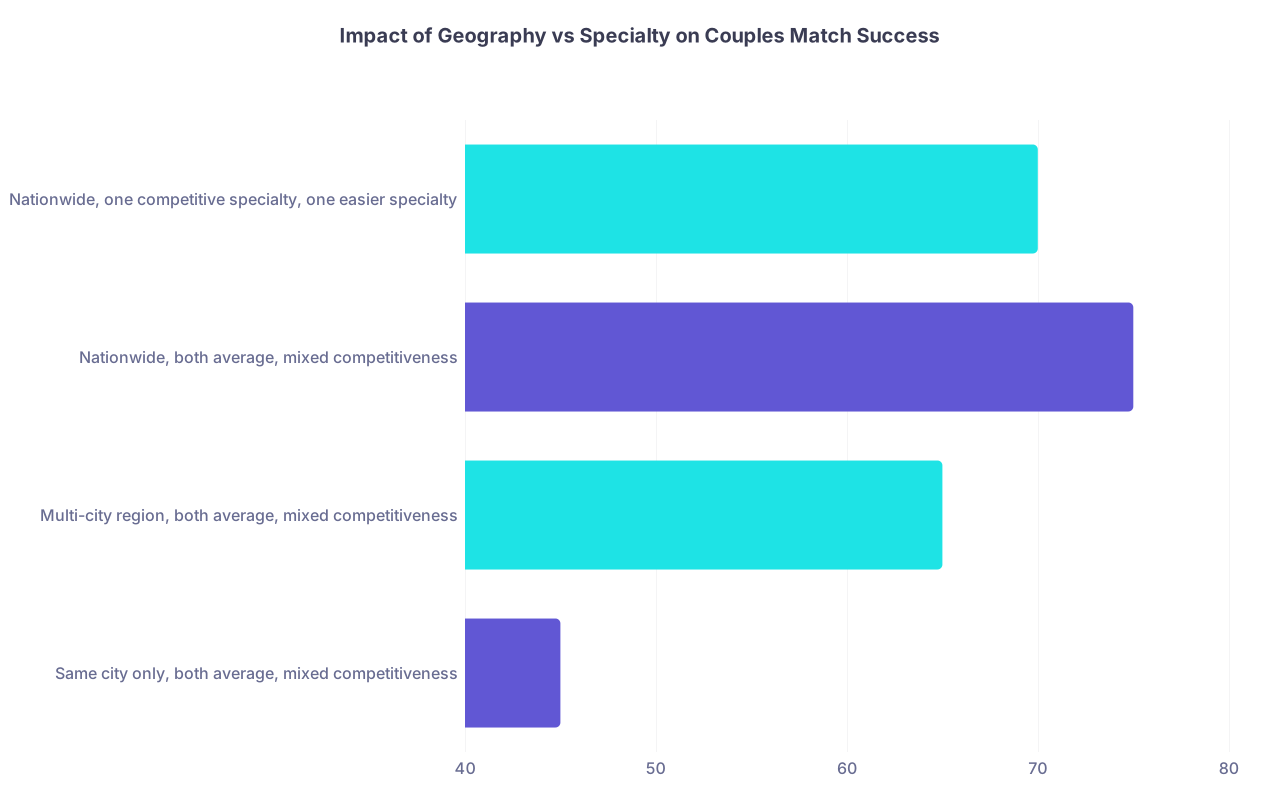
| Category | Value |
|---|---|
| Same city only, both average, mixed competitiveness | 45 |
| Multi-city region, both average, mixed competitiveness | 65 |
| Nationwide, both average, mixed competitiveness | 75 |
| Nationwide, one competitive specialty, one easier specialty | 70 |
You can absolutely couples match as:
- IM + Ortho
- Peds + ENT
- Psych + Ophtho
…but only if you loosen your grip on a 20-mile radius around one expensive metro.
Reality Check: When Couples Match Is a Bad Idea
Now for the part almost no one says out loud. There are situations where couples matching is genuinely dumb.
Here are a few:
One partner is in freefall
- Multiple fails
- Severe professionalism issues
- Barely any interviews in a previous cycle
In that scenario, linking your outcome to theirs is like tying yourself to the anchor, not the boat. The “couple” piece doesn’t fix a chronically noncompetitive file.
One partner is trying to salvage a reapplication A re-applicant trying to pivot from a failed competitive match to something new often needs maximal flexibility: prelims, different regions, one-year gaps, research. Couples Match constrains that.
You two can’t be honest about priorities I’ve sat in meetings where:
- Partner A actually cares more about specialty and training quality
- Partner B actually cares more about same-city living
- Neither will admit it out loud
So they couples match with a fake “we value exactly the same things” story and then resent each other for the outcome. The mechanism didn’t hurt them. Their refusal to rank priorities did.
In those 3 scenarios, yes—Couples Match might objectively be a worse choice than applying independently and trying to cluster regionally.
How Less-Competitive Couples Win: Strategy, Not Mythology
Let me walk you through how a very normal, non-superstar couple can use the system intelligently.
Example:
- Partner A: US MD, Step 2 CK 230, 1 mid-tier publication, applying IM.
- Partner B: US MD, Step 2 CK 221, average clerkship grades, applying Peds.
They decide:
- They’re willing to live in 4 multi-city regions (say Midwest, Southeast, Northeast, Mountain West).
- They’ll accept community programs, not just university hospitals.
- They’ll rank “one matches, one doesn’t” pairs late in their list as an absolute last resort.
Their playbook:
Each applies to ~70–80 programs across their chosen regions.
They intentionally include:
- High-tier academical
- Mid-tier university-affiliated
- Solid community programs
When building the couples list, they:
- Start with ideal same-program or same-city matches.
- Then build cross-city but drivable pairs (ex: 60–90 minutes apart).
- Then add “Partner A match + Partner B No Match” and the reverse as hard backups.
This kind of list can easily reach 80–150 combinations, even with moderate geographic constraints.
Does that guarantee a great match? No. But now the math finally works for them instead of against them.
They stop acting like “average applicants who want top-of-the-heap urban academic spots only.” And suddenly they’re not doomed.
Quick Contrast: Bad vs Smart Couples Strategy
| Feature | Bad Strategy | Smart Strategy |
|---|---|---|
| Program count | 20–30 each | 60–80+ each |
| Geography | One major city only | Multiple regions or multiple cities |
| Program tiers | Only big-name academics | Mixed: academic + community |
| Pairings | 10–25 combos | 60–150+ combos |
| Backup pairs | None or very few | Includes one-match + No Match late in list |
| Self-assessment | “We’re strong enough, it’ll be fine” | “We’re average, so we need surface area” |
You don’t need to be a “competitive applicant in an easy specialty” to make the right-hand column work. You just need to be honest and methodical.
What the Data and Logic Actually Say
To pull everything together:
Couples Match doesn’t reward or punish competitiveness directly.
It’s a constraint overlay on your existing individual odds. Strong couples can be lazy and survive; average couples can succeed if they’re disciplined.The problem isn’t competitive specialties; it’s inflexible expectations.
Ortho + IM, Derm + Psych, ENT + Peds can and do match together. The couples who implode are usually those insisting on one small region and narrow program types.The real question isn’t “Are we competitive enough?” but “Are we realistic and strategic enough?”
If you’re willing to expand geography, mix program tiers, and build a long, serious paired rank list, you’re already ahead of most couples—regardless of your specialty mix.
Ignore the hallway myths. Run the numbers, be brutally honest about your priorities, and then decide whether Couples Match serves you, not some imaginary “ideal applicant” that doesn’t exist.


