

52% of couples in the NRMP Couples Match pair into different specialties.
So the “we have to choose the same field or we’ll never see each other” narrative? It is not just exaggerated. It is often backward.
Most of the terrified questions I hear from med students in relationships sound like this:
- “Do we both need to do IM so we can match together?”
- “Is anesthesia + EM a relationship death sentence?”
- “Everyone says same-specialty couples have it easier… should I change my specialty?”
You are getting advice from people who’ve seen one toxic surgery–surgery couple implode and decided that’s universal truth.
Let’s run the actual numbers. And then talk about what actually matters for cross-specialty couples in the Match.
What the NRMP Data Actually Shows About Couples
The NRMP does something very useful: it separates applicants participating as singles vs couples, and it also reports match outcomes.
Couples are not rare edge cases anymore. In recent years, roughly 5–7% of all applicants choose the Couples Match pathway. That’s thousands of people every year.
The common myth goes like this:
“Couples doing different specialties are way less likely to match. You basically have to be same specialty or both do IM/FM for it to work.”
Wrong.
Here’s a simplified comparison with representative numbers from recent NRMP data trends (I’m rounding to make this readable, but the proportions reflect real patterns):
| Group | Overall Match Rate |
|---|---|
| All single applicants | ~80–84% |
| All couples (either partner) | ~90–94% |
| Both partners in same specialty | ~93–95% |
| Partners in different specialties | ~89–93% |
Two big realities jump out:
- Couples (overall) actually have higher match rates than singles. Because they over-apply and strategize more aggressively.
- Different-specialty couples do not crater their chances. The drop, when it exists, is modest, not catastrophic.
You’ll hear a lot of scary stories. You won’t hear the quiet, boring updates from the radiology + pediatrics couple who matched at two hospitals down the street and are now arguing over baby names instead of call schedules.
Those don’t make good Reddit posts.
Myth #1: “If We’re Different Specialties, We Won’t Match Together”
I’ve heard attendings tell students this in front of patients. As if it’s settled science.
The data says otherwise.
What’s true is more nuanced:
- Same-specialty couples can leverage programs that love “couple hires” (think IM + IM at big academic centers, OB+OB in high-volume programs).
- Cross-specialty couples instead rely on geographic density. Think regions with many residencies within ~30–45 minutes.
You are not trying to win some magical “program wants both of us” lottery. You’re trying to maximize the number of geographic pairs (A’s program within X minutes of B’s program) on your list.
That’s a math problem, not a “same specialty or bust” problem.
The real lever: how many usable pairs you rank
Couples who match successfully—same or different specialty—do one thing extremely well: they build long, flexible rank lists.
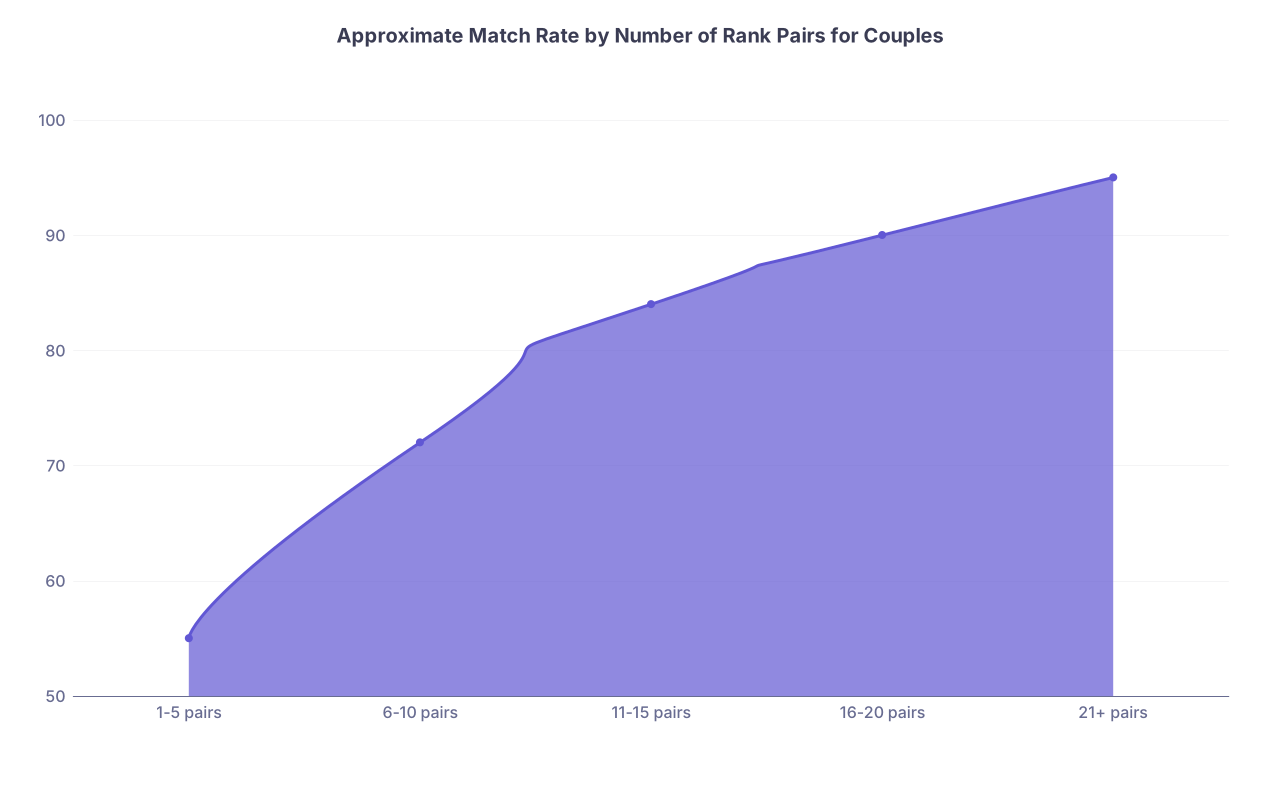
NRMP’s own analyses repeatedly show: couples who rank more pairs match at dramatically higher rates than couples who rank only a few.
Here’s the sort of pattern those reports show (again with representative, rounded numbers):
| Category | Value |
|---|---|
| 1-5 pairs | 55 |
| 6-10 pairs | 72 |
| 11-15 pairs | 84 |
| 16-20 pairs | 90 |
| 21+ pairs | 95 |
People fixate on “same specialty vs different.” The more honest predictor is “did we do the work to build 15–20 realistic geographic pairs?”
Same specialty helps a bit; a lazy rank list kills you regardless.
Myth #2: “If We’re Both Competitive, We Must Choose the Same ‘Tier’ Specialty”
This one’s sneaky.
You’ll hear: “We’re both competitive. We should both go for derm, or both go ortho, so we can land at the same top program.”
That’s gambler’s thinking. Risk-stacking.
Two highly competitive applicants both aiming for ultra-competitive specialties might still do fine. But the couple-level risk goes up, not down, when you reduce options.
The probability problem looks like this:
- Single derm applicant with solid stats: decent chance.
- Two derm applicants needing to land in the same city with programs both actually like them: much lower joint probability.
Cross-specialty pairings can increase your flexibility:
- Psych + EM
- IM + Anesthesia
- Peds + FM
- Pathology + Anything (path programs are everywhere and less saturated)
One of the easiest couples I watched succeed: anesthesia + pediatrics. They had:
- Tons of geographic options
- A mix of academic + community programs
- Different competitiveness profiles, but neither hyper-narrow
They ended up with 22 ranked pairs and matched high on their list at a big Midwestern academic center.
If they had both tried for derm at coastal powerhouses? Very different story.
Myth #3: “Schedules Will Be Impossible If We’re Not in the Same Field”
This one is more emotional than statistical, but it drives people into specialties they don’t actually like.
The assumption: same specialty = aligned schedules = happy relationship. Different specialty = chaos. No time together. Constant resentment.
I’ve watched some same-specialty couples in fields like surgery or EM who barely saw each other for years because:
- They were on opposite service schedules
- Seniority staggered (PGY1 vs PGY3)
- Call assignments weren’t coordinated
Same specialty is not a scheduling cheat code. Program chiefs do not sit around carefully pairing your calls.
Meanwhile, I’ve known cross-specialty couples who managed remarkably well:
- EM + Radiology: one built their shift requests around the other’s more predictable daytime structure
- FM + OB/Gyn: the FM program director was flexible, OB was more rigid, so they optimized the flexible one
- Psych + Neurology: both had relatively humane call; weekends were more negotiable
What mattered wasn’t the field. It was:
- How fragmented vs block-based each schedule was
- Whether at least one program leadership team was willing to adjust within reason
- How much the couple communicated before matching about what they were okay sacrificing
You cannot hack this just by picking the same acronym.
Where Cross-Specialty Couples Do Face Real Risk
Now the part where I stop being nice.
You can absolutely blow up your odds as a cross-specialty couple by doing a few very predictable dumb things.
1. Picking incompatible geographies
If one of you insists: “Only NYC or nothing” and the other specialty has 4 programs in NYC that are realistic for them while yours has 25… that’s asymmetric risk.
Worse: wanting some super-specific micro-location—“we must be near this exact suburb”—when your specialties don’t both have dense program clusters there.
You want regions like:
- Large academic cities with multiple hospitals (Boston, Philly, Chicago, Houston, etc.)
- Metro areas with both university and community programs
- States where multiple mid-size cities are within a commutable radius
Do not die on the hill of “we must be in this one trendy coastal neighborhood.” You’re playing a national algorithm, not booking an Airbnb.
2. Refusing to expand your program list
I’ve watched couples swear they “did everything right” and then find out they:
- Applied to 20 programs each in moderately competitive fields
- Ranked 6–8 pairs total
- Didn’t apply broadly to community or mid-tier academic places
Single applicants can sometimes get away with that (though it’s risky). Couples cannot.
Reason is simple: cross-specialty pairing thin out possible combinations quickly. One weak link or one narrow specialty, and your pairable options shrink.
You compensate by:
- Applying more broadly than your ego thinks you “should”
- Keeping community programs on the table
- Not both trying to match at only the top 10 name brands in the country
Prestige is a terrible tiebreaker if the alternative is “one of us doesn’t match.”
How to Actually Build a Rational Strategy as a Cross-Specialty Couple
Let’s talk about how this looks in practice, because most advice stays abstract and useless.
Step 1: Map your specialty realities side by side
You need brutal honesty here:
- How competitive is each specialty this year?
- Where are the program clusters? Not just famous names, actual volume of programs.
- What’s your real application strength? (USMD vs DO vs IMG, Step scores, red flags)
Then build a rough matrix of where you both have realistic shots:
| Region | Partner A (Anesthesia) | Partner B (Pediatrics) | Overall Couple Potential |
|---|---|---|---|
| Boston | Moderate (few spots) | High (many programs) | Medium |
| Midwest big city | High | High | High |
| West Coast coastals | Low | Moderate | Low |
| Southeast mid-size cities | High | High | High |
You’re looking for “both at least moderate” clusters. Those should become your primary application targets.
Step 2: Prioritize regions, not single programs
Couples who succeed think like this:
“We want to be in the Triangle area or Houston or Chicago, not ‘this one IM program’ and ‘that one EM program’.”
Then they list:
- All reasonable programs for A in that region
- All reasonable programs for B in that region
- Every cross-product combination of A–B programs that are within a drivable commute
That’s how you get to 15–25 real rank pairs, even as a cross-specialty couple.
Step 3: Use the flexibility you actually have
Someone is more flexible. Always.
Could be:
- Less competitive specialty
- Applicant with stronger stats and broader appeal
- Person who cares slightly less about academic vs community vs “tier”
Whoever has more leverage should be willing to say: “I will loosen my constraints so we can gain 5–10 more rank pairs.”
The couples that match well usually have at least one person who does this without drama.
Where Same-Specialty Actually Helps (And Where It Does Not)
Just to be fair, let me call out the real advantages of being same-specialty:
- Some programs love taking couples in the same field and will quietly advocate for you.
- Interview scheduling can sometimes line up, which reduces travel and financial pain.
- A few large departments will explicitly say, “We try to accommodate couples when we can.”
That’s all real. I’ve seen it firsthand in IM and pediatrics especially.
But here’s what same-specialty does not automatically fix:
- Basic geography scarcity (there are still only so many programs in some cities)
- Personality compatibility with the program culture
- Poor rank list strategy
- Rampant overconfidence (“we’re both strong, of course we’ll end up together at a top place”)
I’ve seen same-specialty couples end up in different cities because they only ranked a handful of programs that would take both and refused to list realistic fallbacks in separate locations.
Match algorithm doesn’t care that you both love GI or both love ortho. It just sees rank lists and positions.
Emotional Reality: Choosing Your Field vs Choosing Each Other
The worst stories I’ve seen are not cross-specialty couples who matched into different cities.
It’s the person who chose the wrong specialty “for the relationship” and then woke up PGY-2 realizing they hate their actual daily life.
And now they resent:
- The partner
- The work
- The hours
- The version of themselves who gambled their adult career on a myth
Doing IM when you wanted EM. Doing FM when you wanted OB. Doing psych when you wanted surgery. You live that mismatch every day.
Here’s the uncomfortable truth:
- You can usually adapt around geography and schedules if you both like your work and commit to creative solutions.
- You cannot out-schedule a specialty you hate.
- You absolutely cannot patch over deep professional regret with “at least we’re in the same city.”
For most couples, the rational order is:
- Choose specialties you can see yourself doing for 30 years without slowly dying inside.
- Be brutally pragmatic about geography and program tiers.
- Maximize rank pairs with flexible, ego-light strategy.
- Accept that a tiny residual risk of temporary long-distance is still better than a guaranteed lifetime in the wrong field.
Practical Red Flags: When You Might Want to Reconsider Your Plan
Cross-specialty itself isn’t the issue. But here are situations where I’d sound the alarm:
- One of you is going for an ultra-competitive specialty (derm, plastics, neurosurg, ENT, ortho) with only “average” stats and you both insist on one coastal metro only.
- You’re both applying in moderately competitive fields but only to big-name academic programs while ignoring strong community programs that would give you more pairs.
- You refuse to create a “break glass in case of emergency” solo rank list for each person (NRMP strongly recommends this), because you’d “rather go unmatched than be apart.” That’s bravado talking, not strategy.
- You’re so conflict-avoidant you haven’t had a real conversation about what you’d do if one of you doesn’t match.
Those are not “cross-specialty problems.” They’re planning problems.
The Bottom Line
Same specialty is not some magic couples-match hack. It gives you certain advantages in specific contexts, and it introduces its own risks.
Cross-specialty is not a curse. The NRMP numbers, year after year, show that different-specialty couples match at high rates when they:
- Apply broadly in geographic clusters
- Build long, realistic rank lists
- Let at least one person be flexible on program type or region
- Stop worshipping prestige at the expense of actual options
You do not need to bend your entire career around matching the same field just to protect a relationship. You need to be clear-eyed, data-literate, and slightly less in love with the fantasy that there’s a perfect, sacrifice-free outcome.
Smart couples stop asking, “Do we need the same specialty?” and start asking, “Are we willing to do the unglamorous, spreadsheet-heavy work of building a strategy that gives us 20+ real pairs?”
Years from now, you won’t remember the exact program names on that spreadsheet. You’ll remember whether you chose a career and a plan you can still stand to live with.


