
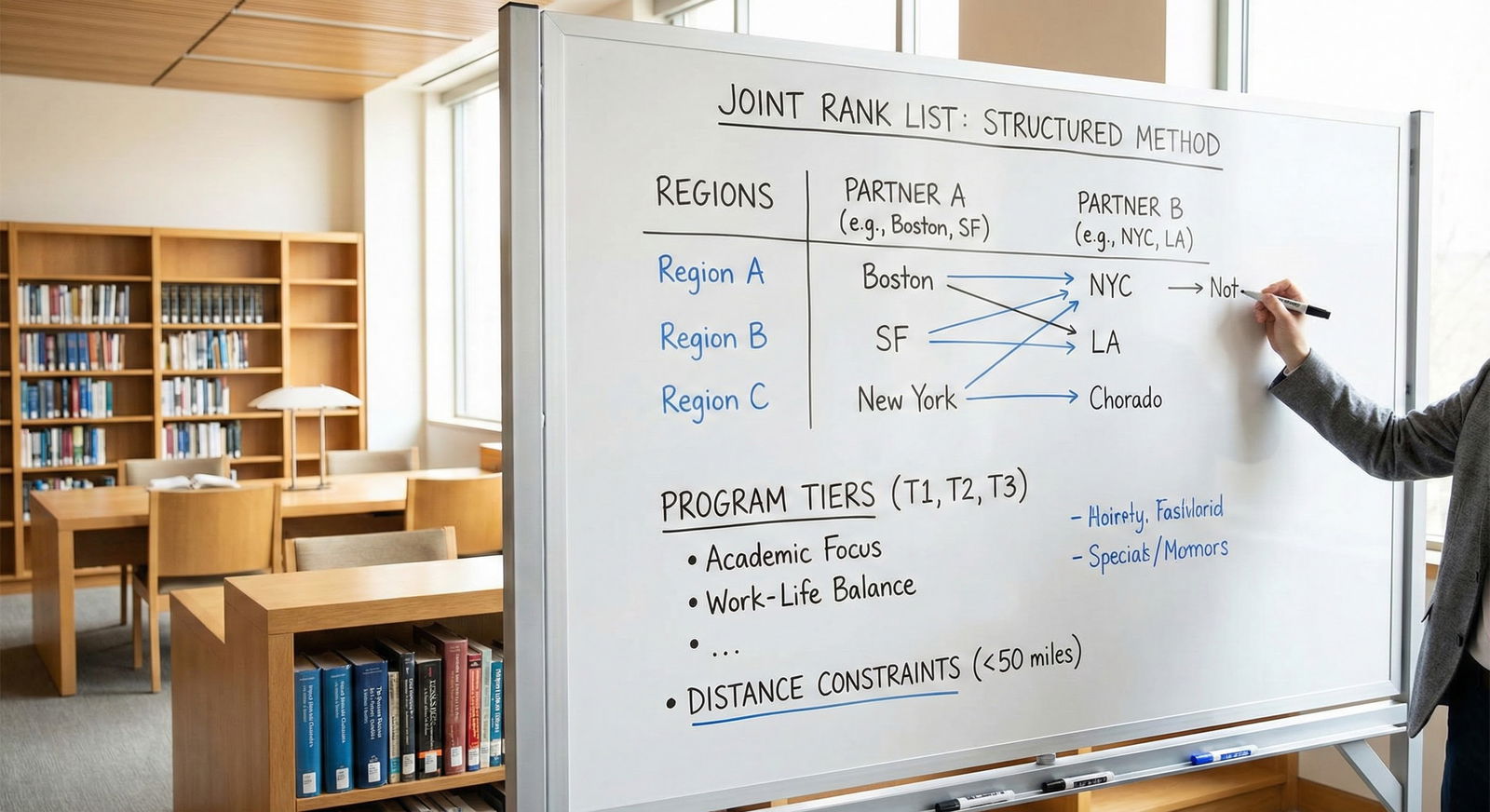
Couples Matching does not “blacklist” you from academic programs. The data flatly contradicts that myth.
You hear the same story every cycle: “If you Couples Match, the big-name academic places will drop you. They don’t want the hassle.” I’ve heard attendings repeat it, interns whisper it to MS3s on rounds, and even advisors throw it in as a half-serious warning.
Let’s walk through what actually happens, what NRMP data shows, and where the real risk is hiding. Spoiler: the risk is usually not what Reddit tells you it is.
What Programs Actually See When You Couples Match
First misconception: programs do not see your partner’s file, their scores, or their specialty. They don't see your rank list. They don’t see “we only want Boston together.” None of that.
They see one thing: that you checked the box “participating as a couple.”
That’s it.
No extra “risk score.” No penalty column that says “Couple – probably needy.” They evaluate you the same way as everyone else for their own rank list. Interview selection, step cutoffs, research expectations, letters – all of that is done as if you were an individual applicant.
I’ve sat in meetings where PDs quickly glance at the ERAS header and say, “Oh, they’re Couples Matching,” and then continue arguing about their Step 2 score, their Sub-I performance, or their research output. The couple box is usually a side note, not a central factor.
Where programs sometimes care is this: they might ask in the interview, “So how are you and your partner thinking about geography?” And what they’re really trying to figure out is: are you likely to tank us on your list because your partner is locked into one city?
That’s a logistics question, not an academic-versus-community question.
What the NRMP Data Actually Shows About Couples
Let’s look at something objective for a second.
The NRMP publishes detailed data on couples every year. The numbers bounce a bit by cycle, but the pattern is stable:
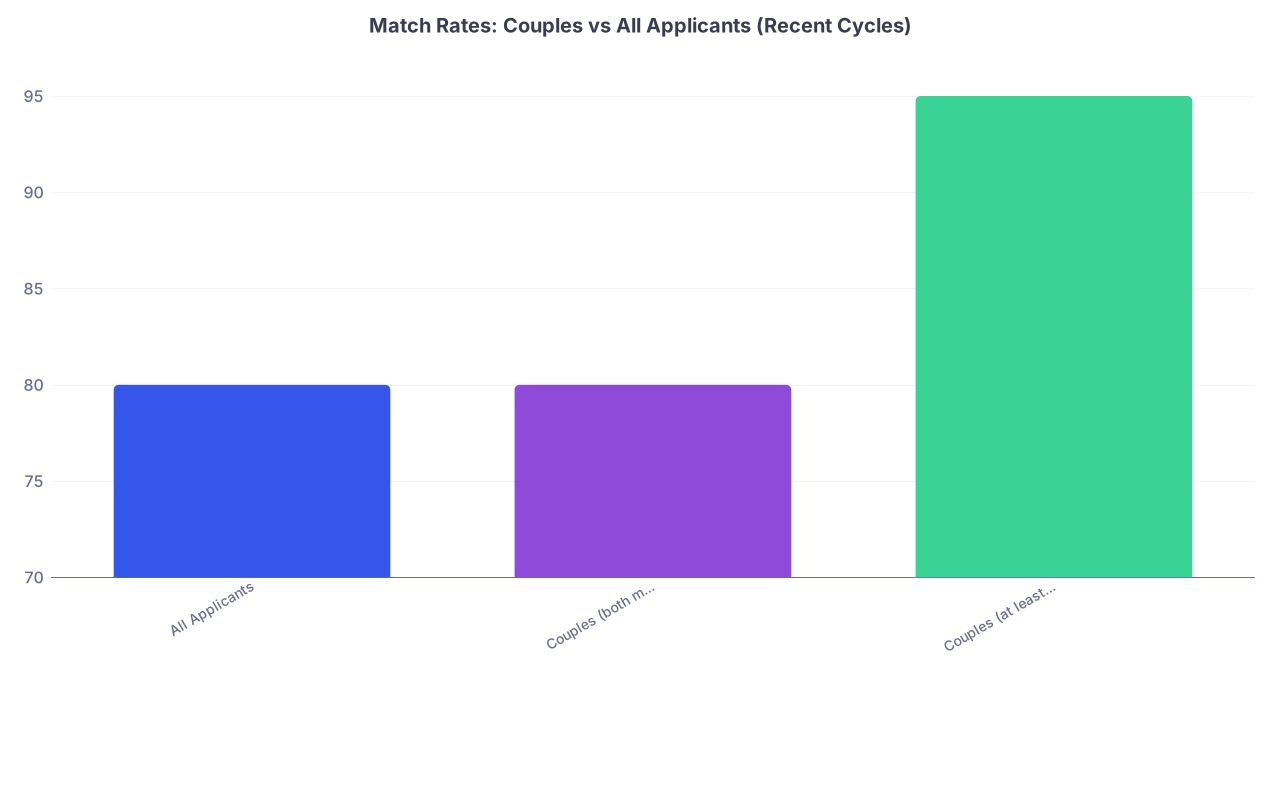
| Category | Value |
|---|---|
| All Applicants | 80 |
| Couples (both matched) | 80 |
| Couples (at least one matched) | 95 |
Rough ballpark:
- Overall PGY-1 match rate for all applicants: ~80–81%
- Couples where both partners match: ~80%
- Couples where at least one partner matches: mid‑90%s
So no, Couples Match is not some death sentence. Your odds are, on average, similar to the general pool. The NRMP’s own “Results and Data” reports spell this out every year.
If Couples Match made you toxic to academic programs, you’d expect lower match rates for that subgroup. You do not see that. Not in IM, not in peds, not in psych. Even in competitive specialties, couples do reasonably well when they apply intelligently.
The NRMP also shows that:
- Many couples match into different program types (one academic, one community) in the same metro area.
- Plenty of couples match into academic–academic pairings.
- A nontrivial chunk match into “reputation name brands” on at least one side.
In other words, the system is not set up to exclude you from academic centers just because you’re a couple.
The limiting factor is almost always geography and competitiveness, not the academic label.
Where the Real Risk Is: Geography, Not “Academics”
The real constraint of Couples Match is brutally simple: you are no longer one applicant trying to get one job. You are two applicants trying to land two jobs in overlapping zip codes. That’s math, not bias.
Here’s how that plays out in practice.

| Step | Description |
|---|---|
| Step 1 | Decide to Couples Match |
| Step 2 | Multiple Cities Listed |
| Step 3 | Fewer Pair Options |
| Step 4 | More Academic+Academic Combos |
| Step 5 | Higher Risk of Unmatched or One-Sided Match |
| Step 6 | Geography Flexible? |
If you both insist on “only Boston or only San Francisco” AND you both want high-powered academic programs AND one of you is in a competitive specialty… yes, that will hurt. But the problem isn’t Couples Match itself. It’s that you’re doing competitive × competitive × geographically tiny.
Now contrast that with something more realistic:
- One partner: Internal medicine, wants solid academic or hybrid program
- Other partner: Pediatrics, open to academic or strong community
- Geography: 3–5 metro areas you’d actually live in
Suddenly the system has breathing room. Both academic and community programs in those cities can appear in pair combinations on your couples rank list. You’re not inherently less attractive to, say, University of X Internal Medicine just because your partner is looking at Peds across town.
The couples algorithm simply looks for pairings where both programs rank each of you highly enough. It doesn’t care whether the program is “university” or “community-based university-affiliated.” It cares about rank positions.
So the more cities and tiers of programs you’re willing to consider, the more likely you are to preserve access to academic spots.
The “Academic Programs Don’t Want Couples” Myth
Let’s dismantle this properly.
You’ll hear things like:
- “Big academic programs want independence, they don’t want to accommodate couples.”
- “University hospitals think couples will just leave if one person is unhappy.”
- “PDs don’t like the politics of dealing with two people together.”
Do some PDs personally roll their eyes at couples? Absolutely. Some also roll their eyes at MD/PhD applicants, or at people coming from Caribbean schools, or at applicants who say they only want one city. Humans have biases.
But structurally? Academic programs have reasons to be more tolerant of couples, not less:
Volume and size.
Large academic programs have more resident slots and more affiliated programs in the same city. That means more possible pair combinations for the Couples Match algorithm to exploit. A 40‑resident IM program tied to a big anesthesia, peds, and EM program has far more flexibility than a tiny community hospital with 6 IM interns.Institutional ecosystems.
Big academic centers usually share HR, GME offices, and institutional policies. They already handle dual-career faculty issues, visa/relocation complexity, etc. A resident couple is not some unique snowflake problem.Reputation and recruiting.
Prestigious academic programs want top candidates. Top candidates have partners. Tossing every couples applicant out of contention is a good way to shrink your talent pool and generate bad word-of-mouth at feeder med schools.
I’ve watched academic IM programs in major cities quietly coordinate with anesthesia and peds PDs to “pay attention” to certain couples, especially if both members were strong. They didn’t guarantee anything, but they were more engaged, not less.
Does this happen everywhere? No. But it completely contradicts the lazy claim that academic programs categorically dislike couples.
Where Couples Can Get Dinged (And How to Avoid It)
There are real pitfalls. They’re just not the ones most students obsess over.
1. Overly rigid city demands
“I will only go to Manhattan or the Bay Area, and my partner wants derm at Stanford or UCSF.”
That’s not a couples problem. That’s you picking the hardest version of the game and then being surprised it’s hard.
Academic programs in competitive cities are already drowning in high-stat, research-heavy applicants. If they suspect you’re a geographic long shot because of your partner, they might quietly discount your likelihood of ranking them highly. That can hurt.
The fix: be honest but not fatalistic.
Saying, “My partner is applying to pediatrics and we’re focusing on the Northeast, but we’ve both built lists that work independently too” is very different from, “We have to be in Boston or we won’t rank you.” One keeps you in play. The other makes them question whether a rank slot on you is a wasted bullet.
2. Mismatched competitiveness
Classic pattern: one partner strong (e.g., 260+ Step 2, strong research, AOA), the other with more average or weaker stats. The stronger partner wants “top 15 academic only,” the weaker one realistically needs a broader, more forgiving list.
If the strong partner refuses to include mid-tier academic or community programs in the same region, yes, their academic odds get worse. Not because programs hate couples. Because you’ve artificially shrunk the set of feasible pairings.
The fix: the stronger partner needs to decide if they care more about proximity or prestige. You can’t demand both across the board in a constrained geography and expect the algorithm to perform miracles.
3. Sloppy or lopsided rank lists
I’ve seen couples torpedo strong academic chances because their lists made no logical sense.
Example I actually saw play out:
- Partner A (IM) ranked: Only 6 super-elite academic programs in two cities.
- Partner B (Psych) ranked: 20 programs in 5 cities, mostly academic and academic-affiliated.
On paper, B had great odds. A did not. Their couples list ended up with just a handful of realistic pairings. They both could have individually matched well at academic programs; as a couple, they nearly didn’t match at all.
The algorithm is not magic. It can only work with what you give it.
Data Reality Check: Academic vs Community for Couples
Let’s be concrete. This is the part no one bothers to quantify.
| Couple Profile | Geography Flexibility | Likely Outcome Pattern |
|---|---|---|
| IM + Peds, average stats, 4–5 cities | Moderate–High | Mix of academic + community combos |
| IM + EM, strong stats, 3 cities | Moderate | Academic + academic or hybrid pairs |
| Derm + Ortho, high tier only, 1 city | Very low | High risk of one unmatched or tradeoffs |
| Psych + FM, broad list, 6+ cities | High | Very high chance both match, mixed sites |
| IM + Anesthesia, rigid “top 10 only” | Low | Lower match rate than they could have |
Notice what drives the risk: competitiveness of specialty + geographic rigidity. Not “academic program” as a category.
You’ll absolutely see couples where both end up at solid university programs. You’ll absolutely see couples where one ends up at a flagship academic center and the other at a strong community affiliate in the same city. That last scenario is probably the most common “academic-adjacent” outcome.
Academic programs are often the anchor sites because they’re bigger and in the academic hubs where multiple residencies exist.
How to Preserve Academic Options While Couples Matching
If your dream is academic medicine and you’re Couples Matching, you don’t need magic. You need to not sabotage yourself. A few principles:
Be realistic about at least one of the three: geography, specialty competitiveness, or program tier. You cannot demand “all three maxed” and then blame Couples Match.
Build rank lists that work individually and together. That means each of you would have a reasonable solo match if the other somehow didn’t exist. Then you combine those lists into a couples list that has depth in multiple cities.
Talk openly during interviews – but strategically. “We’re Couples Matching but open to multiple cities, and we’ve targeted programs that could work for both of us” reassures academic PDs that you’re serious, not fantasy-planning.
Do not delete all community or mid-tier academic programs “to keep our list elite.” That’s how strong couples end up needing SOAP unnecessarily.
Quick Reality Snapshot: Who Actually Gets Hurt?
Let’s be blunt.
The couples who truly hurt their academic chances are usually:
- Couples insisting on one hyper-competitive city.
- Couples where one partner is out of touch with their competitiveness.
- Couples who build fantasy rank lists with 8–10 total pairings, nearly all at top‑10 brand-name places.
In other words, not “people who Couples Match.” People who ignore math.
Strong couples who:
- Apply smartly.
- Use 3–5 metro areas.
- Mix academic and academic-affiliated/community options.
…very often land in at least one academic program, sometimes two.
Years later, when those residents are applying for fellowships or junior faculty spots, nobody cares that they Couples Matched. They care what you did with the training you got.
FAQ: Couples Match & Academic Programs
1. Do academic programs see that I’m in the Couples Match and automatically rank me lower?
No. They see the “couple” flag in ERAS, but most use it as context, not a penalty. They still rank you based on your file: scores, letters, interviews, fit. Some PDs do privately worry about geographic risk, but that’s not the same as systematically ranking all couples lower.
2. Will being in the Couples Match hurt my chances at “top-tier” academic programs?
It can if you insist on narrow geography and refuse to include realistic backup options. But the primary limiting factors are your competitiveness and how crowded the city is, not the couples designation. Many couples match to “top-tier” or at least upper-mid-tier academic programs every cycle.
3. If my partner is applying in a less competitive specialty, will that drag down my academic chances?
Not directly. Programs don’t see their scores or their application. The risk comes if your partner’s realistic options are clustered in places where your list is weak or nonexistent. If your lists are geographically misaligned, that can force you to compromise more than you’d like.
4. Is it safer for academic aspirations if we don’t Couples Match and just ‘hope’ to end up nearby?
Usually not. Then you’re gambling on independent algorithms with no coordination. Couples Match at least lets you rank pairings intentionally. If both of you care about being together and one or both want academics, Couples Match is generally the more rational way to protect both goals, provided you build intelligent lists.
5. Does Couples Match matter for academic fellowships later (cards, heme/onc, GI, etc.)?
No. Fellowship directors care about your residency performance, research, letters, and reputation of your training program. They do not care whether you Couples Matched as an MS4. By the time you’re applying for fellowship, Couples Match is ancient history.
Years from now, you will not remember the rumor that “Couples Match kills academic chances.” You’ll remember whether you and your partner made clear-eyed, mathematically sane choices about where to go and what mattered most.


