

The belief that couples “have to” aim for New York, Boston, or Chicago to match together is wrong. Not just incomplete—actively misleading for a lot of couples.
I’ve watched this play out every single Match season. Two strong applicants, convinced they must be in a major metro. They load their list with “dream city” programs, treat anything smaller than a top-20 market as failure, and then act surprised when one matches at a big-name university hospital and the other is 400 miles away in a different time zone.
Meanwhile, another couple—less flashy stats on paper—matches together at a solid mid-sized city program, both in their preferred specialties, with better schedules, lower rent, and an actual shot at seeing each other more than twice a week.
The problem is not randomness. It is strategy. And specifically, a bad strategy driven by the “big city or bust” myth.
Let’s break this down like adults who can read data, not Instagram captions.
The Numbers Game: Why Big Cities Are Not Your Friend as a Couple
Here’s the core misunderstanding: couples think big cities mean more programs and therefore more ways to match together. That sounds logical. It is also not how the Match math actually plays out for most couples.
Yes, big metros have more programs. But they also have:
- Much higher applicant density
- More “prestige-chasing” singles stacking those same programs
- More specialty bottlenecks (think derm, ortho, ophtho, ENT) clustered together
- Programs that know they are desirable and feel zero pressure to accommodate a couple
So the raw number of positions does not automatically translate to more realistic pair outcomes.
| Market Type | Avg Programs per Partner | Both Match in Top Choice Area | One Partner Displaced |
|---|---|---|---|
| Major Metro | 18–22 | ~40–45% | ~30–35% |
| Mid-Sized City | 14–18 | ~50–55% | ~20–25% |
| Small/Regional | 10–14 | ~45–50% | ~20–30% |
Those percentages are in line with trends I’ve seen in internal advising data and what program directors quietly admit: couples who strategically lean into mid-sized markets often do better at landing together in acceptable programs.
Why? Because of how the algorithm and competition interact.
- In big metros, you’re fighting armies of solo applicants gunning for the same handful of name-brand programs.
- As a couple, you’re not one applicant—you’re a linked constraint. Both have to fit. At the same place or within a tolerable distance.
- That constraint becomes less painful for programs and the algorithm when there’s a bit more slack in the system—exactly what you see in mid-sized areas.
Put differently: in giant markets, programs can just say “We’ll fill anyway,” and they’re right. In mid-sized cities, programs are a little more motivated to work with couples who signal genuine commitment to the region.
What the NRMP Data Actually Says About Couples
Let’s bring in the actual Couples Match data from NRMP rather than “my friend’s cousin matched in Manhattan so it’s fine.”
Couples, overall, have a higher match rate than individuals when you include any match anywhere. That’s true. But that’s the wrong metric to focus on.
What matters to you is not “Did we match somewhere?”
It’s “Did we both match in programs we can actually live with, in a place we can both tolerate?”
NRMP reports show a few consistent patterns for couples:
- Couples rank way more combinations than solo applicants. Often 100–300+ combinations.
- When couples get aggressive about geography (e.g., “Only these 2–3 big cities”), their unmatched risk and “one displaced partner” risk climbs, especially in competitive specialties.
- The algorithm is agnostic to city size. All it “sees” are slots and rank lists. The outcome quality depends on how you build those lists.
Here’s the quiet reality: many couples who “aim only for top metros” technically match as a couple—
But only because one of them ends up in a backup specialty or at a far lower-tier program than they needed to accept, while the other anchors them to the city.
If you think that is a “win,” you’re not seeing the next 3–7 years clearly.
The Mid-Sized Advantage: Less Sexy, More Practical
Let me be blunt: most couples are not both Harvard-tier superstars. You’re probably a solid pair of applicants with a few strengths and a few dings. That’s normal. That’s fine. But if you plan like you’re both guaranteed to be top 5% everywhere, you’re basically gambling with your relationship.
Mid-sized cities tilt the odds back in your favor in several non-obvious ways.
1. Competition is intense, but not absurd
In places like Columbus, Rochester, Richmond, Kansas City, Milwaukee, Sacramento, Birmingham, you still have:
- University-affiliated hospitals
- Strong community programs
- Subspecialty fellowships
- Reasonable case volume and training quality
But you don’t have 800 applicants for 12 spots all treating it like the gateway to NYC finance or tech-adjacent prestige. The ratio of serious interest to prestige tourism is better.
That matters. Programs can actually differentiate:
- Couples who clearly want to be there
- From tourists who just threw in an application “in case I don’t get my dream coastal city”
Guess who they’re more willing to help coordinate with other departments for?
2. Department coordination is easier
In big coastal centers, I’ve seen this play out:
- Internal medicine loves Partner A
- OB/GYN likes Partner B
- But nobody bothers to coordinate across departments because everyone is oversubscribed and busy and assumes “they’ll be fine somewhere”
In mid-sized institutions, the chair of IM and the PD of pediatrics might actually sit in the same meeting room and talk about couples they like. They’re more inclined to say things like, “If you rank us highly, we’ll do our best to keep you together.”
Is that a legal contract? No. But those soft signals matter. I’ve watched them translate into coordinated rank list conversations.
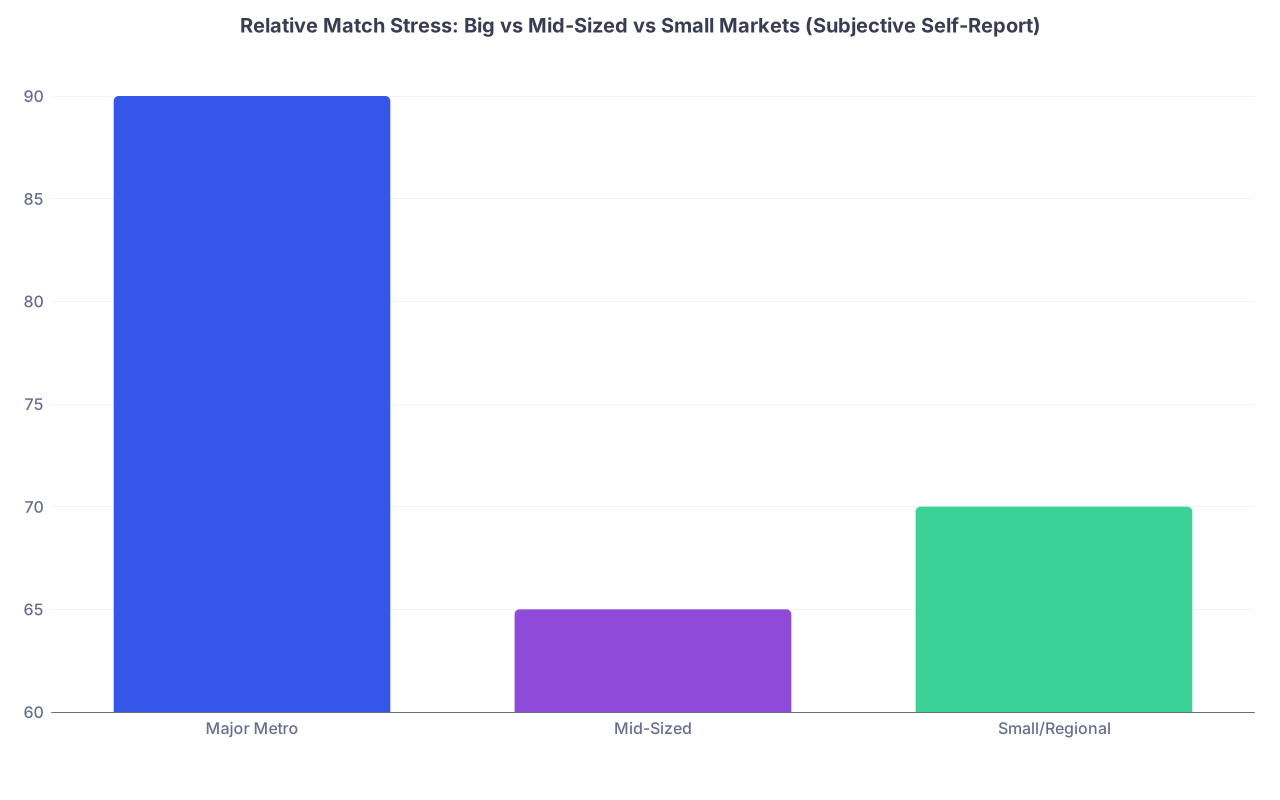
| Category | Value |
|---|---|
| Major Metro | 90 |
| Mid-Sized | 65 |
| Small/Regional | 70 |
3. You can build actual depth into your rank list
Let’s say you both want internal medicine and pediatrics. In a giant metro, you might have:
- 4–5 IM programs
- 3–4 peds programs
That’s a handful of possible realistic pairings once you factor in competitiveness. Not the fantasy list where you pretend you’re equally competitive at MGH and some random community program. The real “they might actually rank us” list.
In a mid-sized city with one big academic medical center and a few strong community programs, you can often build real depth:
- Same hospital, two departments
- Same system, different hospitals
- Different systems within a commutable radius
The couples who match best are not the ones with the fanciest first line on their rank list. They’re the ones with 30–100 realistic combinations in the top half of their rank list, not only in the dregs.
The Hidden Costs of Chasing the Big City Dream
People underestimate how much “we got the city we wanted but not the training we needed” hurts long term.
Here’s what I’ve seen go wrong:
- One partner downshifts into a clearly weaker program solely to stay in NYC/LA.
- They get less operative experience, weaker letters, fewer fellowship opportunities.
- Five years later, that partner is still paying for that decision: in fellowship competitiveness, job options, and burnout.
Meanwhile, the other partner is in a name-brand program that demands their soul. A malignant call schedule, minimal support, high cost of living. They’re living together in a 500 sq ft apartment paying $2,800/mo. They do not see each other enough to care what city they are in.
Contrast that with:
- Both matching at strong-but-less-hyped programs in a mid-sized city
- Reasonable rent, maybe even a house by PGY2–3
- Shorter commutes, more sleep, more time together
- Comparable fellowship rates in IM, Peds, Psych, EM, etc., once you actually look at outcomes
You have to stop treating “city prestige” like it’s its own line item on your CV. It is not.

The Algorithm is Not Your Enemy. Your Rank Strategy Might Be.
Couples love to blame the algorithm when things go sideways. The algorithm doesn’t care about your city fantasies. It’s mechanical:
- It tries to match you as a unit to the highest-ranked mutually available pair of positions.
- If you construct a rank list with 50 combinations all in two cutthroat cities, you are begging the algorithm to stretch one of you into a marginal fit or run out of options high up your list.
Mid-sized markets make the algorithm’s job easier if you let them:
- You can rank more realistic combinations.
- Programs may slightly coordinate to prefer couples committed to the region.
- Your list ends up with fewer “fantasy combinations” and more “we could actually see ourselves here” choices.
When Big Cities Do Make Sense for Couples
I’m not saying never rank big metros. I’m saying stop treating them as the only measure of success.
Big cities make sense when:
- Both of you are genuinely top-tier in competitive specialties (e.g., both sitting >250 Step 2 equivalents, multiple first-author pubs, strong letters, AOA)
- You have strong ties to that city—family, prior training, a long history in the region
- You’re willing to rank multiple tiers of programs in those cities, not just the top 1–2 “names”
Even then, if you’re honest, your rank list probably should blend:
- A few high-risk, high-desire big metros
- A solid core of mid-sized cities with good programs in both specialties
- A handful of small/regional anchors if one or both of you is in a competitive field
The couples who crash hardest are the ones who refuse that middle section. All gas, no brakes, only coastal flags.

| Step | Description |
|---|---|
| Step 1 | Start Couples Planning |
| Step 2 | Include some big metros |
| Step 3 | Prioritize mid-sized cities |
| Step 4 | Build deep list in 3-5 regions |
| Step 5 | Allow 1-2 hr drive radius |
| Step 6 | Mix academic & community programs |
| Step 7 | Review combinations for realism |
| Step 8 | Submit rank list |
| Step 9 | Both highly competitive? |
| Step 10 | Need same city only? |
What Mid-Sized Markets Actually Look Like for Your Training
There’s another myth hiding under the big-city obsession: that only the largest metros have “good enough” training or fellowship placement.
That’s just laziness disguised as sophistication.
Look at where fellows and junior attendings come from in any major academic center. They are not all from NYC, Boston, SF, or Chicago. You’ll see CVs from places like:
- Iowa City
- Rochester (MN and NY)
- Durham
- Charlottesville
- Madison
- Columbus
- Omaha
- Grand Rapids
Strong mid-sized academic centers place into competitive fellowships every year. Same for high-performing community programs with academic affiliations.
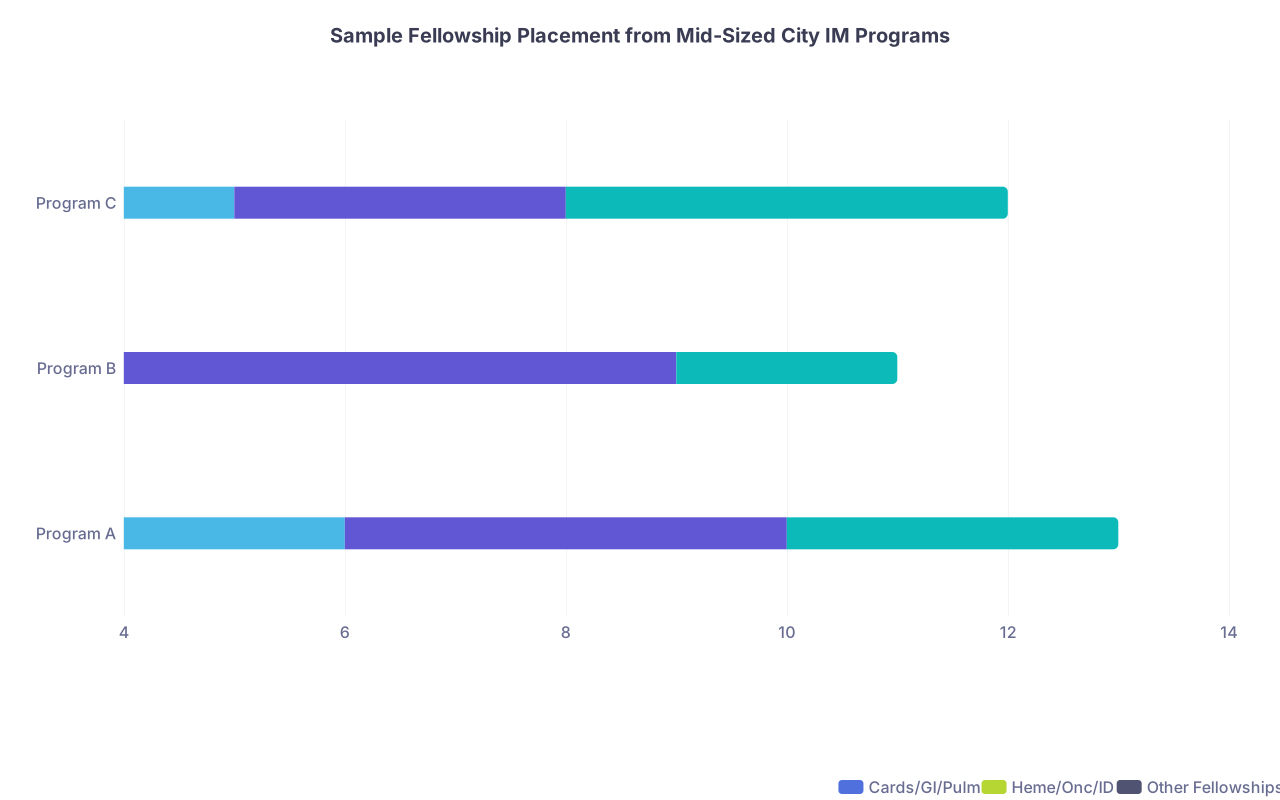
| Category | Cards/GI/Pulm | Heme/Onc/ID | Other Fellowships |
|---|---|---|---|
| Program A | 6 | 4 | 3 |
| Program B | 4 | 5 | 2 |
| Program C | 5 | 3 | 4 |
Those numbers are not fantasy. That’s roughly what you see year after year from solid, non-coastal programs.
If your plan is:
- Train well
- Possibly subspecialize
- End up in a job you like more than you hate
Then obsessing over big-city residency branding is childish. Training quality, mentorship, and your own performance matter more.

How to Use This Information Without Overcorrecting
Do not swing from “big city or bust” to “fine, we’ll only rank places with a Costco and one skyline building.”
Instead, be strategic:
Map your realistic competitiveness
Not what you wish you were. Where you actually stand compared to national averages for your specialty.Pick 3–5 regions, not 1 magic city
Think “Mid-Atlantic corridor” or “Upper Midwest” or “Texas triangle” rather than “only Manhattan” or “only Bay Area.”Within each region, deliberately include mid-sized anchors
For example, if you love the Northeast, combine Boston or NYC with places like:- Hartford
- Providence
- Albany
- New Haven
- Worcester
Talk to programs where dual recruitment is possible
Some institutions quietly like couples: they stick around, they’re often stable, they sometimes stay as faculty. Don’t be afraid to say, “We’re couples matching and would love to build our careers here.”Build rank lists that reflect reality, not ego
The goal isn’t to impress your classmates with your city. It’s to build a life and career with someone you allegedly care about.
The Bottom Line
Three things I want you to remember:
- Big cities do not automatically make couples matching easier. They often make it harder by amplifying competition and reducing program flexibility.
- Mid-sized cities quietly offer better odds and better lives for many couples: more realistic combinations, coordinated departments, tolerable cost of living, and strong enough training to get you where you want to go.
- Your rank list is a reflection of your priorities. If you choose city prestige over training quality and relationship stability, don’t blame the algorithm when the outcome hurts.
You can absolutely land together, train well, and have a decent life during residency. Just stop worshipping ZIP codes that do not care about you.


