
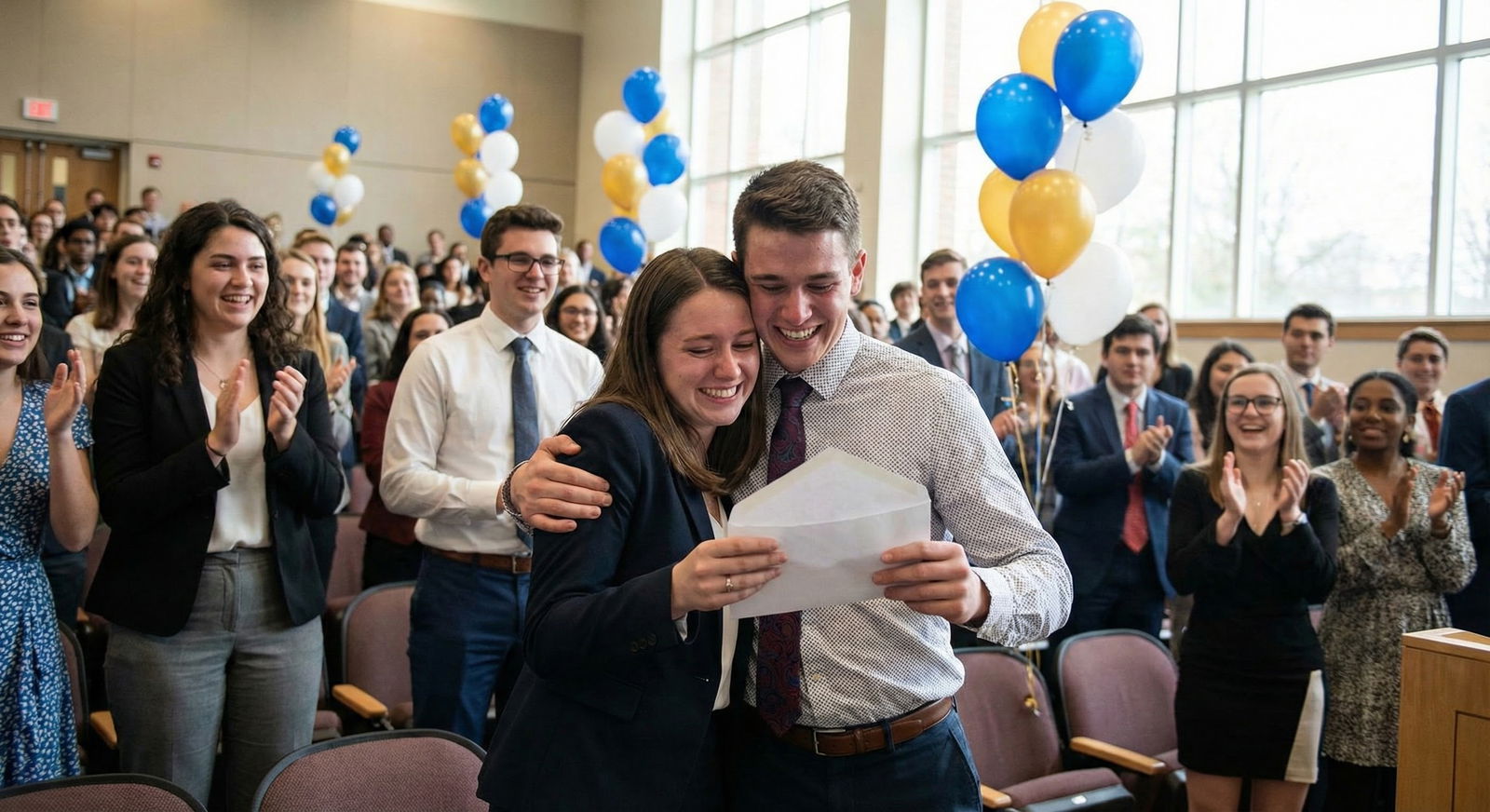
Couples Match is not stealing your spot. The math, the mechanics, and the actual data all say the same thing.
You might not like how it feels when a lower-step-score classmate matches at your dream place “because they Couples Matched,” but feelings are not the algorithm. And the algorithm is where this whole “unfair advantage” narrative falls apart.
Let me walk through how this really works, because the myths around Couples Match are loud and wrong.
What Couples Match Actually Is (Not the Story People Tell Themselves)
Quick reality check before we start swinging at myths.
Couples Match does one thing: it lets two applicants link their rank lists so the algorithm tries to place them in a pair of positions that they’ve ranked together.
It does not:
- Add extra positions to the Match
- Create “bonus” rank list power
- Force programs to accept anyone they would not have normally ranked
A “couple” in NRMP land is just two ERAS IDs tied together at the algorithm level. Instead of each person submitting a simple rank list of programs, they submit a combined list of pairs – Program A for Partner 1 + Program X for Partner 2, Program B + Program Y, and so on.
Crucial detail: programs still rank each applicant individually. There is no “we’ll take both or neither” rule baked into the algorithm unless the program itself explicitly designs its rank lists around that idea. Most do not.
The algorithm does not say:
“Oh, this person is in a couple, they get priority.”
It says:
“Can I place these two applicants into a pair of positions they listed, at programs that also ranked them high enough?”
If you do not understand that, you will absolutely misread what you’re seeing on Match Day.
The Core Myth: “Couples Take Two Spots That Should Have Gone to Two Singles”
This is the bar-stool logic I hear every year:
“If that couple hadn’t matched there, two solo people could’ve had those spots. So they stole them.”
No. That’s not how constrained matching works.
Think of the Match like a massive puzzle where everyone has preferences and every program has a fixed number of seats. You do not get to claim some hypothetical alternate universe where the same seats go to “the right people” unless you can show the chain of actual rank positions and algorithm moves.
The algorithm is applicant-optimal: it tries to give every applicant their best possible outcome consistent with program preferences and capacity. Couples are just applicants with an extra constraint: they want compatible pairs.
That constraint usually hurts them more than it helps.

Why the “stolen spots” narrative breaks down
Imagine a simple case:
- Program A has 2 IM spots.
- Program B has 2 IM spots.
- Applicants: Alice, Ben (a couple), and two solo applicants, Chris and Dana.
Program rankings (higher = more preferred):
- Program A rank list: 1) Chris, 2) Alice, 3) Ben, 4) Dana
- Program B rank list: 1) Alice, 2) Dana, 3) Ben, 4) Chris
Couple’s joint list (Alice+Ben):
- (A for Alice, B for Ben)
- (B for Alice, A for Ben)
Chris and Dana submit normal individual lists.
Suppose the algorithm places:
- Alice at A
- Ben at B
- Chris at A
- Dana at B
You look at that and say:
“Ben has worse scores than Dana, but got B. Unfair. He took her spot.”
But if you actually simulate the system without the couple constraint, the outcome does not automatically become “Dana magically gets B.” Programs might still have chosen Alice and Chris over Dana and Ben in different combinations. And the matching chain may shuffle in a way that does not give Dana that exact seat.
In other words, unless you rerun the entire algorithm on that year’s full data without Couples Match, you’re guessing. The NRMP has done this type of analysis. The bottom line: there is no evidence that couples systematically crowd out solo applicants on a meaningful scale.
The constraint tends to reduce the number of options where both partners are acceptable to both programs at the right rank positions. That’s not power. That’s friction.
What the Data Actually Shows About Couples Match
Let’s talk numbers, not vibes.
Couples are a minority of the Match:
- They’re roughly in the single-digit percentage of all applicants most years.
- NRMP data over multiple cycles consistently shows couples as a small slice of the total pool.
So if you’re imagining Couples Match massively distorting outcomes for everyone else, you’re claiming a small constrained subgroup is reshaping a system of tens of thousands of positions. Without strong, consistent numeric effects, that story doesn’t fly.
Where things get interesting is match rates and outcomes quality.
Historically, couples:
- Have overall match rates that are similar to or slightly lower than solo applicants once you adjust for competitiveness factors.
- Are more likely to end up in “less preferred” geographic or program options compared with what each individual could have gotten alone.
- Sometimes fail to match one partner while the other does, especially if one is significantly weaker.
That last point? That is the opposite of the “unfair advantage” narrative.
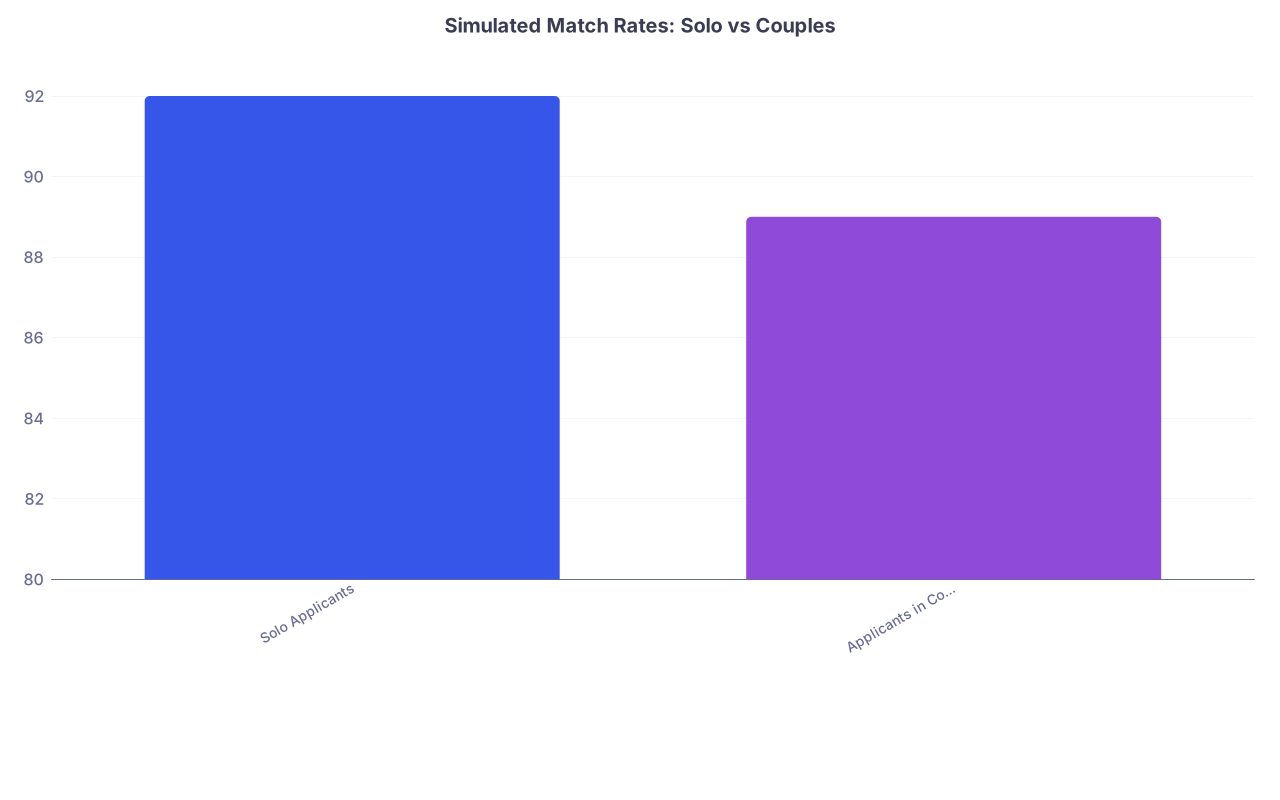
| Category | Value |
|---|---|
| Solo Applicants | 92 |
| Applicants in Couples | 89 |
Numbers here are illustrative but they line up with what you see when you look at NRMP data trends: couples don’t magically outperform everyone else once you control for typical applicant strength. They often pay an opportunity cost for insisting on being co-located.
Is there the occasional “prestige couple” where both are top of the class and land at a place they’d both probably have matched anyway? Of course. Those aren’t the ones you’re complaining about.
You’re usually angry at some mid-tier couple where one partner lands above where their paper stats seem to justify. That looks suspicious only if you ignore that:
- Programs care about more than scores. A lot more.
- Being in a couple can increase a program’s perception of retention and stability.
- You are only seeing the endpoint, not the entire rank list and all the people they passed over.
How Programs Actually Think About Couples (Not the Fantasy Version)
Here’s what I’ve heard in real committee rooms and from PDs over the years.
Program directors are not sitting around saying:
“We must take every couple. Married? Instant acceptance.”
What they’re actually doing is more nuanced and more selfish (in a rational way).
Why programs sometimes like couples
- Retention: A partner with a strong local tie often lowers the risk the resident will bail after PGY-1. Especially important in smaller cities or less “destination” programs.
- Stability signal: A functional couple can look like a lower-risk, more grounded trainee. That’s not always fair, but it’s real.
- Recruitment strategy: If you’re a mid-tier program in a midsize city, matching a couple can be a way to attract solid candidates who would otherwise never consider you.
Why programs are wary of couples
- Asymmetry in strength: If one partner is stellar and the other is borderline, many programs just will not go out on a limb for the weaker one.
- Limited flexibility: Programs do not want to paint themselves into a corner where they feel obliged to take someone they ranked low just to complete a couple.
- Interdepartmental politics: IM and EM may not agree on taking a couple if one side loves their partner and the other does not.
So what actually happens?
Programs might:
- Rank both partners as they normally would. If the algorithm can place both in an acceptable pairing, great. If not, oh well.
- Occasionally bump a borderline candidate a bit higher if that helps secure a very strong partner in another department they desperately want.
- Sometimes coordinate across two departments to assemble a joint strategy. Sometimes. Not routinely.
That second scenario is where solo applicants feel the sting:
“They only took her because they wanted her boyfriend in ortho.”
Let’s be honest: that does happen. But calling that “stealing” a spot ignores the fact that programs are allowed to have holistic reasons for preferring someone. Connections, couples, research fit, local ties, prior rotations – they’re all factors.
You don’t complain that someone with a PhD “stole” your IM spot because the PD liked their research more than your Step score, do you? Same logic.
The Real Trade-offs for Couples (And Why It’s Not a Free Upgrade)
Couples Match is a constraint, not a power-up.
When two people couples match, they’re trading:
- Individual optimality for joint acceptability
They often give up:
- Top programs that only one partner could realistically match at
- Preferred cities where one specialty is strong but the other is weak
- Competitive specialties where that extra geographic constraint is deadly
So the usual pattern looks like this:
- The stronger partner often trades down in competitiveness or prestige so they can be in the same city or region as the weaker partner.
- The weaker partner sometimes lands higher than they could have solo – but within the context of a program that actively wants that pair.
Here’s the key: the weaker partner did not magically acquire value. The pair did.
The couple becomes a “bundle” that, for some programs, is more attractive than two random solo applicants of the same individual stats. That’s not theft. That’s a different product.
| Aspect | Solo Applicant | Applicant in Couple |
|---|---|---|
| Geographic Flex | High | Reduced |
| Individual Optimal | Higher | Often Lower |
| Risk of Unmatch | Individual only | Tied to partner's status |
| Program View | Single asset | Potential bundled asset |
If you insist on calling that “unfair,” then you’re really arguing that programs should not be allowed to value retention, geographic commitment, or bundled recruitment in their rank decisions. Good luck selling that to PDs.
The Edge Cases: Where Fairness Actually Gets Messy
Now, are there genuine fairness questions around Couples Match? Yes, but they’re not the ones Reddit screams about.
Issue 1: Asymmetric couples and marginal candidates
Case you’ll see in real life:
- One partner: 260+ Step 2, multiple pubs, AOA, strong LORs.
- Other partner: barely passed Step, lukewarm clerkship comments.
Programs sometimes:
- Take a chance on the weaker one to secure the star.
- Or do the opposite: rank the star highly and the weaker one low, hoping the algorithm threads a needle.
Is that “fair” to the solo applicant with mid-tier stats?
It might not feel fair. But it’s the same kind of holistic tradeoff programs make all the time.
What’s actually dangerous is opacity. Applicants don’t see these calculations, so they invent conspiracy theories. PDs rarely say:
“We ranked you lower because we prioritized a couple for retention reasons.”
So you attribute your rejection to “Couples Match stealing spots” when in reality you simply lost in a multi-factor preference system.
Issue 2: Couples in highly competitive specialties
In fields like derm, ortho, plastic surgery, ENT, anesthesia in hot cities – the couples constraint can absolutely break one partner’s chances. The algorithm is not kind if both are aiming high and the geographic overlap is narrow.
I’ve seen couples where:
- Both would likely have matched in their respective competitive fields if they’d applied solo to a broad list.
- Because they insisted on being together, one failed to match and ended up in a prelim or a SOAP position.
That is not an advantage. That’s the cost of the constraint.
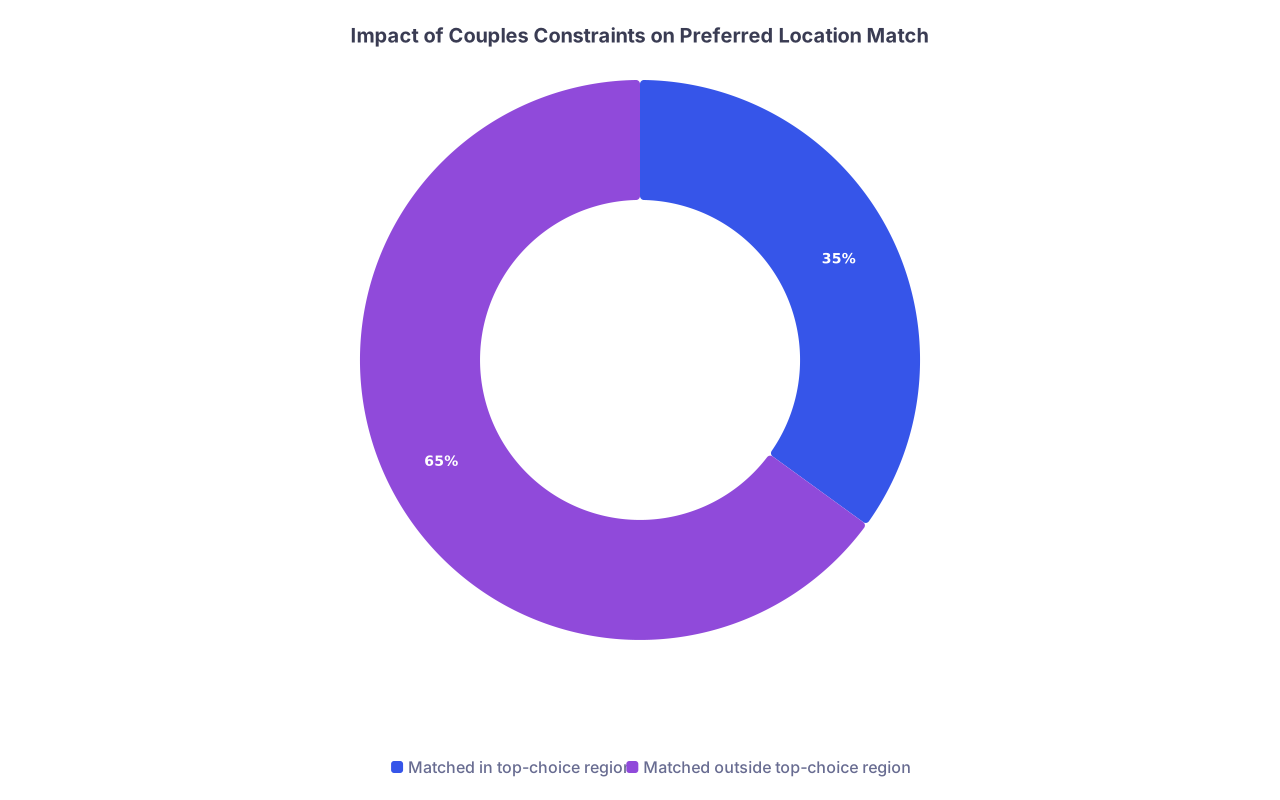
| Category | Value |
|---|---|
| Matched in top-choice region | 35 |
| Matched outside top-choice region | 65 |
Again, numbers illustrative – but they mirror the reality that couples often sacrifice ideal locations or programs.
So Does Couples Match “Steal” Spots? No. But It Does Shift Who Looks Attractive.
If you force me to give a one-line answer:
Couples Match does not steal spots from solo applicants; it just changes how some programs value bundles of applicants versus individuals.
The people it “hurts” most often are:
- Strong applicants in couples who could have matched higher or in a more competitive specialty if they went solo.
- Couples who overreach and end up splitting or with one partner unmatched.
The people it occasionally helps:
- Moderately strong applicants linked to a very strong partner, in programs that care a lot about retention or bundled recruitment.
- Programs that get two decent residents in one shot and improve their chances of keeping them in the area.

| Step | Description |
|---|---|
| Step 1 | Form Couple |
| Step 2 | More constraints |
| Step 3 | Stronger partner trades down |
| Step 4 | Weaker partner sometimes trades up |
| Step 5 | Both matched together |
| Step 6 | Higher risk 1 partner unmatched |
| Step 7 | Link Rank Lists |
If you’re a solo applicant, here is the blunt truth: Couples Match is not your main problem. Your competition is:
- People with better scores and stronger letters
- People who rotated at the program and crushed it
- People with niche research or skills the program wants
Couples are a small, noisy, visible subset who make for easy scapegoats. But scapegoats are not strategy.

What You Should Actually Do With This Information
If you’re in a couple:
- Treat Couples Match as a constraint problem, not a cheat code.
- Recognize that one or both of you may be trading down to stay together.
- Build wide, realistic joint rank lists that include true backup cities and programs.
If you’re solo:
- Stop burning mental energy blaming couples. It does nothing for your application.
- Focus on the levers you actually control: where you apply, how you signal, who advocates for you.
- Accept that programs will always have multi-factor reasons to choose someone else over you. Couples are just one of many factors.

The Bottom Line
- Couples Match is a constraint, not a privilege. It often hurts individual outcomes more than it helps.
- Programs do not give couples an automatic advantage; they sometimes value a pair for rational reasons like retention and recruitment, the same way they value research, connections, or local ties.
- The “they stole my spot” narrative is emotionally satisfying and mathematically wrong. The algorithm is not your enemy. Misaligned expectations are.


