

It is August. ERAS is about to open.
You and your partner are staring at a shared spreadsheet that has become a minor war zone.
- One of you has a 257 on Step 2, strong research, great letters, aiming for Derm/Ortho/ENT/Anesthesia/EM at “good” programs.
- The other has a 228, one publication that barely counts, and is applying to IM/Peds/FM/Prelim TY.
- You are trying to match together.
- The word “I do not want to hold you back” has already been said. More than once.
This is the classic couples match imbalance: one competitive, one average.
Most couples wing it. They over-apply, throw in a few random prelims, and just “hope NRMP magic works.”
That is how you end up with:
- The strong partner scrambling into a backup they hate, or
- The average partner not matching at all, or
- A “match” in two cities that are technically “within driving distance” if you consider four hours reasonable.
You can do better than that. But only if you are deliberate.
Below is a stepwise, practical strategy specifically for couples where one partner is significantly more competitive than the other.
Step 1: Get Absolutely Honest About Both Candidacies
Do not start with geography. Do not start with “dream programs.” Start with cold numbers and realistic tiers.
1.1 Define who is who (and how far apart you are)
You need a brutally honest assessment, not wishful thinking.
For each of you, list:
- USMLE/COMLEX: Step 1 (if reported), Step 2 CK / Level 1–2
- Class rank / quartile / AOA / Gold Humanism
- Research: # of pubs, posters, quality (actual data vs fluff)
- Strongest features: leadership, teaching, language skills, nontraditional background, etc.
- Weak points: fails, leaves of absence, red flags, weak letters, low school reputation
Now, put yourselves into rough tiers by specialty. Do not overthink, just place yourselves.
| Partner | Specialty Target | Competitiveness Tier | Key Notes |
|---|---|---|---|
| A | Anesthesiology | Upper-Mid | Step 2 252, 4 pubs, solid home program |
| B | Internal Medicine | Lower-Mid | Step 2 225, no research, community MD school |
If you are not sure about tiers, ask 2–3 honest attendings or PDs you trust. Not your class group chat. People who actually read ERAS.
1.2 Decide your joint priority: prestige vs proximity vs safety
You cannot optimize everything. Choose one primary objective and a secondary.
I recommend:
- Primary: Matched in the same city (or functional city)
- Secondary: Reasonable career fit for both
- Tertiary: Program prestige
If the competitive partner is secretly prioritizing prestige but says “Of course, being together is what matters most,” your strategy will leak at every step.
Have one explicit conversation:
- “If we have to choose between:
- You at a ‘top’ program and me 3 hours away, OR
- Both of us in the same mid-tier city…
Which do we actually pick?”
Document this in your own words. Literally write it down. When stress hits in January, you will forget what you agreed on in August.
Step 2: Design a Program Strategy Around the Less Competitive Partner
This is the single biggest mistake couples make: they anchor to the competitive partner’s list. That is backwards.
2.1 Build around the “limiting reagent”
Think about it like chemistry. Your match success is saturated by the less competitive application. You build around that person.
So:
- Choose the average partner’s specialty first (or specialties, if they are open).
- Map out where that specialty is more forgiving:
- Community vs academic
- Regions that are less competitive (often Midwest, some South, smaller cities)
- Programs known to be FMG-friendly often are also lower-score friendly for AMGs.
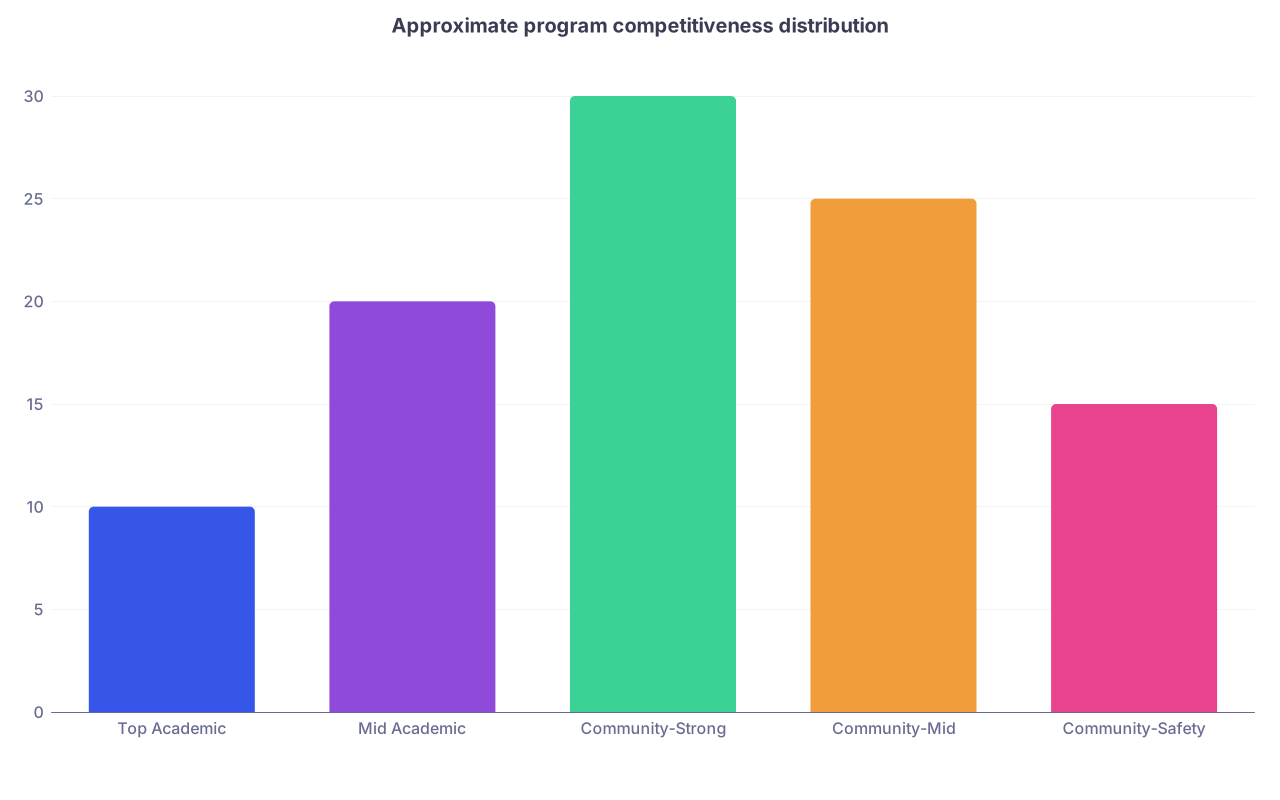
| Category | Value |
|---|---|
| Top Academic | 10 |
| Mid Academic | 20 |
| Community-Strong | 30 |
| Community-Mid | 25 |
| Community-Safety | 15 |
Rough idea: your less competitive partner probably needs most of their interviews from the last 3 bars in that chart.
- Only then ask: “Where can the strong partner reasonably match, given these locations?”
2.2 Segment your cities into 3 buckets
You are going to over-apply on geography, but you must categorize:
Bucket 1: Ideal Cities
- Both specialties present
- Multiple programs for at least one of you
- Places you would be happy to live
Bucket 2: Acceptable Safety Cities
- Maybe not your dream, but livable
- Stronger for the less competitive partner
- Even if the strong partner lands at a slightly “below potential” program, still fine
Bucket 3: Emergency Backup Cities
- Places you would tolerate for 3–4 years
- High probability of match for the average partner
- Strong partner must be emotionally prepared to go here if it means matching together
You need all three. Couples who only build Bucket 1 lists are the ones calling PDs in March asking for a SOAP miracle.
Step 3: Build Asymmetric Application Lists on Purpose
The competitive partner should not just “apply broadly.” They should apply strategically broadly.
3.1 Over-apply with the average partner; sniper + safety for the strong partner
Here is the rough structure I recommend for many pairs (adjust numbers to your scenario):
- Average partner (IM/FM/Peds/Prelim):
- 60–120 programs depending on competitiveness and specialty
- Focus on community and mid-tier academics in your target regions
- Competitive partner:
30–80 programs
Split their list:
- ~30–40%: Programs aligned with partner’s strongest cities (Bucket 1 & 2)
- ~30–40%: Higher-tier programs in bigger cities that still have programs for the average partner
- ~20–30%: Safety / mid-tier programs in Bucket 2 & 3 cities where average partner is likely to get a lot of interviews
This is not about ego. It is risk management.
3.2 Use parallel columns in your spreadsheet
You need a joint programs spreadsheet with at least:
- City / Metro area
- Program A (specialty and partner)
- Program B (specialty and partner)
- Bucket (1/2/3)
- Overall city priority (High / Medium / Low)
- Notes (visa, red flags, malignant rumors, etc.)
You are not making a rank list yet. You are planning where interviews are most valuable.
Step 4: Aggressively Coordinate Away Rotations and Signals
This phase is underrated in couples match planning. The strong partner needs to shift some of their “prestige chasing” energy into “location anchoring.”
4.1 If away rotations matter for your specialties, make them count for geography
Example:
- Strong partner: Anesthesia
- Average partner: IM
- Priority city: Chicago
Instead of the strong partner doing 2 aways at top-10 programs in different cities, they should consider:
- 1 away at a competitive program in your top city (e.g., Northwestern)
- 1 away at a solid but slightly less elite program in the same or neighboring city (e.g., Rush, UIC, Loyola)
This does three things:
- Gives you a chance to impress in a city where there are multiple options for both of you.
- Increases the chance that at least one program in that metro really wants the strong partner.
- Tells the PDs a coherent story: this couple truly wants to be here.
4.2 Using signals (if your specialty uses them)
If your specialty has preference signaling (e.g., EM, IM in some pilots, etc.), do not burn all your most competitive partner’s signals on dream programs in cities where the average partner has no realistic options.
At least half of the strong partner’s signals should go to:
- Programs in Bucket 1 cities where:
- Both have programs
- The average partner is likely to be interview-competitive as well
The average partner should use their signals to create “anchor programs” in those same cities.
You are creating gravity wells. Places where both of you have above-average odds of interviews.
Step 5: Interview Season – Create and Update a Joint Heat Map
This is where couples either get organized or get destroyed.
5.1 Track interviews by city, not just by program
Every time an invite comes in:
- Mark the city as one of:
- Dual-invite (both of you have at least one interview there)
- Solo-strong (only competitive partner has interview(s))
- Solo-average (only average partner has interview(s))
Then, update a simple “city strength” score weekly.
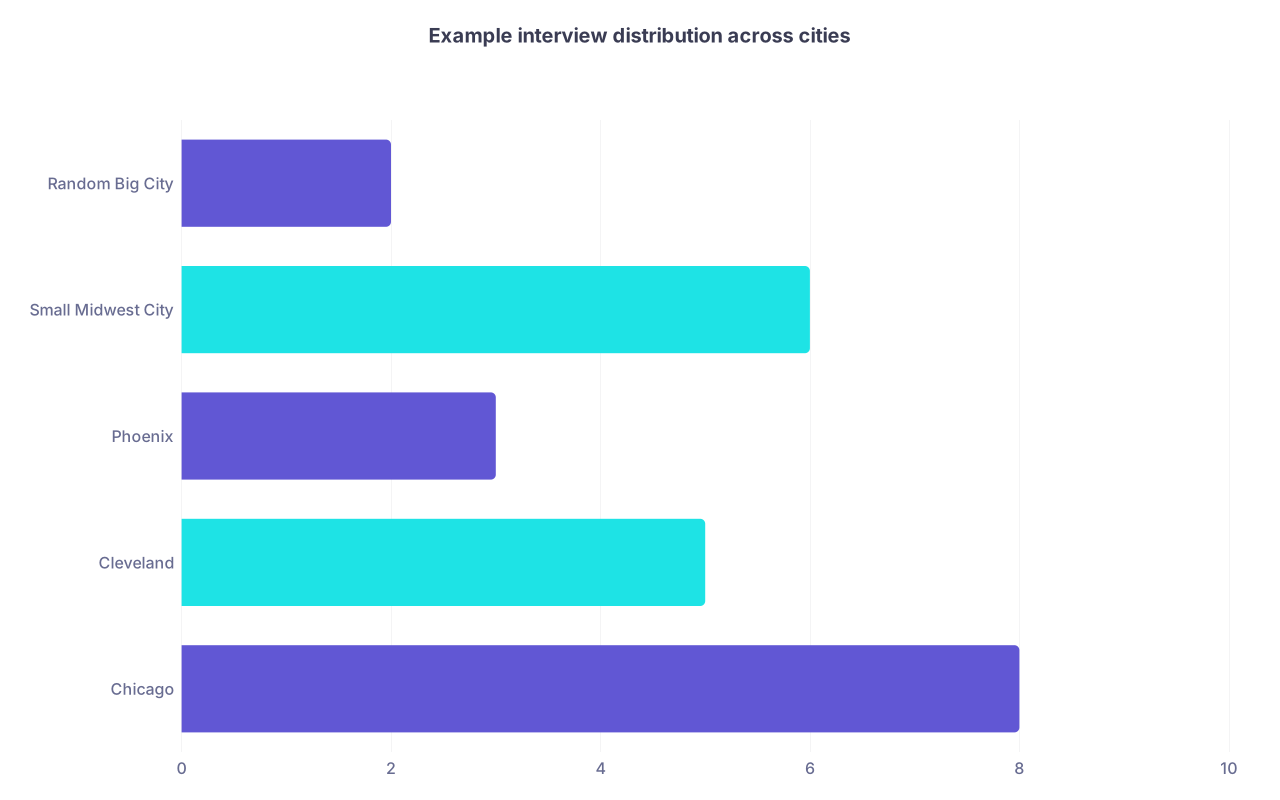
| Category | Value |
|---|---|
| Chicago | 8 |
| Cleveland | 5 |
| Phoenix | 3 |
| Small Midwest City | 6 |
| Random Big City | 2 |
For example, assign:
- +2 points for each interview the average partner has in a city
- +1 point for each interview the strong partner has in a city
So if:
- City A: Average partner has 3 interviews; strong partner has 1 → 32 + 11 = 7
- City B: Average partner has 1 interview; strong partner has 4 → 12 + 41 = 6
City A actually has a slightly better couples value, even though the strong partner likes B more.
This lets you objectively see where the math favors you as a pair.
5.2 Fight for paired or coordinated interview dates
The moment one of you gets an interview in a high-priority city, the other should:
- Email that program (politely):
- State you are couples matching
- Mention your partner’s invite and date
- Express strong interest in their program and city
- Ask if there is any availability for an interview (or waitlist)
You will not always get one. But I have seen this nudge programs off the fence, especially for the average partner.
It also matters for scheduling: being in the same city on the same day tells both programs you are serious about that location.
Step 6: Rank List Strategy – Anchor to Cities, Not Single Programs
This is where couples mess up the worst. They build beautiful rank lists for each partner, then use the algorithm to link them, but the actual combinations are chaos.
You need to think in blocks.
6.1 Build city blocks: rank combinations by location first
Take your final list of interviews and create “city blocks”:
For each city, list all program combinations:
- Program A1 + Program B1
- A1 + B2
- A2 + B1
- A2 + B2
- Etc.
Then assign each combination:
- Tier 1: Both are happy / very satisfied
- Tier 2: One is happy, one neutral
- Tier 3: One is mildly unhappy but still willing
- No-go: Someone would be miserable or harmed career-wise
If a combination is no-go, do not rank it “just in case.” That is how you wake up matched somewhere you hate each other for.
6.2 Prioritize multi-program cities where the average partner did well
Between:
- City X: Strong partner has 3 interviews, average partner has 1
- City Y: Strong partner has 1 interview, average partner has 3
Your rank list should usually give more real estate to City Y combinations. Not because of fairness. Because the match probability math is better.
The strong partner can more often “punch down” and still have an acceptable program. The average partner rarely can “punch up” successfully.
6.3 Use “chaining” for the strong partner
Here is how I often structure the strong partner’s list logically:
- First few ranks:
- Best programs in top-tier cities where both have solid prospects
- Then:
- Decent-but-not-elite programs in those same cities
- Then:
- Strong programs in second-tier cities where the average partner did well
- Only after that:
- Solo glory picks (prestige programs in cities where the partner is less competitive), and only if you agreed that long-distance for 1–3 years is acceptable as a last resort
Remember: every time you put a high-prestige, low-couples-city option above a “both mid-tier but same city” option, you are saying: “We accept lower chance of matching together for the possibility of this program.” That might be fine. But be explicit.
Step 7: Backup Plans and “Break Glass” Scenarios
If you pretend all-or-nothing couples match is the only path, you are being naive. You need a pre-agreed fail-safe.
7.1 Decide on your SOAP / reapply philosophy early
Have this conversation before interview season:
If one of us matches and the other does not:
- Does the unmatched partner SOAP into prelim / TY / off-specialty in the same region if possible?
- Or do they wait and reapply next year, possibly moving?
If neither of us matches as a couple but one gets a strong individual spot:
- Do we accept that solo match and postpone geographic unity?
- Or do we both decline and reapply?
There is no universal right answer. But having no plan is the wrong answer.
7.2 Use the couples match option intelligently, not blindly
You do not have to couple for every rank. You can:
- Link the majority of your list
- Then have a few “decoupled” ranks at the end where one of you still ranks programs individually
For example:
- First 15 combinations: fully coupled, same or nearby cities
- Last few ranks:
- Strong partner ranks 2–3 dream programs solo
- Average partner ranks a cluster of safer solo options
This is advanced and you should get faculty / advisor input, but it can protect against both going unmatched while still giving some room for individual success.
Step 8: Psychological Management Between “Competitive” and “Average” Partner
I have watched couples implode over this. Not because of the match, but because of how they handled the imbalance.
8.1 The strong partner must genuinely internalize this:
- You are not “throwing away” your career by going to a solid mid-tier over a prestige monster.
- Reputation matters. But so do:
- Case volume
- Fit
- Opportunities within a region
- Your partner not being two states away and miserable
Prestige is a multiplier when you already perform well. If you are the kind of person who got a 255, you will probably do fine anywhere that is not malignant.
8.2 The average partner has responsibilities too
They cannot hide behind, “Well, you are more competitive, so you should sacrifice.”
Your job:
- Apply broadly and smartly
- Take Step 2 / COMLEX 2 seriously (no “I just need to pass”)
- Be extremely on top of emails, interview replies, signaling, and professional behavior
- Own your narrative in personal statements and interviews so PDs are not wondering why you are tagging along
You must make yourself as strong a candidate as you can within your lane. That is your side of the bargain.
Step 9: Specialty Pair–Specific Adjustments
A few quick patterns I have seen repeatedly.
9.1 Competitive + Primary Care combo (e.g., Derm + FM, Ortho + IM)
- Let the primary care partner drive geography. They have more jobs everywhere.
- The competitive partner should strongly favor large academic centers in cities where primary care options are plentiful.
- Do not waste all Derm/Ortho signals and aways in bougie, oversaturated coastal cities if your FM/IM partner will be drowning in competition there.
9.2 Competitive + Competitive, but one clearly stronger (e.g., EM 250 vs EM 230)
You are not “one competitive, one average” in the general sense, but you are within the specialty.
- Same logic: anchor on the weaker EM applicant
- Stronger EM partner: apply to a few higher-end places, but keep a big chunk of your list aligned with where the weaker EM applicant is viable
- For both: do not pretend you are independent. PDs know you are a package deal.
9.3 One with geographic restriction (family, visa, kids), the other flexible
If one partner has hard constraints (elder care, legal status, child custody), that side wins. No discussion.
The flexible partner’s job is to convert “limited geography” into “maximum possible program quality within those constraints,” not to fight for cities you cannot realistically do.
Step 10: How to Actually Execute This Week
You do not need to fix your entire couples match in one sitting. You need to move one step.
Here is what to do today:
Create a 2-column honest profile.
- List both of your Step scores, rank/quartile, research, major plusses/minuses.
- Label each of you clearly: “higher competitive” and “lower competitive” for your chosen specialty.
Draft your three buckets of cities.
- Bucket 1: 5–10 realistic, desirable cities where both have programs.
- Bucket 2: 5–10 “fine” cities, slightly less desirable but maybe friendlier to the average partner.
- Bucket 3: 5–10 places you would tolerate if it meant staying together and matching.
Open your shared spreadsheet.
- Add columns: City, Program (Partner A), Program (Partner B), Bucket, Notes.
- Populate at least 10 programs for each of you that fit Buckets 1 and 2.
Ask one attending or advisor for a 15-minute reality check.
- Send them your honest profiles and rough city buckets.
- Ask one focused question: “Given these stats and desired specialties, are our Bucket 1 cities realistic for both of us?”
Do that, and you are already ahead of most couples stumbling into this process on autopilot.
Then tomorrow, open that spreadsheet again and highlight every program where:
- Your average partner is likely competitive, and
- The city has at least one reasonable program for the strong partner.
Those are your anchor points. Everything else in your couples match strategy will grow out of that map.


