

It is late November. Interview offers are pouring in. You are sitting on the couch with your partner, laptops open, spreadsheets visible, and you both realize the same awful thing at the same time:
Your “dream” programs are 900 miles apart.
Neither is budging.
And Couples Match is not some magic wand that will “figure it out.”
This is where couples either get strategic or get resentful. You do not want to be in March still having the same circular argument about “but this program is top 10” vs “but this city is my support system.”
Let me be direct:
If you try to “wing it” or “see how interviews go,” you are gambling your relationship, your training, and your sanity on vibes.
You need a framework.
Not another emotional debate.
A structured, mediation-style process that forces clarity and exposes trade‑offs.
That is what we will build here.
Step 1: Call a Truce and Name the Real Problem
You are not fighting about a program.
You are fighting about:
- Identity (“I have always seen myself at a top academic center.”)
- Security (“If I leave this city, I lose my family support.”)
- Fairness (“I compromised for med school; I will not compromise again.”)
- Fear (“If I give this up, I will never get a shot again.”)
Until you admit that, every “discussion” will devolve into re-litigating old decisions and talking in circles about program rankings.
Do this first.
Schedule a dedicated session.
Not after a 12‑hour shift. Not squeezed between cases. Pick 90–120 minutes where you are both reasonably human.Set explicit rules. Write them down.
- No interrupting.
- No scorekeeping (“Well, I moved for you before…”).
- No ultimatums.
- No “you always / you never” statements.
- The goal: a joint plan, not winning the argument.
Name the conflict out loud.
Literally say:
“We are in conflict because my dream program is X in City A, and your dream program is Y in City B. These cannot both happen in the same city. We need a joint solution that we can both live with.”Each of you gets 5 minutes uninterrupted to answer three questions:
- What does my dream program represent to me? (Not just the name. The meaning.)
- What am I most afraid of losing if I do not end up there?
- What would I regret 10 years from now if we chose against it?
This sounds fuzzy. It is not. You are pulling the emotional landmines into the open so they do not detonate later during rank list week.
Step 2: Clarify Non‑Negotiables vs Preferences
Most couples conflate “preferences” with “non-negotiables.” That is how you get deadlock.
You need a written, shared language for what is truly non‑negotiable and what is just “really, really would like.”
Use three categories:
- Red = Non‑negotiable (deal‑breakers)
- Yellow = Strong preference (you will feel real loss if you give this up, but you can live without it)
- Green = Nice to have
Each of you fills this out individually first, then you compare.
| Priority Item | Partner A (Specialty: IM) | Partner B (Specialty: Derm) |
|---|---|---|
| Geographic region | Yellow | Red |
| Prestige / ranking | Red | Yellow |
| Proximity to family | Yellow | Red |
| Fellowship opportunities | Red | Yellow |
| Program culture (support) | Red | Red |
How to do this properly
Brainstorm a list of dimensions for each of you. Some common ones:
- Geographic region or specific city
- Program prestige / reputation
- Proximity to family / support system
- Case volume / pathology
- Fellowship opportunities
- Lifestyle (call schedule, hours)
- Cost of living
- Research resources
- Visa considerations (if applicable)
- Safety, schools (if you have or want kids soon)
For each dimension, each of you independently label Red / Yellow / Green.
Then sit down and compare. You are looking for:
- Shared Reds — these are your joint non-negotiables.
- Conflicting Reds — this is where the real mediation is needed.
- Anywhere you can downgrade something from Red to Yellow after discussion.
If everything is “Red,” you are not being honest. Nobody gets 12 non-negotiables. Force yourselves to pick 2–3 true Reds each.
Step 3: Build an Objective Program Scorecard (Not in Your Head)
If you are arguing over vague impressions instead of structured comparisons, you are just trading anecdotes.
You need a shared tool: a simple, weighted scorecard.
Step 3A: Agree on shared categories and weights
Together, pick 5–8 categories that matter for both of you. Then assign a weight (how much each category counts) on a 1–5 scale.
Example for an IM + EM couple:
| Category | Weight (1–5) |
|---|---|
| Location/Region | 4 |
| Program Reputation | 3 |
| Lifestyle/Call | 3 |
| Family Proximity | 2 |
| Fellowship Options | 3 |
| Program Culture | 5 |
The weights reflect your joint priorities, not one person’s fantasy.
Step 3B: Score programs independently, then average
For each program you interview at, each of you rates it 1–5 in each category.
Then you:
- Average your scores for each category
- Multiply by the category’s weight
- Sum to get a joint program score
This is not perfect science. It is a structured way to see where your combined value is actually highest.
Step 3C: Visualize the reality
Now you graph the situation so you can see the tradeoffs instead of just feeling them.
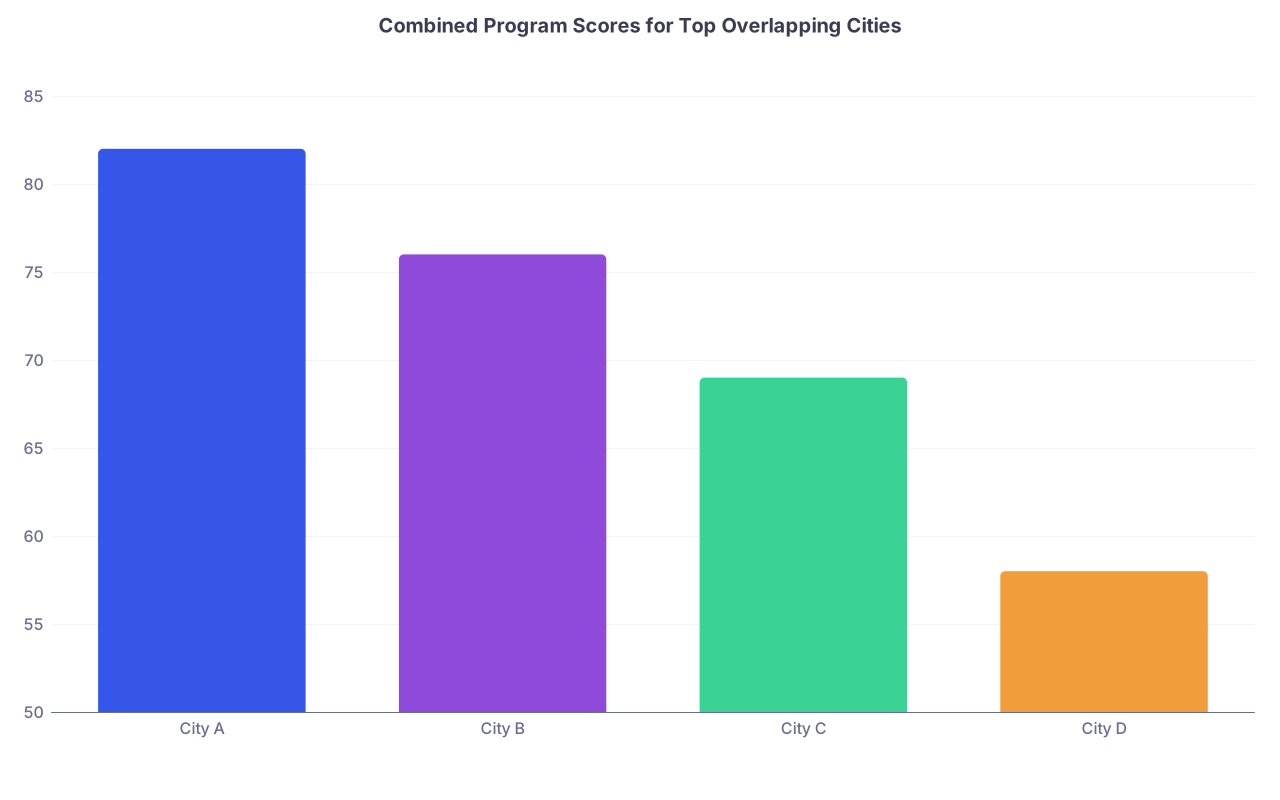
| Category | Value |
|---|---|
| City A | 82 |
| City B | 76 |
| City C | 69 |
| City D | 58 |
This is where things often get interesting. I have seen couples realize that the non‑dream city actually has the higher combined score when you factor both careers + life.
If you see that and still say, “I do not care, I want the name brand,” at least you are admitting you are choosing prestige over joint value. That is a conscious decision, not an accident.
Step 4: Map Concrete Couples Match Scenarios
Abstract “we will see where we match” is dangerous. You need to lay out the actual NRMP couples options on paper.
Learn your couples codes
On ERAS/NRMP, couples submit pairs like:
- Program A (You) – Program B (Partner)
- Program A – Program C
- Program D – Program E
- And so on…
You can pair:
- Same institution
- Same city, different institutions
- Nearby cities (commutable)
- Or even “Program X – No Match” as a fallback line
Now you build scenarios, not fantasies.
Use three buckets:
- Ideal joint outcomes
- Acceptable but not ideal
- Do-not-rank outcomes (even if possible on paper)
Example structure:
- Tier 1 (Ideal)
- Same hospital, both in strong programs
- Same city, both in solid programs that meet core Reds
- Tier 2 (Acceptable)
- Same region, 1–2 hour drive, decent programs for both
- One slightly stronger program, other mid‑tier but still safe for career goals
- Tier 3 (Last resort, but better than splitting long‑distance)
- One at near‑dream, other at less ideal but still accredited + safe + tolerable
- Never:
- One person at dream, other at a program they viscerally hated
- Permanent long‑distance (unless both truly agree)
Now translate this into actual City/Program pairs.
Step 5: Run the “10‑Year Future” Test
You are likely overweighting prestige and underweighting daily life and relationship stability. That is normal. The system trains you to worship name brands.
You need to sanity‑check that.
Do a 10‑year projection exercise individually, then compare.
For each of your top 3 realistic scenarios, both of you answer:
- Where are we living?
- What am I actually doing day to day (clinic, OR, research, etc.)?
- How is our relationship?
- What would I be resentful about?
- What would I be proud of?
Write this, not just think it. Then read each other your answers.
This is where one partner sometimes realizes, “If I go to Dream Program but you are stuck in a malignant program across town, I will not actually be happy.”
The question I always push couples on:
Would you trade a 10–20 ranking jump in prestige for a clearly better daily life for both of you?
If the answer is no, own that. You are betting heavily on brand value. Make your eyes open.
Step 6: Decide Your Fairness Framework Upfront
The fastest way to poison this process is vague “fairness” resentment.
You need an explicit rule for what “fair” means in this match.
Here are three frameworks I have seen actually work:
1. Alternating Sacrifice Framework
- One partner got their top choice for med school.
- Other partner gets priority for residency geography.
- When fellowship comes, the pendulum swings back.
This is clean if your past decisions already skewed in one direction.
2. Joint Optimal Value Framework
You treat both of you as a single unit. The “winner” is the scenario that maximizes combined long‑term value, even if neither gets their #1 personal program.
This is the most mature option. It feels the most like a true partnership.
3. Anchor and Orbit Framework
One career is structurally more location‑sensitive (say, a niche fellowship, visa restrictions, or extremely competitive specialty), so that person becomes the “anchor.” The other agrees to be more flexible and “orbit” around the anchor’s best available outcome, within pre‑agreed limits of what is tolerable.
You must explicitly articulate which framework you are choosing and write it at the top of your planning doc:
For this match, we agree to use the Joint Optimal Value Framework and will prioritize the combined best outcome, even if it means neither of us gets our #1 individual program.
If you cannot agree on any fairness framework, you are not ready to apply as a couple. That is not a judgment. That is just reality.
Step 7: Use a Mediator if You Are Stuck (And How to Use Them Well)
Some conflicts are too charged to untangle alone. That does not mean the relationship is doomed. It means you are human.
Your options:
- A trusted mentor who knows both of you
- A faculty advisor with couples match experience
- A professional couples therapist familiar with medical training
- A residency program advisor (careful here — bias is real)
How to use a mediator effectively:
Send a one‑page summary before the meeting:
- Your specialties and competitiveness ranges (Step 2 score, AOA, etc.)
- Your conflicting dream programs and cities
- Each of your top 3 Reds
- The fairness framework you think you are leaning toward
Ask for specific help, not “please fix us”:
- “Can you help us sanity‑check the tradeoffs between City A and City B?”
- “Can you give an honest take: is this prestige jump really worth the life hit?”
- “What outcomes have you seen for couples who tried long‑distance in residency?”
Agree in advance what you will do with the mediator’s input:
- Are they a tiebreaker?
- A consultant you will listen to but not obey?
- Just a reality‑tester?
If you are both quietly hoping the mediator will side with you so you can “win,” step back. The problem is not the programs. It is the dynamic.
Step 8: Stress‑Test Your Plan Against Realistic Outcomes
You need to explicitly walk through best‑case and worst‑case scenarios before ranking.
Use a simple flow.

| Step | Description |
|---|---|
| Step 1 | Start: Build Rank List |
| Step 2 | Prioritize same-city pairs |
| Step 3 | Use Anchor & Orbit framework |
| Step 4 | Focus on Tier 2 regional options |
| Step 5 | Build Tier 1 ideal pairs |
| Step 6 | Add safety pairs and No Match backstops |
| Step 7 | Finalize logical, not fantasy, list |
| Step 8 | Both get many interviews in same city? |
| Step 9 | One with clearly stronger apps? |
Then do this verbally:
Best case:
- Both of you match into top‑3 programs in same city.
- How does life look? Are there any hidden regrets?
Most likely case:
- One of you lands in top‑3, other in a mid‑tier but solid program in same city/region.
- Can you both live with that scenario without simmering resentment?
Worst acceptable case:
- You land in Tier 2 city, both at okay programs, neither at “dream.”
- Would you rather do this than risk separating or forcing one into a malignant environment?
Truly unacceptable case (do not rank anything that leads here):
- One at dream, one at a program they hated or that fails core Reds.
- One matches and the other is effectively pushed into a weak backup they only ranked out of fear.
If a scenario feels genuinely unacceptable, stop saying “We will just rank it in case.” Do not rank outcomes you cannot emotionally tolerate. That is how people blow up their own match day.
Step 9: Rank List Construction Protocol (Concrete Steps)
Here is a practical protocol you can follow to actually build the couples list.
List all individual programs for each of you in personal rank order first. No joint thinking yet.
Mark the following on each list:
- DNR (Do Not Rank) — anywhere that violates your Reds
- DREAM — top 3 or so where you would be thrilled
- SAFE — solid programs you would not love but can accept
Cross off all DNRs from both lists. They are gone. Do not bring them back.
Identify overlap cities/regions.
This is your starting sweet spot. Build from there.Construct Tier 1 pairs:
- Same hospital where both are in DREAM or SAFE
- Same city, acceptable tradeoff in program strength
Construct Tier 2 pairs:
- Same region, 1–2 hours apart, both in SAFE or better
- Include strong + mid-tier combos that still align with fairness framework
Add realistic “stretch” pairs where one gets DREAM and the other gets SAFE but not miserable, if and only if both explicitly agree they can accept this.
Only after building joint pairs, add in any “No Match” fallback lines like:
- Partner A: Solid Program X – Partner B: No Match
- Partner A: No Match – Partner B: Solid Program Y
That is advanced mode. Use it if you both decide that one of you matching somewhere is better than neither matching.
Check internal consistency:
- If you have (City A top programs) lower than (City B mid programs), you should be clear why. Check your fairness framework and priority weights.
Lock version numbers.
Literally tag your Google Sheet:- “Rank List Draft v1 – Before Mentor Meeting”
- “Rank List v2 – Final”
No late‑night, last‑minute changes based on feelings from a single interview day unless you both agree and can articulate the reason in writing.
Step 10: Watch Out for These 5 Common Traps
I have seen these sink more couples than anything else.
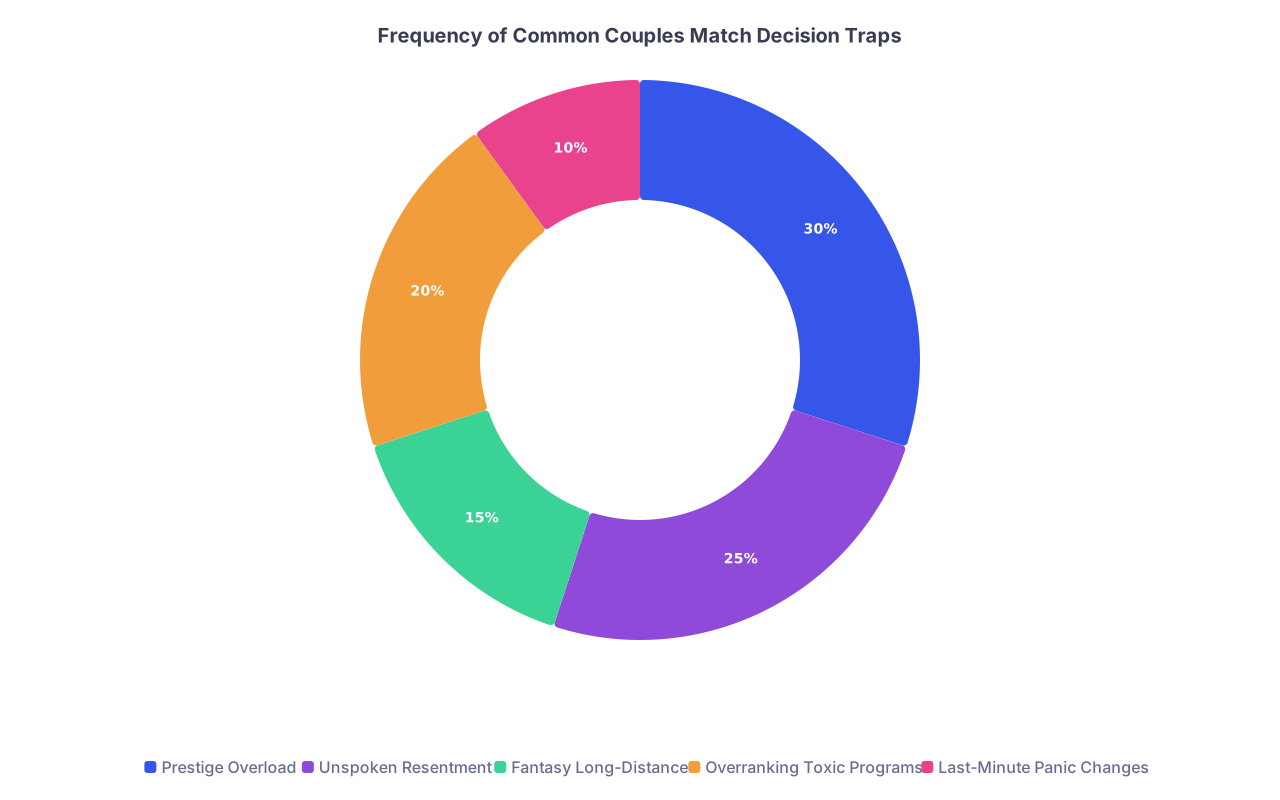
| Category | Value |
|---|---|
| Prestige Overload | 30 |
| Unspoken Resentment | 25 |
| Fantasy Long-Distance | 15 |
| Overranking Toxic Programs | 20 |
| Last-Minute Panic Changes | 10 |
Prestige Overload
One person is blinded by a big‑name program and refuses to admit the daily life and relationship cost. They say things like “It is only three years” about a malignant environment. It rarely plays out that cleanly.Unspoken Resentment
One partner “agrees” verbally but internally logs it as a debt to be collected later. That shows up as arguments years down the line about decisions that were never really agreed on.Fantasy Long‑Distance
You convince yourselves that 4–6 hours apart is fine “for just a few years.” Residency is brutal. Long‑distance is brutal. Combining them is not romantic. It is a grind. Some couples make it, but do not assume you will be the exception without talking it through in depth.Overranking Toxic Programs
Do not rank malignant or unsafe programs just to be in the same zip code. Matching together into misery is not a win.Last‑Minute Panic Changes
The week rank lists are due, somebody spirals. They hear a rumor. See a ranking. Panic. Suddenly they want to flip the whole strategy. That is how you get mismatch outcomes that do not reflect months of thoughtful planning.
Step 11: Protect the Relationship During the Process
This whole thing can corrode a relationship if you let the match become your only shared project.
You need a basic maintenance plan:
Time box match talks.
Example: “We only discuss match decisions Tuesday and Sunday nights for 1 hour.” Everything else goes in a shared doc.Explicitly separate “us” from “the process.”
Say it out loud sometimes:
“The NRMP is the enemy, not you.”
Silly but surprisingly helpful.Small, concrete rituals.
Post‑interview debrief walk, end-of-week non‑medical date, whatever resets your brain away from lists and scores.Agree on off‑limits comments.
No jokes like “If you really loved me, you would just come to City X.” That is manipulation, not humor.
Step 12: After Match Day – Debrief and Close the Loop
Whether you match into your top joint plan or end up in Plan C, you need to “audit” the process.
Within 1–2 weeks of Match Day:
Sit down and ask:
- What did we do well in our decision-making process?
- Where did we let fear or ego override our stated framework?
- Would we use the same fairness framework again for fellowship or jobs?
Each of you answers:
- “The thing I am most grateful for in how you handled this is…”
- “The part of the process that was hardest for me was…”
Close it formally:
“We made this choice together. We own it together.”
Why bother? Because after Match, the narrative can twist. One partner starts re-writing history: “I only came here for you.” That is poison. Debriefing locks in what actually happened.
Your Next Action Today
Do not overhaul your entire plan right now. Start small and concrete.
Tonight, schedule a 60‑minute “framework only” session with your partner.
Agenda:
- Each of you lists your top 3 Reds (true non‑negotiables).
- You agree on one fairness framework for this match (Alternating Sacrifice, Joint Optimal Value, or Anchor and Orbit).
- You create a shared Google Sheet with columns for:
- Program name (for each of you)
- City/Region
- Your weighted categories
- Scores for each program
That is it. No arguing over specific programs yet. Just build the structure.
Once that skeleton exists, every decision gets easier. Because you are not two people fighting about dreams. You are a team working through a defined plan.


