

The hardest truth in the Couples Match is this: if only one of you is competitive at a given program, you have almost zero leverage—unless you create it.
Most couples in your situation either panic, pretend it will “work out somehow,” or throw themselves at programs with vague emails about “we’re really interested as a couple.” That does not move program directors. They are running a service, balancing call schedules, and fighting their own battles with GME. Your relationship is not their priority.
You have to make it their problem and their solution. That is what negotiation is here.
I am going to walk you through exactly how to negotiate for linked positions when only one program really likes one of you:
- What leverage you actually have (and do not have).
- How to identify realistic linked options.
- The email scripts that work and the phrases that get you ignored.
- When to use your “one big ask” so you do not burn it on the wrong place.
- How to build a rank list that protects both of you if negotiations fail.
If you want fluff, close this. If you want a protocol, keep reading.
1. Understand Your Real Position (Not the One in Your Head)

You are a couples match pair where:
- Program A clearly likes Partner 1 (good interview, clear interest, maybe a follow-up email, maybe a pseudo “soft signal”).
- Program A is neutral or uninterested in Partner 2 (late invite, no invite, or clear coolness).
- You want two positions in the same city or system.
This is the most common Couples Match pain point. Here is the blunt reality:
- Programs do not “owe” you a second slot.
- PDs will not blow up their rank list to save your relationship.
- They will, however, help you if:
- It costs them little.
- It solves a problem they already have.
- You make it logistically easy and politically safe.
Your job is to:
- Lower the cost for them to help you.
- Increase the value of bringing Partner 2 to their institution or city.
What leverage do you actually have?
You have leverage if:
- Partner 1 is clearly a top candidate for that program/specialty (strong letters, top Step scores, “we really like you” vibe).
- The program is not hyper-competitive (mid-tier academic, community, or newer program).
- The institution has multiple residencies where Partner 2 could plausibly fit (IM, FM, peds, psych, prelim, TY, etc.).
- The program (or GME office) has a history of supporting couples.
You have very little leverage if:
- It is a hyper-competitive program in a top city with hundreds of strong applicants.
- Partner 1 is average for that program.
- Partner 2’s specialty is tiny there (e.g., 2 positions per year).
- The program director seems rigid, non-communicative, or overwhelmed.
Stop fantasizing. Judge your situation like a PD would.
2. Map Your Realistic Linked Options Before You Ask
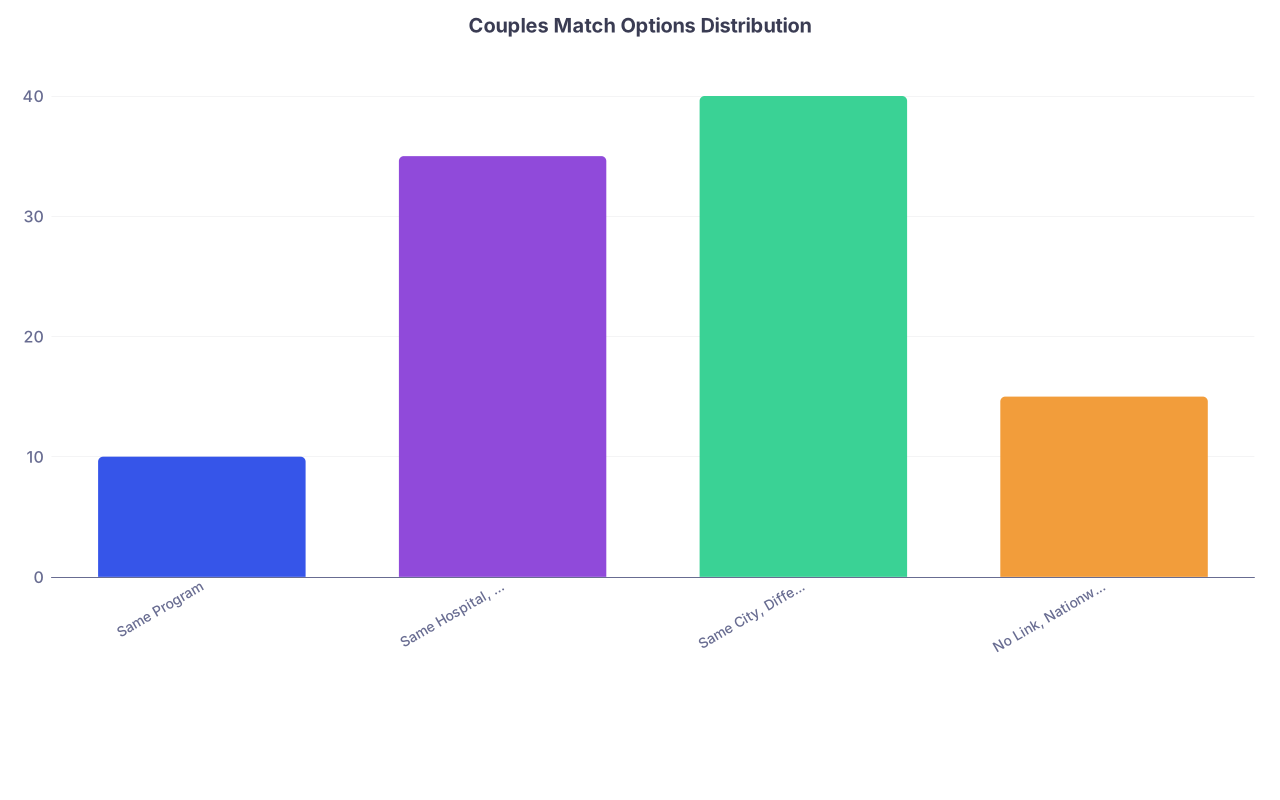
| Category | Value |
|---|---|
| Same Program | 10 |
| Same Hospital, Different Programs | 35 |
| Same City, Different Hospitals | 40 |
| No Link, Nationwide | 15 |
Before you send one email or make one call, you need a clear picture of what you are asking for. Most couples skip this and send vague “please help us” requests. That is amateur hour.
Step 1: List all viable configurations
You want specific, concrete configurations, not dreams. For example:
Same hospital:
- Partner 1: Internal Medicine at Big City Med
- Partner 2: Psychiatry at Big City Med
Same system, nearby:
- Partner 1: University Hospital Surgery
- Partner 2: Community Hospital IM (in same university system, 10 minutes away)
Same city, separate institutions:
- Partner 1: Program A (academic)
- Partner 2: Program B (community, same metro area)
Now write down, for each configuration:
- Program names.
- Specialty.
- Distance between hospitals.
- Whether each program interviewed that partner.
- Gut assessment: realistic / stretch / fantasy.
Step 2: Identify “anchor” vs “flex” partner
Usually, one partner has clearly more leverage.
- Anchor: The one with a strong shot at a specific program that is genuinely a good fit.
- Flex: The one more likely to adjust specialty type (IM vs prelim vs TY), program tier, or geography.
Be brutally honest:
- If Partner 1 has 260+ and strong research and Program A clearly courted them → Partner 1 is anchor.
- If Partner 2 has 12 interviews and Partner 1 has 4 → Partner 2 might be anchor even if Program A likes Partner 1 more.
You negotiate around the anchor.
Step 3: Identify “institutional options” for Partner 2
For the anchor’s institution, list all programs where Partner 2 could realistically match:
- Internal Medicine (categorical, prelim)
- Transitional Year
- Family Medicine
- Pediatrics
- Psychiatry
- Neurology (sometimes more flexible)
- Prelim Surgery if relevant
Look for:
- Programs that already interviewed Partner 2.
- Programs at the same institution that did not interview but might still be open (low fill rate history, newer program, etc.).
This becomes your “ask menu.” You are not just begging the anchor PD to find “something.” You are suggesting specific, plausible slots.
3. Who to Ask, When to Ask, and What to Say
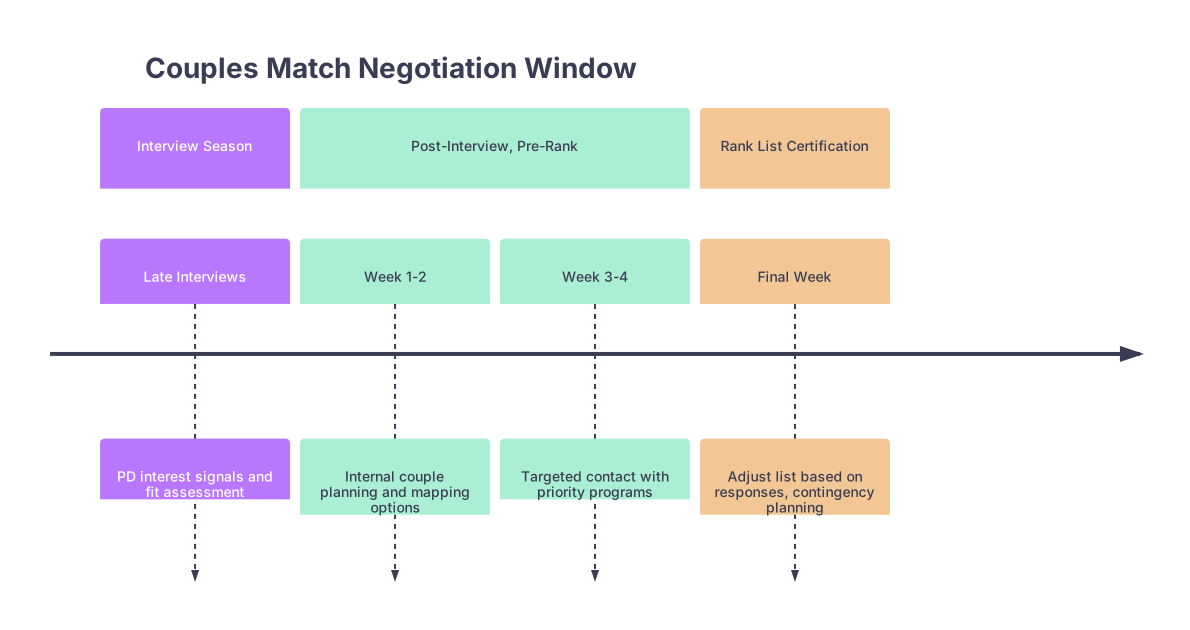
| Period | Event |
|---|---|
| Interview Season - Late Interviews | PD interest signals and fit assessment |
| Post-Interview, Pre-Rank - Week 1-2 | Internal couple planning and mapping options |
| Post-Interview, Pre-Rank - Week 3-4 | Targeted contact with priority programs |
| Rank List Certification - Final Week | Adjust list based on responses, contingency planning |
Timing and targeting matter more than people admit.
Who you should not contact first
- Do not start with the less interested program.
- “Hi, you were lukewarm about me, but can you rearrange your rank list to accommodate my partner too?” No.
- Do not send mass emails to every place you interviewed.
- PDs talk. Over-asking makes you look unserious and desperate.
Who you should contact
You start with the one program that clearly likes the anchor and has institutional options for the flex.
Typically:
- Anchor’s top or near-top program.
- A PD or APD who seemed human, supportive, and attuned to wellness or family issues.
- A program in a system with multiple residencies and a central GME that has handled couples before.
When to contact
- Post-interview, before rank list certification. Two to three weeks before the deadline is ideal.
- Too early: they forget.
- Too late: rank list is locked internally.
How to structure the ask (the actual script)
You are not manipulating. You are offering a trade:
- “If you help us bring Partner 2 here, Partner 1 will rank you very highly and you will get a dedicated, stable resident who is not going to transfer out.”
Here is a script template for the anchor partner emailing their enthusiastic program:
Subject: Couples Match — [Your Name], [Specialty] Applicant
Dr. [PD Last Name],
Thank you again for the opportunity to interview at [Program Name]. Our conversations about [specific detail from interview] reinforced that [Program Name] is at the very top of my list.
I wanted to share that I am participating in the Couples Match with my partner, [Partner Name], who is applying in [Partner Specialty]. We are both very interested in training at [Institution Name] and building our lives in [City].
[Partner Name] has applied to [list 1–3 specific partner programs at the same institution or city] at [Institution / City]. If there is any possibility to coordinate with those programs or consider us as a couple for positions within the [Institution/health system], we would be extremely grateful. I would be very comfortable ranking [Program Name] at the top of my list if there were a realistic path for us to be in the same institution or city.
I understand that the Match process and institutional policies limit what can be done, and I respect that. I simply wanted to be transparent about our situation and our strong interest in [Program Name] and [Institution/City].
Thank you again for your time and consideration.
Sincerely,
[Your Name], [AAMC ID]
[Medical School]
Why this works:
- Clear interest.
- Concrete ask (programs / institution named).
- Offers value: you will rank them highly.
- Respects boundaries, not pushy.
Partner 2’s parallel move
Same time or slightly later, Partner 2 can email the PDs of the programs they applied to at the same institution or in the same system/city:
Subject: Couples Match — [Your Name], [Specialty] Applicant
Dr. [PD Last Name],
My name is [Your Name], and I interviewed for [Program Name] on [date] / (or: applied this cycle to [Program Name]). I wanted to briefly share that I am in the Couples Match with my partner, [Partner Name], who interviewed at [Anchor Program Name] in [Anchor Specialty].
We are both very interested in training at [Institution/City]. If there is any flexibility to consider my application in the context of our Couples Match, I would be very grateful. [Optional 1–2 lines reinforcing fit: “My clinical interests in X and Y and my previous rotations at Z make me particularly excited about your program.”]
I understand that interview slots and rank lists are tightly constrained, and I respect the limitations of the process. I simply wanted to let you know of our situation and our strong interest in [Program/Institution/City].
Thank you for your consideration.
Sincerely,
[Your Name], [AAMC ID]
[Medical School]
The ask is light, but specific. You are not saying, “Give us two slots or we walk.” You are saying, “You can probably lock in an invested resident and support a couple with minimal cost.”
4. Advanced Levers When Only One of You is Truly Wanted
Sometimes the situation is harsher:
- Partner 1: multiple strong interviews, clear interest from Program A.
- Partner 2: few interviews, maybe none at that institution or city.
You still have plays.
| Lever Type | When To Use | Risk Level |
|---|---|---|
| TY or Prelim Year | Needs bridge to PGY2 | Low |
| Switch to nearby specialty | Flexible about ultimate specialty | Medium |
| Ask for late interview | Already a decent applicant | Medium |
| Ask for off-cycle / future PGY2 | Program expands often | High |
Lever 1: Preliminary / TY positions as a bridge
If Partner 2 is in IM, surgery, or undecided, a prelim or TY year in the same institution can buy you time.
What you say (Partner 2):
- Highlight willingness to do a prelim or TY year at the same hospital or system.
- Emphasize long-term intent to stay in the institution if a PGY2+ opens later.
Programs love flexible prelims who are happy to be there and not bitter about not being categorical.
Lever 2: Target slightly less competitive specialties in the same institution
Examples where pivoting is sometimes realistic:
- From categorical IM to prelim IM or TY.
- From Neurology to prelim IM or TY.
- From Surgery to prelim Surgery + later PGY2 hunt.
You do not switch from Derm to Psych in February. That is fantasy. But if Partner 2 is already on the fence, this can be a rational move.
Lever 3: Ask for a late interview or reconsideration
If Partner 2 did not get an interview at the anchor’s institution but is not an obviously poor fit:
Email from Partner 2 to that PD:
- Brief, respectful.
- State couples match with strong candidate in [Anchor Program].
- Express strong interest in institution/city.
- Ask if there is any possibility of late consideration if interview capacity changes.
Sometimes:
- A cancellation opens 1–2 late interview slots.
- A program that is under-filled on interviews will add a few.
I have seen this work. Not often. But enough.
5. What Programs Commonly Offer (and How to Read Their Signals)
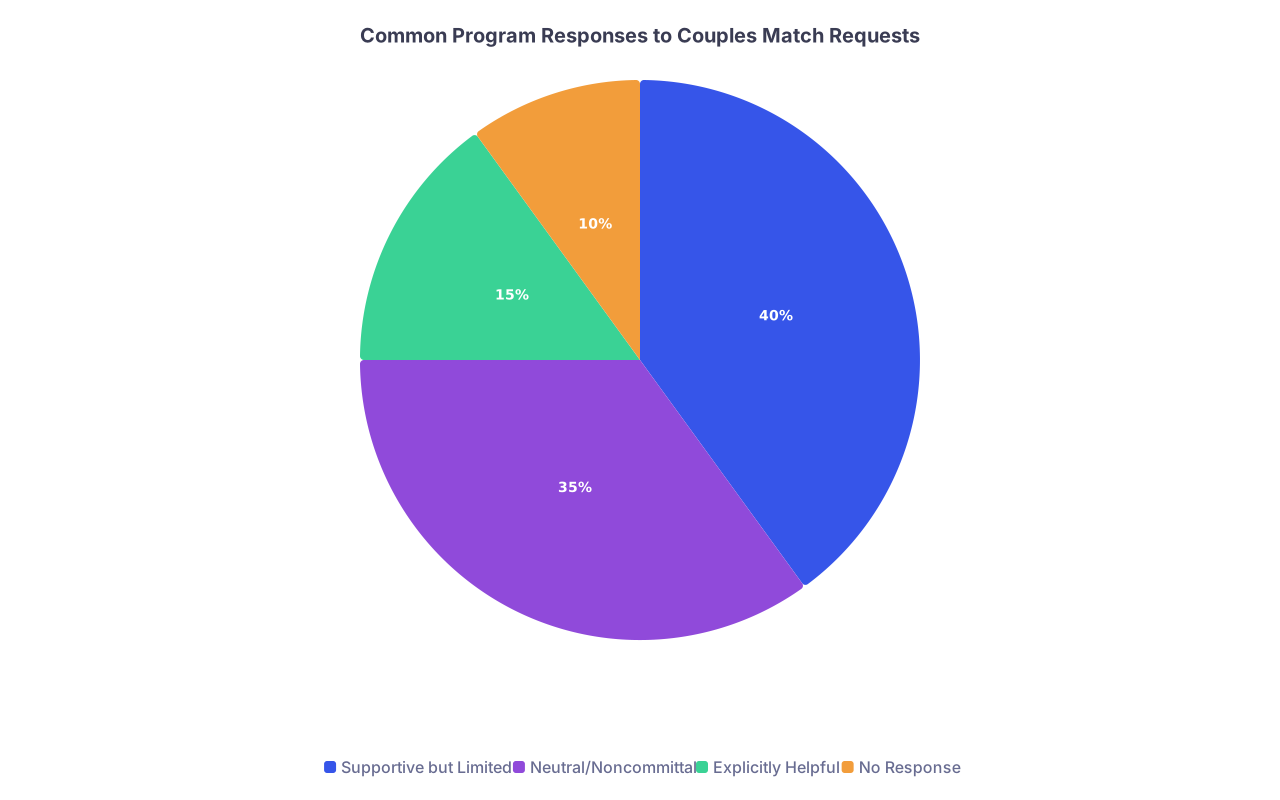
| Category | Value |
|---|---|
| Supportive but Limited | 40 |
| Neutral/Noncommittal | 35 |
| Explicitly Helpful | 15 |
| No Response | 10 |
You send the emails. Then what?
Response type 1: Warm but vague
“We are very excited about your application, and we will certainly keep your Couples Match status in mind when we work on our rank list.”
Translation:
- They like you (anchor).
- They are not promising anything.
- They might push you up a bit if they think Partner 2 could match nearby.
What you do:
- Thank them once.
- Do not push for more detail.
- Consider ranking this program highly if it is already a top choice.
Response type 2: Concrete effort
“I have reached out to our colleagues in [Partner Specialty] to make them aware of your situation. I cannot make any promises, but we will see what might be possible.”
Translation:
- They are actually doing something.
- Likely they sent an email or had a quick hallway chat.
- This is the ceiling of what most PDs will explicitly say.
What you do:
- Strongly consider boosting this program on your list.
- Partner 2 should send a concise thank-you to their PD if contacted.
Response type 3: Explicit limitation
“Due to institutional policies and our current rank list, we are unfortunately unable to adjust positions specifically for Couples Match arrangements.”
Translation:
- Door is mostly closed.
- Not hostile; just no bandwidth or flexibility.
What you do:
- Accept it.
- Do not argue.
- Adjust expectations; this is not your primary “bet-the-relationship” program.
Response type 4: Silence
No response.
Assume:
- They either missed it, are overwhelmed, or uninterested.
- You have no extra leverage there.
Proceed as if nothing changed. Do not keep sending follow-ups.
6. Building a Rank List That Protects You If Negotiation Fails

You can negotiate perfectly and the algorithm can still separate you. Your best defense is a disciplined rank list.
Principle 1: Define your “must-not” outcomes
You need to say out loud:
- “We are not willing to end up 2,000 miles apart for 5+ years.”
- Or: “We can tolerate 1 year apart if there is a realistic PGY2 solution.”
Write down:
- Outcomes that are unacceptable (distance, program type, etc.).
- Outcomes that are painful but survivable for 1 year.
Do not skip this. Couples destroy their sanity by avoiding this conversation.
Principle 2: Use the full power of Couples Match pairings
Remember: every line of your couples rank list is a pair:
- (Program X – Partner 1, Program Y – Partner 2)
- You can repeat the same program for one partner with different options for the other.
Your structure should look something like:
- Best-case same institution pairs.
- Same city, different institution pairs.
- “Anchor matches, flex close enough” pairs.
- “One matches, the other unmatched” pairs (only if acceptable).
- Worst-case singles (optional, if you are ok being apart).
Example for clarity:
- (Partner 1: Big City Med IM; Partner 2: Big City Med Psych)
- (Partner 1: Big City Med IM; Partner 2: City Community IM)
- (Partner 1: Big City Med IM; Partner 2: City Community TY)
- (Partner 1: Suburban Med IM; Partner 2: Suburban Med FM)
- (Partner 1: Big City Med IM; Partner 2: No Match)
- (Partner 1: No Match; Partner 2: Big City Med Psych)
You place these in true preference order as a couple, not individually. That is the game.
Principle 3: Do not sacrifice both of your careers to chase a fantasy double
If Partner 1 has a realistic shot at a strong home program and Partner 2 has fewer options, do not:
- Drop Partner 1’s solid program way down your list chasing a “maybe” pair at a weak, far-away program that has shown no interest in helping.
Healthy compromise:
- Rank a few “stretch” double options early.
- Quickly move into “anchor realistic + flex plausible” options.
- Avoid ranking any pair that you, as a couple, would regret if it hits.
You will regret chasing a mirage much more than “we stayed in a city we like where at least one of us is thriving.”
7. Fallback Planning: If Only the Liked Partner Matches There

You need a plan for the worst common outcome:
- Partner 1 matches at the “loves you” program.
- Partner 2 matches somewhere else. Maybe far.
You are not powerless here either.
For Partner 2: Immediate steps
- Connect early with GME and PD at Partner 1’s institution about:
- PGY2 openings.
- Future expansion plans.
- Transfer policies.
You frame it like this:
- “I am committed to my matched program, but my long-term goal is to be in [City] with my partner. I want to understand if there are realistic future opportunities so I can plan responsibly.”
Meanwhile:
- Partner 2 builds a stellar CV in year 1:
- Strong clinical performance.
- No professionalism red flags.
- Maybe a project or QI with a mentor connected to the target city/institution.
Transfers and PGY2 jumps happen. Quietly. They favor residents who are:
- Low drama.
- High performing.
- Transparent and respectful with both programs.
For Partner 1: Do not treat this as a “win” you achieved alone
Worst move: Partner 1 celebrates, steps off the gas, and assumes Partner 2 will “figure something out.”
Better:
- Partner 1 becomes a visible asset in their program.
- Builds relationships with PD, APDs, and GME staff.
- At the right time, says: “If any future spots ever open for [Partner 2 specialty], I would be grateful to be considered or to pass along notice.”
You are not asking for favoritism. You are asking to be kept in the loop.
FAQ (4 Questions)
1. Should we tell programs we will rank them #1 if they help us as a couple?
You should not make explicit ranking promises in writing. You can say: “I would be very comfortable ranking your program at the top of my list if there were a realistic path for us to be in the same institution or city.” That signals strong intent without violating Match communication rules or boxing yourself in if something dramatic changes.
2. What if my partner did not get any interview at the anchor’s institution—worth trying at all?
Yes, but keep your expectations low. Partner 2 can send a single, thoughtful email explaining the couples match situation and strong interest in the institution/city, and ask if late consideration is possible if circumstances change. Sometimes cancellations or an under-filled interview season lead to late invites. Often they do not. You try once, politely, and then move on.
3. Is it ever smart to rank “one matches, the other does not” outcomes above “both match far apart”?
For some couples, yes. If one of you has a clear dream program that changes your long-term career trajectory, you might both decide that having one person match that program (with the other possibly SOAPing or reapplying) is better than both being locked into weak or miserable programs far from your support network. That is a deeply personal call. But you should discuss it explicitly rather than letting the algorithm decide by default.
4. How many programs should we actually “negotiate” with?
One or two maximum, and only where you have clear anchor leverage and institutional options. If you are sending customized couples-match-plea emails to ten programs, you are doing it wrong. Focus on your most realistic and desirable anchor program(s), make one thoughtful ask, and then build a rational rank list that assumes no one will rearrange their universe for you. Anything you get from negotiation is a bonus, not the foundation.
Open a shared document with your partner right now and:
- List your top 3 realistic “anchor” programs.
- Under each, write down at least 2 plausible “flex” options (same hospital, system, or city).
- Decide which one program you will approach first, and paste in the email template with your specific details.
That is your next step. Do it before the week ends.


