

How Do We Decide Which Cities to Prioritize as a Couples Match Pair?
What do you do when one of you loves Boston, the other wants the West Coast, and you only have 20–25 couples ranks to work with before you hit insanity? That’s the real question beneath “How do we choose cities for the couples match?”
Let me be direct: if you and your partner do not get ruthless and systematic about cities early, you will waste applications, drain your bank account, and make your rank list a mess.
Here’s how I would structure this decision if I were sitting with you at your kitchen table, laptop open, VSAS/ERAS/Thalamus tabs everywhere, and a half-eaten takeout box next to a map of the U.S.
Step 1: Decide What Actually Matters (And What’s Just Noise)
You cannot compare cities until you’re honest about what you’re optimizing for. Not in theory. In reality. For this match cycle.
You need to answer three questions first:
- What is our non‑negotiable priority?
- What are our strong preferences?
- What are our nice‑to‑haves?
If everything is “important,” nothing is.
Here’s a common split I see in couples:
- Non‑negotiable: Same city or truly drivable distance (e.g., ≤1 hour).
- Strong preferences: Certain specialty training quality, cost of living, support system, climate.
- Nice‑to‑haves: “Fun city,” food scene, outdoors, nightlife, etc.
You both list your top 5–7 factors separately first. No discussion. Then compare.
You’re looking for:
- Clear overlap (these become your core criteria)
- True conflicts (these need trade‑offs or you’ll fight about the same thing all year)
If one of you says, “Family nearby is non‑negotiable” and the other says, “Big coastal city is non‑negotiable” and those are incompatible, you either downgrade something or accept more risk of long distance. Pretending both are non‑negotiable is fantasy.
Once you’ve done this, boil it down to 4–6 shared decision pillars. For most couples, those end up being some version of:
- Program quality / reputation in each of your specialties
- Probability of both matching there (program density)
- Cost of living / salary stretch
- Proximity to family or support network
- Lifestyle fit (climate, culture, safety, commute)
Write those pillars down. You’ll use them repeatedly.
Step 2: Understand Your Odds by City Before You Get Attached
This is the part no one wants to do because it’s less romantic than dreaming about living in Seattle. But it’s where smart couples separate from the rest.
You don’t start with, “Where do we want to live?”
You start with, “Where is it statistically feasible for both of us to match?”
You’re looking for program density: cities where there are multiple programs in both of your specialties.
| City | IM Programs | EM Programs | Overall Couples Feasibility |
|---|---|---|---|
| Boston | 6 | 2 | High |
| Chicago | 8 | 4 | Very High |
| Denver | 2 | 1 | Moderate |
| Seattle | 2 | 1 | Moderate |
| Portland | 1 | 1 | Low |
You want to map this for your actual specialties. A few patterns:
- IM + almost anything: easier in big cities with tons of IM spots
- Derm/ENT/Optho + anything: you need cities with multiple programs or multiple nearby cities
- Two competitive fields (e.g., Ortho + EM, Derm + Rad Onc): you should heavily favor big academic hubs, even if they’re not your dream towns
Here’s the move:
- List your joint potential cities (initial brain dump; don’t judge yet).
- For each city, count how many programs exist for Specialty A and Specialty B (use FREIDA, ERAS, specialty websites).
- Flag:
- High feasibility: several programs for both of you
- Moderate feasibility: multiple programs for at least one of you, and ≥1 for the other
- Low feasibility: basically one good shot for one or both of you
This instantly changes how you think.
That cute mid‑size city with one EM program and one FM program? Romantic, but high‑risk. If you prioritize it, you’re implicitly accepting more risk of separation or unmatched outcomes.
Step 3: Build a City Scoring System (Then Actually Use It)
This is where you stop hand‑waving and start making decisions.
Take your 4–6 shared pillars from Step 1 and score each city from 1–5 on each pillar. Do it separately, then average your scores.
Example pillars:
- Training strength for Partner A
- Training strength for Partner B
- Number of programs for each specialty (likelihood both match)
- Cost of living vs PGY‑1 salary
- Proximity to family/support
- Lifestyle (climate, safety, things you care about)
Use a rough but consistent scale:
- 1 = Actively bad
- 3 = Fine/neutral
- 5 = Strong positive
You’ll end up with something like this:
| City | Training A | Training B | Match Odds | Cost of Living | Family Proximity | Lifestyle | Total (out of 30) |
|---|---|---|---|---|---|---|---|
| Chicago | 5 | 4 | 5 | 3 | 2 | 4 | 23 |
| Denver | 3 | 3 | 2 | 3 | 3 | 5 | 19 |
| Boston | 4 | 5 | 4 | 1 | 3 | 3 | 20 |
You don’t let this spreadsheet fully control your life, but you let it embarrass your laziness. If a city you’re obsessed with keeps scoring 13/30, you either admit you’re choosing it for emotional reasons (which is fine, if you accept the risk), or you cut it from your “priority” list.
Step 4: Group Cities into Tiers Before You Apply Everywhere
You should not treat all cities equally. That’s how you burn money and time.
Once you’ve scored cities and looked at program density, sort them into 3 tiers:
- Tier 1: High feasibility + strong personal fit
- Tier 2: Reasonable feasibility or strong fit but with some trade‑offs
- Tier 3: Low feasibility or marginal fit (these are reach / backup / wildcard)
Now connect this to your application strategy, not just vibes.
Rough framework (adjust to your budget and competitiveness):
- You both apply broadly, but:
- Maximize program coverage in Tier 1 cities
- Get decent coverage in Tier 2
- Be selective in Tier 3 (only very strong or very desirable programs)
For example, if you have:
- 4 Tier 1 cities
- 5–7 Tier 2 cities
- 5+ Tier 3 cities
You don’t need to apply to every program in every Tier 3 city. You do want aggressive coverage in Tier 1, because that’s where you’d actually like to end up together, and the odds are better.
Step 5: Tie City Prioritization to Your Couples Rank List Strategy
City decisions are meaningless unless they feed forward into how you rank.
The couples match is brutal because the length of your rank list explodes if you’re not disciplined. City tiers keep it under control.
Here’s how to think about it:
- Rank by combined desirability × feasibility, not just one factor.
- Create bundles of ranks for each top city before moving to the next.
- Decide now how far apart you’re willing to live if “same city” fails.
For a high‑priority City A, your list might look like:
- (A‑Hospital 1 IM, A‑Hospital 1 Peds)
- (A‑Hospital 1 IM, A‑Hospital 2 Peds)
- (A‑Hospital 2 IM, A‑Hospital 1 Peds)
- (A‑Hospital 2 IM, A‑Hospital 2 Peds)
Then move to City B clusters, then City C, and only then start listing “adjacent city” options or one‑matched/one‑unfilled combos if you’re going that far.
The mistake I see a lot: couples scatter their rank list across cities in a chaotic order—A here, then F, then C, then random long‑distance pairing. You want to cluster by city priority.
Step 6: Be Honest About Long Distance and Commuting Radius
You cannot talk cities without talking distance tolerance. This is where many couples avoid the real conversation.
There are three separate questions:
- Are we 100% unwilling to be in different cities?
- If not, what’s our maximum acceptable driving time between programs?
- Do we prefer “same city, different program” over “different city, ideal program”?
You need explicit answers, not “we’ll see.”
Think in concrete radii:
- Same city only
- ≤45–60 minutes driving
- ≤2–3 hours driving (weekend relationship, basically)
- Flights only (true long distance; very different experience)
Map this out. Literally. Look at cities within 1–3 hours of each other and consider whether any of those “clusters” effectively behave like an extended city region for you.
For example, someone might tolerate:
- Durham/Chapel Hill/Raleigh cross‑commutes
- Milwaukee–Chicago (with weekend commuting)
- Fort Worth–Dallas
But not, say, Chicago–Indianapolis every weekend.
Your city list should reflect:
- Primary cluster cities (where you both have multiple program options within one metro)
- Regional clusters (two nearby cities where you could do a “short‑distance long‑distance” relationship if it comes to that)
If you do not want regional separation at all, then you need to be extra conservative with cities and heavily favor large hubs with program density.
Step 7: Reality Check – Your Competitiveness vs City Competitiveness
Some cities are simply stacked with highly competitive applicants. You both might love San Diego. That does not mean San Diego loves your Step scores or class rank.
You need a realism pass:
- If one or both of you is in a very competitive specialty, cut small/low‑density cities down your list unless you’re okay with higher risk.
- If one of you is a weaker applicant, you might need to emphasize cities with more community programs or a wider spread of program tiers.
A quick sanity tool:
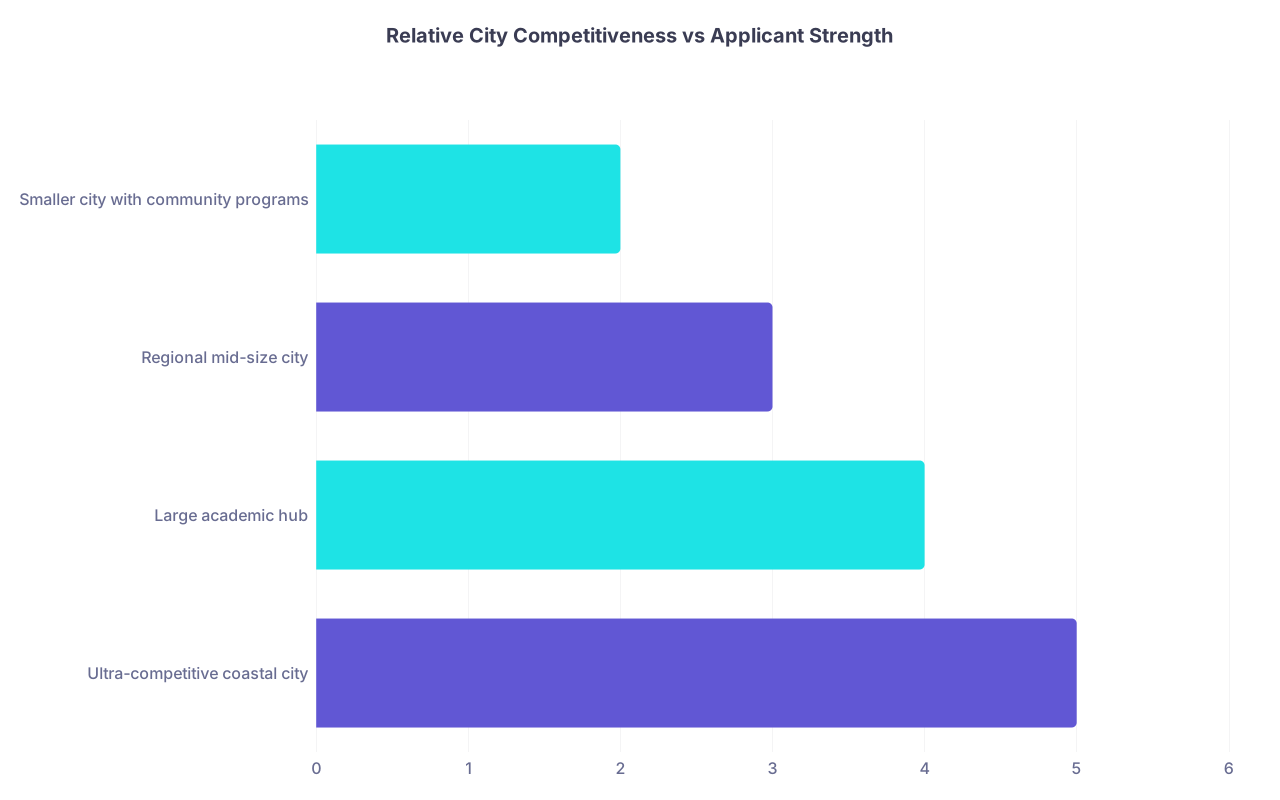
| Category | Value |
|---|---|
| Ultra-competitive coastal city | 5 |
| Large academic hub | 4 |
| Regional mid-size city | 3 |
| Smaller city with community programs | 2 |
Where 5 = hardest on average; 1–2 = easier on average.
Do not prioritize four ultra‑competitive coastal cities and pretend you did a balanced couples strategy if your applications are average. That’s not brave; it’s reckless.
Step 8: Run the Simulation Together (For Real)
Before ERAS deadlines, sit down and pretend:
- “If we get multiple interviews in Cities X, Y, and Z, which order do we rank them in?”
- “If one of us only interviews in 1 program in City A, is that still a ‘priority city’ or does that downgrade it automatically?”
Do a mock rank meeting early. You’ll uncover hidden disagreements:
- One of you cares way more about prestige than you admitted.
- One of you is secretly okay with long distance if it means their dream program.
- One of you hates a city the other listed as Tier 1.
Better to find that now, with time to adjust your city strategy, than in February when the list is due and interviews are done.
This is also when some couples realize:
“We thought we wanted to prioritize City A, but when we really stack everything up, City C is actually our true #1.”
That’s fine. The exercise worked.
Step 9: Use Frameworks, Not Feelings, To Break Ties
Sometimes you’ll end up with two cities that look almost equal on paper. This is where it helps to have a few “tie‑breaker rules” already agreed on.
Common tie‑breakers:
- Better program spread for the weaker applicant
- Lower cost of living to relieve early‑career financial pressure
- Closer to at least one meaningful support person (parents, siblings, close friends)
- Better options for the non‑MD partner (if someone is doing something else)
Do not use vague ideas like “better vibe” as a tie‑breaker at this stage. You can let “vibe” matter within a city, when comparing programs. But when committing 3–7 years of both your lives? Use something sturdier.
A Simple Visual To Keep You Grounded
If you like visuals, sketch something like this:

| Step | Description |
|---|---|
| Step 1 | List all possible cities |
| Step 2 | Check program count for both specialties |
| Step 3 | Drop or mark as low priority |
| Step 4 | Score on shared criteria |
| Step 5 | Assign Tier 1, 2, or 3 |
| Step 6 | Check distance tolerance and clusters |
| Step 7 | Align with competitiveness reality |
| Step 8 | Simulate rank list order |
| Step 9 | Finalize city priority list |
| Step 10 | Enough programs for both? |
You don’t need it to be perfect. You just need a method that’s better than “we like this place.”
The Bottom Line: How To Decide Which Cities To Prioritize
You’re not picking vacation destinations. You’re engineering the next 3–7 years of both your lives under major stress and limited control.
Most couples do best if they:
- Start with feasibility, not fantasy. Look at program density and competitiveness for both specialties before romanticizing cities.
- Score and tier cities using shared, explicit criteria. Training quality, match odds, cost of living, support network, and lifestyle get numbers, not just opinions.
- Connect city priorities directly to application volume and rank list structure. Cluster ranks by top cities, be honest about distance tolerance, and let your “Tier 1 / 2 / 3” system shape where you actually send applications.
If you do those three things seriously, you won’t eliminate uncertainty. But you’ll stop making blind bets—and that’s what separates the couples who feel intentional about where they land from the ones who just hope it somehow works out.


