

Is It Better to Match in the Same Hospital or Just the Same City?
What actually happens to your relationship if you end up in different hospitals across town instead of the same program? Does “same city” work, or do people quietly fall apart by PGY-2?
Let me be direct: for most couples, same hospital is better than just the same city.
But it is not that simple — and for some couples, chasing “same hospital or bust” is the fastest route to both a worse match and a lot of resentment.
Here’s how to think about it like an adult, not a fantasy version of residency.
The Real Hierarchy: Same Program > Same Hospital > Same City > Different Cities
If you want a mental model, use this realistic ranking:
- Same program (same residency, same class)
- Same hospital, different programs
- Same city, different hospitals
- Different cities, drivable distance
- Different cities, flights required
People love to argue about #2 vs #3. That’s your question. Here’s the honest answer:
- If your relationship is serious and long-term → same hospital is usually better
- If your careers require very different program types/tiers → same city at the right programs might be better
The key word: usually. You have to run your actual situation through a few filters.
How Much Does “Same Hospital” Really Change Your Life?
Let’s be concrete. I’ve watched couples live all three versions: same program, same hospital, same city.
Here’s what same hospital gives you that same city usually doesn’t:
- Overlapping call rooms and lounges – You literally run into each other on nights and weekends.
- Shared culture and admin – Same EMR, similar schedule logic, same holiday structure.
- Physical proximity – One commute. One parking garage. One cafeteria. Same security badges.
- More micro-moments – The 5-minute coffee between cases, walking out together at 10 pm, grabbing lunch in the same cafeteria even from different services.
Compare that to “same city, different hospitals”:
- Different EMR, different leadership, different policies.
- Often different vacation request systems and rules.
- Possibly opposite sides of the city = two commutes, two parking headaches.
- Coordinating days off becomes harder than it sounds.
If you care primarily about day-to-day time together, same hospital almost always wins.
But that doesn’t mean you should always prioritize it. Let’s go deeper.
The Big Trade-Off: Relationship Time vs Career Fit
You’re balancing three things:
- Relationship time
- Training quality / career goals
- Mental health and sustainability
Here’s how the two main options stack up.
| Factor | Same Hospital | Same City, Different Hospital |
|---|---|---|
| Day-to-day time together | Higher | Moderate |
| Schedule alignment | Better (same system) | Variable |
| Career fit for both | Sometimes compromised | Often better |
| Commute complexity | One site | Two sites |
| Program independence | Less | More |
When “Same Hospital” Is Better
Same hospital tends to be the better choice when:
- One or both of you are in time-devouring fields (gen surg, OB/GYN, surgery subs, EM at a busy shop, ICU-heavy IM).
- You’re already sure about the relationship (married, long-term engaged, or absolutely committed).
- The difference in program quality between options is small, not massive.
- You’re both reasonably happy with the same hospital’s reputation and case mix, even if it’s not your “dream” place.
Because here’s the hard truth: residency is lonely. Extra 5–10 hours a week with your partner because you work in the same building can matter more long-term than a slight bump in program prestige.
When “Same City, Different Hospital” Might Actually Be Better
Same city can be smarter if:
- One of you has a super competitive specialty or fellowship ambitions that clearly require a stronger name/volume.
- The best programs for each of you are in the same city but not the same hospital (e.g., one at an academic powerhouse, one at a strong community program).
- There are known toxicity/fit issues for one of you at the other partner’s hospital.
- One or both of you are not 100% committed to prioritizing the relationship over career fit (no judgment, just be honest with yourselves).
You do not sacrifice your entire career trajectory just to share a cafeteria. The relationship doesn’t win if you both burn out or one person accumulates 5 years of simmering resentment.
The Logistics People Underestimate
Most couples focus on “prestige” and “how much will we see each other,” but they ignore the actual architecture of residency life.
Here’s where reality bites:
1. Commute and Geography
Same city can still be miserable if:
- You’re at opposite ends of a metro area with 45–60 minute commutes each way.
- Your calls end at 9 pm and your partner’s start at 7 pm on the other side of town.
- One of you needs to Uber between hospitals to crash at the other’s place after post-call.
Same hospital:
- One car (sometimes).
- You can literally walk to each other during call.
- Getting stuck late doesn’t mean choosing between “seeing your partner” and “sleep.”
If you’re considering “same city,” map out real commute times during rush hour. Don’t hand-wave this.
2. Schedules and Holidays
Same hospital doesn’t guarantee identical schedules, but:
- Holidays are usually coordinated by department across the institution.
- System-wide rules on duty hours, PTO, maternity/paternity leave.
- Chief residents sometimes collaborate across departments to support couples if they know early.
Different hospitals?
You might end up with:
- You on Christmas, them on New Year’s. Every year.
- Different vacation bidding windows and completely misaligned weeks off.
- No shared advocacy — your PD doesn’t care that your partner’s program “won’t switch weekends.”
3. Administrative Goodwill
At the same hospital, once admin and chiefs know you’re a couples match, they sometimes work small miracles: shared days off, aligned electives, even joint vacations if you plan far in advance.
At different hospitals, no one cares. They don’t know each other, and they don’t have to.
Decision Framework: How To Decide for Your Situation
Here’s the framework I recommend couples walk through. Honestly. No wishful thinking.

| Step | Description |
|---|---|
| Step 1 | Start |
| Step 2 | Prioritize same hospital |
| Step 3 | Prioritize same city with best programs |
| Step 4 | Re-evaluate relationship/career priorities |
| Step 5 | Serious long-term commitment? |
| Step 6 | Big gap in program quality? |
| Step 7 | Careers top priority? |
| Step 8 | Gap matters for future goals? |
Ask yourselves, out loud:
- Are we planning a long-term life together, or are we still “seeing how it goes”?
- Would I be okay if my partner took a slightly worse program for us to be at the same hospital?
- Would I be okay if I took the slightly worse program?
- In 10 years, which will I regret more:
- We were at the same hospital but I missed a slightly stronger name?
- I got my “dream” program but saw my partner half as much as I’d hoped?
Do not lie to yourselves here. That’s how couples implode PGY-2.
Examples: How This Plays Out in Real Life
To make this less theoretical:
Example 1: Same Hospital Was Absolutely the Right Call
- Partner A: Categorical IM, strong student, wants cards fellowship.
- Partner B: OB/GYN, solid but not top-of-class.
- City X has:
- Big academic center (Hospital 1)
- Mid-tier community teaching hospital (Hospital 2)
Option 1: Both at Hospital 1, IM solid, OB/GYN slightly below top programs nationally.
Option 2: A at Hospital 1, B at a higher-ranked OB/GYN program across town with brutal schedule and long commute.
They chose both at Hospital 1. Result: they saw each other regularly, matched well in cards fellowship, and B still got a solid OB/GYN training with fellowship options. No one regrets it.
Example 2: Same City, Different Hospital Was Smarter
- Partner A: ENT (highly competitive, needs strong name and volume).
- Partner B: Pediatrics, fine with a broad range of programs.
- City Y:
- Hospital 1: Top-tier ENT program, heavy research, national name.
- Hospital 2: Strong pediatrics but no ENT.
They could have forced both into Hospital 2 (ENT spot is weaker, poor outcomes for fellowships). They didn’t.
They went same city, different hospitals. ENT partner matched into a great program, peds partner into a solid one. Commute was 20–25 minutes apart. They had to work harder on schedules but both careers and relationship survived intact.
Typical Misconceptions You Should Ignore
Let me kill a few myths quickly.
“If we’re committed, we should always choose same hospital over career.”
No. Commitment includes respecting each other’s long-term goals. Sometimes that means same city with better programs.“Same city is basically the same as same hospital.”
Not even close. The day-to-day difference can be massive, especially in big metro areas.“Program reputation doesn’t matter at all; only being together does.”
Also wrong. Reputation, volume, and mentorship matter for competitive fellowships and future jobs. It just might not matter as much as you think for every specialty.“We’ll just fix schedule conflicts later.”
Only if your programs care and have flexibility. Many do not. Assume conflicts will be common and hard to fix.
How To Use the Couples Match Algorithm Intelligently
Mechanics matter. If you’re trying to prioritize “same hospital vs same city,” you need to rank strategically.
Basic strategy:
- Create one cluster of ranks with same hospital options at the top where you’re both comfortable.
- Then a second cluster where you’re in the same city but best programs for each.
- Then your individual “reach” programs, if you’re both okay with the risk of slightly worse coordination.
Think like this:
- Tier 1: Same program/same hospital combinations that are good fits for both.
- Tier 2: Same hospital, slightly imperfect for one, still acceptable.
- Tier 3: Same city, each at the best realistic program.
- Tier 4: Strong individual programs even if it risks distance.
Do not forget: the couples algorithm treats you as a pair. If you aggressively push for “one person at a top-5 program and the other anywhere nearby,” you might drag both of you down the list in a way you do not expect.
Quick Reality Check Before You Finalize Your List
Ask yourselves these tough but necessary questions:
- If we end up at different hospitals across town, will we actually have the energy to make it work, week after week?
- If one of us ends up in a clearly weaker program just to be at the same hospital, will that breed resentment?
- Are we overvaluing prestige and undervaluing sleep, proximity, and actual human connection?
- Have we talked — really talked — about what happens if we don’t match together?
You’re not just picking a job. You’re building the environment your relationship has to survive in for 3–7 years.
A Simple, Pragmatic Bottom Line
- If both of you can get strong enough training at the same hospital without major sacrifice, choose same hospital. It usually gives you more real time together and less logistical pain.
- If there’s a major gap in program fit or future opportunity between hospitals in the same city, prioritize the right programs in the same city. Do not tank one person’s career to share a cafeteria.
- Map commutes. Talk to current residents. Ask specifically about how couples at the same vs different hospitals are doing. People will tell you.
You’re not looking for the perfect answer. You’re looking for the trade-offs you can both live with.
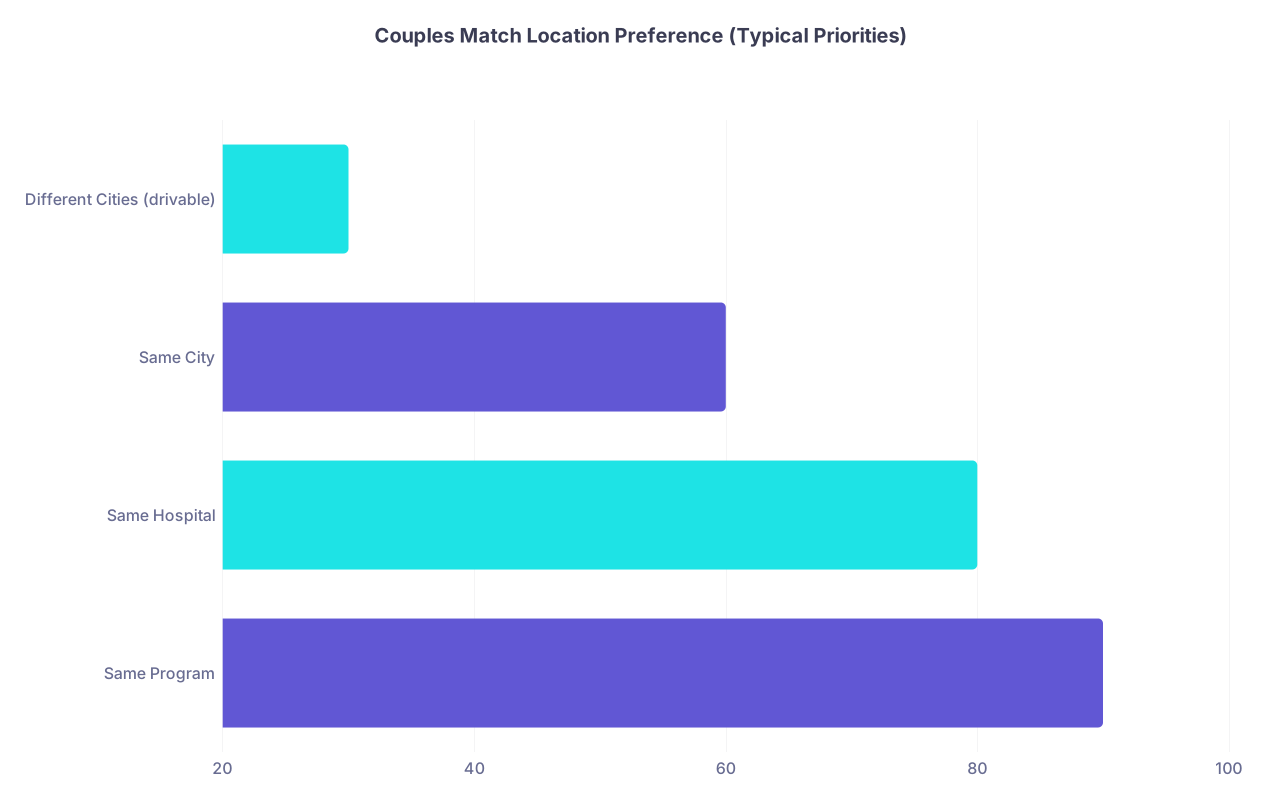
| Category | Value |
|---|---|
| Same Program | 90 |
| Same Hospital | 80 |
| Same City | 60 |
| Different Cities (drivable) | 30 |
FAQ: Couples Match – Same Hospital vs Same City
1. Does the match algorithm actually favor couples staying in the same hospital?
No. The algorithm doesn’t “favor” anything. It just follows the rank list pairs you submit. If you put a lot of same-hospital pairings high on your list, you increase the chance of landing there, but only because you prioritized it, not because the system likes couples. The only “favor” is that you’re treated as a unit: both match or neither matches at a given pair.
2. Is it risky for one partner to go to a weaker program just to be at the same hospital?
It can be. If “weaker” means slightly lower reputation but still solid training and good outcomes, it’s usually fine. If “weaker” means poor board pass rates, bad fellowship match, or toxic culture, that’s too big a sacrifice. The right question isn’t “Is it weaker?” It’s “Will this meaningfully limit my future options or destroy my happiness?” If yes, don’t do it just for same hospital.
3. How do we talk to programs about being a couples match without hurting our chances?
You’re allowed to mention you’re couples matching and prefer the same hospital or same city. Do it simply and non-demandingly: “My partner is applying in X specialty, and we’re couples matching. This program is a top choice for us because we can both see ourselves here.” Programs hear this constantly. They’re not offended. Just avoid sounding like you’re using them purely as a geographic pawn.
4. Are there specialties where same hospital matters even more?
Yes. High-intensity, high-hour fields: general surgery, OB/GYN, neurosurgery, orthopedics, EM at very busy centers, and some IM programs with brutal ward months. In those specialties, the difference between same hospital vs just same city can literally be the difference between seeing each other daily vs only on some weekends. For more lifestyle-friendly fields (peds, FM, psych at reasonable programs), same city can be quite workable.
5. What’s one thing couples regret most about their location choice?
Two big ones:
- Underestimating commute + call: “We thought same city would be enough, but 40-minute commutes each way plus q4 call meant we barely saw each other.”
- Over-sacrificing one person’s training: “I took a clearly bad program just to be at the same hospital and spent years bitter about it.”
Your job is to avoid both extremes. Choose the best mutual compromise: strong enough training and a structure where your relationship has a real chance to thrive, not just survive.
Open your tentative rank list right now and mark each pair: “same hospital,” “same city,” or “other.” Then for each category, write one sentence about what you’re actually trading away. If you cannot name the trade-off in concrete terms, you are not ready to lock that list.


