

The worst way to ask about couples match friendliness is to say, “So… are you couples match friendly?”
You’ll get a vague “Oh yes, we’ve had couples before.” Totally useless.
Let’s fix that.
You’re not trying to find out if a program claims to support couples. You’re trying to figure out:
- Will they actually help you match together?
- Will they resent the extra work?
- Are you about to tank one partner’s career for the other?
Here’s how to ask residents the right questions, in the right way, so you get honest, specific answers instead of canned PR.
Step 1: Shift Your Goal – You Don’t Want a Yes/No Answer
Your goal is not to get a “yes, we’re couples friendly.” Every program will say yes.
You’re trying to get:
- Specific examples
- Patterns over time
- How residents felt about the process
- Whether anyone got burned
So you don’t ask:
“Are you couples match friendly?”
You ask things like:
“How has the program handled couples in the last few years?”
“Do you know any couples who matched here or nearby and how did that play out?”
You’re fishing for stories. Not slogans.
Step 2: Use These Exact Phrases With Residents
Here are concrete, high-yield questions you can use on interview day, second looks, or resident socials. Adjust them to your style, but keep the structure.
Core resident questions (copy these)
Ask 2–4 of these, not all ten like a robot:
“Do you know any couples who have matched here or with nearby programs in the last few years? How did that go for them?”
“When couples have matched here, did the program leadership actively help coordinate with other programs, or were the couples basically on their own?”
“Have you seen any situations where a couple tried to match together and it didn’t work out? What actually happened there?”
“If a couple is trying to match here and at [partner specialty] across town, how flexible has scheduling and call been for those residents?”
“Would you personally recommend this program to a close friend doing couples match, or would you warn them about anything?”
“How much does the program actually talk to other departments or institutions to support couples, versus just saying they’re supportive?”
“Has anyone here felt like they had to rank this program lower to give their partner a better shot somewhere else?”
“Do you get the sense that leadership sees couples as a headache or as something they’re really willing to work with?”
“Have there been any situations where one person in a couple clearly had to compromise more than the other to make it work here?”
“If you were couples matching again, what would you want to know about this program that nobody told you?”
You’re trying to spark conversation, not interrogate them. If a resident opens up on one story, ride that wave. That one anecdote will tell you more than ten yes/no answers.
Step 3: Ask the Right People, in the Right Setting
You’ll get different answers depending on who you ask and where.
Best people to ask
Prioritize:
- Residents who are currently in a couple (matched together or long-distance)
- Residents who graduated recently (they remember the match clearly)
- Chiefs or senior residents – they’ve seen multiple classes go through the match
- Residents who seem a little less filtered / more honest at social events
Bad sources:
- PDs or APDs (they’ll spin hard)
- The “extremely polished” resident clearly chosen for PR
- Anyone who starts talking in brochure-speak
Where to ask:
- Pre-interview dinner / social: best time for honest answers
- Post-interview lunch with residents
- Second looks
- Follow-up emails to residents you clicked with
Don’t waste your entire faculty interview slot on couples questions. Residents are better for this.
Step 4: What You’re Actually Trying to Learn (Decode Their Answers)
When residents answer, you should mentally sort what you hear into 4 buckets:
- Track record
- Leadership behavior
- Day-to-day reality
- Sacrifices couples made
Let’s break that down.
1. Track record: what’s actually happened?
You want concrete data, not vibes.
Good signs:
- Multiple couples have successfully matched there in the last 3–5 years
- Couples matched both in the same institution and across nearby hospitals
- Residents can name actual people: “Yeah, Sarah (IM) and James (EM) matched here together last year”
Red flags:
- “I think there was a couple like… a while ago?”
- Only one success story from 8+ years back
- Residents look confused or have literally never heard of a couple there
Use a follow-up like:
“You’ve mentioned a few couples – roughly how many over the last few classes?”
You’re not looking for an exact number. You’re checking if it’s “common and normal” versus “rare and weird.”
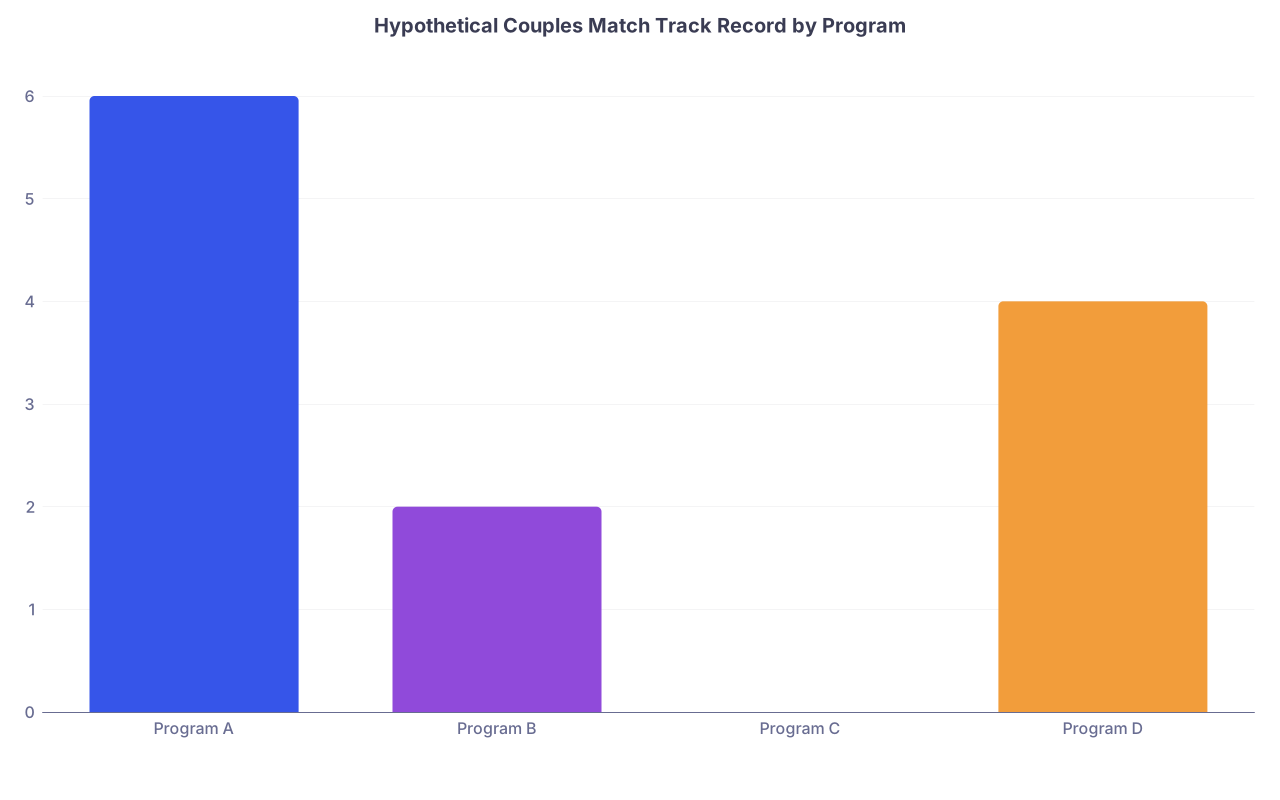
| Category | Value |
|---|---|
| Program A | 6 |
| Program B | 2 |
| Program C | 0 |
| Program D | 4 |
2. Leadership behavior: do they work for couples, or just tolerate them?
Listen for verbs. What did the program do?
Green flags:
- “The PD personally called the PD at [partner’s program].”
- “They let one partner start two weeks later to align start dates.”
- “They helped them switch rotations to line up vacations and call.”
Yellow flags:
- “They were supportive in theory, but mostly said ‘We’ll see what we can do.’”
- “They didn’t block anything, but they didn’t really help either.”
Red flags:
- “They told the resident, ‘We don’t really get involved with that.’”
- “They said they didn’t want to coordinate with outside programs.”
- Anything that sounds like annoyance or burden: “It’s complicated, and they didn’t love it.”
Residents will usually give this away with tone even before words.
3. Day-to-day reality: once you’re matched, does it actually function?
A program can “support couples” in March then ignore them in July.
Ask things like:
- “Do couples here usually get their schedules coordinated or is it chaos?”
- “Have you seen couples actually get the same days off, holidays, or similar call blocks?”
Good signs:
- Residents casually say, “Yeah, our chiefs usually do what they can.”
- You hear: “They swap calls to let couples attend important things together.”
- Couples are known socially and seem integrated, not isolated and miserable.
Red flags:
- “They said they’d coordinate, but in reality the schedules never lined up.”
- “They told them, ‘We treat everyone the same; we don’t give special treatment.’”
That last line is a huge red flag for couples. “We treat everyone the same” often translates to “We won’t do anything extra for you even if it’s simple.”
4. Sacrifices: who took the hit, and how bad was it?
You need to know what trade-offs real couples made.
Ask:
- “Did either partner feel like they had to compromise a lot more than the other?”
- “Were there any couples where one person ended up at a clearly weaker program just to stay nearby?”
Patterns:
- If you keep hearing “Oh yeah, the [less competitive specialty] partner took a big hit,” take that seriously.
- Or “They both landed fine, but they ranked programs they probably wouldn’t have ranked if they weren’t together.”
This helps you judge your own situation honestly:
Derm + IM is very different from FM + Psych in the same city.
Step 5: How Direct Is Too Direct?
You can be very straightforward with residents. They get it. Many will say, “Honestly, if you’re couples matching, you have to ask this.”
You can say word for word:
“We’re couples matching in [your specialty] and [partner specialty], likely in [region]. I’m trying to get a realistic sense of how this program has handled couples in the past — both good and bad.”
That level of candor helps them give better, more specific answers.
Don’t:
- Apologize: “Sorry if this is weird to ask…”
- Act like you’re asking for a secret favor.
You’re not. This is standard and smart.
Step 6: Email Follow-ups That Don’t Feel Awkward
Sometimes the best info comes later, in a 1:1 email with a resident you clicked with.
Here’s a simple, clean template you can adapt:
Hi [Name],
Thanks again for talking with me during the interview day at [Program]. I really appreciated your honesty about the culture and training.
My partner and I are couples matching in [specialty] and [partner specialty], and we’re seriously considering ranking [Program] highly. I wanted to ask a slightly more detailed question that felt easier over email than in the big group:
Have you seen couples successfully match at [Program] or with nearby programs in the last few years? If so, how supported did they feel by leadership (both in the actual match process and once scheduling started)? And were there any situations where you felt like the program didn’t handle the couples match very well?
Any candid insight would help us a lot as we build our list.
Best,
[Your Name]
That “good and bad” line gives them permission to tell the truth.
Step 7: Red Flags You Shouldn’t Ignore
Specific things that should make you very cautious about ranking a place high as a couple:
- Residents look at each other before answering, then say something vague like, “Yeah… I think they’re supportive?”
- “We’ve never really had any couples, but I’m sure they’d be fine with it.” (Translation: you’ll be the experiment.)
- PDs say, “We treat couples like any other applicant” and residents echo that verbatim.
- You hear about couples where:
- One partner had to scramble or SOAP because communication between programs was poor
- One partner clearly ended up at a much weaker program or an hour away, and residents act like that’s normal or acceptable
- Couples asked for basic schedule adjustments and got stonewalled
On the flip side, strong programs usually have specific, recent stories where leadership bent a little to make it work and nobody resents it.
Step 8: Put It All Together – Quick Decision Framework
After you’ve talked to residents at a few programs, sort them mentally:
| Tier | What You Typically Hear from Residents |
|---|---|
| Strong | Multiple recent couples, PDs call other programs, real schedule flexibility |
| Moderate | 1–2 couples ever, some help but limited coordination |
| Weak | No track record, “we treat everyone the same,” vague support |
| Unknown | Residents unsure, leadership claims support but no examples |
Reality check: you may still rank a “Moderate” or even “Weak” program higher because of training quality, geography, or one partner’s dream program. That’s fine.
But go in with your eyes open. Don’t pretend a program is couples friendly because they used the phrase on interview day.
You only trust what residents can describe in real life terms.

| Step | Description |
|---|---|
| Step 1 | Identify as couples match |
| Step 2 | Ask residents at socials |
| Step 3 | Ask for specific stories |
| Step 4 | Assume experimental risk |
| Step 5 | Assess leadership support & schedules |
| Step 6 | Classify as Strong/Moderate/Weak |
| Step 7 | Any recent couples? |
FAQ: Couples Match Friendliness
1. Should I tell residents we’re couples matching or keep it vague?
Tell them. Residents aren’t admissions. You get better, more specific answers if they know your situation. Just don’t overshare personal drama. A simple “We’re couples matching in X and Y and trying to stay in [region]” is enough context.
2. Is it safe to mention couples match to the program director?
Yes, but be strategic. If your couples application makes you more attractive (“We’re both strong applicants who want to be here”), it’s fine to mention in a calm, matter-of-fact way. If one partner is much weaker or in a hyper-competitive specialty, I’d lean on residents for intel first and be more cautious about how directly you pitch it to the PD.
3. How many programs should we ask about couples match at?
Every program you’re seriously considering ranking in the top 8–10. Below that, it matters less because those are already backup options. Don’t burn half your interview day on this, but at least get a feel from 1–2 residents at each serious program.
4. What if residents give conflicting answers about couples friendliness?
This happens. One resident says, “They’re very supportive,” another seems lukewarm. In that situation, trust specificity. The person who can name a couple, describe what the PD did, and recall how schedules were adjusted is more reliable than someone speaking in generalities. You can also follow up by email with the more detailed one.
5. We’re different specialties in different institutions – how much can one program really do?
Quite a bit, if they care. A strong program can: proactively reach out to the partner program; schedule interviews on the same day; signal real interest; and later adjust start dates or rotations to help with commutes and life. They can’t force another institution to take your partner. But they absolutely can make it easier or harder.
6. When is a program’s couples match friendliness not enough to justify ranking it highly?
When the trade-off permanently hurts one partner’s career: major step down in program quality, consistently poor fellowship placement, terrible lifestyle with no support. If residents describe scenarios where one partner “took a huge hit” and everyone just shrugs, that’s your warning. A supportive couples culture should feel like both people still got decent outcomes, not one person getting sacrificed.
Key takeaways:
You don’t ask, “Are you couples match friendly?” You ask residents for specific stories about real couples. Pay attention to track record, leadership behavior, and how schedules and sacrifices actually played out. Then rank based on what residents can show you in detail, not what PDs promise in the abstract.


