

You are here
It’s late January. You and your partner are staring at the NRMP couples matching screen. You’ve built your individual rank lists. You’ve linked a few programs. Now the real question hits:
“How many joint programs vs solo programs should we actually rank on our couples list… without screwing ourselves?”
You’re not just ranking programs. You’re deciding how much you’re willing to:
- Risk not matching at all
- Risk matching in different cities
- Trade “together at okay programs” vs “apart at dream programs”
This is the line you’re walking. Let’s make it concrete.
The short answer (that nobody gives you clearly)
Here’s the blunt framework I use with couples:
Start with a hard rule:
At minimum, build your couples list so that:- Each person would match somewhere in >90–95% of historical simulations if they were solo
- Then layer couples combinations on top of that
Joint vs solo buckets (typical for most couples):
- Top of list: 10–40 fully joint pairs (same program or same city)
- Middle: 10–40 “partial joint” pairs (same city, related systems, acceptable commute)
- Bottom: Solo safety tail where one or both of you match alone rather than go unmatched
If you want a number:
- Competitive × Competitive couple: often 40–80 joint pairs total
- Competitive × Less-competitive: often 30–60 joint pairs
- Less-competitive × Less-competitive: 20–40 joint pairs can be enough if both have strong solo lists
You generally should not:
- Rank only joint options unless you both have extremely strong apps and broad lists
- Go shorter than ~60–80 total couples rows unless you have a clear, data-backed reason
- Put joint “fantasy combinations” above realistic local/regional joins
Now let’s unpack this properly.
Step 1: What does “joint vs solo” actually mean on the couples list?
Quick reminder (because people get this wrong all the time):
On couples match, every row is a pair of programs:
(Partner A Program X, Partner B Program Y)- You can pair the same program (e.g., both at University Hospital)
- Or different programs in the same city
- Or even “Program for A, No Rank for B” (solo match option)
The algorithm doesn’t care whether a row is “joint” or “solo.” It just treats rows as ordered preferences. You decide how often you’re only willing to match as a unit (both match on the same row) vs allow one person to match while the other doesn’t or matches elsewhere.
So when we say:
- Joint programs = rows where both of you are at programs that are geographically and practically acceptable as a couple (same program or truly workable same-city options)
- Solo programs = rows where:
- One person is at a program and the other is “No rank” or
- You’ve put rows that effectively treat one person’s match as more important or much more flexible than the other’s
Reality: your list will probably be a mix of:
- Same program / same hospital pairs
- Different program / same city pairs
- Different program / different city but “we’d tolerate it if we must” pairs
- Solo safety tails
Step 2: Decide your real priority: together vs location vs prestige
Before numbers, you need one brutally honest statement:
“We would rather ______ than ______.”
Examples I’ve heard in rank meetings:
- “We would rather end up in the same city at mid-tier programs than in different cities at top-10 programs.”
- “We would rather be long-distance for training than both lock into a city we hate for 3–7 years.”
- “We would rather risk not matching one person than guarantee a match in a place that locks us far from family.”
Your choice here directly controls:
- How high on the list you put joint pairs
- How deep you go with solo options
- How many “stretch” joint combinations you bother to rank
If your true North Star is:
“Same city beats everything” → heavy joint list, short solo tail.
If it’s:
“Both match into our specialty somewhere” → more solo depth, especially for the more competitive partner.
Step 3: The real constraint — your solo match strength
Forget couples for a minute. Ask:
“If I submitted my solo rank list, how confident am I I’d match?”
Very different answer for:
- An AMG with solid application in FM with 15 programs ranked
vs - An IMG applying to Derm with 6 interviews
vs - Mid-range US MD applying to Gen Surg with 10 interviews, half of which are reach
Your couples flexibility depends on this.
Here’s the rule of thumb:
- If either of you would be at material risk of not matching solo, you cannot afford to be too picky or too short on your couples list. Joint-only is dangerous.
- If both of you would almost certainly match solo (good spread, lots of interviews), then you can push harder for joint-only up top and a thinner solo tail.
Step 4: Typical patterns that actually work
Let’s talk structures, not just numbers.
Pattern A: “We MUST be together” couple
Usually:
- Married or long-term, often with kids or serious life constraints
- Both relatively marketable (not ultra-competitive specialties with marginal apps)
- Priority: same city, same program if possible
Their couples list often looks like:
Top 20–40 rows:
- Same program/same hospital combos
- High priority city clusters (e.g., “All possible A/B combos in Boston, then NYC, then Philly”)
Next 20–40 rows:
- Same city but different programs
- Slightly less preferred cities but still acceptable
- All permutations of A’s top 3–5 in a city × B’s top 3–5 in that city
Bottom 10–20 rows:
- Either:
- Same region but commuting burden (e.g., 60–90 minutes apart)
- Solo safety for at least the more at-risk partner
- Some couples actually stop the list before solo — knowingly accepting the risk of both not matching if they can’t be together
- Either:
Total rows: usually 60–100.
Pattern B: “We strongly prefer together, but individual match > nothing”
Common when:
- One partner is much more competitive
- Or one partner is in a super competitive specialty (Derm, Ortho, Plastics, ENT, Ortho) and the other is in something like IM/FM/Peds/Neuro
Their list:
Top 20–50 rows:
- All realistic joint combinations they’d actually be happy with
- Some “reach” city combos but still plausible (where both interviewed)
Middle rows:
- “Weird” combos that technically work but aren’t ideal (e.g., one at a university program, one at a community 45 mins away)
- Regional spreads (“Anywhere we both interviewed within 2 hours of City X”)
Bottom 20–50 rows:
- Solo tails:
- First: both solo in overlapping regions if possible
- Then: more competitive partner’s solo list extended
- Often: less competitive partner allows more geographic flexibility
- Solo tails:
Total rows: 80–150 is very common here.
Pattern C: “We’re okay with distance if we both match strong individually”
Often:
- Ambitious couple, high stats, prestige-focused
- Different specialties, limited overlap at top programs
Their structure:
Top 10–30 rows:
- Dream joint pairs only (top programs in top cities where both have interviews)
Next 10–30 rows:
- Good but not dream joint combos
- Maybe some city stretches but still livable
Then a LOT of solo depth:
- Each individual’s honest solo rank list mirrored as couples rows with “No rank” or far-apart cities
- The list ends only when both solo lists are exhausted
Total rows: can easily hit 100–200+ if they’re being thorough. This is fine.
Step 5: Concrete numbers by scenario
Let’s give you some actual ranges you can adapt.
| Couple Type | Joint Rows (Same/Same-City) | Solo / Mixed Rows | Total Rows (Typical) |
|---|---|---|---|
| Both less-competitive specialties | 20–40 | 20–40 | 60–80 |
| One competitive, one less-competitive | 30–60 | 30–80 | 80–140 |
| Both competitive specialties | 40–80 | 40–100 | 100–180 |
These are not quotas. They’re sanity checks.
If you’re both applying to super competitive fields and your couples list is 25 rows long with almost no solo options, you’re playing with fire. I’ve seen that end in both unmatched, and the couple saying, “We didn’t realize how risky that was.”
Step 6: Don’t waste rows on fantasy combinations
“Just rank everything” sounds smart until you realize some rows are dead on arrival.
Here’s what I tell couples to delete:
- Rows where one of you didn’t get an interview at that program
- Cities one of you actually hates but is too polite to say out loud
- Combinations where you’d never choose that pair over far fewer but more realistic local pairings
Better: focus on dense clusters where you have multiple combinations that could work in the same city/region.
Use this mental test for every row:
“If this were the only row we matched on, would we both say yes without hesitation?”
If the answer is “ehh…” cut it or move it way down beneath better solo options.
Step 7: Protect yourselves from the “both unmatched” scenario
You’re not just optimizing for “perfect together”; you’re avoiding disasters.
Two rules that save couples:
Each person separately builds a solo list they’d be willing to submit alone.
Then you reconstruct as couples rows so that:- Your combined list “covers” almost everything you’d do individually
- You use joint rows to prioritize being together without erasing safety
You deliberately decide where your last joint row is.
And say explicitly:
“Below this line, we’re accepting the possibility that we’ll be apart in order to protect against neither of us matching.”
Most couples never have this explicit conversation. Then they’re shocked in March.
Visual: How couples often stack their list

| Step | Description |
|---|---|
| Step 1 | Top of List |
| Step 2 | High-priority joint same-program pairs |
| Step 3 | Joint same-city different-program pairs |
| Step 4 | Lower-priority joint / regional pairs |
| Step 5 | Solo or long-distance safety rows |
| Step 6 | End of List |
It really is layered like this for most people.
Step 8: A layout strategy that actually works
Here’s a simple, efficient way to build the list without losing your mind:
- Each of you writes your solo rank list in true preference order.
- Identify city clusters where both interviewed (e.g., “Boston,” “NYC,” “Chicago”).
- For each city cluster:
- List Partner A’s programs in that city in rank order
- List Partner B’s in that city in rank order
- Create all realistic pairs from those lists in the rough order you’d prefer as a couple
- Place city clusters in order of joint preference:
- Best clusters at the top of the couples list (heaviest joint saturation)
- Less preferred clusters or “one really likes it, one tolerates it” below
- Only after your joint cluster blocks are done do you:
- Decide where to insert true solo/long-distance rows
- Add each person’s solo safety runs at the bottom
This way, the joint rows are intentional, not random.
When to lean heavier on joint vs solo
Let me be direct.
You should lean heavier on joint rows (fewer solo rows) if:
- Both of you:
- Have 10+ interviews each in reasonably less-competitive specialties
- Have multiple overlapping cities
- Would be miserable long distance or have serious practical constraints (kids, visas, elder care)
- You’d seriously consider reapplying or SOAPing together if you didn’t match rather than live apart
You should lean heavier on solo rows (longer tail) if:
- One or both of you:
- Are in highly competitive specialties with marginal interview numbers
- Have geographically narrow interviews with little overlap
- You both agree that:
- Matching somewhere in your field > being together at any cost
- You’d accept one person doing a prelim year or research year alone if it came to that
Quick gut-check math
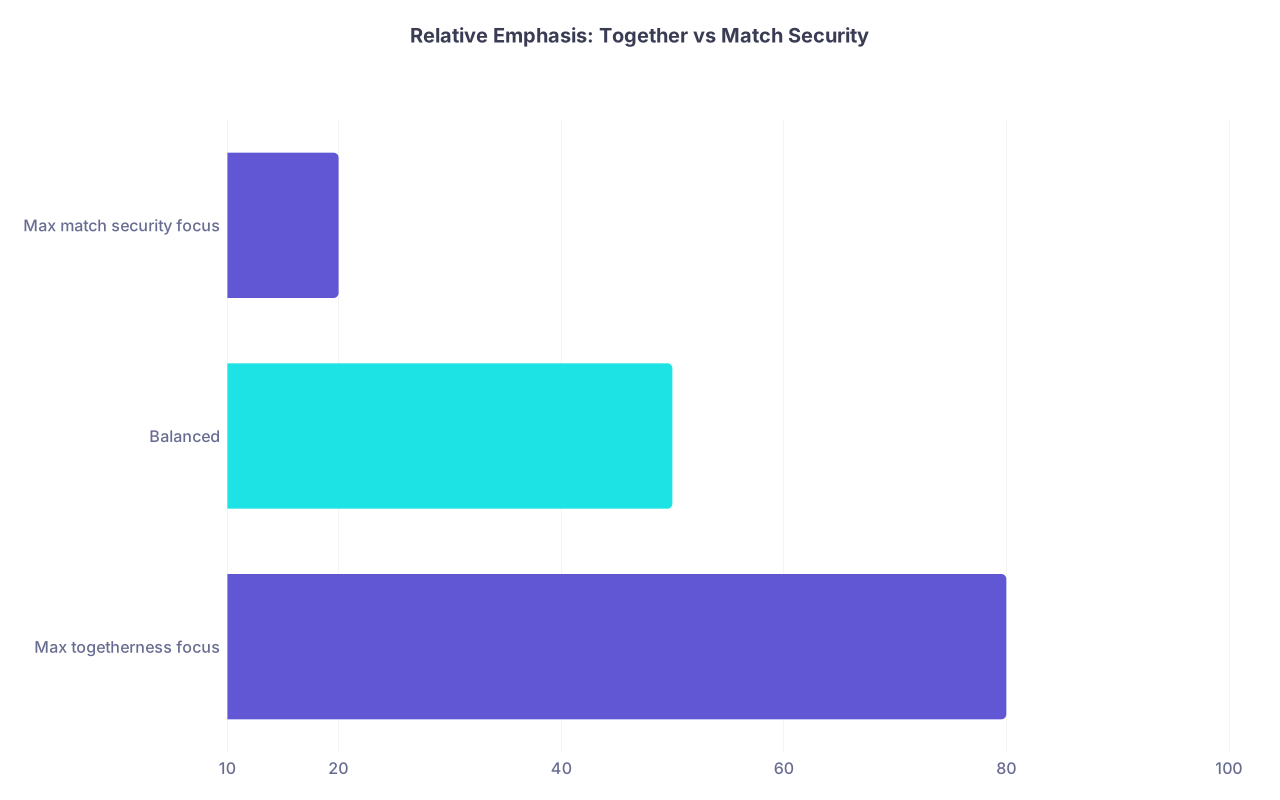
Here’s a mental model couples find helpful:
| Category | Value |
|---|---|
| Max togetherness focus | 80 |
| Balanced | 50 |
| Max match security focus | 20 |
- If you’re at the “max togetherness” end → most of your list should be joint rows, solo only at the very bottom (if at all).
- If you’re at “max match security” → plenty of joint rows, but a robust and honest solo tail.
Literally rate “How important is being in the same city vs both just matching?” on a 0–10 scale. That should inform how deep you go before solo.
FAQs
1. Is there such a thing as “too many” couples rows?
Functionally, no. The algorithm doesn’t punish long lists. The problem isn’t length; it’s nonsense. If you have 200 rows but 80 of them are combinations you’d never truly accept, that just makes your decision-making fuzzy. Long but intentional is fine. Long and random is pointless.
2. Can we rank only joint programs and no solo options?
You can. Some couples do. I’ve seen it work when:
- Both partners have strong applications
- Decent number of interviews with decent city overlaps
- They’d rather SOAP or reapply than be apart
But it’s risky. If you do this, you’re explicitly saying: “We accept that both of us might not match this year if we can’t be together.”
3. How many joint same-program rows vs same-city/different-program rows?
If you have them, rank every single same-program combo you’d accept first in that city cluster. Same-program is just simpler for your life. After that, fill in same-city/different-program pairs. I don’t care if you have 2 vs 20 same-program rows; rank them in honest order, then expand to different programs in that city.
4. Should the more competitive partner “sacrifice” more on location?
Usually yes. If one partner can match almost anywhere and the other is borderline, the flexible one should use that flexibility to create more viable joint options. That often means: they accept less prestige or less perfect fit so you can be in the same city and the weaker app still has enough choices.
5. How do we handle prelim + advanced combinations as a couple?
Treat prelim years bluntly. If one partner is applying to advanced positions (e.g., Rads, Anes, Derm), you can:
- Group prelim options in the same city as the other partner’s categorical programs
- Rank joint rows that pair “Partner A prelim + Partner B categorical” in cities you’d actually accept
Don’t go crazy building endless “prelim in random city + B somewhere else” fantasy pairs. Focus where the advanced + prelim + partner’s options line up geographically.
6. What’s the biggest mistake couples make with joint vs solo ranking?
Two big ones:
- Going too short with joint options and ending up with a lot of solo rows at the top by accident
- Avoiding the hard conversation about distance vs risk of no match and then building a list that doesn’t actually reflect what they want
The solve is simple: talk honestly, write down your priorities, consciously decide where joint ends and solo begins, and then build the list to match that.
Key takeaways:
- Build around realistic joint city clusters, then add solo depth based on your risk tolerance and individual match strength.
- For most couples, 40–100 joint rows plus a thoughtful solo tail is the sweet spot, adjusted for competitiveness.
- Don’t be lazy: make your rank list explicitly reflect what you’d do if the algorithm handed you only that row.


