

The fantasy that “if we couples match, it’ll all just work out” is exactly how people end up with zero real backup plan.
You need a backup that’s deliberate, written down, and agreed on before you click “Certify.” Not something you “figure out if we don’t match.”
Here’s how to actually build that.
Step 1: Get Real About What “Backup Plan” Actually Means
Backup plan doesn’t mean “we hope we match as a couple, but if not, we’ll be sad.”
A real backup plan answers four brutally specific questions:
What will each of us do if:
- We both match, but far apart?
- One of us matches, the other doesn’t?
- Neither of us matches?
What’s our priority hierarchy?
- Stay geographically together at all costs?
- Both start residency the same year?
- Protect the stronger applicant’s trajectory?
- Protect the more competitive specialty attempt?
What concrete options have we created in advance?
- Extra individual rank lists?
- SOAP strategy?
- Pre-identified gap year jobs (research, prelim, home program, etc.)?
What’s off the table?
- Are there cities one of you refuses to live in alone?
- Is reapplying in a different specialty acceptable or a last resort only?
- Is long-distance 100% acceptable for 1 year? For 3+ years?
If you haven’t explicitly answered those together, you don’t have a backup plan. You have vibes.
Step 2: Understand the Actual Match Mechanics (So You Don’t Game It Wrong)
Here’s where people screw themselves: they try to “game” the couples match instead of using it intelligently.
At a high level:
- Couples can link rank lists so the algorithm tries to match you to pairs of programs (Program A for you + Program B for partner) as if they’re one combined choice.
- You can also put “one matches, one doesn’t” or “one matches, other gets no rank” as intentional lines on your couples list.
- Each of you also can (and should) have an optional individual rank list that kicks in if the couples options don’t work out.
So you’re really designing three layers:
- Primary: Couples rank list (best-case scenarios and realistic pairs)
- Secondary: Individual rank lists (for each partner separately)
- Tertiary: SOAP + reapply + gap year strategies
If you treat the couples list like your only list, you’re gambling your entire career on a single pass of the algorithm.
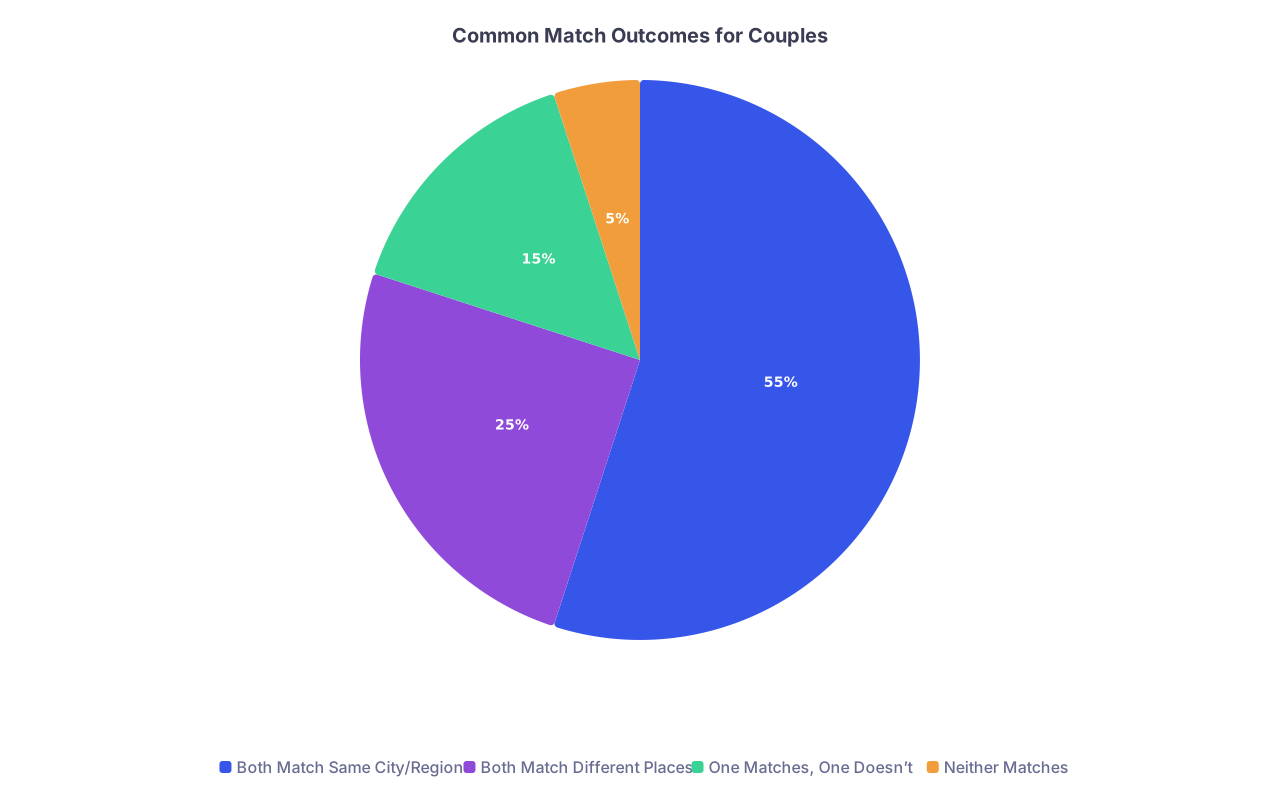
| Category | Value |
|---|---|
| Both Match Same City/Region | 55 |
| Both Match Different Places | 25 |
| One Matches, One Doesn’t | 15 |
| Neither Matches | 5 |
This isn’t exact national data — it’s a realistic distribution from what I see with couples. Meaning: a non-trivial number of pairs wind up in a less-than-ideal scenario. Plan like you might be one of them.
Step 3: Build Your Couples Rank List With Backup in Mind
Most couples build their list like this:
- Top 10: Dream same-hospital/same-city pairs
- Then… random chaos, unexamined, often incomplete
Here’s the better structure.
1. Tier your options
Sit down and literally group your potential pairs into tiers:
- Tier 1: Same hospital / same city at programs you both like
- Tier 2: Same city, different hospitals
- Tier 3: Same region (e.g., 1–2 hours apart)
- Tier 4: Intentional “one matches, one doesn’t” lines (if acceptable)
- Tier 5: “We’d rather be apart than both unmatched” options
Your rank list should reflect this logic, line by line. Not just wishful thinking up top and random stuff at the bottom.
2. Decide how far apart you’re actually willing to go
Don’t handwave this. Is a 90-minute drive OK? 4 hours? Different time zones? You want a clear sentence like:
“If we’re both matched but more than X hours apart, we treat that as long-distance and we’re OK with it for Y years.”
That X and Y matters. It shapes:
- Whether you include certain regional pairs
- How aggressively you add Tier 3 options
- Whether you add a pair where one of you has a great program but the other is at a clearly mediocre one
Step 4: Design Individual Rank Lists That Protect Each Person
Here’s the thing almost nobody tells you: you can preserve your individual preferences after the couples options fail.
You each can create an individual list that the system uses if no couples pair works out. That’s your personal safety net.
You need to decide in advance:
- Does each person want to match somewhere rather than potentially go unmatched in pursuit of being together?
- Is there any program you’d only accept as part of a couple (e.g., “I’d only go there if we’re both there”)?
Build your individual lists according to clear rules:
- Rank programs you would actually attend in order of your true preference.
- Do not put any “only if we’re together” places on your solo list unless you explicitly mean that and you’re OK going there alone.
- Keep your solo list long. This is not the place to be selective and proud.
| Priority Level | Applicant A (IM) Example | Applicant B (Peds) Example |
|---|---|---|
| 1 | Home Program | Same City as A if possible |
| 2 | Strong Academic Nearby | Community Program Nearby |
| 3 | Mid-tier Regional | Any Accredited Peds Program |
| 4 | Far but Solid Program | Far but Solid Program |
| 5 | Any Acceptable Program | Any Acceptable Program |
Write this down and agree: “If couples doesn’t work, our individual lists are designed to maximize each person’s chance of matching rather than intentionally risk both going unmatched.”
If that’s not what you want, be honest about it. But then you’re choosing risk with your eyes open.
Step 5: Plan for the “One Matches, One Doesn’t” Scenario
This is the most emotionally loaded case and the one couples avoid talking about. That’s a mistake.
You must answer:
- If one of us matches and the other doesn’t, do we:
- A) Both move to where the matched partner is, and the unmatched partner finds a local job/research/prelim?
- B) Let the unmatched partner choose the best career move anywhere, even if that means long-distance?
- C) Intentionally include “one matches, one doesn’t” options on the couples list as an acceptable outcome?
There’s no universal right answer. There is a wrong answer: “We’ll just see what happens.”
Here’s a common and reasonable framework:
- Prioritize the match the stronger applicant got, especially if it’s in a competitive specialty or a great program.
- Have 1–2 backup activities in that city pre-identified for the unmatched partner:
- Research position (cold emails sent before Match Week)
- Prelim year (IM or surgery) that you’ve already researched
- MPH, MBA, or other grad option only if it genuinely aligns with their goals (don’t default to this)
- Chief scribe, clinical research coordinator, or teaching position with a clear reapplication plan

| Step | Description |
|---|---|
| Step 1 | One Partner Unmatched |
| Step 2 | Consider SOAP or Reapplying Elsewhere |
| Step 3 | Unmatched Seeks Local Gap-Year Option |
| Step 4 | Long-Distance + Optimized Career Move |
| Step 5 | Reapply Next Cycle |
| Step 6 | Matched Partner Happy With Program? |
| Step 7 | Move Together? |
Talk through this now, not on Match Day with your brains on fire.
Step 6: Plan for SOAP and Gap Years Like Adults, Not Victims
If you end up in SOAP or taking a gap year, that doesn’t mean you failed as a couple. It means you’re in a competitive system and had a rough year. That’s it.
What matters is whether you flail or execute a plan.
SOAP Strategy (for one or both unmatched)
Decide ahead of time:
- Are you willing to SOAP into:
- A different specialty?
- A prelim or transitional year?
- A less desirable geographic region?
- Where does “I’d rather not SOAP into X” line get drawn?
Broad SOAP willingness increases the chance that both of you start residency the same year, but it may involve training in a specialty or place you didn’t love. That’s a trade-off, and you should name it.
Gap Year Strategy
If someone doesn’t match and doesn’t SOAP into something acceptable, your backup is a productive year.
You want three things lined up before Match:
- Target city (or cities) you’re willing to live in if this happens
- 3–5 potential mentors or PIs already contacted who could support research or clinical work
- A rough reapplication strategy:
- Same specialty with stronger application?
- Slight pivot (e.g., neurology instead of neurosurgery, FM instead of IM)?
- Total reorientation?
Don’t wait until after Match to write the first “Hi Dr. Smith, I’m interested in research…” email.
Step 7: Protect the Relationship While Protecting the Career
Let’s be blunt. A couples match that goes badly can strain, or even break, a relationship.
Your best defense is not “we love each other.” It’s clarity and advance agreement.
Here are the conversations you should have before rank list certification:
- “If we have to do long-distance for 1–3 years, are we both actually willing?”
- “If one of us gets our dream program and the other doesn’t, do we prioritize the dream or staying together?”
- “If one of us needs to pivot specialties to have a better chance next year, is that on the table?”
- “If we end up in a scenario we hate, how do we avoid blaming each other for the rank decisions?”
I’d literally recommend you write down a one-page “match agreement”:
- Our top three shared priorities
- Our clear decisions for each major scenario
- A sentence you both sign onto like:
“We’re making these choices together. If the outcome isn’t what we hoped, we’ll treat it as a shared challenge, not one person’s fault.”
Cheesy? A little. Effective at reducing future fights? Absolutely.
Step 8: Put It All Together In a Concrete Backup Blueprint
Let’s pull this into something you can actually execute.
Here’s what a solid backup plan looks like on paper:
- A couples rank list with:
- Tiers clearly structured (same hospital → same city → same region → intentional split outcomes)
- No “wishful thinking only” beyond the first few lines
- Two individual rank lists where:
- Each person has a long, honest list of programs they’d attend solo
- No one is unintentionally locking themselves into going unmatched
- A written decision tree that says:
- If both match in same city: we move, done.
- If both match but far apart: distance threshold + duration we’re OK with.
- If one matches, one doesn’t: our pre-chosen answer to “move together” vs “optimize career.”
- If neither matches: SOAP strategy → gap year plan.
- A pre-built gap year plan with:
- Target cities
- Research/clinical opportunities identified
- Draft emails ready to go if needed
That’s what real couples do when they’re serious about both the relationship and the careers.
FAQs
1. Should we ever rank “one matches, one doesn’t” pairs on our couples list?
Yes, if you’ve decided that one person matching somewhere decent is better than both going unmatched. For example, pairing (Program X / No Match) as a line means: “We’d accept one of us matching at X even if the other doesn’t match anywhere.” That can make sense if one of you is in a very competitive specialty or has a strong option you don’t want to lose.
2. Is it selfish for the stronger applicant to protect their own career more?
No. It’s rational. You’re not doing each other any favors if both of you tank your careers trying to stay perfectly aligned geographically. The key is transparency: both of you should agree on whether you’re prioritizing the stronger application, the competitive specialty, or staying physically together. You can choose relationship-first, but pretending you’re not making trade-offs is what causes resentment.
3. How many programs should we rank as a couple vs individually?
There’s no magic number, but as a rule: your couples list should include every reasonable pairing you’d genuinely accept. That might be 20–100 lines depending on your specialties and interview spreads. Your individual lists should be longer than you think—ideally every program you interviewed at that you’d actually attend solo, ranked honestly. Err on the side of more options, not fewer.
4. What if we completely disagree about what’s acceptable as a backup?
Then you don’t have a couples problem; you have a relationship alignment problem. You need to settle that before you certify anything. Sometimes it means compromise on location. Sometimes it means one of you being more flexible about specialty or program prestige. If you absolutely can’t agree, you might be better off not couples matching and just coordinating the best you can instead of hard-linking your fates.
5. How does SOAP work differently for couples?
There is no “couples SOAP.” Once you’re unmatched, you’re just two separate applicants in SOAP. That means your couples strategy is completely front-loaded: you use the couples function for the main Match, and if that fails, your backup plan is all about individual tactics that are coordinated but not algorithmically linked. Don’t expect SOAP to magically fix a poorly built couples rank list. It won’t.
6. What’s the single biggest mistake couples make with backup planning?
They refuse to plan for the painful scenarios. They’ll obsess over the top 5 “dream” pairs and never seriously answer, “What if only one of us matches?” or “What if we’re 8 hours apart?” Then Match Week hits, they’re blindsided, and decisions get made emotionally in 48 hours instead of thoughtfully over months. Don’t do that. Open your shared rank list document today and add a new section called “If Couples Match Fails,” and write out your decisions for each scenario before you certify.


