

Should We Couples Match If Only One of Us Is Sure About Our Relationship?
What happens if one of you is 100% ready to couples match… and the other is quietly wondering if you’ll even still be together in two years?
Let me be direct: if only one of you is truly confident about the relationship, you should treat couples matching as a high‑risk move, not a default option. You might still do it—but only after you’re brutally honest about three things: your risk tolerance, your individual competitiveness, and what happens if the relationship ends.
I’ll walk you through exactly how to think about this.
First: What Couples Matching Actually Changes
Couples Match isn’t a romantic gesture. It’s a binding logistics tool.
When you couples match:
- You link your rank lists.
- The algorithm now tries to find paired positions that match your joint list of combinations.
- You are no longer maximized purely as individuals. You’re optimized as a unit.
That means:
- You can absolutely hurt your individual match outcome.
- You can end up somewhere that’s good for the relationship but suboptimal—or bad—for your career.
- If you break up, you can be stuck in a city you never would have chosen alone, without the person you moved for.
Most people underestimate #3. They imagine either “it’ll work out” or “if we break up, we’ll handle it.” I’ve watched PGY-1s sob in call rooms because they couples matched to a city for someone they broke up with two months before orientation. It’s not theoretical.
The Core Question You Actually Need to Answer
Forget “Should we couples match?” for a second.
The real question is:
“If we break up during residency, would I still be okay with my match outcome?”
If your honest answer is “no,” then it’s not time to couples match. You don’t need an ethics consult to see the problem.
If your answer is “yes, it would still be acceptable—even if painful,” then couples matching might be reasonable, even if one person is less certain about the relationship’s future.
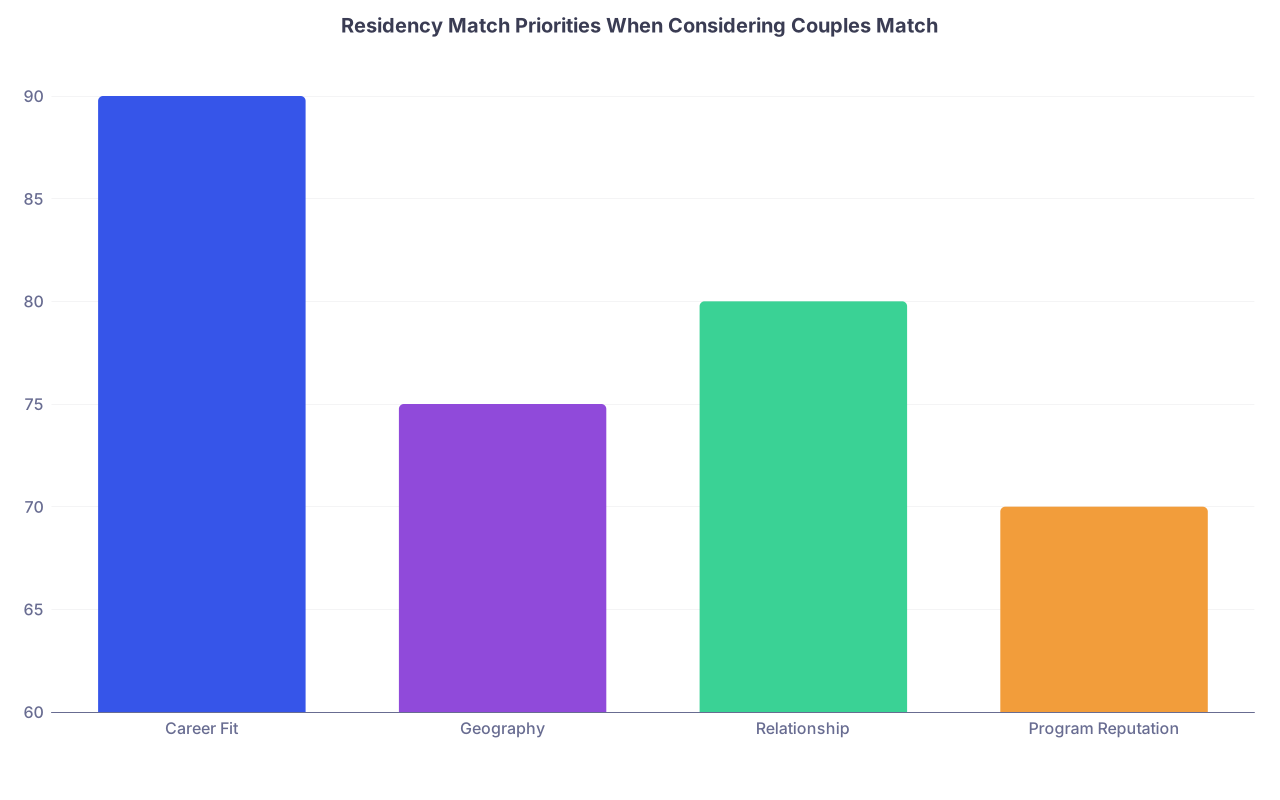
| Category | Value |
|---|---|
| Career Fit | 90 |
| Geography | 75 |
| Relationship | 80 |
| Program Reputation | 70 |
A Simple Decision Framework: 4 Axes That Actually Matter
Use this. Don’t overcomplicate it.
| Axis | Low-Risk Situation | High-Risk Situation |
|---|---|---|
| Relationship Certainty | Both >8/10 confident | One <6/10, big doubts or recent breakup talk |
| Career Flexibility | Both in flexible or mid-competitive fields | One in very competitive or location-bound |
| Geography Flexibility | Both okay with multiple regions/cities | One needs strict region (family/visa etc.) |
| Risk Tolerance | Both okay with non-ideal programs | One insists on prestige or top-tier only |
If you’re stacking up “High-Risk” boxes AND only one person is sure about the relationship, couples matching becomes a bad gamble.
Let’s break these down briefly.
1. Relationship Certainty
You don’t need a proposal. You do need realism.
Red flags for couples matching:
- You’ve recently “taken a break.”
- One of you has openly said, “I’m not sure you’re my forever person.”
- You’re staying together mostly because of inertia or fear of being alone during applications.
- You’re already fighting about rank lists, cities, or whose career “matters more.”
If those are present and only one of you feels secure, that’s not couples match territory. That’s “we need to stop and have an honest talk” territory.
2. Career Competitiveness and Flexibility
Here’s where people blow up their futures to save a dying relationship. I’ve seen:
- A strong Step 2 CK 255 ortho candidate give up several top-20 interviews to “stay aligned,” only to break up the next summer.
- An FM applicant forced into a tiny, weak community program because their partner insisted on one major metropolitan area for derm.
Be blunt with each other:
- Are either of you applying to ultra-competitive specialties (derm, ortho, plastics, urology, neurosurgery, ENT, ophthalmology, IR, rad onc)?
- Are either of you barely competitive even in a less competitive field (borderline scores, few interviews expected)?
- Does either of you have non-negotiables: specific research track, fellowship pipeline, visa requirements, military obligations?
If one of you is already career-fragile, couples matching can push that person over the edge into not matching or into a program that bottlenecks your future.
3. Geography and Non-Negotiables
If both of you say:
“I could be reasonably happy in any of these 4–5 regions,”
then couples matching is safer.
But if your conversation sounds like this:
- “I have to be near my sick parent.”
- “I refuse to live in the Midwest.”
- “I can’t be more than a 2-hour flight from my country because of visa issues.”
- “I will not do four years in a small town.”
…and the other person is less sure they even want the relationship long term?
You’re not just couples matching. You’re handcuffing your life options to someone who may not be around in a year.
4. Risk Tolerance
Some people can tolerate:
- A community program rather than academic.
- A city that’s not their first or second choice.
- Being farther from family.
Some can’t. They say they can, then six months into residency they’re resentful and burned out, and the relationship pays the price.
You need to say out loud:
- “What’s an unacceptable outcome for me—even if we stay together?”
- “What’s an acceptable but not ideal outcome that I could live with even if we break up?”
If one of you has zero tolerance for compromise AND is less sure about the relationship, couples matching becomes a bad bet.
Concrete Scenarios: When It Makes Sense vs. When It Doesn’t
Let’s make this real.
Scenario 1: You Probably Should Not Couples Match
- Partner A: IM applicant, solid candidate, wants academic, 240+ score.
- Partner B: Psych applicant, average candidate, applied broadly.
- Relationship: Together 1.5 years. A is all-in. B is quietly unsure. They’ve had multiple fights about future plans and almost broke up two months ago.
B’s view (if they’re honest): “I care about you but don’t know if I see marriage. I also don’t want to crush your chances.”
In this setting, couples matching risks:
- A landing at a weaker IM program they wouldn’t have ranked alone.
- B feeling guilty and trapped.
- A breakup leaving both stuck somewhere suboptimal.
Better option: Apply separately, aim for same regions, coordinate interviews, rank with “soft coupling” (similar geographic priorities) but do not formally couples match.
Scenario 2: You Might Couples Match Carefully
- Partner A: OB/GYN, decent candidate.
- Partner B: Pediatrics, strong-ish.
- Relationship: 3+ years, lived together, realistic but not fairy-tale. One says “I’m sure,” the other says “I think we’re long-term, but nothing is 100%.”
They both:
- Are open to 3 different regions.
- Are okay with academic or strong community.
- Willing to rank some combinations where one has a slightly weaker program in exchange for staying together.
- Have explicitly said: “If we somehow break up, I would still be okay training at any program we rank in our top 10.”
Here, couples matching can make sense—if the rank list is built with the “breakup test” in mind.

| Step | Description |
|---|---|
| Step 1 | Discuss relationship honestly |
| Step 2 | Do NOT couples match |
| Step 3 | Assess career risk |
| Step 4 | Strong caution; consider separate match |
| Step 5 | Define acceptable cities/program tiers |
| Step 6 | Build joint list with clear floors |
| Step 7 | Both OK with outcomes even if breakup? |
| Step 8 | One in high-risk specialty? |
How to Talk About This Without Blowing Up the Relationship
This is where people freeze. One person is sure. The other is hesitant. No one wants to be the “villain.”
Here’s the script structure I’ve seen work:
Start with honesty, not reassurance.
- “I care about you a lot. I don’t want either of us to end up resenting the other because of where we match.”
Put your worries on the table directly.
- “I’m not 100% certain what our relationship will look like in 5 years. That makes me nervous about linking our futures in such a high-stakes way.”
Separate love from logistics.
- “Me hesitating about couples matching is not the same as me not loving you. It’s me respecting how big this decision is.”
Ask them to answer the breakup question.
- “If we broke up during residency, would you still be okay with us matching at any program/city we put on a couples list?”
If they answer “no” and still push to couples match, that’s a problem. They’re asking you to shoulder a risk they themselves would not accept.

Practical Alternatives to Full Couples Match
If one of you isn’t sure about the relationship, you don’t have only two options (couples match or break up). You have a middle lane.
Geographic coordination without formal couples match
- Apply broadly, but both prioritize the same regions.
- When interview offers arrive, lean toward overlapping cities.
- Rank with heavy weight on overlapping areas, but keep your lists independent.
“Soft floors” for each person’s career
- Each of you sets non-negotiable program/city thresholds you won’t go below, even for each other.
- If there’s no overlap at a reasonable level, that’s your answer: you should not couples match.
Delayed life commitments
- Decide you won’t move in together or get engaged just because of the match.
- Let residency be a real-world stress test. Hard, but honest.
Hard Truths People Don’t Say Out Loud
Let me say what attendings and advisors often think but won’t state plainly.
- If one of you is emotionally leaning on couples match to “prove” the relationship is serious, that’s a bad sign.
- If one of you is secretly hoping couples match will “force” the other person to stay, that’s manipulative—and it often backfires.
- Matching in the same city does not automatically preserve a rocky relationship. Residency stress magnifies cracks; it doesn’t fix them.
- You can deeply love someone and still decide not to couples match because your professional risk is too high. That’s not betrayal. That’s adulthood.
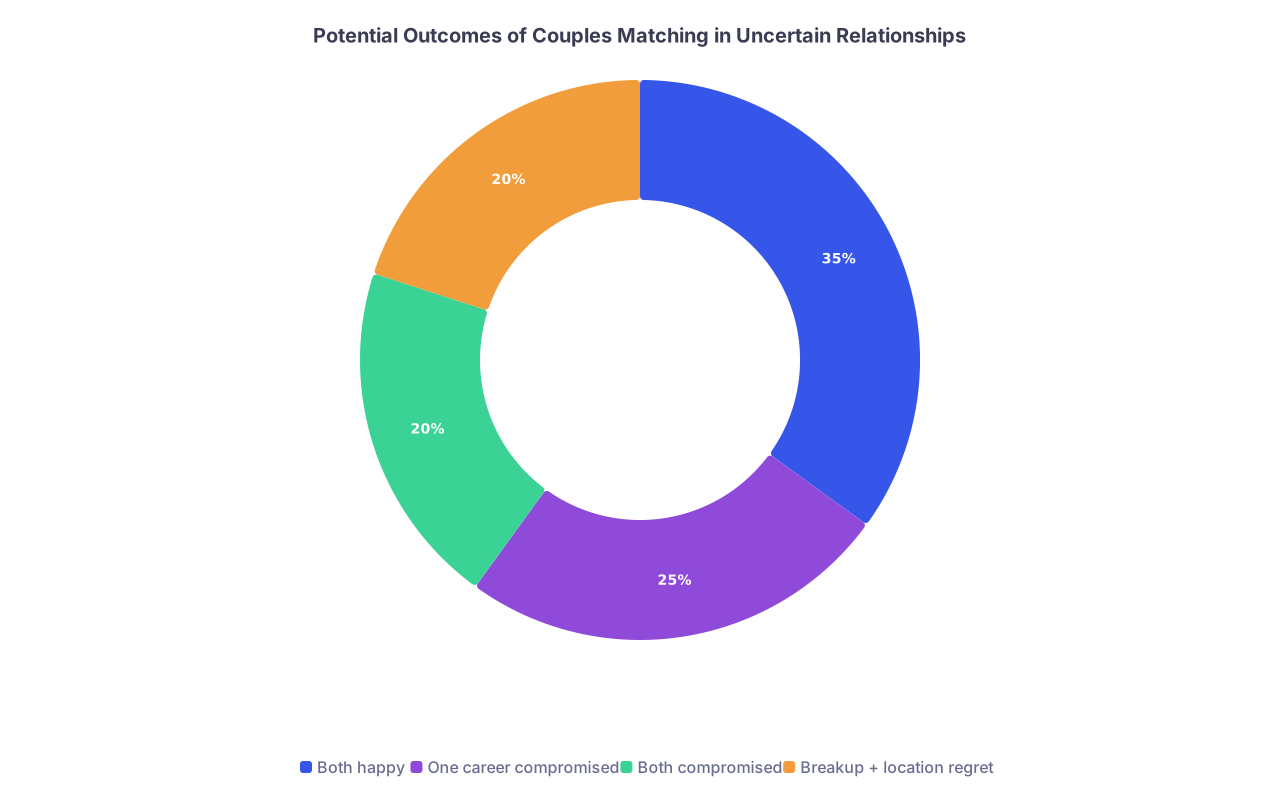
| Category | Value |
|---|---|
| Both happy | 35 |
| One career compromised | 25 |
| Both compromised | 20 |
| Breakup + location regret | 20 |
A Simple Rule of Thumb
Use this:
Only couples match if both of you would still call your individual outcomes “acceptable” even in the worst-case scenario of a breakup.
If one of you is sure about the relationship and the other is not, that bar becomes even more important. Because the power imbalance is already there. The unsure person should not be dragging the sure person into career risk as a way to avoid a hard conversation.

FAQ: Couples Match When Only One Partner Is Sure
1. Is it “wrong” or unfair to say no to couples matching if my partner really wants it?
No. This is your career and your life. Saying “I’m not comfortable linking our match outcomes” is honest, not cruel. What is unfair is pretending you’re sure when you are not, or letting guilt push you into sacrificing your future without informed consent.
2. What if refusing to couples match makes them break up with me?
Then the relationship was already conditional: “Be willing to take this huge career risk for me, or I’m out.” That’s not a stable base to build residency and life on. Painful, yes. But it probably saves you from a much nastier crisis later.
3. Can we start as a couples match and then back out if things get bad?
Not really. Once you submit a couples rank list, you are in it for that cycle. If you break up before Match Day but don’t undo the couples status in time (and both resubmit new separate lists), you’re still functionally linked. Do not treat couples match as something you can casually reverse.
4. What if I’m sure about them now, but I know residency is stressful and things might change?
That’s normal. You’re not predicting with 100% certainty. That’s why the “breakup test” exists. You’re not promising eternal love—you’re deciding whether your match outcome is acceptable under both scenarios: staying together or breaking up.
5. Who should we talk to for neutral advice about our specific situation?
Talk to separate people, not a shared mentor. Each of you should have your own advisor (PD, dean, specialty advisor) who will advocate for your career first. Then compare notes. If every advisor is saying, “This couples match will seriously hurt your options,” take that seriously.
Key points:
- If only one of you is sure about the relationship, couples matching becomes a high-risk decision that demands brutal honesty, not romance.
- Use the breakup test: if you wouldn’t accept your match outcome even in a worst-case breakup, you shouldn’t couples match.
- There are middle-ground options—like geographic coordination without formal coupling—that protect both your careers while the relationship proves itself in the real world.


