

The worst financial mistakes in couples match don’t happen after Match Day. They happen now—when you assume “we’ll figure it out” in a $3,000/month-rent city.
Let’s fix that.
You’re couples matching, likely into an expensive city (NYC, Boston, SF, LA, Seattle, DC, etc.). You’re staring down:
- Two uncertain locations
- Uncertain salaries (PGY1 vs PGY2, prelim vs categorical)
- Sky‑high rent and cost of living
You need a framework, not vibes. Here’s exactly how to plan your finances and housing when you’re couples matching in a high-cost-of-living city.
1. Start With the Only Thing You Actually Control: Your Numbers
Before you look at a single apartment, you and your partner need a brutally honest, combined financial snapshot. No rounding. No “I think it’s about…”
Do this on one shared spreadsheet (Google Sheets is fine):
List expected PGY1 salaries
- Pull actual numbers from program PDFs or FREIDA, not stale Reddit threads.
- Use base salary only. Don’t count moonlighting or “possible bonus.”
List minimum required student loan payments
- If you’ll be on IDR (e.g., SAVE, PAYE), run estimates now (use the federal loan simulator).
- If you have private loans, grab the actual monthly amounts.
List fixed non-negotiable bills
- Insurance (health if not fully covered, disability, car)
- Car payment
- Phone, internet
- Minimum credit card payments or other debts
List cash you’ll have on Day 1 of residency
- Current savings
- Expected leftover from 4th year (be realistic—interviews and moving burn cash fast)
- Family support if it’s guaranteed, not hypothetical
Once you’ve done that, build a conservative monthly net-income estimate for each of you:
- Take gross salary
- Subtract ~25–30% for taxes/withholding (higher if high-tax state/city)
- That’s the number you’ll actually see hitting your bank
Then combine them into a couples budget.
Now, lock in one rule:
Your total rent (including required fees) should be ≤ 30–35% of your combined net income.
If loans are heavy or you’re supporting dependents, push that down to 25–30%.
If 30–35% of your combined net in Boston or NYC looks depressingly low? Perfect. That means your expectations are now anchored in reality instead of Instagram apartments.
2. Accept the Big Truth: For PGY1, You’re Paying for Commuting or Paying for Rent
In an expensive city, you basically choose which pain you want:
- Short commute = higher rent
- Lower rent = longer, often more painful commute
You two need to decide your shared priority:
- “We’ll live close to Hospital A and one of us commutes hard”
- “We’ll live in the middle and both commute moderately”
- “We’ll live farther out and both commute longer to save real money”
This is where couples screw up: they pick housing emotionally, then discover the commute is wrecking them, or the rent is unmanageable.
Instead, model it.
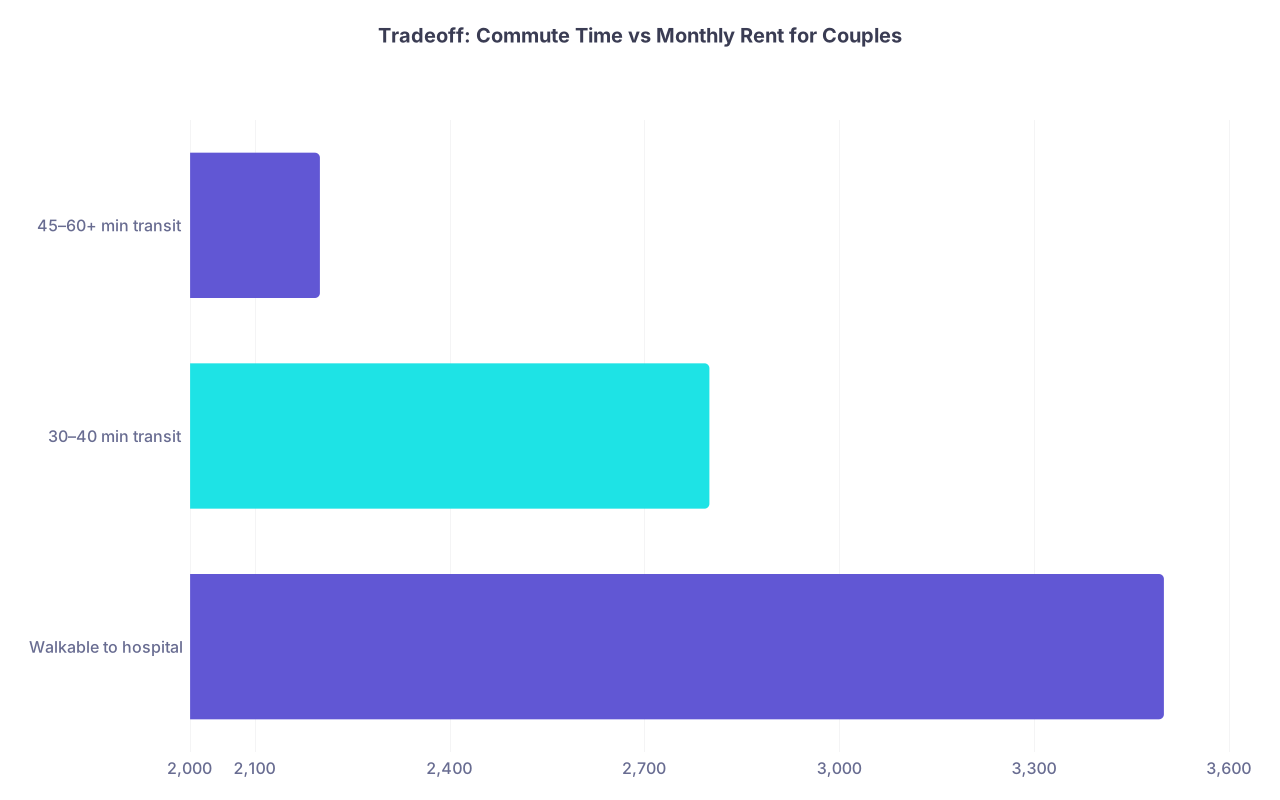
| Category | Value |
|---|---|
| Walkable to hospital | 3500 |
| 30–40 min transit | 2800 |
| 45–60+ min transit | 2200 |
Ask three questions:
- What’s the maximum single-leg commute either of you can tolerate daily (in minutes)?
- How much is 1 extra hour per day of commuting worth in dollars to you both?
- Which of you has the more brutal schedule (nights, 28‑hour calls, trauma, OB)? That person’s commute should usually be shorter.
General rule I stand by:
- The person doing q4 or q5 calls, nights, or 80‑hour weeks should NOT be the one with the 70‑minute commute each way. That’s how you burn out and crash your car.
If one of you is in a more lifestyle specialty and the other is in surgery or OB in a brutal program, weight the shared decision accordingly.
3. Budget Backwards: Define the Housing Cap, Then Shop
Most couples do this backward. They look at apartments first, then try to retrofit a budget.
Do it this way instead:
- Take your combined monthly net income
- Subtract:
- Minimum loans
- All fixed monthly bills
- Lowball but realistic amounts for: groceries, transport, utilities, basic fun, subscriptions
- Whatever is left: housing + savings.
Now:
- Set a hard housing cap: rent + mandatory building fees + parking
- Aim: rent ≤ 30–35% of combined net, and still room for at least $300–500/month combined savings (bare minimum)
If your spreadsheet says you “can” afford $3,800/month but that leaves you $0 in savings and $0 buffer for car repairs, flights home, or board fees? You can’t afford that place.
Set a written hard cap.
Literally write: “Max all‑in rent we will sign: $X/month.”
And don’t cross it because the unit “has in‑unit laundry and a rooftop.”
4. Plan for the Worst Matching Scenario, Not the Best
Couples matching in one city love to assume: “We’ll both match in the same core area of the city.” Sometimes. Not always.
You have to scenario-plan:
- Both match in Hospital Cluster A (best case)
- One in Cluster A, one in Cluster B, across town
- One matches in the main city, the other 30–60 min outside
- One unmatched or prelim-only, scrambling
Use a simple map and draw these zones. Then be explicit:
- “If we land in X + Y, here are 2–3 neighborhoods we’d target.”
- “If we end up split city/suburb, we prioritize the person with calls for proximity.”
This is where a simple flowchart helps:

| Step | Description |
|---|---|
| Step 1 | Match Results |
| Step 2 | Pick target neighborhood near shared area |
| Step 3 | Live closer to higher-intensity program |
| Step 4 | Choose midpoint neighborhood |
| Step 5 | Filter by rent cap |
| Step 6 | Select 3-5 viable apartments |
| Step 7 | Same Hospital Area? |
| Step 8 | Commute priority? |
Bottom line: don’t plan your housing assuming the perfect outcome. Plan a flexible zone strategy you can adapt in Match Week.
5. Use These Housing Rules for Expensive Cities
Here’s where things get concrete.
How much space can you actually expect?
City reality:
- NYC, SF, Boston, Seattle, DC, LA cores:
Studios/1BRs in safe, reasonable areas for residents often start around $2,000–3,000+ - Most co-resident couples I’ve seen in these cities:
- Live in 1BRs or small 2BRs
- Often split with a roommate early PGY1 to save cash
Here’s a basic comparison:
| Option | Pros | Cons |
|---|---|---|
| Studio / 1BR near work | Short commute, less stress | Higher rent, less space |
| 2BR with roommate | Lower rent per person | Less privacy as a couple |
| Farther-out 1–2BR | More space, cheaper | Longer commute, transport cost |
| Live near one hospital | Protects one partner’s time | Other partner bears commute |
Must-have vs nice-to-have
Be ruthless:
Must-haves for residents in HCOL cities:
- Safe neighborhood (you’ll be walking home at weird hours)
- Reasonable commute (one or both)
- Solid enough building/area that feels safe at 2 a.m. post-call
- Heat/AC that works (your sleep matters more than a view)
Nice-to-haves (don’t blow your budget here):
- In-unit laundry
- Luxury amenities
- Doorman
- Brand-new renovation
- Instagram kitchen
If those “nice-to-haves” push rent above your cap? Skip them. You’re not buying your forever home. You’re surviving training.
6. Build a Realistic PGY1 Budget for an Expensive City
Let’s run a simple model.
Say:
- Combined gross income: $140,000
- After taxes (rough est., depending on state/city): ~$8,000–8,500/month net combined
- Loans + fixed bills + basic expenses: ~$4,000–4,500/month
That leaves maybe $3,500–4,500/month for:
- Rent
- Utilities
- Savings
- Unexpected crap
If you spend $3,800 on rent, you’ve basically told Future You: “Good luck with emergencies.”
Instead, aim for something like:
- Rent + building fees: $2,500–3,000
- Utilities + internet: ~$200–250
- Savings: $500–700
- Buffer: $400–600
That buffer is what keeps you from putting every unexpected cost on a card.
Here’s a simplified breakdown:
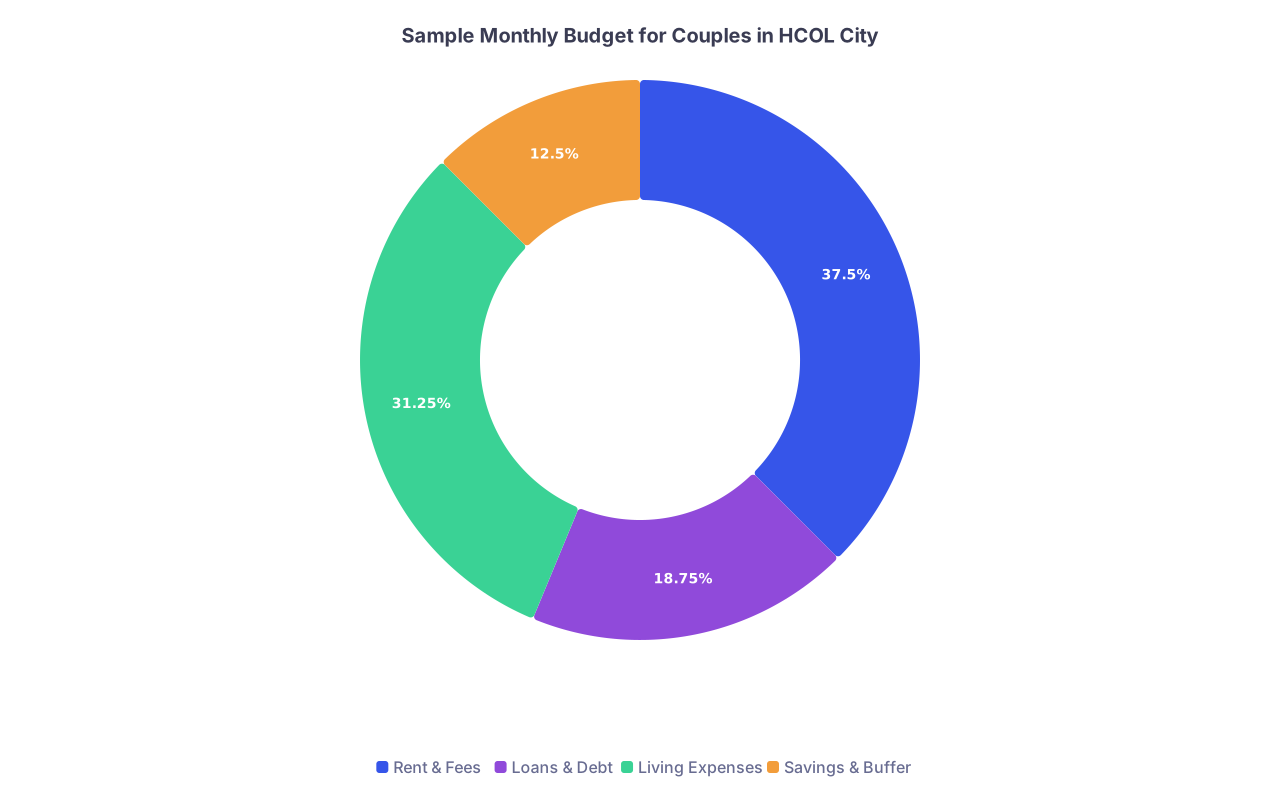
| Category | Value |
|---|---|
| Rent & Fees | 3000 |
| Loans & Debt | 1500 |
| Living Expenses | 2500 |
| Savings & Buffer | 1000 |
Adapt the numbers, but keep the structure: rent, debts, living, savings/buffer.
7. Timing and Logistics: When to Sign a Lease During Couples Match
You’re probably wondering: “Do we wait until after Match Day? What if we delay and everything gets taken?”
Here’s the practical approach that actually works in big cities:
Before Rank List Certification
- Research neighborhoods for your top 3–5 combined scenarios
- Know realistic rent ranges
- Decide your hard housing cap
- Agree on dealbreakers (safety, commute).
After Match Day, Before Contracts Start Flying
- As soon as you know your programs and hospitals, narrow to 1–3 target neighborhoods
- Spend 1–2 weekends (or a focused 2–3 days) actually walking them if possible
- Get prepped with paperwork: pay stubs (or offer letters), bank statements, IDs, maybe a guarantor if required.
When to sign the lease
- In most large cities, signing 4–8 weeks before your move date is pretty standard
- Don’t sign earlier than you need to—program start dates are usually July 1, some have orientation a week before
If you’re doing this from afar, many residents sign places sight unseen using video tours. It’s not ideal, but it’s common. Just:
- Read reviews (Google, Reddit, resident forums)
- Ask current residents where they live and if they’d choose it again
8. Talk About Money Like Adults: Avoid the Silent Resentment Trap
The financial side of couples match isn’t just numbers. It’s emotional.
Common blow-ups I’ve seen:
- One partner wants the “nice” building closer to their hospital; the other quietly panics about the rent.
- One has massive loans; the other doesn’t, but feels obligated to split everything 50/50 anyway.
- One’s family can subsidize rent; the other feels guilty or inadequate.
You need one blunt conversation:
- How will we split rent and shared expenses? 50/50? Proportional to income? Adjusted for loans?
- If one of us has much heavier debt, do we acknowledge that in the budget?
- What level of lifestyle are we both actually comfortable with?
For many couples, splitting proportional to net income or overall financial burden is fairer than strict 50/50. Especially if one partner’s loans are monstrous.
9. Emergency Planning: What If One of Us Doesn’t Match or Has a Prelim Year?
You can’t skip this scenario.
Build a Plan B that answers:
- If one of us doesn’t match: do we still move to the matched partner’s city?
- How do we afford housing if only one salary is coming in?
- Do we pick an apartment that’s survivable on one income, even if it’s tight?
A brutally honest but smart strategy in expensive cities: choose housing that one salary could barely cover, with the understanding that life will be tight but stable if needed.
That may mean a smaller space, older building, or longer commute—but it also means you’re not completely wrecked if one person’s income is delayed, reduced, or temporarily gone.
10. Concrete Next Steps (Do These This Week)
Here’s what to actually do—not in theory, but on your laptop tonight:
- Build a combined income and expense spreadsheet with real numbers.
- Use it to calculate a hard rent cap. Write it down.
- Map hospital locations for your likely programs and sketch best/mid/“ugh” housing zones.
- Email or text 2–3 current residents at your top programs: “Where do residents actually live that’s affordable and safe?”
- Decide together: who gets commute priority if you end up far apart?
You’ll feel calmer almost immediately when the decisions go from vague fear to concrete tradeoffs.
FAQs
1. How much should a couples match realistically budget for rent in cities like NYC or SF?
As a combined couple, aim for no more than 30–35% of your combined net income going to rent and mandatory housing fees. That often lands around $2,500–3,200/month for many resident couples, depending on salaries and loans. If your numbers are pushing you over 40% for rent, you’re in the danger zone—start expanding your search radius or consider a roommate.
2. Is it worth having a roommate as a couples match in an expensive city?
Financially, yes, it can be a game changer. A 2BR shared with another resident couple or a single roommate can cut your per-person housing cost dramatically. The tradeoff is privacy and sometimes friction with different schedules. For very high-cost cities where you’re both loaded with loans, doing 1–2 years with a roommate then “graduating” to your own place once you stabilize is a very reasonable path.
3. Should we prioritize living close to one partner’s hospital over the other’s?
Usually, yes—prioritize the partner with the most intense schedule (frequent 24–28 hour calls, q4 nights, brutal early OR times). The extra 20–30 minutes of commute for the other partner is painful but survivable. Chronic sleep deprivation plus a long commute after call is how bad accidents and burnout happen. If both schedules are equally rough, consider a midpoint location with two moderate commutes instead of one ideal and one awful.
4. How do we handle rent if one of us has much higher student loan payments?
Don’t pretend that doesn’t matter. You’ve got three realistic options:
- Split rent 50/50 and accept that the higher-debt partner will have less flexibility and savings,
- Split proportional to net income after minimum loan payments, or
- Agree as a couple to treat finances more “jointly” and budget together instead of tallying who pays what. Any of these can work—what doesn’t work is silence and resentment. Put the numbers on paper and pick an approach you both explicitly agree to.
5. When should we start seriously looking for housing during the couples match timeline?
You should research and plan before rank list certification, but you shouldn’t sign anything until after Match Day when you know your actual programs and locations. Realistically, in most big cities, signing 4–8 weeks before your move-in date is standard. Use the months before Match Day to learn neighborhoods, set your rent cap, and collect paperwork so that once you match, you can move quickly and intentionally.
6. What’s one mistake you see couples make over and over in expensive cities?
They let their housing choice be driven by fear (“we won’t find anything later”) and aesthetics (“but this lobby is so nice”), not by math and lifestyle reality. They sign for a place at the very top of what they “can” afford on paper, then a car breaks down, a board exam fee hits, or a family emergency pops up—and it all goes on credit at 20% interest. Don’t do that. Open a spreadsheet tonight, calculate your real rent cap, and then pull up rentals that fit under that number. If you don’t have time, pick one thing: write down your maximum all-in rent and make a deal with your partner that you won’t cross it.


