

Yes — sometimes it’s absolutely smarter not to couples match, even if you’re both applying.
Let me be blunt: couples match is a powerful tool, but it is not a free buff. Used in the wrong situation, it can tank both of your outcomes. I’ve seen strong applicants drag each other down with a poorly thought-out couples strategy. I’ve also seen smart pairs quietly decide not to couples match and end up way happier.
If you’re asking this question seriously, you’re already in the gray zone where the answer is “it depends.” So let’s walk through when it’s smarter not to couples match, and what to do instead.
Quick Reality Check: What Couples Match Actually Does
Before deciding not to couples match, you need a clean picture of what it changes.
Couples match:
- Lets you link your rank lists so that the algorithm tries to place you in a pair of programs that match your joint preferences.
- Requires you to rank combinations (Program A + Program X, Program A + Program Y, etc.).
- Does not guarantee you’ll be in the same city. You can (and often should) include “same region but different city” or even “one matched, one unmatched” as lower-ranked options.
In other words, couples match is a constraint you voluntarily add. Any constraint in the Match makes things riskier.
Here’s the question you two actually need to answer:
“Does linking our outcomes give us more good possibilities or fewer?”
If it clearly gives you fewer, or it forces one person to take a huge hit, that’s when not couples matching starts looking smarter.
Situations Where Not Couples Matching Is Smart
Let’s be specific. These are the scenarios where I’d seriously consider not couples matching, even if you’re both in the same cycle.
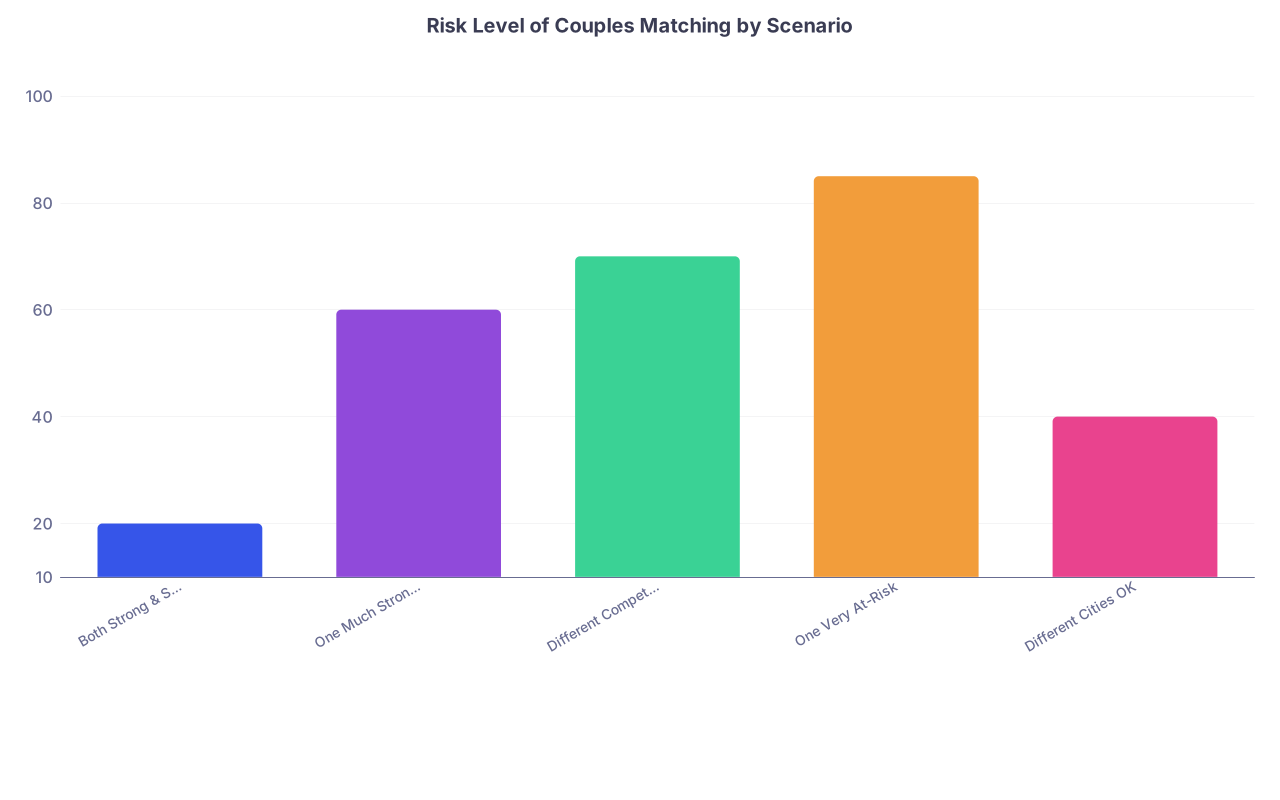
| Category | Value |
|---|---|
| Both Strong & Same Competitiveness | 20 |
| One Much Stronger | 60 |
| Different Competitiveness Specialties | 70 |
| One Very At-Risk | 85 |
| Different Cities OK | 40 |
1. One of You Is at Real Risk of Not Matching
Example profile that makes me nervous for couples:
- Below-average Step/COMLEX
- No home program in the specialty
- Limited or weak letters
- Low interview count (e.g., <8–10 in a competitive specialty)
If one partner is already in a “this might not work” situation, couples matching can magnify the damage:
- The stronger partner might have to rank safety programs they’d never consider alone.
- The weaker partner might still not match, even with those sacrifices.
- You blow up both careers in one shot.
In this situation, smarter plan:
- Do not couples match.
- Both apply broadly, independently, prioritizing best realistic fit.
- Agree ahead of time you’ll do long distance if needed for 1–2 years, then aim to realign for fellowship or job.
I’ve seen this save couples where the weaker partner SOAPed into a prelim or a different specialty. If they’d couples matched, both would have been sunk.
2. Large Competitiveness Gap + Ambitious Target
Classic combo:
- Partner A: Applying ortho, derm, plastics, ENT, neurosurg, or similarly brutal field
- Partner B: Applying FM, psych, peds, IM, or prelim/TY
If Partner A is marginal for their specialty (average-ish board scores, no huge research, mid-tier school) and they insist on matching in a specific city because of couples match? That’s how you go from “maybe match” to “didn’t match.”
Couples match in this setup often forces:
- The competitive applicant to restrict programs to a region where the less competitive specialty has lots of spots.
- The less competitive applicant to be fine, no matter what.
- The shared list to become artificially short and top-heavy.
When is it smarter not to couples match here?
- When the competitive partner is not clearly a strong candidate (no safety margin).
- When you’re fixated on one metro area with limited spots in the competitive specialty.
- When forcing geographic coupling will significantly lower either person’s overall match probability.
Better strategy:
- Don’t couples match.
- The competitive partner ranks widely across the country where their odds are highest.
- The less competitive partner double-applies or targets places with loads of positions and community programs (e.g., for IM/FM/psych).
You can still coordinate informally: talk to programs at interviews about your partner’s applications, signal interest in overlapping regions, but you don’t shackle your actual match outcomes together.
3. You’re Not Actually on the Same Timeline Psychologically
I don’t mean months. I mean headspace.
Red flags:
- One of you is “I must be in Top 20 or bust.”
- The other is “I’d rather be in a mid-tier program in my preferred city near family.”
- One is willing to do long distance. The other absolutely isn’t.
- One would rather switch specialties than do long distance. The other wouldn’t.
Couples match forces joint decisions:
- What trade-offs are acceptable?
- Would you both rather be together in weaker programs or separately in stronger ones?
- Are you both OK with one person dramatically sacrificing for the other?
If you can’t get to a mature, aligned answer, you probably aren’t ready to tie your outcomes algorithmically.
This doesn’t mean your relationship is weak. It means your priorities differ. In that case, not couples matching and revisiting location alignment at fellowship or job search may be saner than a resentful, forced compromise.
4. You’re in Very Different Application Realities
Think about these mismatches:
- MD vs DO with very different specialties and program access
- US MD vs IMG with a highly competitive specialty
- One partner couples matching as a reapplicant who didn’t match last year
When your application realities are wildly asymmetric, couples matching often becomes a straightjacket. The stronger partner now has to build a list that “works” for both of you, which sometimes means:
- Fewer academic programs
- Narrow geographic zones that are IMG- or DO-friendlier
- Over-indexing on “where will they take both of us” vs “where is this good for me”
Sometimes that’s worth it. Often it’s not.
If the weaker candidate is already in a fragile position, tying their fate to the stronger candidate can just pull both down.
5. You’re Both Extremely Flexible on Distance and Future Plans
Here’s the quiet truth a lot of couples figure out:
If both of you are:
- Very serious long-term
- Willing to tolerate 1–3 years of distance
- Confident you can re-align at fellowship/hospitalist/attending job stage
- More focused on program quality / fit than zip code
Then the benefit of couples match shrinks. A lot.
You can:
- Each rank your best programs independently.
- Make a mutual agreement about how you’ll handle long distance: visits, flights, vacation stacking.
- Prioritize reunion for fellowship or job hunting, where you actually have control.
In this scenario, couples matching adds complexity and constraints with less meaningful upside.
When Couples Match Does Make Sense
To be fair, there are clear situations where couples match is usually smart.

You probably should couples match when:
- You’re both average to strong candidates in moderately competitive or less competitive specialties.
- Your geographic priorities are aligned (e.g., “We’d be happy in the Northeast or Midwest” vs “it must be this exact zip code”).
- You’ve had blunt conversations about trade-offs (both are willing to give up some program prestige for togetherness).
- You’re both actually terrified of long distance and would regret not at least trying to avoid it.
Couples match works best when:
- You have enough interviews to build a long joint list.
- Neither of you is clinging to unrealistic goals.
- You treat your match as a team optimization problem, not “who wins more.”
A Simple Framework: Should We Couples Match or Not?
Let’s build an actual decision tool rather than vibes.
| Factor | Couples Match Stronger | No Couples Match Stronger |
|---|---|---|
| Similar competitiveness | ✅ | |
| One clearly at-risk | ✅ | |
| Very different specialties | ⚠️ Depends | ⚠️ Depends |
| Huge city constraints | ✅ | |
| Both hate long distance | ✅ | |
| Program prestige priority | ✅ |
Now score yourselves honestly on these five questions (0–2 each):
How similar are our competitiveness levels in our respective fields?
- 0 = very different, 1 = somewhat different, 2 = similar
How many cities / regions would we both genuinely be happy in?
- 0 = one city, 1 = 2–3 regions, 2 = pretty open
How terrified of long distance are we (both)?
- 0 = we can handle it, 1 = we’d tolerate it, 2 = we really want to avoid it
How much is program strength/future opportunities a priority individually?
- 0 = very high priority, 1 = moderate, 2 = low
How risky is either partner’s chance of not matching at all?
- 0 = quite risky, 1 = moderate, 2 = low risk
Rough guide:
- 9–10: Couples match probably makes sense.
- 6–8: You’re in the gray zone—consider a hybrid strategy (see next section).
- ≤5: Strongly consider not couples matching.
No, this isn’t a validated scale. It’s just a forcing function to make you talk about the real trade-offs.
Smart Alternatives to Formal Couples Matching
You’re not stuck with a binary: couples match or totally separate. There are in-between strategies.
1. “Soft Couples Match” Without Linking
You do not have to tell NRMP you’re a couple to behave like a couple.
You can:
- Apply to overlapping regions on purpose.
- Schedule interviews in the same time windows at nearby cities.
- Mention your partner in interviews:
- “My partner is also applying in X and is very interested in this region.”
- Rank programs with each other in mind (e.g., both pushing Midwest programs higher).
You preserve flexibility: if pairing works out, great. If not, the algorithm doesn’t drag you both down trying to force pairings.
2. Contingency Planning Before Rank Lists
Before you lock anything in, sit down and answer:
- “What do we do if we end up 1–2 hours apart?”
- “What if we’re cross-country for 3 years?”
- “Would either of us re-apply, transfer, or switch specialties later to align?”
Often, once couples say these out loud, they realize they’re willing to tolerate more distance than they thought, which nudges them away from needing formal couples match.

| Step | Description |
|---|---|
| Step 1 | Both Applying |
| Step 2 | Consider Not Couples Matching |
| Step 3 | Couples Match Reasonable |
| Step 4 | High Risk - Reassess Goals |
| Step 5 | Soft Couples Strategy |
| Step 6 | Similar Competitiveness? |
| Step 7 | Open to Multiple Regions? |
3. One-Partner “Anchor,” One-Partner “Explorer”
I’ve seen this work well:
- One partner applies more widely and is willing to land wherever the best program is.
- The other applies broadly but slightly overweights locations where the first partner is strongest.
You don’t formally couples match, but you intentionally let one partner’s career optimization drive the main decision, with the second partner flexing more on geography or program type.
This works best when you’ve both explicitly agreed whose specialty is harder to re-enter or more time-sensitive.
How Programs Actually View Couples Matching
Quick reality check on program behavior:
- Programs generally don’t punish couples.
- Some like couples because you’re more likely to be happy and stay.
- Some will quietly coordinate if they love one of you and are on the fence about the other.
But programs cannot manufacture new positions for you. If their class is full, it’s full. If your combo is too restrictive (e.g., both in hyper-competitive specialties in a small city), the algorithm can only do so much.

Translation: couples match can give you a small nudge. It does not rewrite supply and demand.
The One Non-Negotiable: Alignment Between You Two
The real failure mode is not “we didn’t couples match and ended up apart.” The real failure mode is:
- One person believes they sacrificed their career for the relationship.
- The other person doesn’t fully recognize or appreciate that sacrifice.
- Resentment builds for years.
Whether or not you couples match, you avoid that outcome the same way:
- Be brutally honest about your priorities before ERAS opens.
- Put your trade-offs in writing if you need to.
- Decide together what “we made the right call” will look like 5–10 years from now.
You can repair long distance. You can’t easily repair festering resentment from feeling dragged into a bad professional decision.

FAQs
1. If we don’t couples match, can we still tell programs we’re a couple?
Yes. You can absolutely mention it in emails or at interviews. Something like:
“My partner is also applying in psychiatry and is very interested in this region; being closer geographically is a strong plus for me.”
That’s a soft signal. It doesn’t tie you in the algorithm, but programs sometimes take it into account.
2. Does couples matching lower our overall chance of matching?
It can. If your joint rank list is short or heavily constrained (few cities, high-competitiveness specialties), then yes, your combined chance of both matching somewhere together can be lower than if you matched independently. If you’re both strong and flexible geographically with long rank lists, the risk is smaller.
3. Is it ever smart for only one of us to apply this year and the other to delay?
Occasionally, yes. If one partner is clearly not ready (weak application, failed exam, no letters) and the other is strong, staggering cycles can protect you both. The downside is guaranteed long distance or delayed training for one of you. It’s a big decision, but better than both going all-in with a high chance of failure.
4. We’re both average applicants in IM and peds and want to be in the same general region. Should we couples match?
In that scenario, couples match often works fine, as long as you’re not insisting on a single ultra-competitive city. Both specialties have lots of spots, and programs commonly see those combinations. I’d lean toward couples matching if you truly want to minimize distance and you’re flexible about city tier and program prestige.
5. What if one of us wants to switch specialties later—does couples matching still make sense?
If one of you is already “maybe I’ll switch after intern year,” I’d be cautious about couples matching tightly around that person’s current specialty. You risk building a joint rank list around a plan that might not last 12 months. In that case, you might either not couples match, or create broader geographic combinations that still make sense even if they change direction.
6. Bottom line: what are the main reasons not to couples match?
Three big ones:
- One partner is at real risk of not matching and you don’t want to drag the other down.
- There’s a big competitiveness/geography mismatch that would severely limit both your options.
- You both care more about training quality and long-term career fit than about avoiding 1–3 years of distance.
If any of those describe you, then yes—it might be smarter not to couples match, even if you’re both applying.
Key takeaways:
- Couples match is a constraint, not a magic fix; it helps some couples and hurts others.
- If one of you is high-risk or there’s a big competitiveness/geography mismatch, not couples matching can protect both careers.
- The right answer depends less on romance and more on cold, honest assessment of risk, flexibility, and long-term goals.


