

The biggest mistake couples make in the Match is acting like two solo applicants who just share a spreadsheet.
You are not doing two parallel Matches. You are running one complex, joint project with twice the risk and a lot more ways to screw it up—or get it exactly right.
Here’s the month‑by‑month plan from January through Match Week so you stay in control instead of letting the algorithm (and bad timing) control you.
Big Picture: What You’re Actually Trying to Do
Before we zoom in month by month, understand the underlying game:
- You’re balancing:
- Individual competitiveness
- Geographic priorities
- Relationship risk tolerance (how okay are you with separation?)
- The Couples Match algorithm:
- Pairs your rank lists line by line
- Tries to match you at the highest pair of programs you ranked together
- Will happily separate you if you tell it to (e.g., one matches, one doesn’t on certain lines)
So every month, your tasks fall into four buckets:
- Clarify priorities (each of you and together)
- Gather intel (programs, locations, competitiveness)
- Communicate with programs (strategically, not desperately)
- Build/adjust the pair rank list
We’ll run this from January → Match Week, assuming a typical ERAS cycle where interviews are mostly Nov–Jan.
January: Lock Down Data and Start Scenario Planning
By January, interviews are in full swing or winding down. This is your “reality hits” month.
At this point you should:
Week 1–2: Get the Full Picture On Paper
Sit down once—phones away, email closed.
Each of you should:
- List every program you’ve interviewed at (or highly likely to interview at)
- Mark:
- “Love”
- “Like”
- “Acceptable”
- “Would only rank if desperate”
- Note:
- City
- Program tier (roughly)
- Your competitiveness fit (strong / match / reach)
Then combine into a shared document.
| Partner | Program | City | Tier | Personal Rating | Couple Priority |
|---|---|---|---|---|---|
| A | IM - Program X | City 1 | Mid | Love | High |
| B | Peds - Program Y | City 1 | Mid | Like | High |
| A | IM - Program Z | City 2 | High | Like | Medium |
| B | Peds - Program W | City 3 | Mid | Love | Low (no couple option) |
If you’re not tracking everything in one place, you’re flying blind.
Week 2–3: Define Your Non-Negotiables
This conversation is where couples go off the rails or finally get on the same page.
Each of you answers honestly:
- Would you accept:
- 1–2 hours driving distance?
- Same state but different cities?
- Different states but same region?
- Are there absolutely “no‑go” cities or regions?
- How much does program prestige matter vs being together?
Then define 2–3 joint rules. Examples:
- “We won’t rank anything that puts us more than 3 hours apart.”
- “We will accept 1 year apart only if it’s your dream program and I’m at least matched somewhere safe.”
- “We must have at least 3 realistic ‘together in same city’ pairings near the top.”
Write these rules down. They’ll matter when emotions go haywire later.
Week 3–4: Start Rough Pair Ranking Scenarios
You’re not building the final rank list yet. You’re stress‑testing.
At this point you should:
- List all cities where both of you have at least one interview
- For each shared city, sketch possible pairs:
- Example: City A
- Partner 1: IM Program 1, IM Program 2
- Partner 2: Peds Program 1
Possible pairs: - (IM1, Peds1)
- (IM2, Peds1)
- Example: City A
Make 2–3 mock rank lists with different philosophies:
- “Max together in same city”
- “Max your dream program”
- “Max match security”
You’re learning how your options move when you change priorities.
February: Finish Interviews, Clarify Signals, Start Building the Real List
For most specialties, interviews are wrapping up this month. This is decision‑making season.
At this point you should:
Early February: Clean Up Remaining Interviews
If you still have interviews:
- Coordinate travel so you can visit shared cities the same week if possible
- After each interview:
- Write down private impressions within 24 hours
- Ask explicitly about:
- Couples in the program
- Flexibility for partner schedules
- Nearby programs in your partner’s specialty
Do not say “We will rank you #1” unless you are absolutely sure—and only one of you says that to one program.
Mid February: Strategic Communication with Programs
This is where a lot of couples either help themselves or embarrass themselves.
Reasonable to do:
- If you both like programs in the same city:
- One of you emails PD/coordinator:
- Brief, professional
- Mention you’re Couples Matching
- Express strong interest in that program and that city
- One of you emails PD/coordinator:
- If one of you has a strong shot at a program and the other is borderline in that city:
- The stronger partner can mention in a thank‑you or update letter:
“My partner is also applying in [specialty] and we’re Couples Matching, so this city is particularly appealing to us.”
- The stronger partner can mention in a thank‑you or update letter:
Don’t:
- Lobby for interviews that clearly aren’t coming in late February
- Over‑promise your rank intentions to multiple places
Late February: Build Version 1.0 of the Paired Rank List
By end of February, you should have a draft of your couples rank list.
Mechanically, the NRMP Couples Match list is a set of paired ranks:
- Line 1: (Program A1, Program B1)
- Line 2: (Program A2, Program B1)
- Line 3: (Program A3, Program B2)
- etc.
At this point you should:
Rank your individual lists first, independently
Sit down and:
- Start from your joint top dream scenario
- Work your way down, adding realistic pairings
For each line ask:
- Is this a pairing we’d be happy with?
- Or is this a “we’ll accept it to avoid not matching”?
Label sections in your draft:
- Tier 1: Ideal “we’d be thrilled”
- Tier 2: Solid “we’d be okay, together”
- Tier 3: Safety/”better than not matching”
- Tier 4: “Last‑ditch we really don’t want this but we’re scared”
If Tier 3 and 4 are bigger than Tier 1 and 2, your risk tolerance is low. Be honest about that.
Early March (Before Rank List Certification): Ruthless Editing and Final Calls
This is the most critical 10–14 days of your planning.
At this point you should:
March 1–5: Tighten the List and Remove Fantasy
Common bad move: 60‑line couples lists full of pairings that will never happen.
Go through line by line and ask:
- Is this city even realistically possible for both?
- Is this pairing dominated by a clearly better pairing above it?
Example of dominated scenario:
- You already ranked (A: IM CityX Program1, B: Peds CityX Program1) above
- You later have (A: IM CityX Program1, B: Peds CityX Program2) which you both like less
If you’d always prefer both at Program1/Program1 over Program1/Program2, and the algorithm will consider them in order, sometimes extra noise just confuses things.
You want a list that:
- Starts with your best realistic together scenarios
- Gradually trades quality of program for togetherness or security
- Ends with your “separation or nothing” scenarios (if you’re willing to separate)
March 5–8: Decide on Separation vs No Match Scenarios
This is the brutal part most couples avoid until it’s too late.
You need to decide:
- Are there any lines where:
- One partner matches and the other is “No Match” (unmatched option)?
- Are there lines where:
- One is at DreamProgram in DreamCity, and the other is at SafetyProgram in FarAwayCity?
Talk through these explicitly:
- If one of us matches and the other doesn’t, what’s the plan?
- SOAP?
- Research year?
- Couples living apart?
If you are absolutely unwilling to be apart, your list must reflect that. That means:
- No lines with one person at a program and the other at “No Match”
- No “one in Boston, one in California” type pairings
High togetherness priority = you accept a higher chance of both not matching.
Write that sentence down and put it by your laptop when you certify the list.
March 8–10: Sanity Check with a Mentor (If Available)
If you can, show your individual lists and your paired strategy (not every line) to:
- A PD you trust
- A faculty advisor
- A GME dean
Ask specifically:
- “Does our together‑vs‑prestige balance make sense for our competitiveness?”
- “Are we under‑ranking safeties?”
- “Are any of these cities/programs way out of reach?”
You don’t need their emotional opinion. You need their calibration.
Rank List Certification Week: Final Pass and Hitting Submit
NRMP rank list certification is usually due mid‑March.
At this point you should:
5–3 Days Before Deadline: Lock the Logic
Sit down and walk through your list top to bottom together. Literally speak it out:
- “Our first choice is both in City A: me at Program 1, you at Program 1.”
- “If we can’t get that, our next choice is still City A but with you at Program 2.”
- “If City A is off the table, we next prefer both in City B, even at less prestigious programs.”
If there’s a line where one of you hesitates more than 1 second, stop and sort it out.
Typical problems you’ll catch:
- Hidden resentment: one person stacking their dream city/programs too high
- Unknowingly ranking a city high that the other actually hates
- Lines that aren’t consistent with your stated rules from January
Fix those now, not after you hit certify.
48–24 Hours Before Deadline: Technical and Emotional Check
Technical:
- Both NRMP accounts linked as a Couple (double‑check this)
- Programs entered correctly (no typos, wrong codes, wrong tracks)
- No unintentional duplicates or missing favorite programs
Emotional:
- Each of you separately writes down:
- “I can live with all of our top 5 outcomes.”
- Then you compare. If either of you can’t write that sentence honestly, something’s off.
You’re not going to feel good about this list. No one does. Aim for: “This reflects our actual priorities and risk tolerance.”
Deadline Day: Certify and Walk Away
Hit certify at least several hours before the deadline. NRMP website outages and last‑minute panics are real.
Once you certify:
- Agree on a rule: no more opening the NRMP list, no more second‑guessing
- Shift focus to:
- Finances
- Potential moving logistics
- Senior year requirements
You need your bandwidth for what comes next.
Match Week: From Results Email to Reality
Now the algorithm runs. Your job is to respond, not to re‑plan the universe.
At this point you should:

| Step | Description |
|---|---|
| Step 1 | Monday: Did We Match? |
| Step 2 | Wait for Friday Email |
| Step 3 | Decide SOAP Strategy Together |
| Step 4 | Full SOAP + Reassess Cities |
| Step 5 | Friday: Read Results Together |
| Step 6 | Confirm Move and Logistics |
| Step 7 | Both Matched? |
| Step 8 | One or Both Unmatched? |
Monday: “Did I Match?” Email
You both get the same style email: Matched / Not Matched.
Scenarios:
Both Matched
- Breathe.
- You’re locked into something on your joint list.
- Spend the week:
- Reviewing the cities/programs you ranked in your top 10–15
- Looking at housing, COL, and scheduling basics
- Don’t spiral into “what if it’s our #10 instead of #2.” You can’t change it.
One Matched, One Unmatched
- This is where your earlier conversations matter.
- The matched partner:
- Stays calm.
- Supports SOAP and/or scramble strategy for the other.
- The unmatched partner:
- Goes into full SOAP mode with their school advisor.
- As a couple:
- Decide quickly:
Are you trying to target SOAP positions in the same region? Or just maximize any match for the unmatched partner?
- Decide quickly:
Both Unmatched
- This usually means your list was very constrained or both of you aimed too high.
- You now:
- Work with advisors for SOAP
- Consider prelim/transitional years, research years, or reapplying
- Blame is useless here. You regroup and focus on options.
Tuesday–Thursday: SOAP (If Needed)
If either of you is in SOAP:
- The other person should:
- Clear nonessential obligations
- Help with logistics (emails, document gathering, scheduling)
- Strategy:
- Talk with your dean’s office about couples considerations
- If programs in the same region are available in SOAP, prioritize them—but don’t get picky to the point of another no‑match
If neither of you is in SOAP, this is the calm before the storm. Use the time to:
- Refresh yourself on your top few cities
- Sketch very rough moving budgets and timelines for the most likely scenarios
Friday: Match Day – Reading the Email Together
When that email drops:
At this point you should:
- Open both results together if at all humanly possible.
- Immediately figure out:
- City
- Distance between programs (if not same hospital)
- Start dates / orientation dates (that will affect move timing)
If:
You’re in the same city:
- Celebrate properly.
- Then that weekend, start looking at neighborhoods that split commutes or favor the more time‑intense specialty.
You’re in nearby but not same city:
- Pull out a map. You’d be surprised how many people realize “oh, that’s actually a 50‑minute train ride.”
- Decide if you’re going to live in the middle or one will commute more.
You’re far apart:
- Revisit the plan you discussed in March:
- Are you doing long‑distance and aiming to re‑match together later?
- Is one of you considering reapplying soon?
- Revisit the plan you discussed in March:
Do not make any rash “I’ll quit” decisions on Match Day. Sleep on it.
Post‑Match: First 2–3 Weeks After Results
You’ve got your outcomes. Now you execute.
At this point you should:
Week 1 After Match
Joint tasks:
- Email both PDs:
- Short, professional, genuinely appreciative
- Mention that you’re in the Couples Match and ask about:
- Orientation date
- Suggestions for neighborhoods
- Start a shared “Move + Life Setup” doc:
- City research
- Call schedule expectations (as much as you know)
- Major financial decisions (car vs no car, etc.)
Week 2–3 After Match
Concrete planning:
If same city:
- Narrow 2–3 neighborhoods
- Map commutes for both of you
- Estimate rent and living costs
If nearby cities:
- Decide:
- Separate apartments vs one home/base
- How many in‑person days per month are realistic on intern schedules
- Decide:
If far apart:
- Outline:
- Visit schedule
- Communication routines
- When you’ll realistically consider trying to re‑couple in a future Match
- Outline:
You are no longer planning for “the Match.” You are planning for residency as a couple. Very different problem, but the same skills apply: clarity, realism, and talking about the hard stuff early.
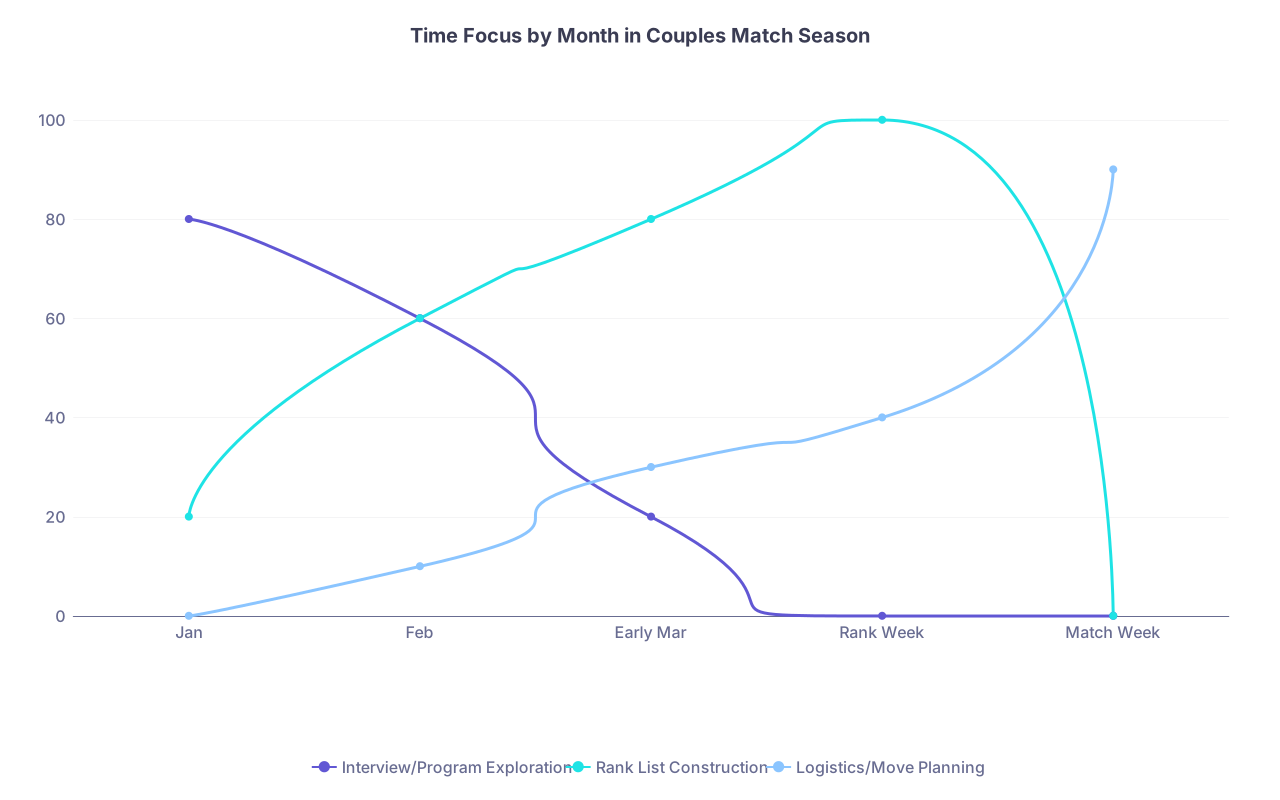
| Category | Interview/Program Exploration | Rank List Construction | Logistics/Move Planning |
|---|---|---|---|
| Jan | 80 | 20 | 0 |
| Feb | 60 | 60 | 10 |
| Early Mar | 20 | 80 | 30 |
| Rank Week | 0 | 100 | 40 |
| Match Week | 0 | 0 | 90 |

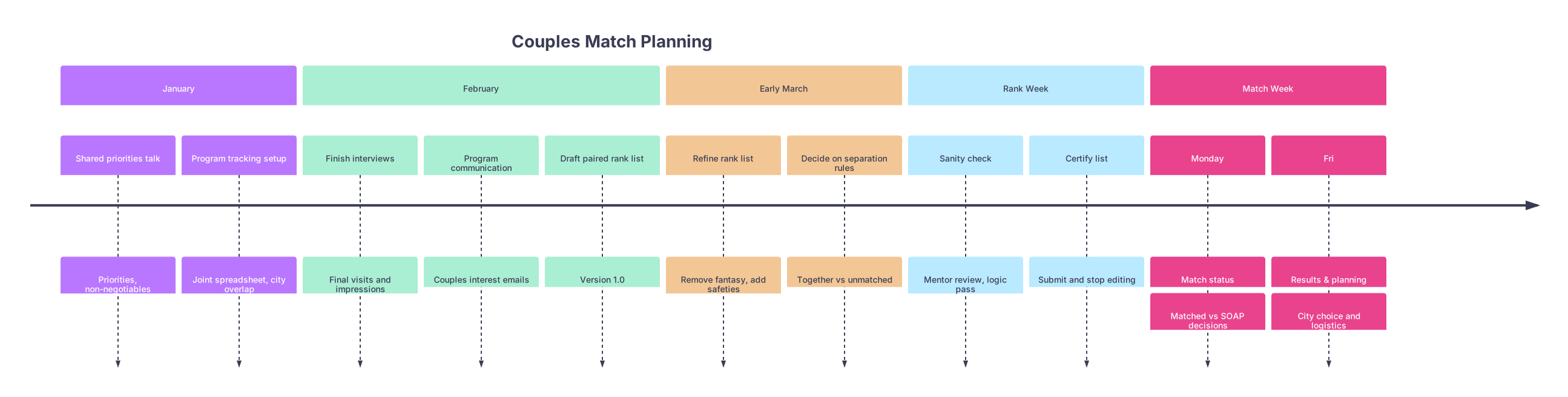
| Period | Event |
|---|---|
| January - Shared priorities talk | Priorities, non-negotiables |
| January - Program tracking setup | Joint spreadsheet, city overlap |
| February - Finish interviews | Final visits and impressions |
| February - Program communication | Couples interest emails |
| February - Draft paired rank list | Version 1.0 |
| Early March - Refine rank list | Remove fantasy, add safeties |
| Early March - Decide on separation rules | Together vs unmatched |
| Rank Week - Sanity check | Mentor review, logic pass |
| Rank Week - Certify list | Submit and stop editing |
| Match Week - Monday | Match status |
| Match Week - Fri | Results & planning |


Boiled Down: 3 Things to Actually Remember
- Decide your rules early. January is for brutal honesty about distance, prestige, and togetherness. Your March list should reflect those rules, not panic.
- Treat it as one shared project. One spreadsheet, one joint strategy, one consistent message to programs. Two solo strategies = chaos.
- Accept the tradeoffs on purpose. More togetherness means more risk of not matching. More prestige means more risk of separation. You don’t avoid that tradeoff; you choose where you stand on it.


