

It’s Match Week Friday afternoon. You just found out: you and your partner both matched. Not only that—you matched in the same city, but not the same hospital. You’ve texted the family, you’ve cried a bit, maybe opened a bottle. And now the high is fading and the oh right hits you:
Where are we going to live? When do we move? Who’s on call July 1?
This is the part nobody preps you for. Everyone obsesses about rank lists and interviews, and then after Match Day you’re suddenly dealing with:
- Two residency schedules
- Two HR departments
- One bank account (or close to it)
- A rental market that does not care you’ll be working 80 hours a week
So here’s the timeline. Week by week, month by month. At each point: what you should be doing, what can wait, and what will bite you later if you ignore it now.
Match Week to Match +7 Days: Get Oriented, Not Panicked
At this point you should not sign anything. You are collecting information only.
Confirm your basics (together). Sit down with both NRMP result emails open and:
- Write down:
- Each program name + hospital system
- City + neighborhood
- Start date (usually July 1)
- Program coordinator contacts
- Take a screenshot of each result and save to a shared folder.
- Write down:
Make a reality map. Open Google Maps and:
- Pin:
- Hospital A (your program)
- Hospital B (partner’s program)
- Turn on transit and traffic layers.
- Roughly check commute times at:
- 6:30–7:30 am
- 9:00 pm
- Weekend mid-day
You’re not choosing housing yet. You’re just getting a sense of geography and traffic pain.
- Pin:
Decide your “home base” priorities. This is a 30-minute, honest conversation. Ask:
- Do we care more about:
- Short commute for the person with the worse schedule?
- Balance of commute time for both?
- Living near one hospital vs in-between?
- How much are we realistically willing to pay in rent? (Per month, not “we’ll figure it out.”)
Write this down. You’ll forget by Wednesday when a cute apartment listing appears.
- Do we care more about:
Match Week +2–7 Days:
Gather program-specific info. Each of you emails your program coordinator:
- Ask for:
- Orientation dates
- Expected first official working day
- Any “strongly recommended” neighborhoods (programs often have a list)
- Parking/transit details for residents
- Ask for:
Sketch a first-draft budget. Not a perfect spreadsheet. A quick outline:
- Combined take-home pay estimate (look up PGY-1 salary for both programs, subtract ~25–30% for taxes/insurance as a rough start)
- Monthly non-negotiables:
- Loan payments
- Car payments/insurance
- Phone/internet
- Minimum savings (even if small)
What’s left is your max housing + utilities number. Be conservative. I’ve seen couples match, over-rent, then moonlight every free hour just to stay afloat. Miserable.
Match +2 to +4 Weeks: Recon, Research, and Rough Decisions
At this point you should be researching options, not chasing apartments. The market moves fast, but most July 1 start leases don’t open until April–May in most cities.
Week 2: Learn the city like a local (fast).
Neighborhood triage. Use program rec lists, online forums, and Google Maps “Explore.” Make a 3-column list:
Couples Match Neighborhood Shortlist Category Examples Notes Top Choices Area A, Area B Good commute for both Backup Options Area C, Area D Longer commute but cheaper Hard No Area X, Area Y Safety/price/commute You want:
- 2–3 “ideal” neighborhoods
- 2 solid back-ups
Commute reality check. For each target neighborhood, plug in:
- Morning commute from neighborhood center → each hospital
- Worst-case time (public transit or car)
- Availability of parking or nearby metro stops
Decide now: are you a car couple, a transit couple, or a one of each situation? That choice shapes everything.
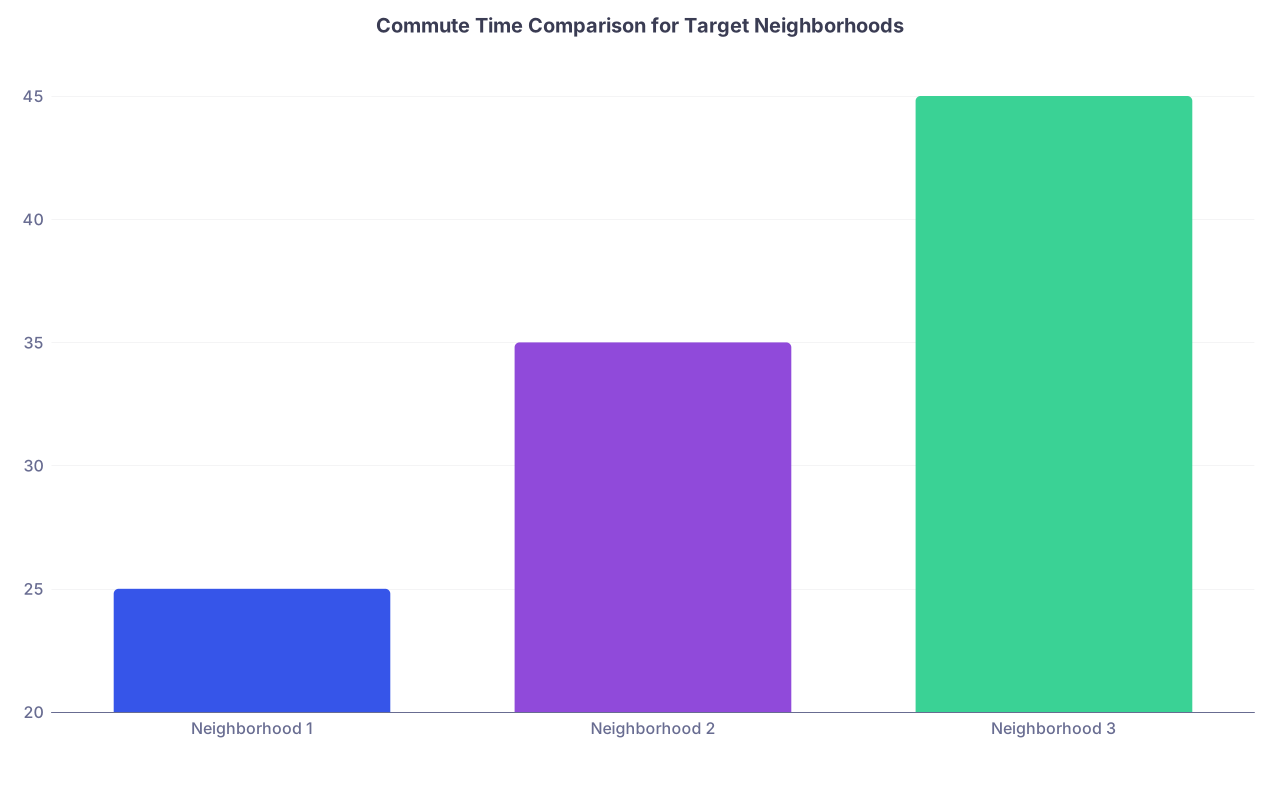
| Category | Value |
|---|---|
| Neighborhood 1 | 25 |
| Neighborhood 2 | 35 |
| Neighborhood 3 | 45 |
Week 3: Align schedules and constraints.
Request sample schedules. Each of you asks chief residents/program admins:
- “Could I see a sample PGY-1 schedule so we can plan logistics as a two-resident household?”
Look for:
- How often you’re on nights at the same time
- Early-pre-round-heavy months vs lighter rotations
- Whether one of you has significantly more in-house call
This affects:
- Who gets priority for shorter commute
- Whether 24/7 garage parking is essential
Transportation decision. Sit down and decide:
- Are you keeping 0, 1, or 2 cars?
- Is parking at each hospital free, subsidized, or viciously expensive?
- Do your target neighborhoods have safe street parking or require garage spots?
I’ve watched couples pay $400/month for an extra garage spot they never used because they were too tired to move the second car. Do not be that couple.
April–May: The Apartment Hunt Window
By early April, at this point you should be actively looking and prepared to apply quickly, but not desperate.
Early April (Match +3–4 weeks):
Lock your time window. Most residencies start July 1. Back up 2–3 weeks:
- Target move-in: June 10–20
- Lease start range: June 1–15
You want:
- At least one week fully moved-in before orientation
- Some buffer for delays (furniture, internet, ID badges)
Clarify non-negotiables (for real this time). Together, list the deal-breakers:
- Minimum:
- Safety level
- Square footage/number of bedrooms (studio vs 1BR vs 2BR if you need office space)
- Requirements:
- In-unit laundry vs building laundry
- Parking spot(s)
- Pet policy (if you have or plan to get one)
Everything else—gym, rooftop, granite counters—is negotiable. You will not care about the rooftop when you’re post-call and the elevator is broken.
- Minimum:
Mid-April: Start touring (virtually or in-person).
Plan one intensive “housing weekend.” If you’re moving to a new city, book:
- 1–2 days on the ground
- Back-to-back apartment tours in your 2–3 target areas
Can’t travel? Do:
- Video tours (ask the agent to walk you through closets, under sinks, the parking area, and the hallways; those get neglected but you’ll see them at 5 am a lot)
- Ask current residents on group chats/Facebook if they’ll show you their place quick.
Application packet ready to go. Before your first tour, have:
- Driver’s licenses scanned
- Match letters / offer letters from hospitals
- Last 2–3 pay stubs or financial aid documentation (if they want income history)
- Credit reports or willingness to pay larger deposit
When you see a good place that fits your criteria, you apply the same day. The market will not wait for you to “sleep on it” for a week.
Decision Time: Late April–May
At this point you should be signing a lease. Dragging this into June makes everything downstream harder.
- Choosing location: tie-breakers for two residents.
If you’re stuck between:
- Place A: 10 min from your hospital, 35 from partner
- Place B: 20 min / 25 min split
Use these tie-breakers:
- Who has more night float/24-hr call? → Shorter commute priority
- Who’s driving vs on transit? → Driving in traffic is more draining
- Is one hospital notorious for unsafe late-night surroundings? → Closer to that hospital
For most couples, a balanced commute in a safer, quieter area wins long-term.
Lease negotiation checklist. When you’re about to sign, confirm:
- Exact move-in date and proration
- Parking included or extra fee (per car)
- Subletting policy (for away rotations/fellowship year)
- Option to renew with capped increase (if possible)
And: read pet policies very literally. I’ve seen people forced to rehome a dog mid-intern year after a policy change.
Parallel Track: HR, Licensure, and Money Logistics
These run in parallel with housing. Don’t ignore them.
April–June: Onboarding and documentation.
Track deadlines on one shared calendar. Create a shared Google calendar just for:
- Hospital onboarding deadlines
- Employee health visits
- Drug tests
- Licensing/permit deadlines
- BLS/ACLS renewal
Color-code:
- Blue = Partner A
- Red = Partner B
- Purple = Both
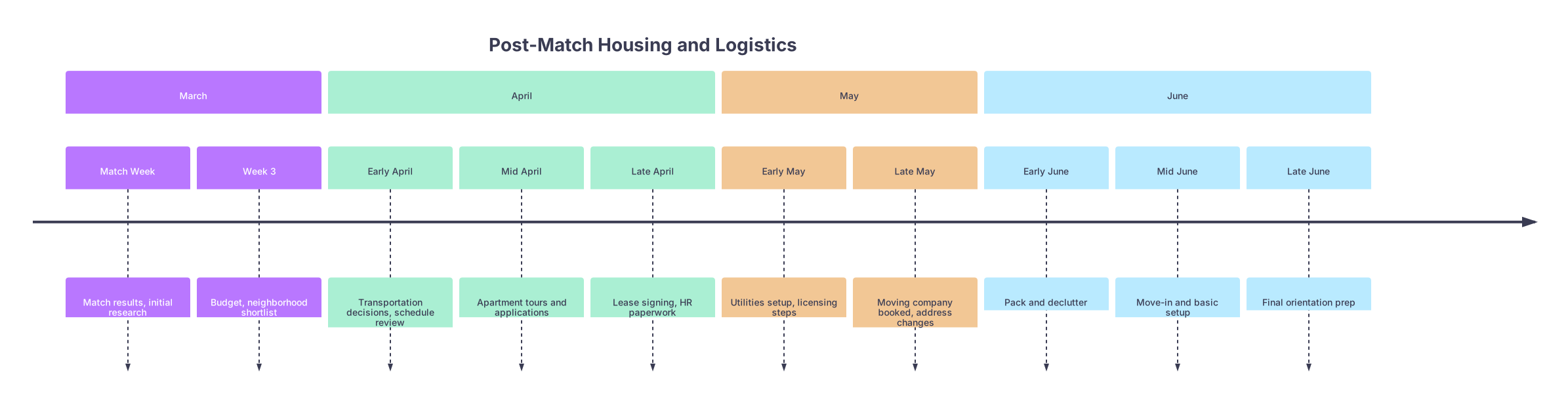
| Period | Event |
|---|---|
| March - Match Week | Match results, initial research |
| March - Week 3 | Budget, neighborhood shortlist |
| April - Early April | Transportation decisions, schedule review |
| April - Mid April | Apartment tours and applications |
| April - Late April | Lease signing, HR paperwork |
| May - Early May | Utilities setup, licensing steps |
| May - Late May | Moving company booked, address changes |
| June - Early June | Pack and declutter |
| June - Mid June | Move-in and basic setup |
| June - Late June | Final orientation prep |
Licensing and IDs. Each of you needs to:
- Complete state training licenses (or full license if required for PGY-1 in that state)
- Know:
- How long background checks take
- Whether your license number is needed before payroll starts
Some states drag. If you wait, you will be doing fingerprinting between night shifts. Awful.
Bank accounts and autopay. Decide:
- Joint account for rent and shared bills?
- Separate, with monthly transfers to a shared “house” account?
Set up autopay for:
- Rent
- Utilities
- Minimum loan payments
Autopay is not about convenience. It’s about “I forgot, I was post-call” protection.
May: Utilities, Moving, and Backup Plans
By early May, at this point you should have a lease signed and be moving into details.
Early May: Set up the invisible stuff.
Utilities + internet. As soon as you have a move-in date:
- Power/gas start date = day before you move in
- Internet install = ideally same or next day
- Water/trash = depends on your city and building
Put the 2–3 hour internet service window on your calendar now. One of you will need to be there. Do not schedule it for a day you’re flying in or driving for 10 hours.
Insurance.
Renters insurance:
- Start date = lease start
- Insure both names and major valuables (laptops, bikes, instruments)
Car insurance:
- Update address, mileage, and parking situation
- New city = different risk class and premiums
Mid–Late May: Moving logistics.
Choose your move type. Be honest about your time and energy:
If you’re:
- Moving cross-country
- Both graduating in May/June
- Low on family/friend help
→ Pay for full-service movers if you possibly can.
If you’re:
- Regional move
- Minimal furniture
→ Rental truck + friends might be fine—but budget your own time like it costs money, because it does.
Book dates strategically. Ideal move:
- Move-out from old place: ~1 week before new job paperwork/orientation
- Move-in: 10–20 days before July 1
- If one of you has an earlier start date (prelim, orientation, etc.), move at least 5–7 days before that person starts.
June: Packing, Moving, and First-Week Setup
At this point you should be transitioning from planning to execution.
Early June: Ruthless downsizing.
Packing priorities for two residents. For each of you, label boxes:
- “First week critical” (scrubs, white coats, shoes, toiletries, minimal kitchen)
- “First month helpful” (extra clothes, basic decor, extra kitchen tools)
- “Can wait” (books, sentimental stuff, non-daily hobbies)
You want to be able to function for a week even if half your boxes are still sealed.
Essentials box (shared). One clearly labeled bin you keep with you, not in the moving truck:
- 3–5 days of work clothes each
- Scrubs, white coats, hospital badges (if you already have them)
- Copies of license, Match letter, HR documents
- Basic tools (screwdriver, tape, box cutter)
- Extension cord, power strip, chargers
- Basic meds and a small first-aid kit
That bin saves you when your first day of orientation is tomorrow and you can’t find pants.
Mid June: Move-in week.
Day 1 in the new place. Your checklist:
Check:
- All keys work
- Hot water and basic appliances work
- Parking situation is what you were promised
Set up:
- Bed(s) first
- Shower curtain and towels
- Simple food plan (you’ll burn out on takeout quickly)
First 72 hours: stabilization tasks. Together, in that first week:
Walk/drive both commutes at typical times
Identify:
- 24-hour pharmacy
- Closest grocery store
- One late-night food option near each hospital
Place:
- Spare badge holder and pens in one central spot by the door
- A shared whiteboard or note pad to track:
- On-call nights
- Trash day
- Packages
Late June: Final Orientation Prep as a Couple
You’re almost there. At this point you should be tweaking, not making huge decisions.
Sync your call schedules. Once you both have final schedules:
- Sit down together and go month by month
- Mark:
- Double-call nights (both of you on call)
- Single-call nights (one at home, one working)
- Any stretches where you both have heavy rotations
Make a list of:
- Nights when you’ll absolutely need:
- Easy pre-made meals
- Someone to handle trash/cleaning (you or a service)
Household division of labor—resident edition. You’re both residents. Neither of you has “normal” free time.
Keep it simple:
- Each of you picks:
- 1–2 “always” tasks (e.g., trash + dishes vs. laundry + bills)
- Everything else:
- Batch it (cleaning every 2 weeks)
- Outsource if you can (cleaning service, grocery delivery)
The enemy here is resentment. If one of you feels like the default housekeeper and a full-time intern, disaster.
- Each of you picks:
Emergency plan. Have these written somewhere both can access:
- Who to call if:
- Both cars are stuck / dead
- One of you gets sick and can’t drive home
- Which friend/co-intern lives nearby and can:
- Let out your dog
- Check your place during a long ICU stretch
Simple, but it’s the difference between minor crisis and total meltdown at 3 am.
- Who to call if:
Quick Day-By-Day Snapshot: The Last Week Before You Start
Here’s how your final pre-residency week should roughly look if you’ve followed the timeline:
| Day | Focus |
|---|---|
| -7 | Final unpacking of essentials |
| -6 | Test commutes (both hospitals) |
| -5 | Set up autopay, confirm utilities |
| -4 | Grocery run, prep easy meals |
| -3 | Review HR/benefits emails |
| -2 | Light clean, set up work bag |
| -1 | Rest, early bedtime |

If You’re Already Behind
If you’re reading this in late May and you haven’t signed a lease yet, skip the perfect planning.
- Pick 2 neighborhoods
- Tour 5–7 places (virtually or in person) within 3 days
- Apply to the first one that:
- Is safe
- Fits your budget
- Gives each of you a commute under ~45 minutes
You can always move again PGY-2 once you know the city. I’ve seen that go much better than trying to find the “forever residency home” under time pressure.
Your Next Step Today
Right now, before you do anything else:
Open a map. Drop pins for both hospitals. Draw a rough triangle around the overlap of commutes you’d tolerate. Then list 3 neighborhoods inside that triangle on a note in your phone.
That triangle is your hunting ground. Everything else is a distraction.


