

The biggest mistake couples make with the Couples Match is not ranking too few programs. It is starting the conversation 12–18 months too late.
Here is how to fix that, step by step, from M1 through M4.
Big-Picture Timeline: Who You Talk To, and When
Before we drill down month by month, you need the skeleton. By year, this is what your conversations should look like:
| Year | Main Goal | Who You Talk To Most |
|---|---|---|
| M1 | Clarify seriousness & values | Each other only |
| M2 | Reality-check specialties & location | Each other + mentors quietly |
| M3 | Lock plan and tell key faculty | Each other + advisors + letter writers |
| M4 | Execute and coordinate | Each other + programs (indirectly) |
If you are having your first real couples match talk during ERAS season of M4, you are behind. Not doomed. But behind.
M1: Foundations, Not Logistics
Fall M1 (Aug–Dec): “Are we actually long-term?”
At this point you should not be mapping out joint rank lists. You should be asking: “Are we realistically planning to be together after graduation?”
Conversations to have with each other:
- How serious is this?
- Do we both see this as long-term (5–10+ years)?
- How do we each feel about:
- Distance
- Career vs relationship trade-offs
- Living near / far from family
Concrete steps in Fall M1:
Have one explicit conversation
- Not a vague “haha maybe we’ll couples match someday.”
- A real talk: “If we are still together by end of M2, should we plan around the Couples Match?”
Set a checkpoint
- Agree: “We will revisit this seriously in late M2.”
- That date matters. It keeps you from winging it in M4.
Who you talk to:
- Each other: Yes.
- Friends / classmates: Lightly. No details.
- Faculty / advisors: No. Too early and too unstable.
At this point you should be building relationship stability, not broadcasting a long-term plan.
Spring M1 (Jan–May): Values and Dealbreakers
You are still early. But by spring, you should be less vague.
Key topics with each other:
- Geography:
- Absolute no-go regions (e.g., “I will not live in the Deep South / Northeast / rural Midwest”)
- Ideal regions (e.g., “West Coast or big city in the Midwest”)
- Lifestyle expectations:
- “I want a city with public transit.”
- “I am okay with smaller cities if the program is strong.”
- Career ambition level:
- Academic vs community
- Prestige vs location priority
At this point you should:
Make a rough “map” together:
On a blank US map, circle “green zones,” cross out “red zones.” Primitive, yes. Useful, also yes.Talk about specialty flexibility very loosely:
- One of you is already saying “I am 95% sure I want neurosurgery”?
Flag that now. That is a high-risk, high-constraint specialty. - Both of you saying “Probably IM / peds / FM”?
Very different planning problem. Much easier.
- One of you is already saying “I am 95% sure I want neurosurgery”?
Who you talk to:
- Still mostly each other.
- Maybe one trusted senior student if you have one who couples matched. Quietly. Off the record.
Do not walk into the dean’s office in M1 saying, “We’re doing the Couples Match in 3 years.” You will look naive. Because you are.
M2: From Hypothetical to Provisional Plan
Here is where real planning starts. Quietly.
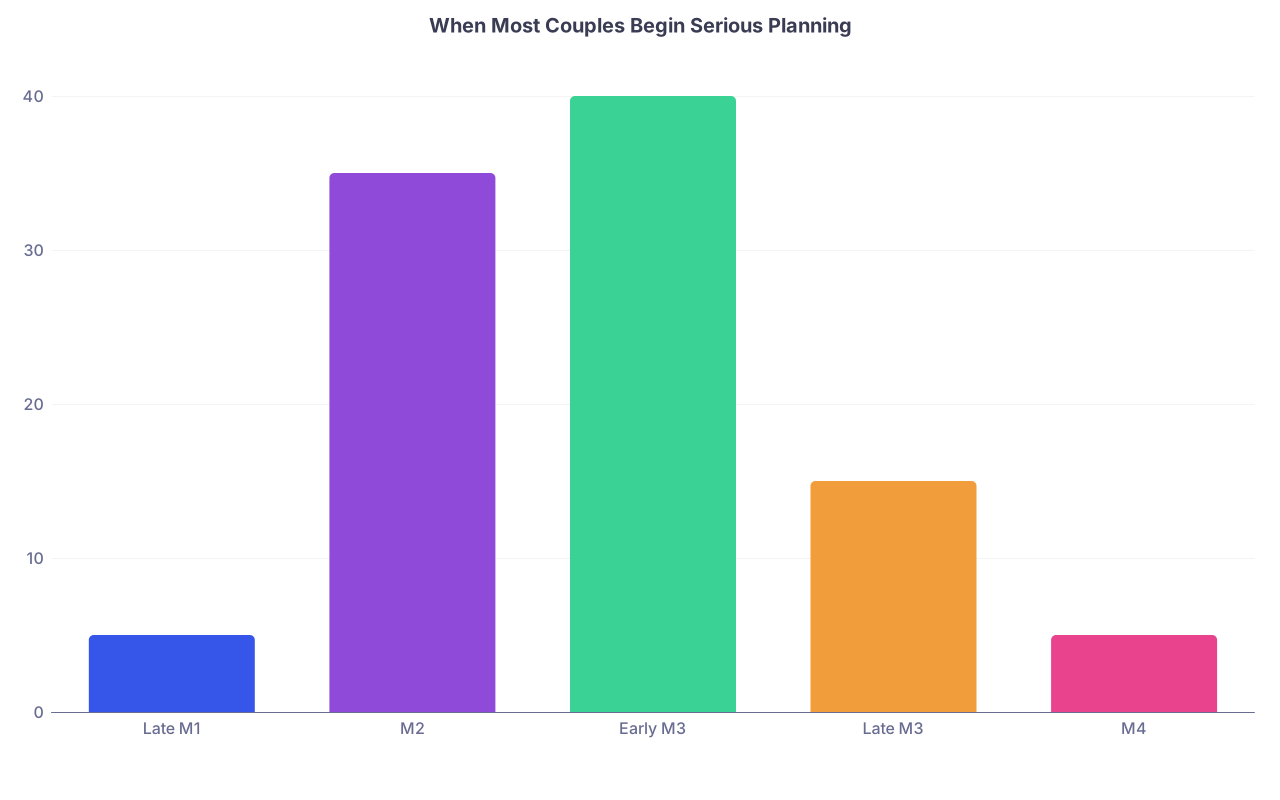
| Category | Value |
|---|---|
| Late M1 | 5 |
| M2 | 35 |
| Early M3 | 40 |
| Late M3 | 15 |
| M4 | 5 |
Summer Before M2 (Jun–Aug): Specialty Reality Check
At this point you should:
Individually sanity-check your likely specialties
- Talk to:
- A resident or senior for each specialty you are considering.
- Your school’s career advisor if available.
- Ask blunt questions:
- “How Couples Match–friendly is your specialty?”
- “How many couples do you see actually both getting what they want?”
- Talk to:
Together, label specialties: easy / moderate / hard to couple Rough guide:
- “Easier” for couples: IM, peds, FM, psych, anesthesia, prelim/TY
- “Moderate”: EM, OB/GYN, general surgery, neurology
- “Harder”: derm, ophtho, ortho, ENT, neurosurgery, plastics, rad onc
This is not to scare you out of competitive fields. It is to make you honest about difficulty.
Who you talk to:
- Each other: Frequently.
- Residents / senior students: For specialty insight, not for your relationship details.
- Career advisor (individually): Yes, but you can mention “I may couples match” as a light flag, not a demand.
Fall M2 (Sep–Dec): The “Are We Really Doing This?” Talk
By mid-fall M2, you should have a serious, explicit decision conversation.
At this point you should sit down, no phones, 60–90 minutes, and answer:
Are we committed enough to assume we will still be together for residency?
- If yes → Proceed with couples match planning.
- If not sure → The default should be to plan individual matches, with a contingency discussion later.
What is each person’s non‑negotiable? Examples I have heard that actually matter:
- “I will not do long-distance for residency, period.”
- “I will go to almost any city, but I will not give up this specialty.”
- “I can flex between IM and FM to stay together.”
How much are you each willing to bend on specialty vs location vs program reputation? You cannot maximize all three for both people. That fantasy dies here.
Who you talk to now:
- Each other: Deeply.
- One trusted mentor each (attending or senior resident):
- You can say: “I am likely going to enter the Couples Match with my partner. I am leaning toward X specialty. Does that change how I should plan M3?”
- That is mature, not premature.
Still do not email program directors. You are two years out.
Spring M2 (Jan–May): Quiet Alignment With Advisors
At this point you should:
Meet with your school’s career advisor / dean for the first clear signal
- Individually, say:
- “I am seriously planning to Couples Match with a classmate in [year]. I am currently leaning to [specialty or two]. I want to make sure my schedule and prep do not sabotage that.”
- Ask:
- “Any pitfalls you have watched couples fall into from this school?”
- “Any rotations / letters I should prioritize to keep options broad?”
- Individually, say:
Start thinking about M3 schedules in a coordinated way
- Not identical, but not chaotic.
- Example:
- Both of you do core rotations on a similar timeline so you are not deciding on specialties a year apart.
Who you talk to:
- Career advisors / deans: Yes, this is the right time.
- A small number of trusted faculty if you already have a mentor relationship.
- Still not broadcasting it to half your class.
M3: The Year That Makes or Breaks Your Couples Match
This is where couples either get disciplined or drift into chaos.

Summer M3 (Jun–Aug): Specialty Lock-In Window
By end of summer M3, here is what should be true:
- Each of you has:
- A primary specialty choice.
- A backup plan discussed (even if you hope not to use it).
- You both understand:
- Relative competitiveness of your pair:
- Example: IM + peds vs derm + ortho.
- Relative competitiveness of your pair:
At this point you should:
Have the “real options” talk Sit down and ask, out loud:
- “What happens if one of us does not get interviews in our dream field?”
- “Would you consider a prelim year? A research year? A less competitive specialty?”
Tell your main clinical mentors
- On your medicine, surgery, or specialty rotation, if you have a faculty mentor you trust, you can say:
- “I plan to Couples Match with my partner, who is likely going into [X]. Does that change how you would advise my specialty choice or backup plan?”
- This is when they can still shape your trajectory.
- On your medicine, surgery, or specialty rotation, if you have a faculty mentor you trust, you can say:
Who you talk to:
- Each other: Weekly check-ins on how your specialty thinking is evolving.
- Clerkship directors / trusted attendings: When asking for advice or letters.
- Dean / career office: At least once mid–M3, explicitly about the Couples Match.
Fall M3 (Sep–Dec): Auditions and Away Rotation Strategy
If you are in a competitive specialty or a tight geographic target, M3 fall is not casual.
At this point you should:
Coordinate away rotations, if you are doing them:
- Not always at the same place, but:
- Same region.
- Same tier of programs.
- Example:
- One of you does an IM away at University A.
- The other does neurology or EM at University B in the same city or nearby region.
- The goal: Expand joint geography possibilities.
- Not always at the same place, but:
Have a formal meeting with your dean as a couple (if your school allows)
- Many schools have a specialty / match advisor.
- You should both be in the room:
- “We are planning a Couples Match. She is going into OB/GYN. I am going into IM. We are targeting [regions]. We want to sanity-check that our plan and application strategy are realistic.”
- Ask very specific:
- “Based on prior classes, do couples like us tend to over‑ or under‑apply?”
Who you talk to:
- Dean / advising office: Together, on the record.
- Program directors? Not yet. You are not applying this year.
Spring M3 (Jan–May): Lock the Plan
By the end of M3, the following must be true if you are couples matching:
Both of you:
- Have declared a specialty.
- Have at least one clear backup option (which can be:
- A different specialty.
- A prelim year + reapply strategy).
You have told:
- Your primary letter writers that you are Couples Matching.
- Your career dean your specialties and likely geographic targets.
At this point you should:
- Tell your letter writers explicitly
Example script:
- “I am applying in internal medicine and will be participating in the Couples Match with my partner, who is applying in pediatrics. We are open to multiple regions but hoping for [X/Y]. Any advice on how to position my application in light of that?”
They do not always adjust what they write. But the context helps.
- Start building your joint program tier list
- Not rank order yet.
- Just:
- “Dream programs”
- “Solid programs”
- “Safety programs”
- And flag where both specialties exist in the same hospital system or city.
M4: Execution Year – Who Needs To Know, and When
This is where timing and communication actually affect your outcome.
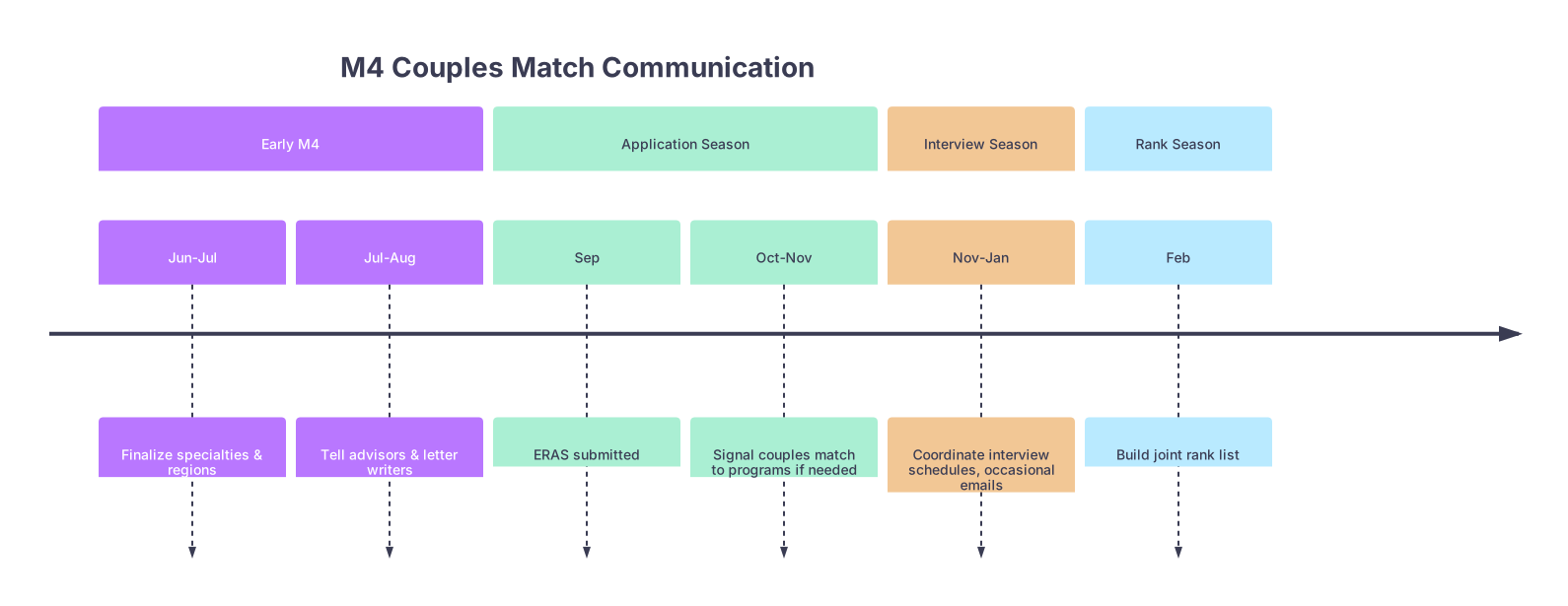
| Period | Event |
|---|---|
| Early M4 - Jun-Jul | Finalize specialties & regions |
| Early M4 - Jul-Aug | Tell advisors & letter writers |
| Application Season - Sep | ERAS submitted |
| Application Season - Oct-Nov | Signal couples match to programs if needed |
| Interview Season - Nov-Jan | Coordinate interview schedules, occasional emails |
| Rank Season - Feb | Build joint rank list |
Early M4 (Jun–Aug): Public Commitment
At this point you should:
Explicitly register and plan as a couple with your school
- Let your dean’s office know:
- “We are definitely Couples Matching: [Name 1, specialty]; [Name 2, specialty]. Match year [year].”
- Many schools have internal tracking. Use it.
- Let your dean’s office know:
Confirm all letter writers understand this
- Gentle reminder email:
- “Just a reminder that I will be in the Couples Match this cycle with my partner in [specialty]. Thanks again for your support.”
- Gentle reminder email:
With each other, define your sacrifice boundaries Extremely concrete:
- “I am willing to drop from ‘top 10 IM program’ to ‘mid-tier but good training’ to stay together.”
- “I am not willing to go to a program where current residents are openly miserable, just because it is close.”
Write these down. Because in January, fatigue will tempt you to panic-edit the list.
Who you talk to:
- Dean / advisors: Yes, this is now fully “on the record.”
- Letters writers / mentors: Yes.
- Other students: Optional. But avoid committee‑forming via group chats; too many opinions.
ERAS Season (Sep): What To Tell Programs, and How
The ERAS application itself has a place to indicate that you are Couples Matching. Use it. But that is not the only signal.
At this point you should:
Use the ERAS Couples Match checkbox
- Both of you must:
- Select the Couples Match option.
- Enter each other’s AAMC IDs correctly. Triple check.
- Both of you must:
Decide if you will mention it in your personal statements
- Mild mention is fine:
- One sentence in the last paragraph:
“My partner and I will be participating in the Couples Match, and we are both excited to train in a setting that supports dual-career physician families.”
- One sentence in the last paragraph:
- Do not turn your entire essay into a relationship story. Programs care about your training, not your romance arc.
- Mild mention is fine:
Decide which programs merit direct communication You do not need to email every program about the Couples Match. That is overkill.
Reasonable to email:
- Home institution if both are applying there.
- A few key “joint” target programs where both departments have interviewed or are likely to interview you.
Who you talk to:
- Programs? Only sparingly, and professionally.
- Everyone else at the school: Your status is now common knowledge. That is fine. You are in it.
Interview Season (Nov–Jan): Coordinated, Not Clingy
This is where couples can either help themselves or anxiously spam PDs and look unprofessional.

At this point you should:
Coordinate your interview schedules weekly
- Keep a shared spreadsheet with:
- Program
- City
- Specialty
- Interview date
- “Has partner applied?” Y/N
- “Has partner interviewed / invited?” Status
- Keep a shared spreadsheet with:
When to talk to programs Good times to explicitly mention the Couples Match:
- At the end of an interview, when they ask, “Do you have any questions for us?”
- “I have one logistical question. I am participating in the Couples Match with my partner, who is applying in [specialty]. Does your program or institution have prior experience supporting couples, and is there any coordination with [other department]?”
Short follow-up emails are acceptable when:
- One of you has an interview at an institution and the other does not, but both of you have applied.
Example email (to the PD or program coordinator, not every faculty you met):
“Dear Dr. X,
I enjoyed interviewing with [Program] on [date]. I wanted to mention that I am participating in the Couples Match with my partner, [Name], who has applied to [Other Specialty] at your institution. We are both very interested in training at [Hospital]. I understand interview offers are highly competitive, but I wanted to make you aware of our Couples Match status for your consideration.
Sincerely,
[Name]”Do not send this to 40 programs. Use it judiciously at places you truly prioritize.
- At the end of an interview, when they ask, “Do you have any questions for us?”
Who you talk to:
- Programs: Selectively, politely, not weekly.
- Dean’s office: If one of you is getting badly skewed interviews (e.g., 18 vs 4), loop them in early. They sometimes have quiet back channels.
Rank List Season (Feb): The Only Opinions That Matter
Here is where too many voices kill clarity.
At this point you should:
Limit your circle
- People who get a vote:
- You.
- Your partner.
- People who get input only if you ask:
- A single trusted mentor.
- Maybe your dean.
- Everyone else? No.
- People who get a vote:
Build the joint rank list systematically
- Start with a grid:
- Rows: Your programs.
- Columns: Partner’s programs.
- Mark:
- Same institution pairings.
- Same city / nearby pairing.
- “Commutable but not ideal” pairing.
- Color-code:
- Green = acceptable for both.
- Yellow = one person sacrifices.
- Red = unacceptable.
- Start with a grid:
Have two separate meetings just for ranking
- Meeting 1:
- Generate the preliminary grid and rules (what is off-limits, what is high priority).
- Meeting 2 (a few days later):
- Confirm final joint list.
- Then enter it separately but match the sequence exactly.
- Meeting 1:
Who you talk to:
- Primarily each other.
- One mentor at most after you have your draft list, if you want a sanity check.
Do not crowdsource your rank list in group chats. That is how you end up chasing someone else’s dream program instead of your own shared reality.
Who To Talk To, By Role
| Person / Group | When | Why |
|---|---|---|
| Partner | M1–M4, early and often | Central decision-maker |
| Senior students | Late M1–M2 | Reality check, stories |
| Career advisor / dean | M2–M4 | Strategy, schedule, realism |
| Clinical mentors | M3–M4 | Letters, specialty advice |
| Letter writers | Late M3–early M4 | Context for recommendations |
| Programs | ERAS + selectively during interviews | Logistics and signal of interest |
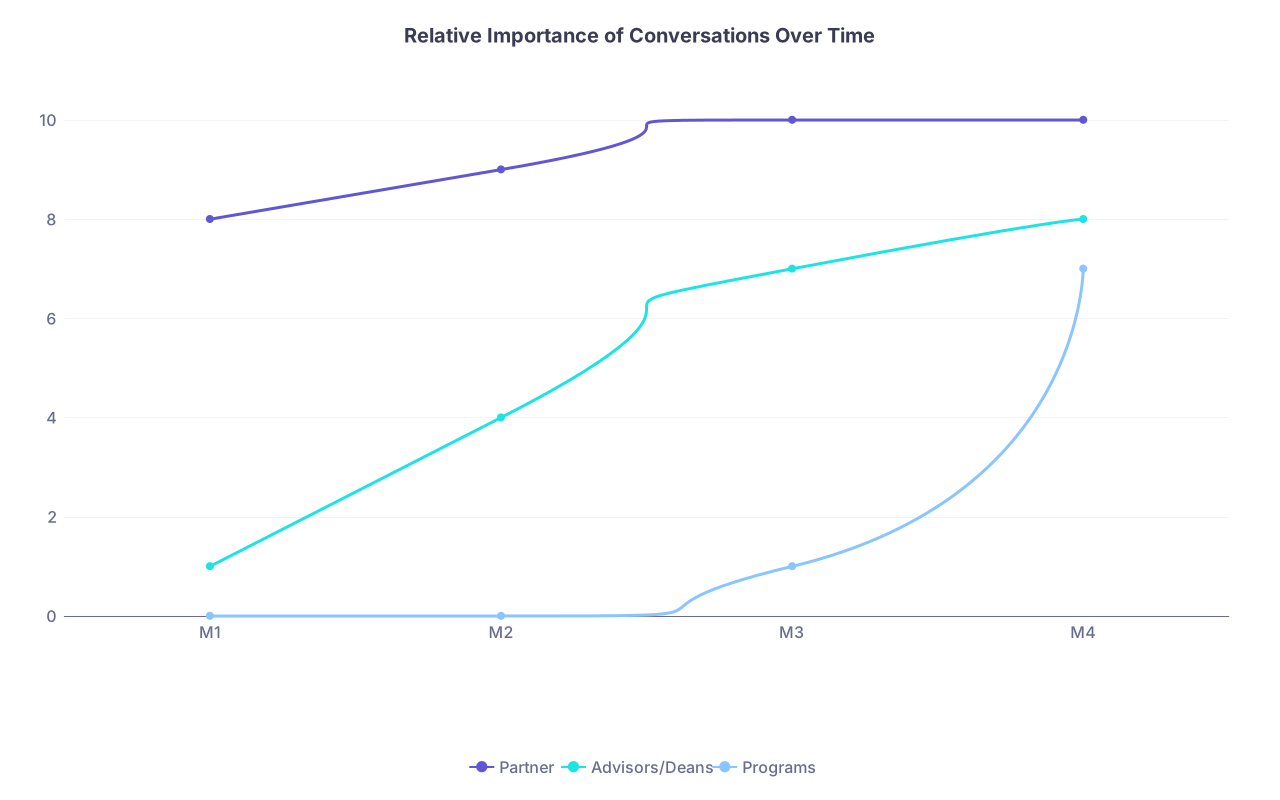
| Category | Partner | Advisors/Deans | Programs |
|---|---|---|---|
| M1 | 8 | 1 | 0 |
| M2 | 9 | 4 | 0 |
| M3 | 10 | 7 | 1 |
| M4 | 10 | 8 | 7 |
Final Takeaways
- Start the serious Couples Match conversations by late M2, not M4.
- Talk deeply and repeatedly with each other, then selectively with advisors, mentors, and only finally with programs.
- Use M3 and early M4 to align specialties, regions, and sacrifice boundaries so that when rank list season hits, you are executing a plan, not arguing one into existence.


