

The worst couples match mistakes are made six months before the rank list deadline—when most people still think they have “plenty of time.”
You do not.
At this point in the residency application cycle, the couples who do well are already having hard, structured conversations. The ones who avoid those talks? They drift. Then panic. Then compromise badly in January.
Here is the timeline and the exact conversations you and your partner need to have, starting six months before the rank list deadline and moving forward, step by step.
Month -6: Define the Non‑Negotiables (Big-Picture Alignment)
At six months before the NRMP rank list deadline (usually early March), you are around September / early interview season.
This is when you set the frame for everything that follows.
Conversation #1: “What are our non‑negotiables?”
By end of this month, you should each be able to clearly state:
Specialty commitment
- Are you 100% locked into your specialty (e.g., Derm, Ortho, ENT)?
- Is either of you willing to:
- Apply to a less competitive tier of the same specialty?
- Add a backup specialty?
- You cannot have a real couples strategy if one of you is pretending a backup is possible but secretly refuses it.
Geographic red lines Break geography into three buckets:
- “Absolutely yes”
- “Okay if needed”
- “No chance”
Do this individually first, then together.
Use a map and be brutally specific. “East Coast” is useless. “Boston/Providence or NYC/Philly corridor” is better.Living situation
- Is long‑distance an absolute no, or a temporary option (1 year, 2 years max)?
- Are you willing to:
- Live 1–2 hours apart if on similar schedules?
- Do true long-distance if one of you gets a dream program?
You should end Month -6 with a short written list. Not a vague idea. An actual document.
Example of what I want to see:
- Partner A:
- Specialty: Internal Medicine only, okay with community programs.
- Geography: Midwest strongly preferred, coasts okay, no Deep South.
- Partner B:
- Specialty: OB/GYN preferred, FM backup list ready.
- Geography: Open to anywhere, but family in Chicago is a big plus.
- Couple:
- Long-distance: Acceptable for max 1 year if it gets one partner a dream program.
- Non‑negotiable: Not both in super malignant, 80+ hr/week cultures if far from support.
If you cannot write this down, you are not ready to be in the couples match strategically.
Month -5: Build the Realistic Scenario Map
Five months before rank list deadline (roughly October), interviews are coming in, some rejections, some silence. This is where couples spiral if they do not talk early.
Conversation #2: “What outcomes are actually on the table for us?”
At this point, you should:
- Lay out the current interview landscape
- How many interview invites does each of you have?
- At what tier of programs? (Top academic vs mid-tier academic vs community)
- How many are in overlapping regions?
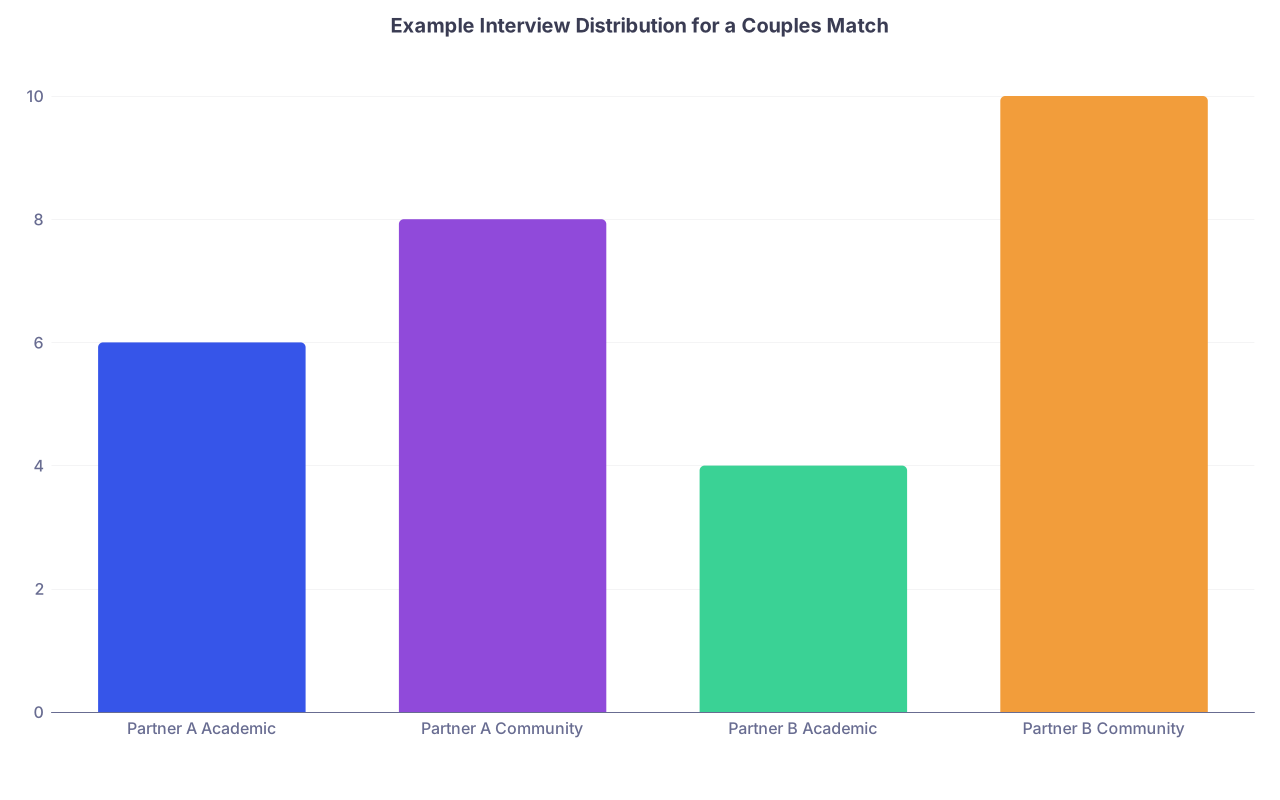
| Category | Value |
|---|---|
| Partner A Academic | 6 |
| Partner A Community | 8 |
| Partner B Academic | 4 |
| Partner B Community | 10 |
You are trying to see pattern, not perfection.
If one of you has 15 interviews in the Midwest and the other has 2 in the same area and 8 on the coasts, that matters. You need to talk about it now, not in January.
- Construct 3–4 realistic “scenarios”
Sit down and map scenarios like:
- Scenario 1: “Same city, both in mid‑tier academic programs”
- Scenario 2: “Same region, 60–90 minutes apart, one academic, one community”
- Scenario 3: “One of us at dream academic program, other at backup specialty/community program”
- Scenario 4: “One unmatched, one matched” (yes, talk about it)
For each scenario, answer:
- Is this acceptable, tolerable, or not acceptable?
- What would the plan be if this happened?
You do not need to like every scenario. You just need to face them.
- Decide where the “weight” lies
This is the part most couples fake their way through.
You need to answer honestly:
- Is one partner’s specialty or career path:
- Much more competitive?
- Much more time‑sensitive?
- Much more location‑locked?
For example:
- Dermatology vs Internal Medicine.
- Neurosurgery vs Family Medicine.
- Physician-scientist track vs standard clinical path.
If so, you must specify:
- Are we prioritizing:
- Getting the competitive partner into the best possible program and fitting the other around that?
- Or maximizing likelihood of same city, even if it means both going slightly “down tier”?
This decision drives all later ranking logic, so do not dodge it with “We’ll see how interviews go.”
Month -4: Money, Logistics, and Reality Checks
At four months before rank list deadline (usually November), interview travel (even if virtual) is running your lives. This is exactly when you will be tempted to avoid uncomfortable topics.
Do not.
Conversation #3: “What can we actually afford and sustain?”
- Financial reality You are about to rank programs that can lock you into very different cost-of-living and debt trajectories.
By the end of this month, sit down with:
- Your total loan balances (yes, both of you, actual numbers).
- Estimated PGY‑1 salaries in your likely locations.
- Realistic rent ranges in your top cities.
| City | Est. PGY-1 Salary | Typical 1BR Rent |
|---|---|---|
| New York | $75,000 | $2,800 |
| Chicago | $68,000 | $1,900 |
| Houston | $60,000 | $1,400 |
| Boston | $73,000 | $2,600 |
Then ask each other:
- Are we okay being geographically somewhere cheap but far from family?
- Or near family/support but in a higher-cost city, which will tighten budgets?
- If we go to a very high-cost city, are we both willing to:
- Live with roommates?
- Take on more debt?
- Delay buying a car?
Support systems
- Who do you actually have in each city? Not “a friend from undergrad.” Real support.
- If you end up both in brutal programs, with nights and 28‑hour calls:
- Is there any family nearby?
- Any chance of help (childcare, emergencies, emotional support)?
Daily life expectations At this point, you should be talking about lifestyle realities:
- Who is okay cooking / cleaning on 28‑hour call schedules?
- Are you expecting regular date nights, or will residency be mostly survival mode?
- Is either of you expecting to start a family during residency, and if so, when?
You are not solving everything in Month -4. You are stress‑testing your preferences against reality.
Month -3: Interview Season Deep-Dive and Red Flags
Three months before the deadline (December), you are in peak interview chaos. This is where couples either communicate extremely well—or end up resenting each other quietly.
Conversation #4: “How do our interviews actually feel from the inside?”
Every 1–2 weeks during heavy interview season, you should be doing a structured check‑in. Not just “How was it?”
Use a simple, repeatable format.
For each program, both of you should independently rate:
- Program quality / training
- Culture / resident happiness
- Fit with your career goals
- Couples-friendliness / flexibility
- City / lifestyle
Then compare.
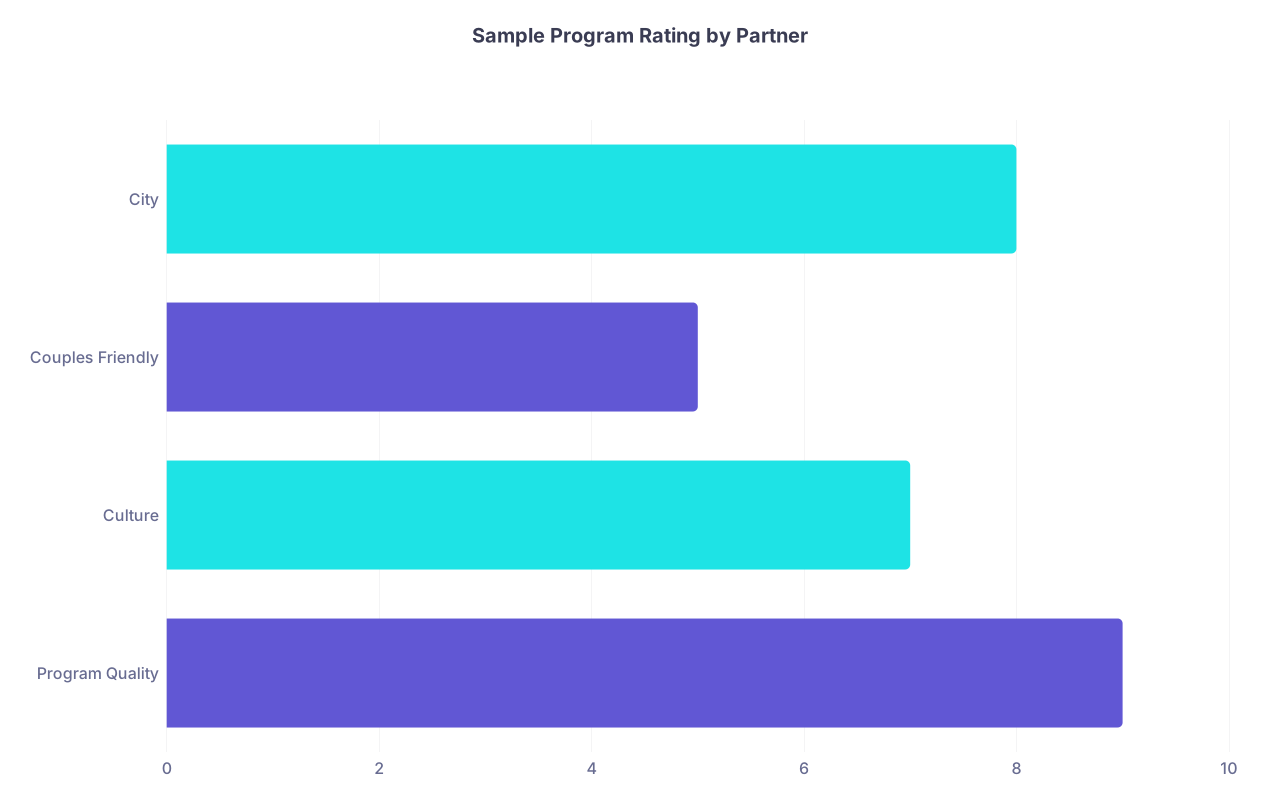
| Category | Value |
|---|---|
| Program Quality | 9 |
| Culture | 7 |
| Couples Friendly | 5 |
| City | 8 |
Ask explicitly:
“Did this program feel safe for us as a couple?”
- Did anyone mention couples match positively?
- Did they seem familiar with coordinating schedules for partners?
- Did faculty roll their eyes at work-life balance questions?
“Did they give off malignant vibes?” Look for:
- Residents who look tired and guarded when faculty are in the room, then open up later.
- Comments like, “You will work hard here, but we are a family” (classic flag).
- No one willing to talk honestly about how many residents leave or seek help.
“How does this place rank for you, if we forget the couples part for a minute?” Do this individually. Then compare your lists.
You should start building two parallel rank-preview lists:
- Your individual rank list (if you were not couples matching).
- Your “joint preference” score based on:
- Overlapping geography
- Program culture
- Relative competitiveness
The couples who do this systematically in December have a much easier January.
Month -2: The Hard Trade‑Offs and Backup Plans
Two months before the deadline (January), interview season is winding down. You likely know where you would each go alone. Now you must decide how far you are willing to bend to stay together.
Conversation #5: “What are we actually willing to trade?”
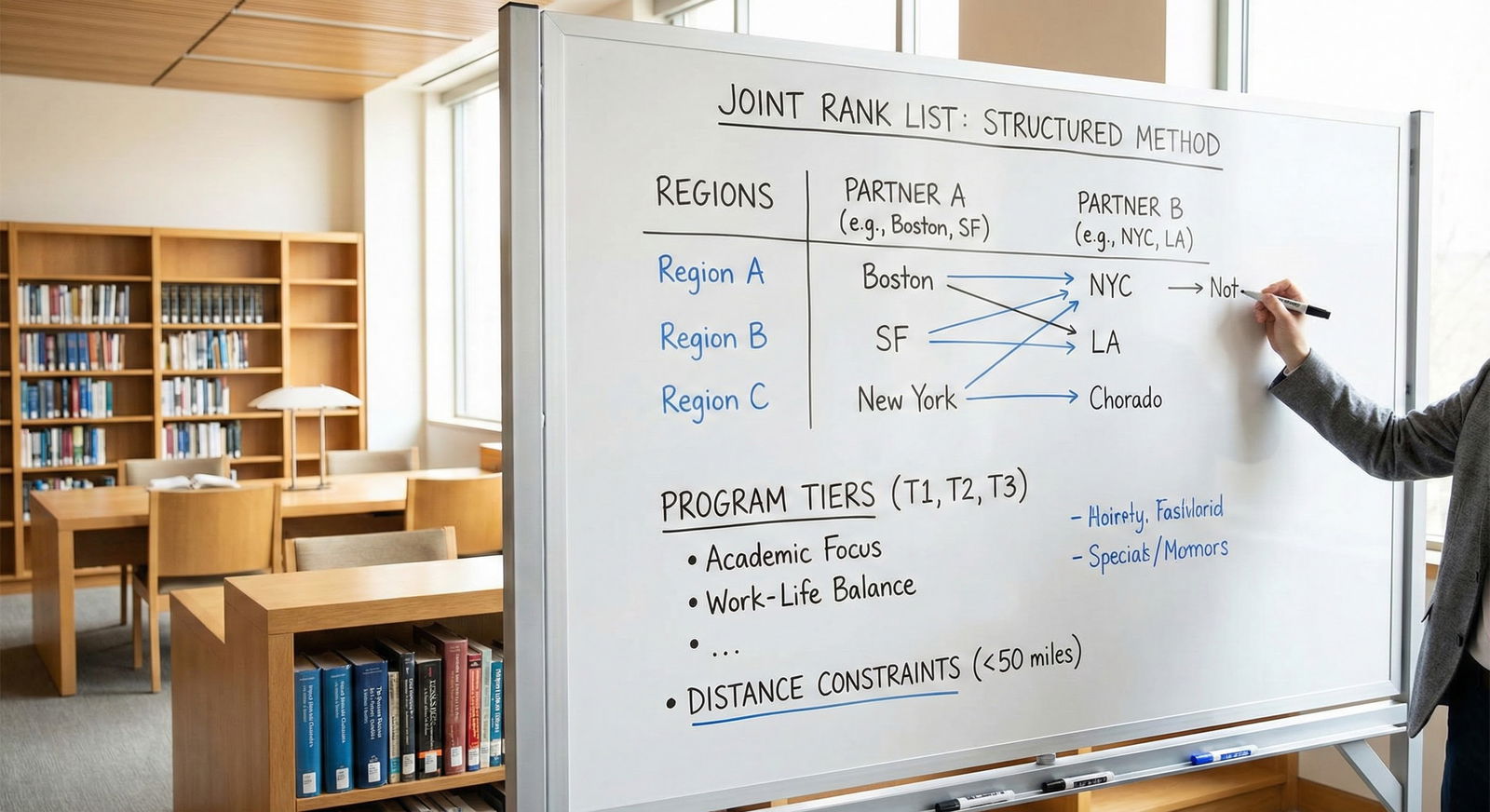
By now, you should have a spreadsheet (yes, seriously) of:
- All programs each of you interviewed at.
- Their locations.
- Which pairings are possible as couples match combinations.
At this point, you should:
- Identify the “anchor” partner (if any)
If one partner is in a high-competition specialty (Derm, Ortho, ENT, NSGY, Plastics) and the other is in something more flexible (IM, Peds, FM, Psych), then:
- Decide explicitly:
- Are we building the list around the competitive partner’s better programs?
- Or around maximizing geographic overlap, even if that means the competitive partner drops programs in bigger academic hubs for mid-tier places with more couples options?
- Define your “deal-breaker downgrade”
Ask each other:
- Would you:
- Take a clearly weaker program to be in the same city?
- Accept a backup specialty match instead of your main specialty to be together?
- Switch to a prelim/transitional year if it increased chances of being together next year?
You do not have to say yes to any of this. But you do have to talk about it.
- Plan for the worst-case match outcomes
This is uncomfortable. Do it anyway.

| Step | Description |
|---|---|
| Step 1 | Couples Match Result |
| Step 2 | One or Both Unmatched |
| Step 3 | Proceed with Plan A |
| Step 4 | Plan B: Long Distance |
| Step 5 | SOAP or Reapply Strategy |
| Step 6 | SOAP, Research, or Reapply |
| Step 7 | Both Matched? |
| Step 8 | Same City/Region? |
| Step 9 | Long Distance Acceptable? |
Talk through:
If one of us does not match:
- Are we both staying in that city?
- Does the unmatched person SOAP aggressively anywhere, or only near the matched partner?
- Are we open to research years, prelim years, or reapplication?
If we match in different cities:
- How far apart is “still doable” (drive vs flight)?
- Are either of us willing to try to transfer after PGY‑1?
You are not deciding all contingencies now. You are deciding your philosophy: relationship-first or career-first, and how far that goes.
Month -1: Build the Rank List Strategy Together
One month before the deadline (February) is where couples either pull ahead or crash. This is where you convert conversations into a precise rank list structure.
Conversation #6: “How exactly are we ordering our rank combinations?”
At this point, you should set aside a full evening together. No pagers, no family, no distractions.
- Start with independent lists
First, each of you builds your solo rank list, ignoring the couples match. Just: “If I were alone, this is the order.”
Then compare.
- Overlay the couples combinations
Now you map all viable combinations:
- (A Program 1, B Program 1)
- (A Program 1, B Program 2)
- (A Program 2, B Program 1)
- Etc.
Most pairs will never rank all combinations—it is too many. You will prioritize:
- Same program, same city > same city, different programs > same region > long distance > one unmatched.
- Agree on core ranking principles
You need to make rules now, not ad-hoc decisions rank by rank.
Examples:
- Rule 1: Any combination where we are in the same program ranks above all options where we are just same city.
- Rule 2: Any option where one of us matches our absolute top dream program ranks above mid-tier overlaps elsewhere, even if long-distance for 1–2 years.
- Rule 3: No combination where either of us is in a program we rated as “unsafe/toxic,” even if it wins us same city.
Once those are agreed upon, build the list accordingly.
- Calibrate risk
You need to be honest with yourselves about risk tolerance.
Ask:
- Are we comfortable with a slightly higher risk of one of us not matching in order to aim higher together?
- Or do we want maximal match probability, even if that means some lower-ranked combos early in the list?
This is where your earlier conversations about:
- Competitive vs flexible specialties,
- Financial constraints,
- Long-distance tolerance, start to matter concretely.
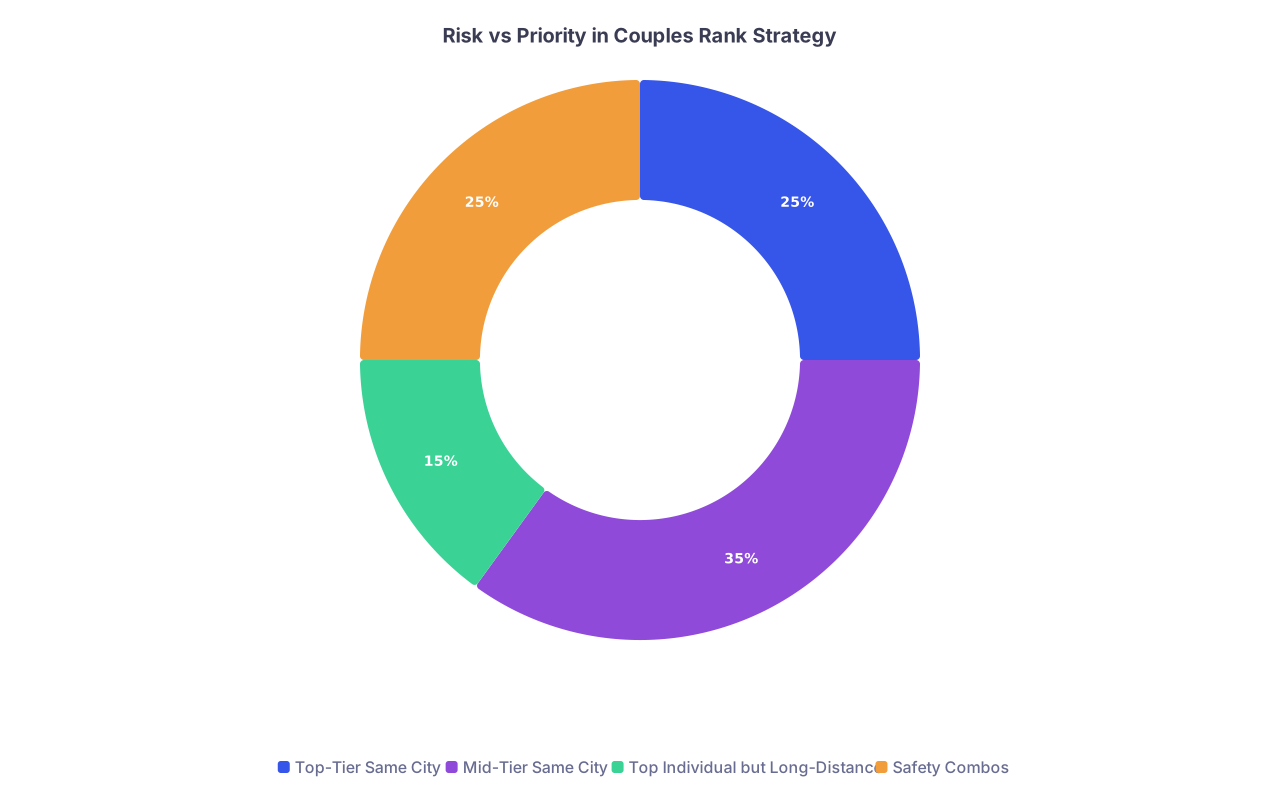
| Category | Value |
|---|---|
| Top-Tier Same City | 25 |
| Mid-Tier Same City | 35 |
| Top Individual but Long-Distance | 15 |
| Safety Combos | 25 |
If you skip this risk talk, you will end up second‑guessing every rank.
Final 2–3 Weeks: Stress Test, Lock, and Communicate
By the last few weeks before the rank list deadline, your goal is not to re-argue everything. Your goal is to test for hidden assumptions and make sure both of you truly understand what you are signing up for.
What you should be doing now
- Run the “If we match here…” drill
Pick the top 10–15 combinations on your list and say out loud:
- “If we match at Combo #3, our life looks like:
- City: X
- Commute: Y
- Cost of living: Z
- Support: [family/friends nearby?]
- Lifestyle: [hours, call, nights]
- Relationship impact: [same schedule vs opposite shifts, distance if any]”
Do this for each top combo.
You will quickly discover that some theoretically “good” combinations feel awful when you verbalize the daily reality.
- Check for resentment hiding under “I’m fine”
If you hear:
- “It’s fine, whatever you want,”
- “I don’t care, just pick,” you have a problem.
Push gently:
- “If you had to choose without worrying about me, what would your top 3 be?”
- “What are you most afraid of with our current list?”
The couples that implode later almost always had one partner silently swallowing a major preference.
- Confirm your worst‑case agreement
Revisit the hard parts:
- If one of us does not match, we will:
- Do SOAP vs reapply vs research?
- Stay in the same city or not?
- If we match long-distance:
- How often are we committing to see each other?
- What is our plan to try to end up together later (transfers, fellowship planning, etc.)?

- Lock the list—and stop tinkering
Once both of you say: “Yes, we understand and accept these trade‑offs,” submit the list.
Do not torture yourselves with daily rearranging afterward. You already did the work.
Quick Chronological Checklist
To keep this grounded, here is the stripped‑down timeline of what you should be doing at each point.
| Time Before Deadline | Primary Focus |
|---|---|
| Month -6 | Non-negotiables, geography, values |
| Month -5 | Scenario mapping, anchor partner |
| Month -4 | Finances, lifestyle, support |
| Month -3 | Program red flags, rating system |
| Month -2 | Trade-offs, backup plans |
| Month -1 | Rank strategy, risk calibration |
| Final Weeks | Stress-test, confirm, submit |

The Bottom Line
By six months before the rank list deadline, couples who match well are already:
- Facing reality together, early. You cannot fix couples match with last‑minute rank list magic if you ignored geography, competitiveness, and finances all fall and winter.
- Committing to clear trade‑offs. You must decide explicitly how much you will sacrifice for same city, for dream programs, and for each other’s specialties.
- Turning emotions into structure. Ratings, scenarios, rules for how you rank combinations—these convert “I hope it works out” into an actual couples match strategy.
Do the hard conversations on schedule. Your future selves will thank you.


