

The month before you certify your couples Match rank order lists is where strong pairs separate from chaotic ones.
Most couples wing this phase. They fight about “dream programs,” toss some combined ranks into NRMP, and pray. That is how you end up split across time zones or unmatched while slightly weaker classmates celebrate.
You have 30 days. Here is exactly what you should be doing, week by week and then day by day, so that when you hit “Certify” you are calm, aligned, and not gambling your relationship on vibes.
Big Picture: Your 30‑Day Structure
At this point you should stop thinking in abstract “preferences” and start thinking in ordered, testable scenarios. Couples Match is not about “Where do we want to live?” It is about:
- How many pair combinations can we realistically list?
- How deep can we rank before we accept the risk of splitting or not matching?
- Which of us is statistically more competitive, and how do we protect the less competitive partner?
The next 30 days should roughly look like this:
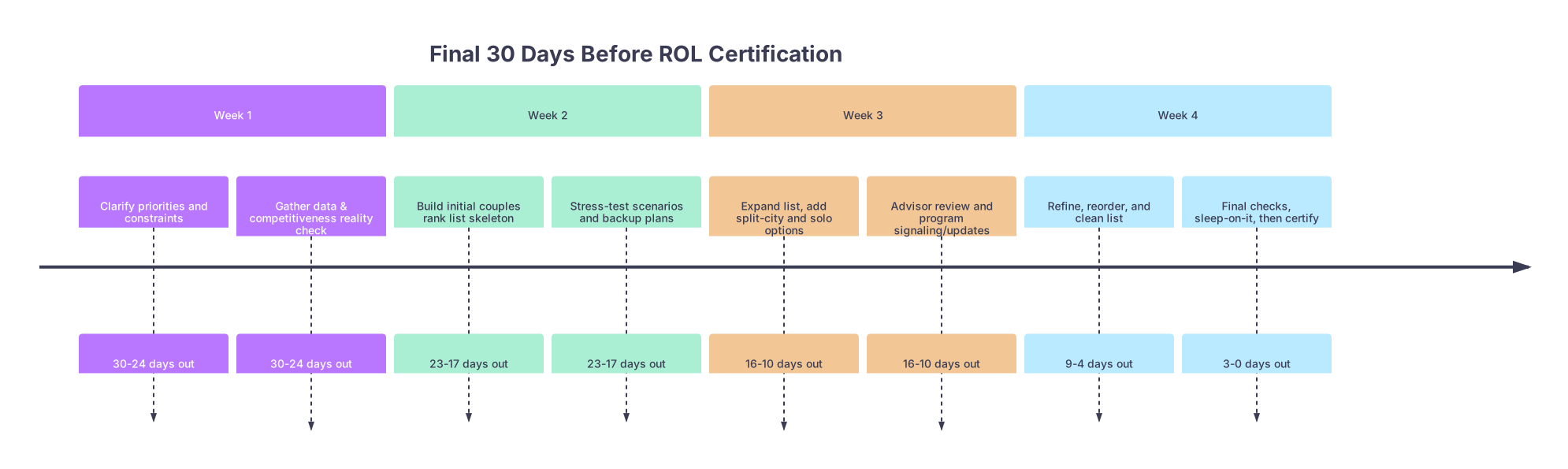
| Period | Event |
|---|---|
| Week 1 - Clarify priorities and constraints | 30-24 days out |
| Week 1 - Gather data & competitiveness reality check | 30-24 days out |
| Week 2 - Build initial couples rank list skeleton | 23-17 days out |
| Week 2 - Stress-test scenarios and backup plans | 23-17 days out |
| Week 3 - Expand list, add split-city and solo options | 16-10 days out |
| Week 3 - Advisor review and program signaling/updates | 16-10 days out |
| Week 4 - Refine, reorder, and clean list | 9-4 days out |
| Week 4 - Final checks, sleep-on-it, then certify | 3-0 days out |
We will walk through each week, then zoom into the final 7 days and the last 48 hours with concrete steps.
Week −4 (Days 30–24): Get Aligned and Get Real
At this point you should stop pretending you are a single applicant. Every decision now has to be framed as “Us, as a unit.”
Day 30: Shared Reality Check Meeting
Sit down together for 60–90 minutes. No phones. No friends. Just both of you and whatever notes you kept from interview season.
You need to answer, explicitly:
Geography hierarchy
- Tier 1: “We really want to be here”
- Tier 2: “We would be fine here”
- Absolute no‑go cities / regions
Program-type hierarchy
- Academic vs community
- Prestige vs lifestyle vs family support
- Specific must-haves (e.g., OB fellowship pipeline, strong ICU for Anesthesia)
Separation tolerance
- Are you willing to:
- Be in the same city but different hospitals?
- Be in nearby cities (e.g., Philly–NYC, Durham–Raleigh)?
- Be in different states for 1 year only (for a prelim/transition year), then re‑couple later?
- What is absolutely off the table?
- Are you willing to:
You want these in writing. I have watched couples implode in Week −1 because they never admitted one partner would never actually move to their “backup region.”
Days 29–27: Competitiveness Reality Check
At this point you should face the numbers. Not feelings. Not “my interview went great.”
Gather for each of you:
- Step 2 score / COMLEX scores
- Number of interviews and rough impression (strong / mid / weak)
- Any red flags (LOA, failed exam, limited interviews)
- Specialty competitiveness (Derm vs Family Med is not a small difference)
Build a blunt table for yourselves:
| Partner | Specialty | Step 2 | Interviews | Tier of Most Programs |
|---|---|---|---|---|
| A | IM | 247 | 13 | Mix mid / high |
| B | Psych | 233 | 10 | Mostly mid-tier |
Then ask:
- Who is more competitive relative to their specialty?
- Which one is more likely to drive where you match?
- Which partner needs more list depth to avoid not matching?
Often, one partner is clearly the “limiting reagent.” Your strategy should protect that partner from going unmatched, even if it pulls the stronger partner slightly down.
Days 26–24: Create the Raw Program Inventory
Individually, list every program where you interviewed. Do not rank yet. Just list.
Then combine into categories:
- Programs where both interviewed (same institution)
- Programs in the same city/metro, different hospitals
- Programs in commutable metros (e.g., Dallas–Fort Worth; SF–Oakland)
- Programs where only one of you interviewed
This becomes your “parts bin” for building couples combinations next week.
At this point you should also:
- Download or open the NRMP Couples Match instructions again.
- Watch NRMP’s short couples tutorial if you have not. Yes, it is boring. Watch it.
Week −3 (Days 23–17): Skeleton Rank List and Scenario Building
Now you stop thinking in lists of programs and start thinking in ordered pairs.
Day 23: Define Your Scenario Tiers
You are going to create 3 conceptual tiers of outcomes:
- Tier A – Ideal together
- Both in same institution, or elite programs in top-choice city.
- Tier B – Acceptable together
- Same city / region, slightly less ideal programs, but still together.
- Tier C – Separation or “one unmatched” safeguards
- Short-term distance or one partner in a prelim spot to protect from SOAP.
Write down, in sentences, what each tier means for you specifically. For example:
- Tier A: “Same institution in Boston or NYC, or top programs in Chicago.”
- Tier B: “Any same-city pairing in Midwest or East Coast where both match.”
- Tier C: “One matches at a top-choice academic program; the other at any reasonable same-state or neighboring-state program. Or one unmatched while the stronger partner still matches at a location we can make work long-term.”
This forces you to be honest about where the line is between “we want it” and “we would accept it to avoid unmatched.”
Days 22–21: Build the Initial High‑Priority Pairs
At this point you should open a spreadsheet or scratch paper and start building the top 15–30 couples entries, focusing on Tier A.
Example couples ranking structure entry:
- Entry 1: Partner A – MGH IM / Partner B – MGH Psych
- Entry 2: Partner A – BWH IM / Partner B – BIDMC Psych
- Entry 3: Partner A – Columbia IM / Partner B – Cornell Psych
For this first pass:
- Ignore distance > same city. Only list:
- Same hospital pairs
- Same city, different hospital pairs
- Roughly order these by joint happiness, not by one person’s dream.
You should finish with a clean, ordered top section that, if you matched there, you would be genuinely thrilled. No “Eh, maybe” entries up here.
Days 20–19: Add Realistic Middle-Tier Scenarios
Now you add Tier B outcomes. This is where conflict usually starts.
Your job here:
- Add combinations where:
- One partner is at a stronger program, the other at a solid-but-not-top program in same metro.
- Both are at mid-tier programs in a city you like.
- Do not yet touch cross-state or long-distance.
I tell couples to sanity-check like this:
“If we landed here, together, would we immediately regret not listing it higher? Or would we both exhale and say, ‘Okay, this works’?”
If the answer is “we would both be fine,” it belongs somewhere in your Tier B section.
Days 18–17: Stress-Test the “Unmatched” Scenarios
This is the least fun but the most crucial part of the week.
At this point you should:
- Explicitly discuss: which partner can better tolerate going unmatched and SOAPing?
- Decide whether to allow any “(Program, No Match)” pairs on your list.
Reminder: In the couples algorithm, you can list pairs like:
- (Strong academic IM, No Match) – meaning:
- You are willing to have Partner A match at that IM program even if Partner B does not match anywhere in the main Match.
You only include this if:
- The matched partner would absolutely take that program even if it means the other SOAPs or re-applies.
- You have a realistic SOAP / reapplication plan for the other partner.
Many couples skip this entirely. Some include a few such entries near the bottom as a last‑ditch protection from both going unmatched.
Do not add these in a panic in the last 48 hours. Decide now, calmly.
Week −2 (Days 16–10): Expand Depth and Get Outside Input
Your skeleton list exists. Now you need depth and external reality checks.
Days 16–14: Add Same‑Region and Short‑Distance Pairings
At this point you should consider your separation boundaries from Week −4 and convert them into actual pairs.
Examples:
- Same metro but painful commute (e.g., SF + San Jose)
- Different cities, but 1–2 hour drive (e.g., Philly + NYC; Durham + Raleigh)
- Different cities, 1 short flight apart (only if you both agreed this is acceptable)
Add these only if both of you, soberly, can say:
- “We would choose this over both going unmatched.”
- “We would choose this over one of us SOAPing into a specialty we do not want.”
This is your “We stay employed and in training, even if it is not romantic” layer.
Day 13: Clean Up and Label Sections
You should now have a preliminary couples list that:
- Starts with 10–30 Tier A same-institution / same-city pairs.
- Flows into 20–40 Tier B same-city or high-priority region pairs.
- Ends with some Tier C separation / protection entries (if you chose to use them).
Label sections in your spreadsheet:
- Rows 1–X: “Tier A – Ideal together”
- Next Y rows: “Tier B – Acceptable together”
- Bottom Z rows: “Tier C – Protective / separation”
This makes it much easier in the final week to reorder without losing the logic.
Days 12–11: Advisor and Mentor Review
At this point you should stop designing your future in a vacuum.
You want at least one of the following to glance at your plan:
- A trusted faculty advisor for each specialty
- PD or APD you have a relationship with
- Your home program director if you interviewed there
- A dean-level advisor who actually understands the couples algorithm
What to ask them:
- “Given our interview lists and scores, are we being too optimistic with our top section?”
- “Do you see any glaring gaps where we have not protected against non-match?”
- “Looking at our bottom section, are we under‑ or over‑using ‘No Match’ entries?”
You are not asking them to choose for you. You are asking for probability and risk assessment. Take their feedback seriously, especially if both of your advisors independently say “You two need more depth” or “You are selling Partner B short.”
Day 10: Program Signaling and Light Updates (Optional)
You are not playing musical chairs with “love letters.” But a small number of targeted, honest updates can make sense now.
At this point you might:
- Send 1–3 “You are our top choice in [city/region]” type emails, max, if you truly mean it.
- Clarify to a PD you know well that you are couples matching and roughly how you are thinking.
Do not send mass emails. Do not tell three programs they are “number one.” People talk.
Week −1 (Days 9–4): Refinement, Trade‑offs, and Hard Conversations
This is where you move from “draft” to “near-final.”
Days 9–7: Re‑Rank with Joint Utility, Not Ego
At this point you should sit together and review the full list from top to bottom.
For each entry, ask:
- If we woke up matched here, would either of us feel secretly resentful?
- Does this entry sit above another entry we would actually prefer as a couple?
You will probably find:
- Entries too high because one partner is prestige‑drunk.
- Entries too low because of fear or inertia.
The rule here: no single‑person “trophy picks” that meaningfully hurt the other’s outcomes unless you have both explicitly agreed this is worth it.
Days 6–5: Decide on Final Separation Boundaries
Revisit the bottom third of your list.
You must decide:
- Where exactly does “together no matter what” end?
- Where does “protect at least one of us from being unmatched” begin?
Many couples end up with something like:
- Ranks 1–80: Together‑only outcomes (no “No Match” entries).
- Ranks 81–95: High‑priority single outcomes with the other unmatched.
- Rank 96+: (No Match, No Match) — signaling that beyond this you prefer SOAP over very undesirable matches.
This is brutally personal. But if you do not draw these lines now, the algorithm will draw them for you.
Final 3 Days: Precision, Sanity Checks, and Certification
Now we zoom in. This is where details and typos can sink you.
T‑72 to T‑48 Hours: Enter and Cross‑Check in NRMP
At this point you should have your spreadsheet or paper list ready. Now:
- Log into NRMP and start entering the couples ROL, side by side.
- After entry:
- Partner A reads Partner A’s side aloud, line by line.
- Partner B simultaneously verifies that the corresponding program name and code match what you had planned.
- Then swap:
- Partner B reads their side aloud while Partner A verifies.
You are looking for:
- Wrong program codes
- Swapped prelim/categorical tracks
- Accidental inclusion of programs where you did not interview
I have seen couples accidentally rank a prelim IM where they thought they were ranking a categorical, because the names look nearly identical in NRMP. That is how you end up re‑applying PGY‑1.
T‑48 to T‑36 Hours: Stability Check and “If X Then Y” Stress Test
At this point you should be resisting major changes. But you should stress test:
- If we matched at Entry #1, would we both be happy? (Good.)
- If we matched at Entry #20, would we both be okay? (Should still be yes.)
- If we matched at our last “together” entry, would we still prefer that to our first “separated” entry?
- If one of us matched and the other did not (according to our list), have we both explicitly accepted that trade‑off?
Run through a few hypothetical outcomes out loud:
“Suppose we land at A: MGH / B: ‘No Match.’ Are we both fully okay that this might happen?”
Then the reverse. If either of you hesitates for more than a beat, you need to reexamine that portion of the list.
T‑36 to T‑24 Hours: Freeze Big Changes
This is where people sabotage themselves.
At this point you should freeze any large structural changes to your list unless a major new piece of information drops (e.g., shocking professionalism issue at a program, or serious family health crisis changing your geography).
Small adjustments (swapping #12 and #13 because of a genuine joint preference clarification) are fine. Overhauling your bottom 30 entries because of anxiety is not.
If you feel the urge to perform surgery on your list at 1 a.m., close the laptop. Sleep.
Final 24 Hours and Certification
T‑24 to T‑12 Hours: Technical and Identity Checks
At this point you should:
- Confirm both NRMP accounts are active and not locked.
- Verify that:
- Both of you are checked as “Participating as a couple.”
- The correct partner is listed as Partner 1 vs Partner 2 (does not usually matter, but must be consistent).
- There are no “dummy” or test entries left in your lists.
Do one more synchronized scroll through your ROL:
- Confirm no blank lines or erroneous programs.
- Confirm that the ordering still reflects your written Tier A/B/C logic.
T‑12 to T‑4 Hours: Last‑Chance Sanity Conversation
Have one final, calm, 20–30 minute conversation. No list editing during this talk. Just:
- “Is there anything you are quietly unsettled about?”
- “Are you okay with our separation scenarios, if they happen?”
- “If we wake up on Match Day at our Entry #67 outcome, are we both going to be able to live with it?”
You are not seeking perfection. You are seeking mutual ownership of the list.
If a real issue comes up (not just nerves), make surgical, not sweeping edits afterward.
T‑4 to T‑0 Hours: Certify – In the Same Room
Certification is boring and critical. Do it together.
Stepwise:
- Sit next to each other. Log in.
- Each of you:
- Click “Certify List.”
- Confirm the pop‑up text that this is your final certified list.
- Double-check the timestamp shows your list as certified and not pending.
- Screenshots are not a bad idea for your own peace of mind.
Do not wait until the last hour. NRMP’s site can lag, your internet can drop, or someone can realize their password is wrong. I have literally watched a couple refreshing in a Starbucks at 8:45 p.m. on deadline night because one partner forgot a password and panicked.
Certify at least half a day before the deadline. Then stop.
A Quick Reality Snapshot: How Your Time Has Been Allocated
To anchor your sense of whether you are over‑ or under‑thinking things, here is roughly how an organized couple’s mental effort usually breaks down over the 30 days:
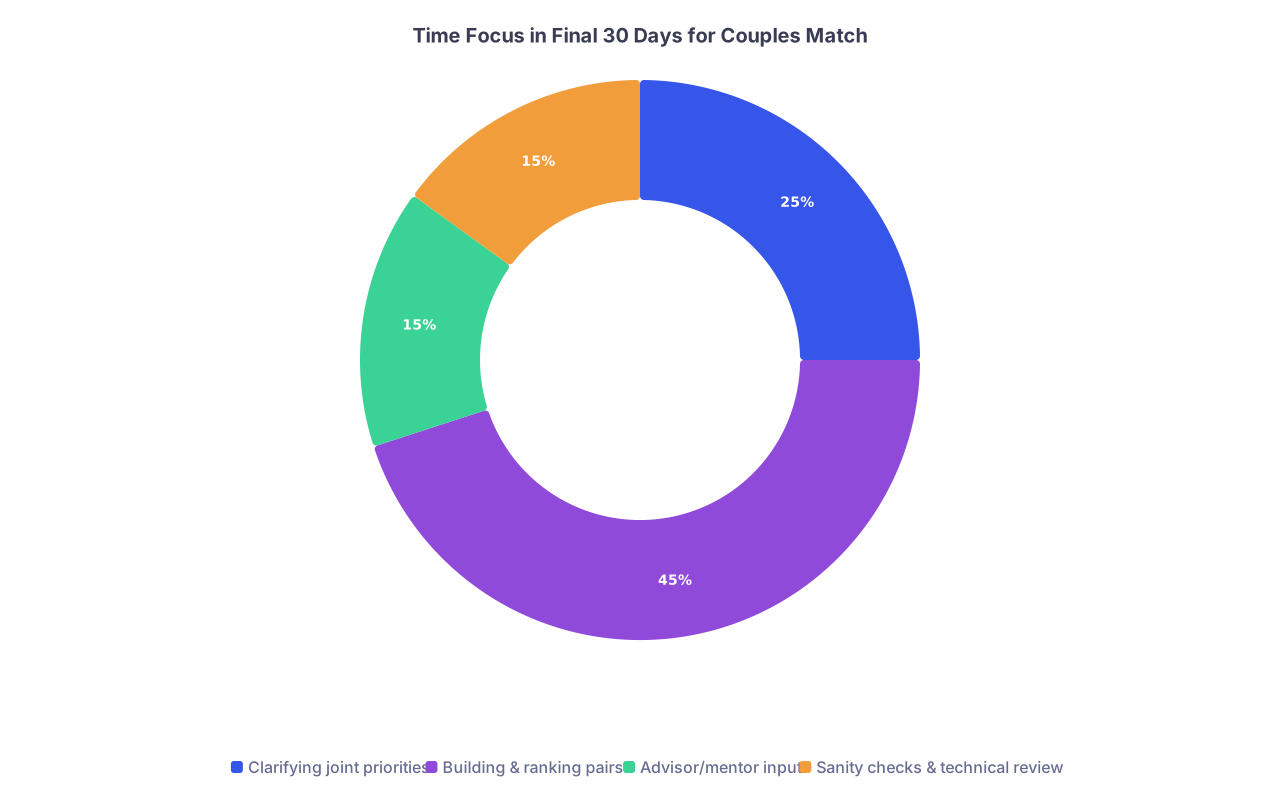
| Category | Value |
|---|---|
| Clarifying joint priorities | 25 |
| Building & ranking pairs | 45 |
| Advisor/mentor input | 15 |
| Sanity checks & technical review | 15 |
If you are spending 80% of your energy writing love letters to PDs and only 10% synchronizing your internal priorities, you are doing this backwards.
Final 48-Hour Emotional Management
Last thing. The emotional part.
At this point you should:
- Stop comparing interview counts and perceived “prestige scores” with other couples.
- Recognize that no list eliminates risk. It just aligns risk with your values.
- Agree on how you will handle Match Day no matter what happens:
- Who do you call first?
- What do you do if one or both of you SOAP?
- How will you avoid blaming each other for an outcome you both certified?
You are not just drafting a list. You are practicing the exact kind of joint decision‑making you will need for careers, finances, kids, the whole deal.
Key Takeaways
- The final 30 days before ROL certification for couples are about structured scenario building, not vibes. You should move from “favorite programs” to ranked, testable pairs with clear Tier A/B/C sections.
- The most important work happens before the last week: aligning your geography and separation boundaries, facing competitiveness reality, and agreeing on how far you will go to stay together vs protect each partner from going unmatched.
- In the last 72 hours, your job is not to reinvent the list. It is to verify, sanity-check, and certify calmly, together, so that whatever Match Day brings, you both know: this is the outcome you chose as a team.


