

It is September of MS2. You and your partner are both in white coats, both exhausted, and both quietly doing the same mental math:
- When do we take Step 1?
- How fast do we need to turn around Step 2?
- How do we avoid being out of sync when ERAS opens and we are trying to couples match?
You are not just planning one exam timeline. You are planning two overlapping, interlocking ones. If you mis-time it, you end up with one person holding a strong Step 2 score while the other is “pending,” and programs quietly downgrade you as a pair.
Let me walk you straight through it—MS2 through Match Week—what you should be doing, by month, if you want your board prep to support a realistic couples match strategy.
Big-Picture Timeline: How Boards and Couples Match Interlock
At this point you should understand the whole arc before you obsess over flashcards.
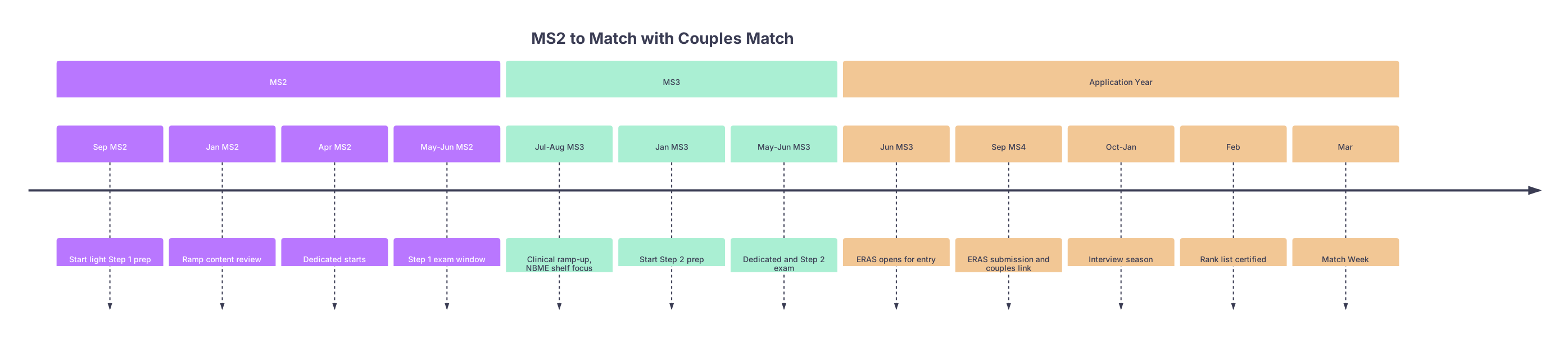
| Period | Event |
|---|---|
| MS2 - Sep MS2 | Start light Step 1 prep |
| MS2 - Jan MS2 | Ramp content review |
| MS2 - Apr MS2 | Dedicated starts |
| MS2 - May-Jun MS2 | Step 1 exam window |
| MS3 - Jul-Aug MS3 | Clinical ramp-up, NBME shelf focus |
| MS3 - Jan MS3 | Start Step 2 prep |
| MS3 - May-Jun MS3 | Dedicated and Step 2 exam |
| Application Year - Jun MS3 | ERAS opens for entry |
| Application Year - Sep MS4 | ERAS submission and couples link |
| Application Year - Oct-Jan | Interview season |
| Application Year - Feb | Rank list certified |
| Application Year - Mar | Match Week |
Here is the core principle:
- For a couples match, both people should have:
- Step 1 completed before core clerkships begin.
- Step 2 CK completed by late June–July of the application year at the latest.
- Scores back before ERAS submission and before most interview offers go out.
If one of you lags 2–3 months, your pair’s “average application strength” drops in the eyes of program directors. I have seen this more than once: one partner with a 250+ on Step 2, the other labeled “Score pending.” Guess who they focus on.
MS2: Building a Synchronized Step 1 Plan
This year is where you either stay aligned or start drifting apart.
September–December of MS2: Set the joint strategy
At this point you should:
Sit down together with:
- Your academic calendars
- The school’s dedicated board period dates
- Any big personal events (weddings, moves, family obligations)
Answer three blunt questions:
- Are we both strong test-takers, average, or struggling?
- How many hours per week can we realistically commit to board prep during MS2?
- Do we both want to take Step 1 in the same 2–3 week window?
You want that last answer to be “yes” unless:
- One of you is repeating coursework
- One of you has serious non-academic obligations (health, caregiving, etc.)
If your school is pass/fail pre-clinical and Step 1 is pass/fail, the temptation is to treat Step 1 as a background task. For a couples match, that is a mistake if it causes your Step 2 timing to slide. Step 1 still controls when you start clinicals and when you can shift fully to Step 2 prep.
At this point, minimum actions:
- Choose your Step 1 date range together (e.g., “last two weeks of May”).
- Draft a shared weekly template:
- 3–4 days / week:
- 40–60 UWorld questions each (timed, mixed or system-based)
- 1 day / week:
- Joint review session: compare missed questions, teach each other weak points.
- 3–4 days / week:
- Decide on your primary resources and lock them in. No hopping between five Q-banks.
January–March of MS2: Ramp and calibrate
Now you move from “maintenance” to “serious prep.”
At this point you should:
Take an NBME or school-provided comprehensive exam by late January.
Compare your performances honestly. If one of you is lagging badly (e.g., one is roughly at a 210-equivalent, the other at a 240-equivalent), this is where you decide:
- Do we keep the same Step 1 date?
- Does one of us pull back on extracurriculars or research to catch up?
- Do we need tutoring for just one partner?
Do not quietly hope the gap will disappear in dedicated. It usually does not.
Weekly rhythm now:
- 5–6 days / week:
- 60–80 UWorld questions / day
- 1–1.5 hours targeted review
- Every 3–4 weeks:
- NBME or school practice exam
- Joint review of “trend” areas: micro, biochem, pharm, etc.
You are not just aiming to pass. You are aiming to have clear, stable scores heading into dedicated so you can both:
- Stay within the same 2–3 week Step 1 test window.
- Start MS3 rotations on time together.
If one of you fails Step 1 or has to delay by 6–8 weeks, your whole couples match timeline is at risk. That person may start clerkships late and cannot reasonably get Step 2 done on time.
Dedicated Step 1 and Transition to Clerkships
April–June of MS2: Dedicated block and exam week
Your school likely gives 4–8 weeks of dedicated. You want your dedicated blocks to overlap heavily, even if not identical.
At this point you should:
- Lock in test dates no more than 14 days apart.
- Create parallel daily structures, even if question counts differ.
Example daily schedule (adapt to your stamina):
- 8:00–12:00: 2 blocks UWorld + review
- 13:00–16:00: Content review (Anki, Pathoma, First Aid, etc.)
- 16:30–18:00: Light review / practice questions
- Evening:
- 30–45 minutes joint “teach back” (e.g., one explains heart murmurs, the other explains nephritic vs nephrotic, etc.)
- Then stop. You are both tired. Protect the relationship.
Do not martyr one partner. If one person finishes their exam first, they should:
- Take 2–3 days completely off.
- Then support the other’s last stretch (meals, chores, flashcard quizzing) without pushing new content. Emotional support matters more here than another practice block.
June–July: Score release and clerkship alignment
Step 1 results usually return in 2–4 weeks.
At this point you should:
- Confirm you both passed.
- If either of you failed:
- You must immediately meet with your dean together to assess how this alters your Step 2 and couples match timeline.
- You may need to:
- Delay clerkships
- Push back Step 2 to the following cycle
- Reassess whether couples matching the upcoming year is realistic
If both passed and start clerkships on time:
- Review your MS3 schedules:
- Try to have core clerkships in roughly the same half-year (e.g., both get IM and Surgery by January).
- This matters because Step 2 CK essentially tests medicine + surgery + peds + OB + psych.
The goal: both of you are clinically prepared to take Step 2 by end of MS3.
MS3: Working Backward from Step 2 and ERAS
Couples match success or failure is often decided here, quietly, 9–12 months before Match Day.
July–December of MS3: Shelf exams and early Step 2 positioning
At this point you should:
- Treat every shelf exam as Step 2 prep. Because it is.
- Track shelf scores side by side. You want:
- Consistently passing shelves
- Ideally trending up in IM, Surgery, and Peds
If one partner is repeatedly borderline or failing shelves, Step 2 will probably need:
- A longer dedicated period
- A slightly later test date
You plan for that now, not in May when score deadlines loom.
By December of MS3:
- Decide your Step 2 CK window as a pair:
- Ideal: both between late May and late June.
- Acceptable: one in late May, one in mid-July.
- Risky: one in June, one after August 1. Programs will start screening before that second score posts.
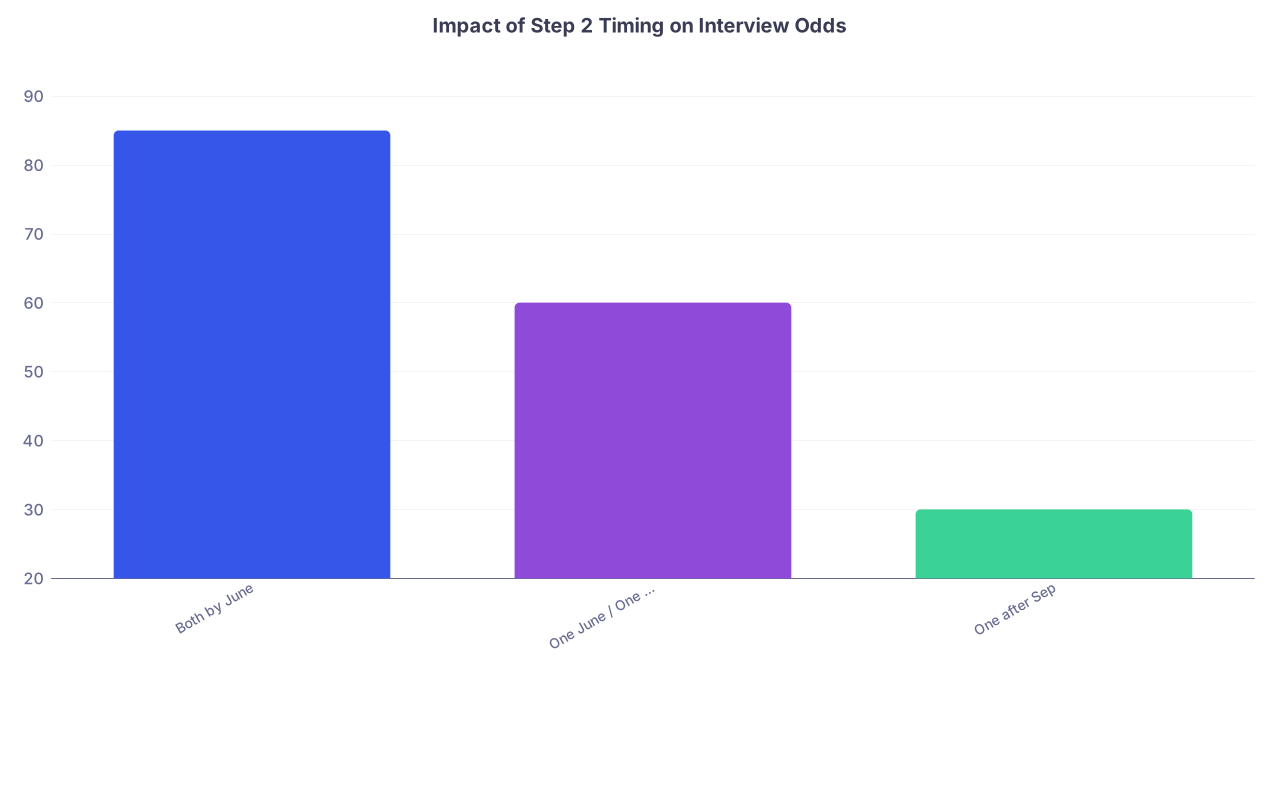
| Category | Value |
|---|---|
| Both by June | 85 |
| One June / One Aug | 60 |
| One after Sep | 30 |
(The numbers are illustrative, but the pattern is real: late scores hurt.)
January–March of MS3: Directed Step 2 prep begins
Clerkships are still going. You cannot suddenly study 8 hours a day. So you structure it.
At this point you should:
- Start a dedicated Step 2 Q-bank (often UWorld if you reset, or a second bank):
- 20–40 questions per day on weekdays
- 40–80 questions one day each weekend
- Once per week:
- Short joint session: identify 2–3 shared weak systems (e.g., endocrine, rheumatology, OB hemorrhage algorithms).
By March:
- Each of you should take a baseline NBME or the school’s CCSE:
- If one of you is scoring near the target (e.g., 235–245+), that person can afford a slightly shorter dedicated.
- If the other is lower (e.g., 210s), plan:
- 4–6 weeks of heavier Step 2 focus after major rotations end.
- Maybe fewer electives or research blocks.
Your couples match plan has to accommodate the weaker test-taker, not the stronger one.
Step 2 Dedicated: Tight Windows, Clear Deadlines
April–July of MS3: Scheduling Step 2 with couples match in mind
Now you set the actual dates. Be ruthless.
At this point you should:
- Pull up:
- ERAS schedule for your application year
- Your school calendar (end of core rotations, start of MS4)
- Work backwards:
Key anchors:
- ERAS opens for data entry: usually early June
- ERAS submission to programs: usually early–mid September
- Programs start sending interview invites: late September onward
Your goals:
- Both Step 2 exams completed by July 15.
- Both Step 2 scores back by mid-August.
- Enough time after Step 2 for:
- Personal statements
- Letters chasing
- Program list research
- Couples match strategy meetings with advisors
A typical good setup:
Partner A:
- Finishes major clerkships: late April
- 3–4 weeks lighter schedule + dedicated
- Step 2 date: early June
Partner B (slightly weaker test-taker):
- Finishes clerkships: mid May
- 4–5 weeks stronger dedicated
- Step 2 date: late June / early July
You end up with:
- A: Score back by early July
- B: Score back by late July / early August
Both visible in ERAS when programs start screening.
If either of you is forced into an August Step 2 date, ask yourself bluntly:
- Is this absolutely necessary?
- Can I rearrange electives or take a short research pause to move earlier?
Because for couples match, having one “pending” Step 2 at ERAS submission is a real handicap, especially for competitive specialties or locations.
ERAS Year: Turning Scores into a Couples Strategy
With both Step exams done, timing now shifts to how you deploy that data together.
June–August before MS4: Building the application around your scores
At this point you should:
- Sit with an advisor (or two):
- One from each of your target specialties
- One dean or career advisor who understands couples match patterns at your school
Put your Step 1 / Step 2 profiles in front of them side by side. You are a package deal now.
| Partner | Specialty Goal | Step 1 | Step 2 CK | Competitiveness Tier |
|---|---|---|---|---|
| A | Pediatrics | Pass | 242 | Solid |
| B | EM | Pass | 228 | Borderline |
With something like the table above, your advisor might say:
- Apply to:
- 40–50 peds programs for A
- 50–60 EM programs for B
- Emphasize:
- Geographic flexibility
- Programs known to take couples (your school will have a list, and NRMP data helps)
Meanwhile, board timing shows up again in letters:
- If one of you took Step 2 very late and barely passed, some letter writers will comment implicitly: “improved performance” vs “required substantial remediation.” Programs read those between the lines.
By August:
- Program lists should be mostly built.
- Personal statements drafted.
- Couples match conversations started:
- Which cities are non-negotiable?
- Which are “backup clusters”?
September–January: Invitations and interviews with test scores locked in
ERAS submission and couples linking usually occur mid–late September.
At this point you should:
- Make sure:
- Both Step 2 scores are already uploaded to ERAS.
- No pending exam statuses that make you look incomplete.
Programs will often prescreen as:
- Hard score cutoffs (e.g., Step 2 ≥ 230)
- Or softer combined filters (e.g., “willing to read below 225 if strong letters/local ties”)
As a couple, your interview distribution will not be identical. And that is fine. What the Step timing did for you is make both applications fully evaluable at the same time. That is what you wanted.
Now you:
- Track:
- Number of invites each of you has by region.
- Decide:
- Which interviews to prioritize together.
- Which to accept solo but rank low unless needed for safety.
Putting It All Together: Year-by-Year Checklist
To simplify, here is how your timing decisions should stack.

MS2 Year
Fall (Sep–Dec):
- Choose Step 1 target window as a couple.
- Start light but consistent Step 1 Q-bank use.
- Sync big commitments (research, jobs, family travel).
Winter–Early Spring (Jan–Mar):
- Take baseline NBME / comprehensive exams.
- Adjust:
- Dedicated length per person
- Extra support for the weaker partner
- Keep Step 1 windows within the same 2–3 weeks.
Dedicated (Apr–Jun):
- Parallel daily structures.
- Shared teaching sessions.
- Test dates no more than 14 days apart.
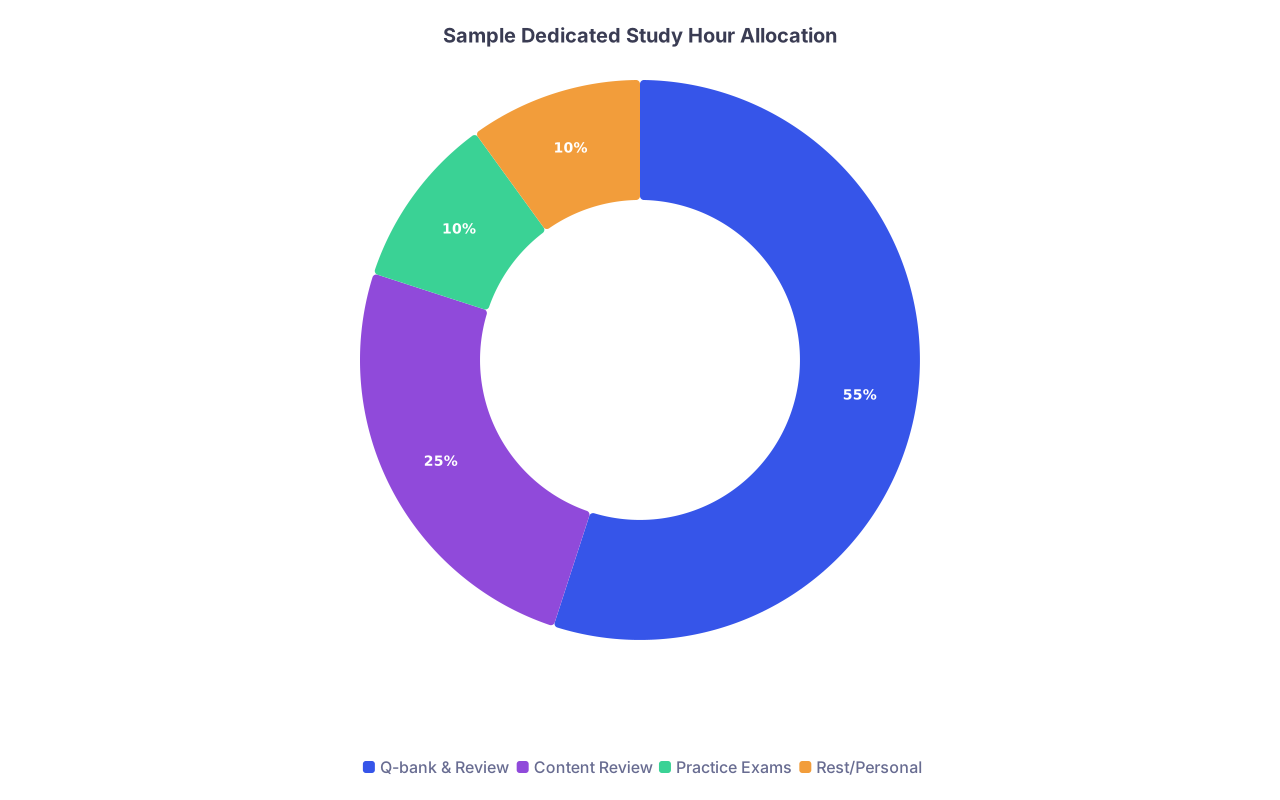
| Category | Value |
|---|---|
| Q-bank & Review | 55 |
| Content Review | 25 |
| Practice Exams | 10 |
| Rest/Personal | 10 |
MS3 Year
Early (Jul–Dec):
- Treat shelves as Step 2 rehearsal.
- Track each person’s weak systems.
- Decide Step 2 CK test window (May–July) by December.
Spring (Jan–Mar):
- Launch consistent Step 2 Q-bank work.
- Take a baseline NBME/CCSE.
- Plan:
- Dedicated lengths
- Clerkship/elective rearrangements if needed.
Late Spring–Summer (Apr–Jul):
- Lock Step 2 dates with:
- Both exams done by mid-July if humanly possible.
- Finish:
- Scores in hand by mid–late August.

Application Year (MS4 start)
Summer (Jun–Aug):
- Build realistic program lists using both partners’ scores and specialties.
- Meet with advisors who know couples match patterns.
- Draft personal statements and update CVs.
Fall–Winter (Sep–Jan):
- Submit ERAS on time with all scores uploaded.
- Attend interviews, coordinating regionally whenever possible.
- Keep track of interview balance; add safety programs if one partner is lagging badly.
Late Winter (Feb–Mar):
- Build a rank list that reflects:
- Score realities
- Geographic flexibility
- Program tiers that make sense for you as a pair

Final Thoughts
Three key points:
- For a couples match, Step timing is not just “when do I feel ready?” It is “how do we both have complete, visible score profiles before programs decide who to interview?”
- Keep Step 1 windows close together and Step 2 dates no later than mid-July for both of you if you want full-strength applications in September.
- Plan for the weaker test-taker’s needs, not the stronger one’s ambitions. Your match outcome will follow the weaker application far more than the stronger one.


