

The way most couples handle interview season is chaotic and reactive. That is how you burn money, miss opportunities, and resent each other by January.
You need a timeline and a system. If you treat couples interview season like two independent people “trying their best,” you will lose ground to couples who planned this tightly.
Below is the month‑by‑month and then week‑by‑week breakdown of what to do, when, and in what order, specifically for coordinating travel and dates as a couples pair.
August–September: Pre‑Interview Groundwork
At this point you should not be thinking about flights. You should be building the structure that will make later decisions automatic.
Step 1 (Late August–Early September): Align Your Priorities
Sit down once. Do this properly.
Create three lists together:
Geography tiers
- Tier 1: Must‑have cities/regions (e.g., “Boston/NYC corridor,” “Pacific Northwest,” “within 2 hours of Chicago”)
- Tier 2: Acceptable but not dream
- Tier 3: Only if one of you over‑performs
Program tiers for each of you
- A: Dream programs
- B: Solid fits
- C: Safety / geographic backup
Deal‑breakers
- Examples:
- “We will not live in separate states.”
- “We will not rank a program where only one of us interviewed.”
- “We will not do >3 long‑haul solo trips if avoidable.”
- Examples:
If you skip this now, you will fight about each decision later. I have seen couples explode over whether one person should fly alone to “one extra” interview in January because they never defined limits.
Step 2 (Early–Mid September): Build the Shared Tracker
You are going to live in a spreadsheet for the next 4–5 months. Build it correctly now.
Use Google Sheets or Notion, shared with both of you (and editable on your phones). Bare minimum columns:
| Category | Example Entries |
|---|---|
| Applicant | Partner A / Partner B |
| Specialty | IM, EM, Derm, etc. |
| Program Name | University of X IM |
| City/Region | Seattle, Boston |
| Tier | A / B / C (your joint tier) |
| Invite Date | 10/15 |
| Response Deadline | 72 hours, 7 days |
Add interview‑specific columns that matter for travel:
- Interview date options (as they come)
- Interview format (virtual, hybrid, in‑person)
- Preferred date selected
- Travel plan (joint / solo / virtual)
- Flight/train reservation numbers
- Lodging booked (Y/N + reservation info)
You do not need to over‑engineer this. You just need everything in one place, visible to both of you.
Step 3 (Late September): Pre‑Decide Your Travel Rules
Before the first invite hits your inbox, agree on rules like:
- How many total trips you each can realistically afford (time + money).
- When one person can decline an invite because there is no realistic couples option in that city.
- Whether you will:
- Cluster interviews into 3–5 multi‑city trips, or
- Do many quick out‑and‑back single‑city trips.
Write these rules directly at the top of your shared spreadsheet as “House Rules.” That prevents you from re‑litigating the same arguments later when you are tired and stressed.
October: Early Invites and Locking a System
At this point you should set up the way you will receive and react to invitations. October chaos destroys couples who are not prepared.
Week 1–2 of October: Technical Prep
You will miss invites if your inbox is a mess.
Standardize emails
- Create a dedicated folder/label for residency emails.
- Set filters for “ERAS,” “Interview Invitation,” “Thalamus,” “Interview Broker,” “Residency recruitment,” etc.
- Forward everything to one shared email if you trust each other with that level of access. If not, at least commit to forwarding invites to each other within 1 hour.
Notifications
- Turn ON push notifications for your main email apps.
- Do not rely on “I check a few times a day.” Some programs send a link and slots are gone in 20 minutes.
Week 2–4 of October: Define Your Date‑Selection Algorithm
You are not picking random dates. You are optimizing for overlap and clustering.
Decide this hierarchy now:
If both of you get an invite from the same city:
- Rule #1: Aim for same week, ideally adjacent days.
- Rule #2: If you cannot get same week, aim for same 7–10 day window to combine into one trip.
If only one of you gets an invite:
- Check your priority list:
- If that city is Tier 1 and that program is Tier A/B for that person → seriously consider going, even solo.
- If that city is Tier 3 and the program is C → usually pass unless you are weak on interviews.
- Check your priority list:
For virtual vs in‑person:
- Many specialties are still largely virtual. Use virtual interviews as “anchors” around which you place in‑person trips.
- Do not travel for a program that is offering virtual as an equal option unless it is top tier for you or you need the geographic stake.
November: Heavy Invite Season and Initial Travel Clustering
By early November, invites are coming steadily. At this point you should be reacting in real time with a consistent process.
Day‑of‑Invite Protocol (Every Time)
The moment one of you gets an invite, follow the same 5‑step sequence:
- Screenshot or copy the available dates before you click anything.
- Check your shared spreadsheet for:
- Existing interviews in that city/region.
- Any travel already booked.
- Text/call each other immediately if:
- Same city as an existing or likely invite for the other person.
- Program is Tier A/B or in a Tier 1 region.
- Decide within 15–30 minutes:
- Pick dates that either:
- Overlap with your partner’s existing/planned interviews, or
- Minimum conflict with their other big programs.
- Pick dates that either:
- Update the spreadsheet:
- Confirmed date.
- Tentative travel plan: “Potential joint trip with X program.”
This sounds rigid. It is. But this is how couples end up with 6 interviews in Boston on 6 separate trips versus 2 combined trips.
Mid–Late November: Start Building Trips
Once you both have 5–8 interviews scheduled, look at the map.
At this point you should:
Identify clusters
- Example:
- Partner A: Yale (New Haven, 12/7), Brown (Providence, 12/9)
- Partner B: Boston programs on 12/6 and 12/10
- That is one Northeast trip. Not four separate ones.
- Example:
Draft rough itineraries
- Trip 1: Midwest loop (Chicago, Milwaukee, Madison)
- Trip 2: Northeast (Boston, Providence, New Haven, NYC)
- Trip 3: West Coast (Seattle + Portland or LA + San Diego)
Set booking thresholds
- Rule: “We book flights once there are at least 2 confirmed interviews in that region, or it is a must‑have program.”
- Rule: “We do not book more than 2 weeks ahead unless multiple dates are anchored.”
You are not locking everything down yet. You are building the skeleton.
December: Peak Interview and Travel Execution
This is when your system either saves you or crushes you. At this point you should be locking trips and protecting your bandwidth.
Early December: Finalizing Major Trips
You will likely know ~70–80% of your final interview list by early December.
Lock your main 2–4 trips
- Confirm:
- Cities and dates.
- Who is interviewing where on which day.
- Book:
- Flights or trains.
- Lodging in central locations (walkable to multiple hospitals or public transit).
- Confirm:
Use one central calendar
- Sync the spreadsheet with Google Calendar or iCal.
- Color code:
- Partner A interviews: blue
- Partner B interviews: red
- Travel days: gray
- Share the calendar so you both see everything at a glance.
Protect buffer days
- Do not stack travel → interview → red‑eye → interview.
- You will show up exhausted and flat. Programs notice.
- As a rule:
- 1 day buffer between cross‑country travel and a big interview.
- Half‑day buffer between back‑to‑back interviews in the same city.
Day‑Before / Day‑Of Travel Routine (Every Trip)
You need a checklist; otherwise you forget basics when stressed.
Night before travel:
- Confirm:
- Flight/train times.
- Ground transport from airport to lodging.
- Lodging address and check‑in details.
- Print or download:
- Interview schedules.
- Parking or shuttle instructions.
- Cross‑check:
- Time zones (people mess this up constantly for virtual + in‑person hybrids).
Day of travel:
- Aim to arrive at least the afternoon before your earliest interview on that trip.
- If you both interview on consecutive days, plan:
- Quiet evening for the person interviewing the next day.
- The other person handles any logistics (food, laundromat, check‑outs).
Mid–Late December: Managing Fatigue and Last‑Minute Invites
Programs will send late invites and “we had a cancellation” emails. You must be ruthless.
At this point you should:
Evaluate each late invite against reality
- Question 1: Is this city in a region where we already have a trip?
- Question 2: Does this program materially change our couples options?
- Question 3: Will this trip make us too exhausted to perform at higher‑priority interviews?
Have a default bias
- By mid‑December, your default should shift from “say yes” to “only if it clearly helps our couples match prospects.”
- Most couples overshoot the number of interviews they can actually handle well.
Start trimming
- If you have more than ~12–14 interviews each and you are dying, drop lowest‑priority ones that are:
- Solo interviews in low‑priority cities, and
- Not necessary as geographic insurance.
- If you have more than ~12–14 interviews each and you are dying, drop lowest‑priority ones that are:
January: Final Wave, Cancellations, and Clean‑Up
By January, the interview calendar is mostly set. At this point you should be optimizing, not accumulating.
Early January: Rational Cancellations
You will both have a clearer picture of which regions are still weak for you as a couple.
Sit down with the spreadsheet and ask:
- Do we have at least:
- 3–5 overlapping geographic options where both of us interviewed?
- 1–2 acceptable “stretch” options where one of us is happier than the other, but still okay?
- Are we holding onto interviews that:
- Are solo.
- In cities neither of you actually want to live in.
- Would require new expensive travel for marginal benefit.
Cancel ruthlessly. Email programs respectfully and early; someone else will be very happy to get your spot.
Mid January: Final Trip Consolidation
If you still have January interviews:
- Combine any remaining single‑city interviews into short, efficient trips.
- Consider turning marginal in‑person interviews into virtual ones where allowed (yes, some programs are flexible if you ask early and politely).
- Protect at least one real break of 3–4 days with no interviews. You need that time to think clearly about ranking as a couple.
The Couples Coordination Process: Visualized
Here is how your decision‑making actually flows every time an invite appears.

| Step | Description |
|---|---|
| Step 1 | Invite received |
| Step 2 | Choose dates in same week |
| Step 3 | Hold flexible date, tell partner |
| Step 4 | Accept, schedule best fit date |
| Step 5 | Politely decline |
| Step 6 | Same city/region as partner? |
| Step 7 | Partner already has invite? |
| Step 8 | High priority city/program? |
| Step 9 | Budget/time allow extra trip? |
Print that if you need a reminder on your wall.
Sample Weekly Rhythm During Peak Season
To prevent this from taking over every waking minute, structure your week.
At this point in November–January you should:
Sunday evening (30–45 minutes)
- Review upcoming 2–3 weeks of:
- Interviews (virtual + in‑person)
- Travel days
- Lodging reservations
- Adjust plans if:
- New invites came in.
- One of you wants to cancel something.
- Review upcoming 2–3 weeks of:
Daily quick check‑ins (5–10 minutes)
- “Any new invites?”
- “Any conflicts or double‑booked days?”
- “Anything we need to book/cancel today?”
After each trip
- Take 10 minutes together to:
- Log impressions of programs in your spreadsheet (score them 1–10 for each of you).
- Tag cities where you both felt reasonably good → those become ranking anchors.
- Take 10 minutes together to:
How Many Trips, Realistically?
Let me be blunt: most couples underestimate the cost and overestimate the value of extra trips.
Here is a rough reality check for a typical couples pair applying broadly in the U.S.:
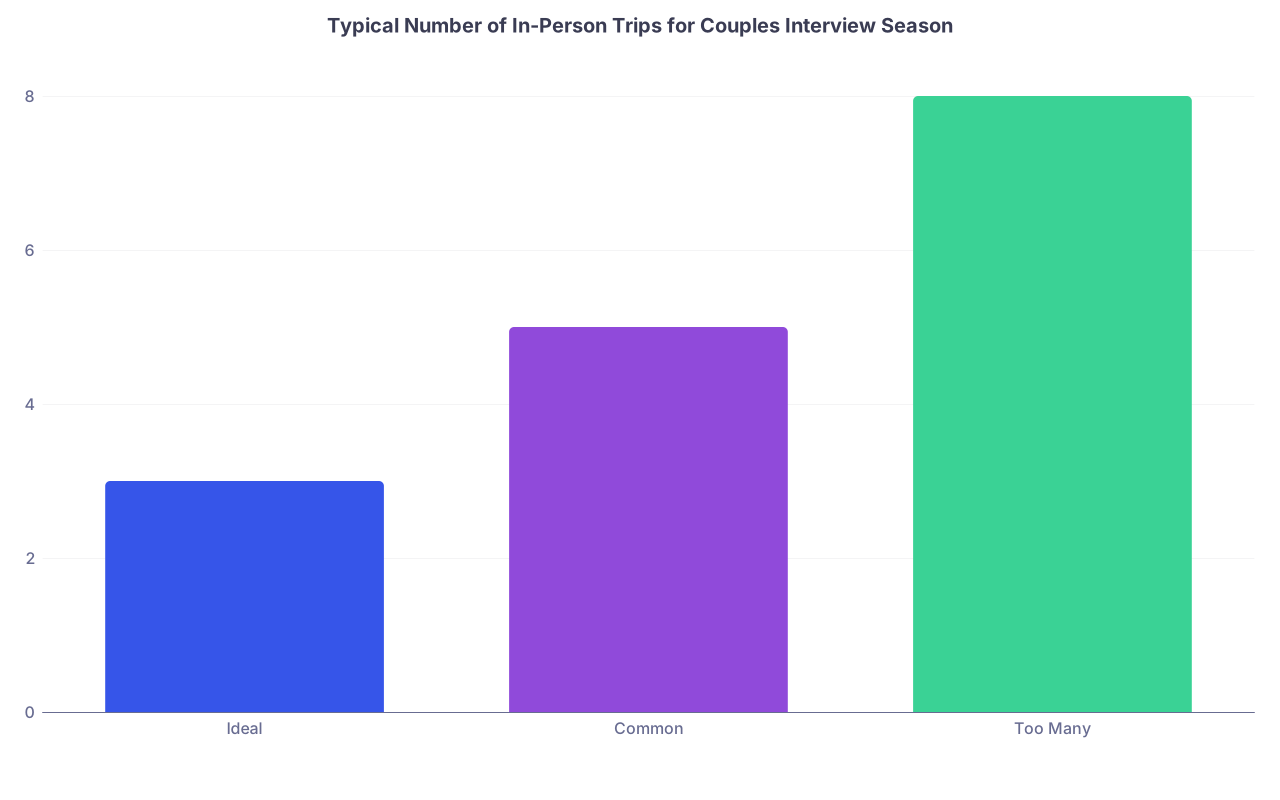
| Category | Value |
|---|---|
| Ideal | 3 |
| Common | 5 |
| Too Many | 8 |
- Ideal: 2–4 multi‑city trips plus scattered virtual days.
- Common: 4–6 because people say yes to too many marginal invites.
- Too many: 7–8+ distinct trips. At this point your performance and sanity fall off.
If you are creeping into the “too many” range, you must start declining or converting to virtual where possible.
Tactical Travel Tips Specific to Couples
You are not just two people traveling. You are two people interviewing on different days, sometimes in different cities, with limited money and time.
Use these rules:
Central lodging beats proximity if you have multiple programs
- In cities like Boston, NYC, Chicago:
- Stay near public transit hubs rather than next to one specific hospital.
- You avoid switching hotels every night.
- In cities like Boston, NYC, Chicago:
One travel manager
- Decide who is in charge of actually pressing “purchase” on flights and hotels.
- The other person double‑checks dates and times before anything is bought.
- Eliminates the “I thought you booked it” disaster.
Backup plans for weather
- In winter regions, do not book last‑flight‑of‑the‑day arrivals before a big interview.
- Aim for afternoon arrivals or even arrive a full day early for key programs.
Luggage strategy
- One checked shared suitcase + two carry‑ons often works better than both checking bags repeatedly.
- Keep interview clothes, shoes, and basic toiletries in your carry‑on in case luggage is delayed.
Use downtime strategically
- While one of you is on interview day, the other:
- Scouts neighborhoods.
- Walks by potential apartment areas.
- Takes notes on how the city feels.
- That information becomes extremely valuable later when you are ranking.
- While one of you is on interview day, the other:
After Interview Season: Preparing for Couples Ranking
Travel is winding down. At this point you should be turning your logistics data into ranking strategy.
Late January–Early February: Debrief and Map Options
Using your spreadsheet and your impressions:
Score each program for each of you
- Simple scores (1–10) on:
- Fit.
- Training quality.
- Lifestyle.
- City livability.
- Simple scores (1–10) on:
Identify actual couples combinations
- Group programs by city/region.
- For each region:
- Which programs did Partner A interview at?
- Which did Partner B?
- Mark combinations that are at least “both acceptable.”
Highlight your anchor regions
- These are places with:
- Multiple possible pairs.
- At least one combination that both of you would rank highly.
- These are places with:
This is when you will be glad you traveled strategically instead of randomly.
Visualizing Your Season at a Glance
Sometimes you just need to see how packed you are.
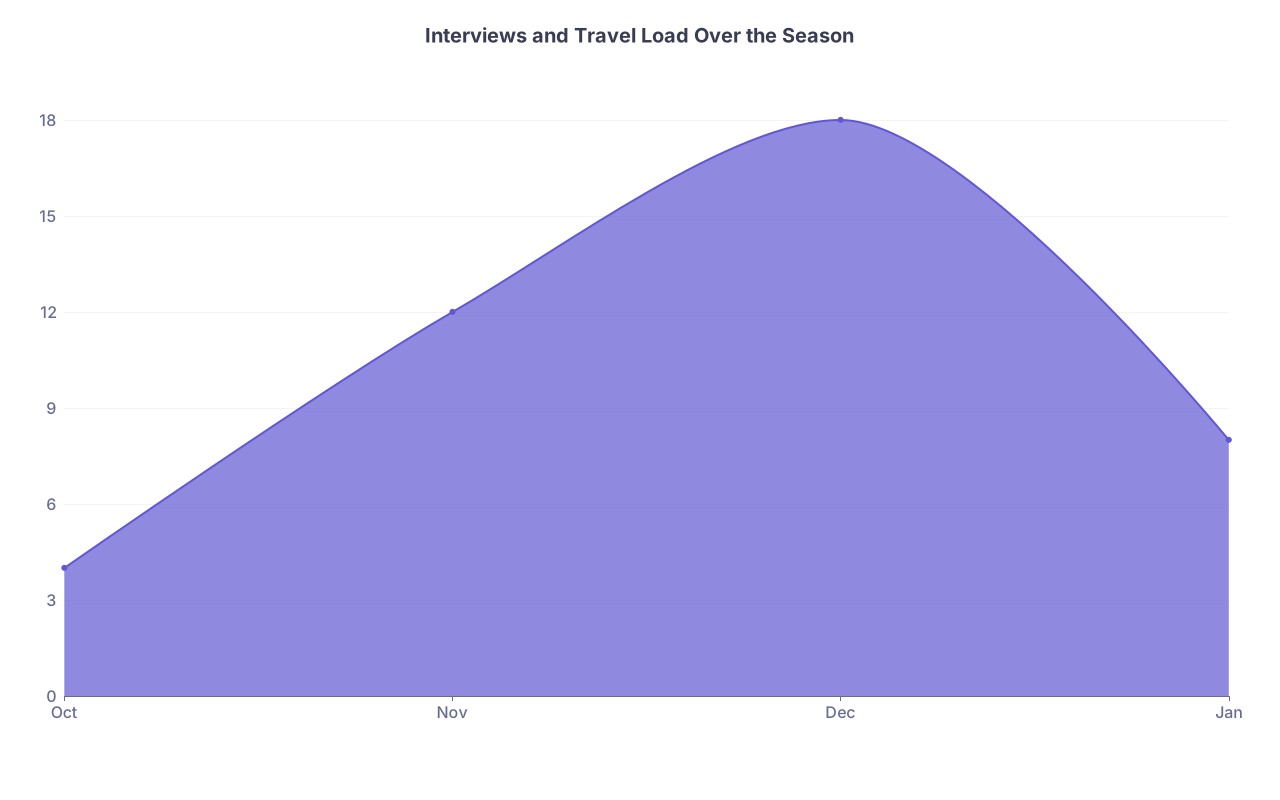
| Category | Value |
|---|---|
| Oct | 4 |
| Nov | 12 |
| Dec | 18 |
| Jan | 8 |
- October: System building, first invites.
- November: Major scheduling and first trips.
- December: Peak overload.
- January: Clean‑up, final strategic moves.
Key Takeaways
- Decisions made in September and October determine how miserable or manageable your November–January will be as a couple. Build the shared tracker, rules, and priorities early.
- React to invites with a fixed system, not vibes. Same‑city weeks, regional clustering, and hard limits on total trips protect both your budget and your performance.
- By January, shift from accumulation to optimization. Cancel ruthlessly, consolidate remaining trips, and turn your travel data into a clear couples ranking strategy.


