
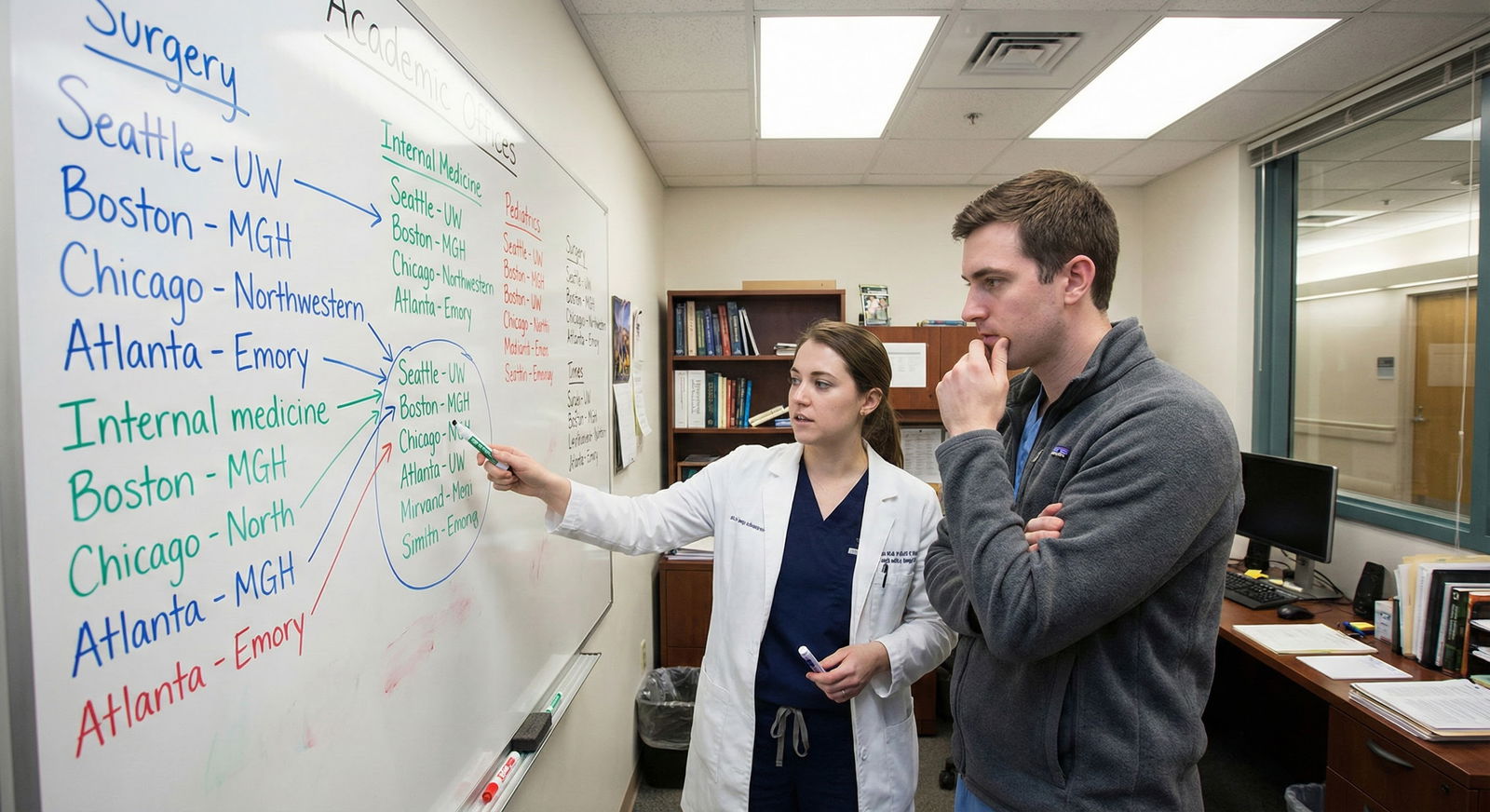
Treating the pre-ERAS summer like “bonus time” for couples is how you end up scrambling in September. If you are serious about Couples Match, this summer is not a vacation. It is your joint strategy phase.
What follows is a practical, time-based guide: month-by-month, then week-by-week within the key window, and finally day-by-day as ERAS opens. At each point, I will tell you exactly what you should be doing together, not just individually.
May: Alignment Month – Lock the Big Rocks First
By the end of May, you should be aligned on your non‑negotiables as a couple. If you skip this, every later decision becomes a fight.
At this point you should:
Define your true priorities as a couple.
Sit down for one focused 60–90 minute conversation. No screens except a shared document. Each person answers these separately first, then compare:- Top 5 cities or regions you would be happy living in
- Any absolute no-go locations (family, weather, politics, cost, etc.)
- Minimum program quality level you are comfortable with
- Willingness to do:
- One partner at community, the other at academic
- One partner at a “reach” program, the other at a “safety”
- Long commute (45–60+ minutes) if programs are in neighboring cities
Then build three tiers:
- Tier 1: Dream + realistic cities where both have options
- Tier 2: Good but not ideal cities
- Tier 3: “If we have to” cities you are willing to rank low but not exclude
Get brutally honest about competitiveness.
This is where couples lose touch with reality. Do not do that.Each of you should list:
- Step 1 (P/F) and Step 2 CK score
- Class rank / quartile or AOA status
- Number of research experiences and pubs/posters
- Home program strength in your specialty
- Red flags (leave, fail, professionalism issue, reassessment year)
Then, together, categorize each partner:
- Stronger applicant (more competitive for their specialty)
- Average applicant
- Vulnerable applicant (low scores, less consistent application, or very competitive specialty)
One of the biggest strategic mistakes: couples pretend both partners are equally competitive when they are not. Your application strategy must be built around the more vulnerable partner’s risk, not the stronger partner’s ego.
Quantify how wide your net must be.
As a couple, you should agree on a target number of applications per person by the end of May. Use this rough guide (assuming both are US MD/DO):
| Couple Risk Level | Per Person Applications | Notes |
|---|---|---|
| Low (both solid, non-competitive specialties) | 30–50 | Fewer if strong home programs and good geography flexibility |
| Moderate (one partner weaker or one mid-competitive specialty) | 60–80 | Most couples land here |
| High (both weaker or at least one very competitive specialty) | 90–120 | Requires financial planning and true geographic flexibility |
You are not carving this in stone yet, but you need a ballpark now to avoid financial shocks later.
Clarify your relationship parameters.
Say the hard part out loud now, not in January:- Are you absolutely unwilling to be in different cities?
- If you had to choose between:
- A weaker program together vs. a stronger program apart – which wins?
- Is “separate for 1 year then try to transfer” even on the table?
Write this down. Literally. A shared Google Doc. When stress hits later, having that early, calmer agreement matters.
June: Information Month – Map the Program Landscape Together
June is your research sprint. At this point you should have stopped hand-waving about “maybe Boston” and started building an actual shared program map.
Weeks 1–2 of June: Build Your Shared Master Spreadsheet
You need one joint spreadsheet, not two disorganized lists.
Columns to include (and yes, this level of detail matters):
- Program name (Partner A)
- Program name (Partner B)
- City / region
- Type (academic / community / hybrid)
- Program size (positions per year)
- Known couples-friendly reputation? (yes/no/unknown)
- Step 2 preferences (cutoffs, typical range)
- Visa issues (if IMG or visa-dependent)
- Existing residents from your school? (Y/N + names)
- Subjective “fit” rating for each partner (1–5)
- Driving distance to each other (when programs are separate but nearby)
- Internal notes (who you know, red flags, random intel)
You can both populate this in parallel.
Weeks 3–4 of June: Reality-Check and Trim
By the end of June, your list should look realistic.
At this point you should:
- Remove fantasy programs that neither of you matches on paper
- Flag “anchor programs” – places that are:
- In your Tier 1–2 cities
- Realistic for both partners
- Large enough to have multiple positions (easier for couples)
Aim for this distribution by June 30:
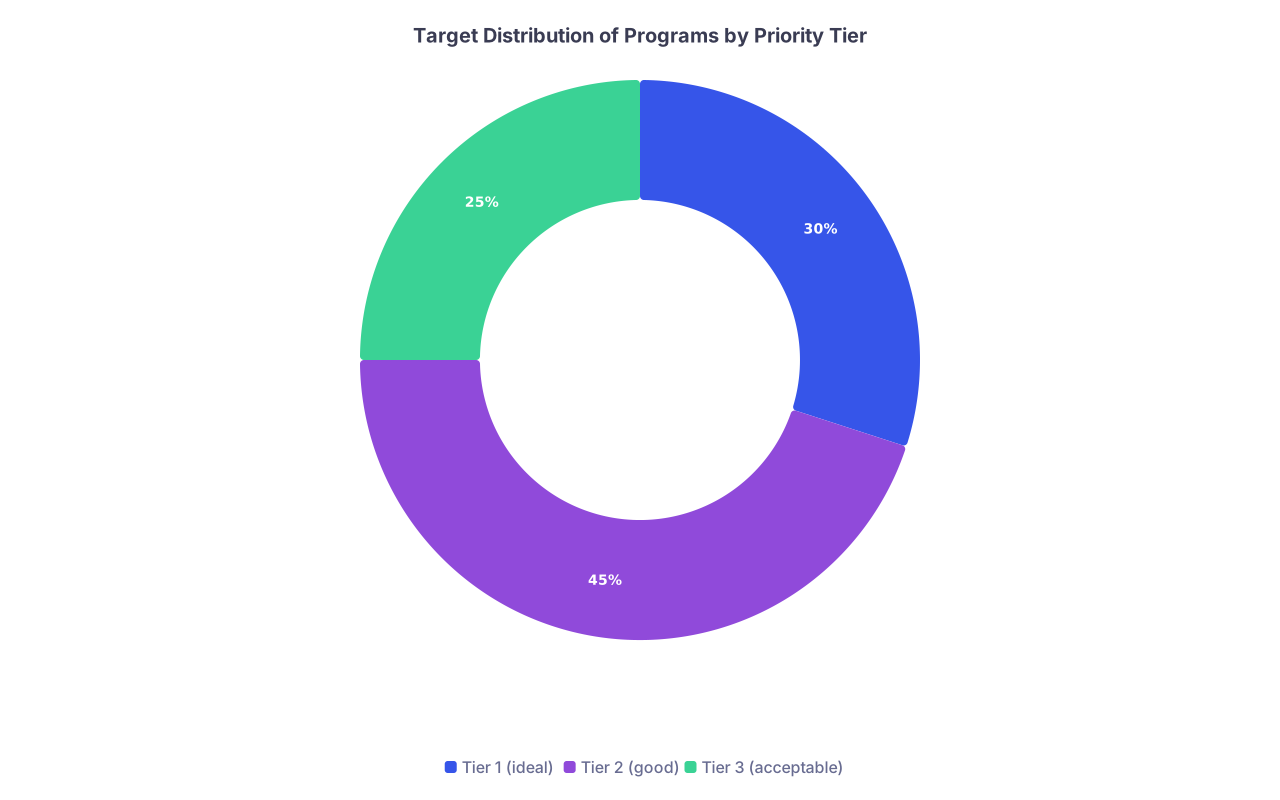
| Category | Value |
|---|---|
| Tier 1 (ideal) | 30 |
| Tier 2 (good) | 45 |
| Tier 3 (acceptable) | 25 |
The exact numbers do not matter. The principle does: not all cities are equal. You need a core of high-priority, high-investment targets.
July: Application Construction Month – Sync Your Narratives
July is where individual ERAS prep and couple strategy have to merge. If you work in silos, your story as a couple falls apart.
At this point you should be doing three things in parallel:
Finalize personal statements with a joint narrative in mind.
No, you do not need a “joint couples personal statement.” But you need consistency:
- If Partner A says they are deeply committed to academic cardiology and big research centers…
- And Partner B is telling programs they are desperate to live in a smaller city near family…
You look disorganized as a couple.
Coordinate on:
- Geographic story: why these regions make sense for both of you
- Career story: whether you expect to need big academic centers vs. strong community programs
- Any couple-specific background worth including (long-distance history, shared commitments, etc.) – keep it subtle, not melodramatic
Build a shared “program communications” document.
This is non-negotiable for couples.
One live document where you track:
- Every PD / PC / faculty email either of you sends
- When you mention that you are couples matching
- who you spoke with at meet-and-greets, virtual open houses, etc.
- Any promises or strong interest you expressed (so you do not double-signal or contradict each other)
This prevents the classic disaster where Partner A tells Program X “You are our top choice” while Partner B is telling Program Y the same thing in the same city 40 minutes away.
Draft a couples match blurb.
You will reuse this language a lot in emails and, later, at interviews.
3–5 sentences that cover:
- Your relationship (brief: “We are a long-term couple in a stable relationship…”)
- Your specialties
- Your geographic focus
- Your flexibility (willing to be at separate but nearby programs vs. strongly prefer same institution)
Have this done by mid-July. You will be glad you did when you are sending 30 slightly customized emails in October.
August (Pre-ERAS Opening): Tactical Month – Lock the List and Prep the Details
The first 2–3 weeks of August are where serious couples either pull ahead or start to drown.
First Half of August: Final Program List and Application Count
At this point you should:
Freeze your program list for 80–90% of applications.
Leave a small buffer for late additions, but stop endlessly tinkering.Assign “application tiers” for both partners at each program.
For each city/region, categorize the combos:
- Same institution, same city – top priority
- Different institution, same city/metro area – solid option
- Different city but within 1–1.5 hour drive – backup
- Different regions – used only to avoid both going unmatched
You are not building the final rank list yet. You are shaping where you flood with applications vs. where you just “take a shot.”
Plan your ERAS financials together.
Do not be surprised by the bill.
- Estimate primary and secondary (if applicable) application costs for both
- Decide whether you need to trim the list for cost reasons
- If one of you is already deep in debt, decide how you are sharing costs (ugly topic, but necessary)
Second Half of August: Polish and Sync
Now you are close to ERAS opening.
At this point you should:
- Have CVs / experiences fully entered in ERAS (for both)
- Make sure your experiences tell parallel but not copy-paste stories if you worked in similar settings
- Finalize letters of recommendation, with at least:
- 1–2 letters that can specifically mention your couples situation (only if writers know you both and it is natural)
- Others focused purely on individual merit
You want everything 95% complete before the final week of August. The last 5% is reserved for tightening and cross-checking.
Last 10 Days Before ERAS Submission: Micro-Timeline
Here is where a lot of couples get derailed by chaos. Do not.
Day –10 to –7: Cross-Audit Each Other’s ERAS
At this point you should:
- Swap logins in person and go through each other’s application (or screenshare)
- Look for:
- Conflicting geographic statements
- Differing graduation dates, research dates, or positions
- Typos that one of you is blind to
- Tone differences that make one of you sound far less serious
You are not editing each other into the same person. You are making sure the applications feel like they are written by two adults who talk to each other.
Day –7 to –4: Finalize Program List and Filters
You already did the big thinking. Now you lock it.
At this point you should:
Confirm the exact list of programs each partner is applying to
Color-code in your spreadsheet:
- Same program, same city
- Different programs, same city
- Nearby cities
- “Solo” programs (one partner only)
Give each category a rough priority score so you can later interpret interview invites through a shared lens.
Day –3 to –1: Final Stress Test
Use one evening to do a joint risk check:
- Ask: “If we only got 3 interviews each in X region, how would we feel?”
- Check whether your list is too top-heavy in some cities
- Adjust 5–10 programs if needed to add more midsafety options for the more vulnerable partner
Then stop changing things. At some point, more fiddling just raises anxiety without improving outcomes.
Early Application Submission Day: How to Handle It as a Couple
When ERAS opens and you finally submit, treat this as a joint operation, not two solo missions.
On submission day you should:
Sit together when you hit ‘submit’ (or at least be on a call).
Final quick checks:- Program counts match your plan
- Programs you absolutely care about are present for both
- No obvious geographic contradictions in your narratives
Immediately save PDFs of both submitted applications.
You will reference these later when drafting emails to PDs or prepping for interviews.Update the master spreadsheet to show:
- Submitted status for each program
- Any last-minute changes
- Priority tags that you can sort later when interview invites start rolling in
This is the moment where your pre-ERAS summer work either pays off or exposes all the lazy shortcuts. If you have done the steps above, you will feel oddly calm. That is the goal.
Visual: Couples Strategy Across the Pre-ERAS Summer
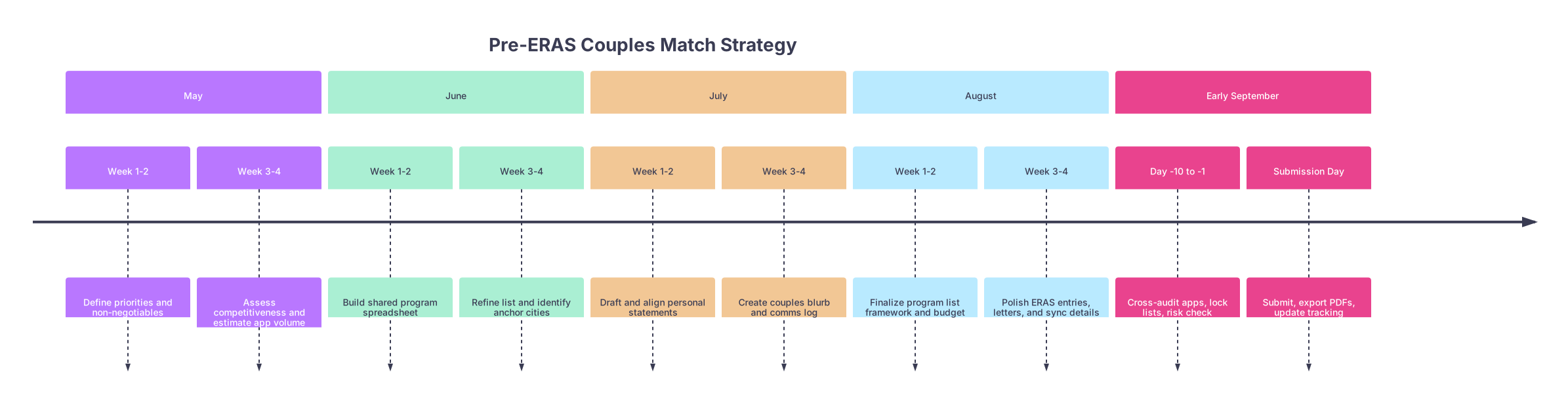
| Period | Event |
|---|---|
| May - Week 1-2 | Define priorities and non-negotiables |
| May - Week 3-4 | Assess competitiveness and estimate app volume |
| June - Week 1-2 | Build shared program spreadsheet |
| June - Week 3-4 | Refine list and identify anchor cities |
| July - Week 1-2 | Draft and align personal statements |
| July - Week 3-4 | Create couples blurb and comms log |
| August - Week 1-2 | Finalize program list framework and budget |
| August - Week 3-4 | Polish ERAS entries, letters, and sync details |
| Early September - Day -10 to -1 | Cross-audit apps, lock lists, risk check |
| Early September - Submission Day | Submit, export PDFs, update tracking |
Common Strategic Mistakes Couples Make in the Pre-ERAS Summer
I see the same errors every cycle:
Pretending the couples problem is solved by “just applying broadly.”
Without a geographic and tiered plan, you waste money and get scattered interviews that do not align.Ignoring the weaker partner’s constraints.
The least competitive partner largely sets the size and shape of your list. Fighting that reality backfires.Failing to document anything.
If you are not tracking programs, communications, and tiers in one shared place, you will lose track by October.Not rehearsing hard choices before they are real.
Talking through “what if we only match in different cities” in January, when you are exhausted and scared, is a nightmare. Do it now.
FAQ (Exactly 4 Questions)
1. When should we tell programs that we are Couples Matching?
You do not need to blast it in your personal statement. The key places to mention it:
- In ERAS, check the Couples Match option and list your partner
- In emails to PDs / PCs after interview invites (or in a very targeted pre-interview email in key cities)
- Briefly in interviews when asked about geography or priorities
You are not hiding it, but you also are not leading every interaction with “We are a couple.” Make it part of your context, not your entire identity.
2. How different can our geographic preferences be and still have a workable strategy?
You need at least one overlapping region where both of you are truly willing to go and have a decent number of programs. If Partner A only wants West Coast and Partner B only wants Northeast, your odds drop sharply. Use May and June to negotiate to 2–3 overlapping regions, then bias your list heavily toward those zones. Outside regions can still be on the list, but they become lower-priority safety or reach options.
3. What if one of us is applying to a hyper-competitive specialty (e.g., Derm, Ortho, Plastics)?
Then your entire strategy must be built around risk containment. The competitive partner should still apply realistically wide, but:
- The other partner must be aggressively broad geographically, especially in overlapping cities
- You should both strongly consider large programs and cities where there are many residencies across multiple specialties
- Have an honest Plan B conversation (re-applying, prelim/TY year, research year) before ERAS opens
Do not pretend the match odds are the same as IM + Peds. They are not.
4. Is it a bad idea to apply to any programs where only one partner is applying?
Not inherently. In fact, it can be a useful backstop against both going unmatched. The mistake is applying to too many solo programs without a plan. Use them strategically:
- Limit solo programs to places where that person would genuinely go even without their partner nearby
- Keep them a lower rank list priority than strong paired options
- Talk through whether you would ever actually choose a solo match over going unmatched together
If you are not willing to act on that solo option, save the money and skip it.
Today, do one concrete thing: open a shared spreadsheet and build the skeleton of your joint program list with three tiers and clear geographic categories. If you do that now, every other decision this summer becomes sharper and easier.


