

The worst-kept secret in the residency process is this: most couples reveal their Couples Match plans either too late or to the wrong people first.
You cannot afford that mistake.
If you are Couples Matching, your calendar is your strategy. Who you tell, and exactly when, affects letters, interview offers, and how programs rank you. There is a right order and a right tempo.
I will walk you through it—month by month, then week by week once interviews start, and finally down to the email timing before rank lists lock.
Big Picture Timeline: Who Needs to Know When
Before we zoom into the calendar, fix this mental model:
- Advisors (school / specialty / career): early and fully.
- Mentors (letter writers, research PIs, away rotation attendings): early–mid, selectively.
- Program Directors (PDs) and programs: late and targeted.
At this point you should be thinking less “Should I tell?” and more “Exactly when and how do I tell each group?”
Here is the high-level sequence:
| Group | Primary Timing | Method |
|---|---|---|
| School advisor | 12–14 months pre-Match | Meeting |
| Specialty advisor | 10–12 months pre-Match | Meeting / email |
| Key mentors | 8–10 months pre-Match | Meeting / email |
| LOR writers | 7–9 months pre-Match | LOR request discussion |
| PDs (broad) | Usually not pre-interview | N/A |
| PDs (priority programs) | Late interview season | In-person / email |
| Final “first choice” PDs | 1–3 weeks before rank deadline |
Now let us run the actual timeline.
12–15 Months Before Match: Quiet Planning, First Disclosures
Think late MS3 / early MS4 for most U.S. students, or roughly March–June for a typical ERAS cycle that submits in September.
At this point you should:
Clarify if you are truly Couples Matching
- Decide if:
- You will actually register as a couple in NRMP (not just “try to be in the same city”).
- You are both applying the same year.
- One of you is willing to SOAP or take a gap year if it goes badly. (Harsh but real.)
- Decide if:
Tell your primary school advisor early
This is usually the official dean’s office advisor or assigned faculty advisor.When:
- As soon as you are 90% sure you will Couples Match. For most, that is ~12–15 months before Match (before sub-I planning, before away rotations are locked).
Why this early:
- They help you:
- Plan away rotations that line up geographically.
- Set realistic specialty targets (for each of you).
- Decide whether one of you needs a less competitive specialty or broader application.
How to say it (in a 30‑minute meeting):
- “We are planning to register as a Couple in the Match. I am applying in [Specialty A], my partner in [Specialty B]. Our priority is [same city vs same program vs specific region]. We want your help planning a strategy and risk level that makes sense.”
Do not sugarcoat competitiveness. If you are both shooting for Derm in Boston with mid-tier applications, your advisor needs to know that now, not in October.
Keep PDs out of the loop—for now
- You are too early.
- There is no upside to telling any PDs or programs at this stage. They will forget by interview season.
9–12 Months Before Match: Specialty Advisors and Mentors
Now we are in the late MS3 / early MS4 spring and early summer, or roughly May–July before a September ERAS submission.
At this point you should:
Loop in specialty-specific advisors
- Example: the Internal Medicine advising director, the EM advising group, the Surgery clerkship director who does residency advising.
When:
- 9–12 months before Match, when you meet them to talk:
- Target program list.
- Number of applications.
- Whether you should apply in a backup specialty.
What you tell them:
- “I am Couples Matching with my partner in [specialty]. We plan to prioritize [regions]. I want to make sure my application strategy aligns with that, including how many programs I apply to in [specialty] and whether I need a parallel plan.”
This helps them shape:
- How aggressive or conservative your list should be.
- Whether they should steer you toward “couple-friendly” institutions (big systems, multiple residencies).
Inform key mentors who might advocate for you
- Research PI.
- Away rotation attendings at your dream institution.
- The faculty member who talks directly to their PD every week.
When:
- 8–10 months before Match, during:
- End-of-rotation feedback conversations.
- Research meetings when you start talking about letters and future plans.
Why here:
- They can:
- Write letters that mention your Couples Match (strategically).
- Call their PD or coordinator and say, “We have a strong couple you should keep an eye on.”
How explicitly to say it:
- “I am Couples Matching with my partner, who is applying in [specialty] this cycle. We are especially interested in [City X / Region Y]. If you think it is appropriate, I would appreciate any guidance on programs that are receptive to couples, or any advocacy you might be willing to do.”
Notice what you did not do: you did not ask them to tell PDs yet. That comes later and more selectively.
6–9 Months Before Match: Letters and ERAS Strategy
This is the heavy planning and ERAS prep phase, roughly June–September.
At this point you should:
Make sure all letter writers know
- Even if you already hinted, confirm when you formally request letters.
When:
- 7–9 months before Match (early summer, before they write).
How to structure the request (email or in person):
- “I am applying in [Specialty] this year and would be honored to have a strong letter from you. I am also Couples Matching with my partner, who is applying in [Specialty B]. We are focusing on [region(s)]. If you feel it is appropriate, mentioning my participation in the Couples Match and my teamwork/communication strengths could be helpful.”
Should letters explicitly mention the Couples Match?
- My view: selectively.
- Good to mention if:
- You are applying to a large academic center with multiple programs.
- Your partnership is an asset (e.g., both in primary care fields, strong institutional fit).
- Less useful or potentially distracting if:
- Your partner is in a very different, riskier specialty.
- Your primary value to the program is your individual research / scores.
- Good to mention if:
Do not describe Couples Match in your personal statement as the main storyline
- You are applying as a physician, not as half a package.
- A single sentence is fine:
- “My partner and I will be participating in the NRMP Couples Match, and we hope to continue our training in the same region.”
- Anything longer starts to read like the residency is an accessory to your relationship.
Still no formal PD outreach about the Couples Match
- PDs at this stage are buried in:
- Reviewing applications.
- Finalizing interview numbers.
- Early “By the way I am Couples Matching” emails in September go nowhere and sometimes annoy.
- PDs at this stage are buried in:
3–6 Months Before Match: Interview Season — Week-by-Week Tactics
Now we are in the core: October–January. This is where timing truly matters.
Here is how to think about it, in phases.
Phase 1: Early Interview Invitations (Weeks 1–3 of invites)
At this point you should:
Coordinate interview dates with your partner quietly
- Use a shared spreadsheet or calendar.
- Keep cities and dates aligned where possible (same week or same trip regionally).
During interviews, disclose selectively and naturally
- You do not lead with “We are Couples Matching” in every room.
- Instead, look for:
- “Any questions for us?” at the end.
- “Do you have location preferences?” discussions.
- “Tell me about your support system” type prompts.
Sample script in the room:
- “One thing that is important to share is that I am participating in the Couples Match. My partner is applying in [Specialty B]. Our goal is to be in [Region / City], and we are applying broadly within that area.”
2 rules:
- Rule 1: You say this to faculty and PD/APD level interviewers, not just residents.
- Rule 2: You do not sound like you are attaching conditions (“I will only come here if…”). Just state it as context.
Keep broad PD-level communication for later
- Resist the urge to send early-season emails about the Couples Match to every program. Programs hear lots of “you are one of my top choices” noise. Early in the season, you are just adding to the noise.
Phase 2: Mid-Season Interviews (Roughly November–December)
By now, patterns have emerged:
- Some cities where one of you has multiple interviews.
- Some crucial programs where only one of you has an interview.
At this point you should:
Start program-specific Couples Match disclosure to PDs/APDs
- Threshold: only at programs you realistically could rank highly and where:
- Both have interviews, or
- One has an interview and the other has a plausible shot.
Best timing:
- Around your interview date or soon after (within 1–2 weeks).
In person, if possible (on interview day):
- At the end of your PD/APD interview:
- “I want to share one more thing: I am Couples Matching with my partner, who is applying in [Specialty] and has interviews at [X/Y]. We would be thrilled to be in this city together, and I wanted you to be aware of that as you consider our applications.”
If no direct PD interview, use a concise follow-up email:
- Subject: “Thank you and Couples Match note – [Your Name], [Specialty] Applicant”
- Body (short, 3–5 sentences):
- Thank them for the interview day.
- One sentence about fit.
- One sentence very clearly stating:
- “I am participating in the NRMP Couples Match with my partner, who is applying in [Specialty B] and has [an interview at Your Institution / interviews at several programs in City X]. We are strongly hoping to train in the same city.”
- Express appreciation, no ranking promises yet.
- Threshold: only at programs you realistically could rank highly and where:
Use your mentors strategically now
- This is the time to ask for quiet advocacy:
- “If you feel comfortable, would you be willing to let [Program X] know that my partner and I are Couples Matching and would love to be at the same institution?”
But be selective:
- 3–5 key programs each, not 25.
- This is the time to ask for quiet advocacy:
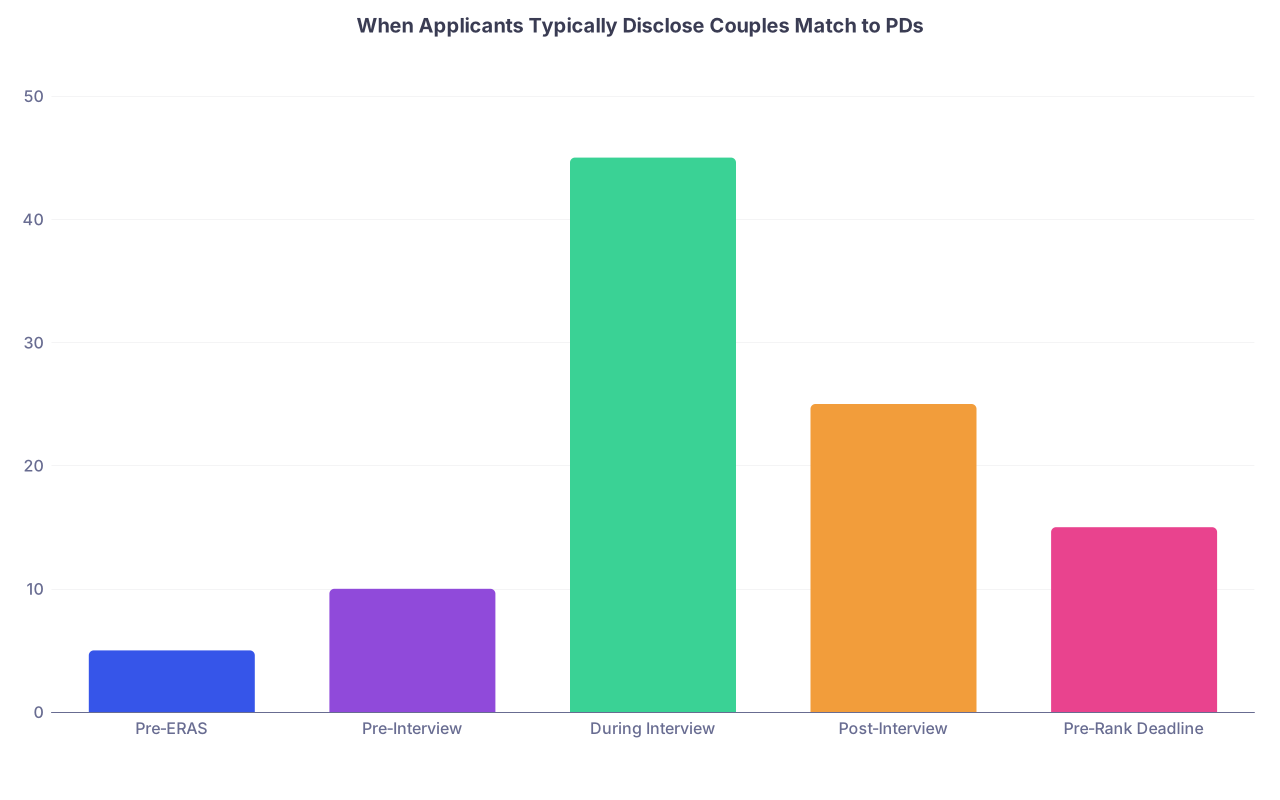
| Category | Value |
|---|---|
| Pre‑ERAS | 5 |
| Pre‑Interview | 10 |
| During Interview | 45 |
| Post‑Interview | 25 |
| Pre‑Rank Deadline | 15 |
1–2 Months Before Rank List Deadline: Tightening the Signal
Now we are in late January to early February. Interview season is ending or done. Your lists are forming.
At this point you should:
Finalize your Couple strategy first
- Sit down, both of you, and decide:
- Top 3–5 cities you would actually be happy in.
- 5–7 programs each that you could realistically rank at or near the top.
- How much each of you is willing to “compromise” so the pair match succeeds.
If you do not have this clarity, emailing PDs about “you are our top choice” is dishonest or stupid. Or both.
- Sit down, both of you, and decide:
Now, and only now, send targeted PD emails with clear signals
Who gets these emails:
- Programs:
- In your genuinely top tier.
- In cities where your partner also has strong programs.
- That have at least hinted they are interested (good vibes, follow-up, resident enthusiasm).
Timing:
- 2–4 weeks before rank list certification.
- Not the night before the deadline when their rank meeting is already over.
Content should include:
- Clear mention that you are Couples Matching.
- Your partner’s specialty and whether they have interviews in the same city or at the same institution.
- If true, that the program is your first choice or in your very top group.
Example:
- “I wanted to update you as we approach rank list decisions. I am participating in the NRMP Couples Match with my partner, who is applying in [Specialty B] and has interviewed at [Program B at Your Institution / several programs in City]. [Your Program] is my top choice, and we would be thrilled to train in [City] together. I hope this information is helpful as you finalize your rank list.”
Put “top choice” or “first choice” language only where it is true. PDs talk.
- Programs:
Coordinate messaging across both specialties
- Your partner should be sending parallel emails in their specialty.
- At this point you should:
- Use similar language.
- Avoid contradictory statements (“You are my #1” at three different institutions in the same city).
Who Not To Tell, and When Silence Is Smarter
A few hard truths I have learned watching couples every year:
Do not overshare with programs you will rank low
- They cannot help you.
- You are giving them information about your dependency on location that might hurt rather than help, especially if they suspect they are a backup for you.
Do not lead with Couples Match in every interview
- If your very first response to “Tell me about yourself” is “I am Couples Matching,” you sound like the program is a prop for your relationship.
- Work, then life. Not the other way around.
Do not let mentors email programs saying “They will rank you #1” unless that is accurate
- PDs remember who plays games.
- You risk burning bridges for your mentors and yourself.
Quick Timeline Recap
If you skimmed everything else, remember this chronological spine:
12–15 months pre-Match:
Tell your school advisor. Start high-level geographic and specialty strategy. No PDs yet.9–12 months pre-Match:
Tell specialty advisors and key mentors. Use this to shape your program list and competitiveness strategy.7–9 months pre-Match:
Tell letter writers, so they can frame you appropriately. Decide whether Couples Match appears briefly in your personal statement.Interview season (Oct–Jan):
- Mention Couples Match in interviews when location, support systems, or future plans come up.
- Start selective PD/APD disclosure during or right after interviews at programs you like and where you or both have interviews.
2–4 weeks before rank deadline:
- Lock your actual couple strategy.
- Send targeted, honest PD emails at your genuinely top programs, clearly mentioning Couples Match and your level of interest.
If you remember nothing else: tell advisors early, mentors mid, PDs late—and never everyone all at once.


