

The biggest mistake couples make in Match Week is “waiting to see what happens.” That’s not a strategy. That’s how you end up making a life‑changing decision in 6 minutes on a shaky FaceTime call.
You need a daily plan and pre‑made decisions for every scenario before those NRMP emails show up.
I’m going to walk you through a countdown structure you can actually follow:
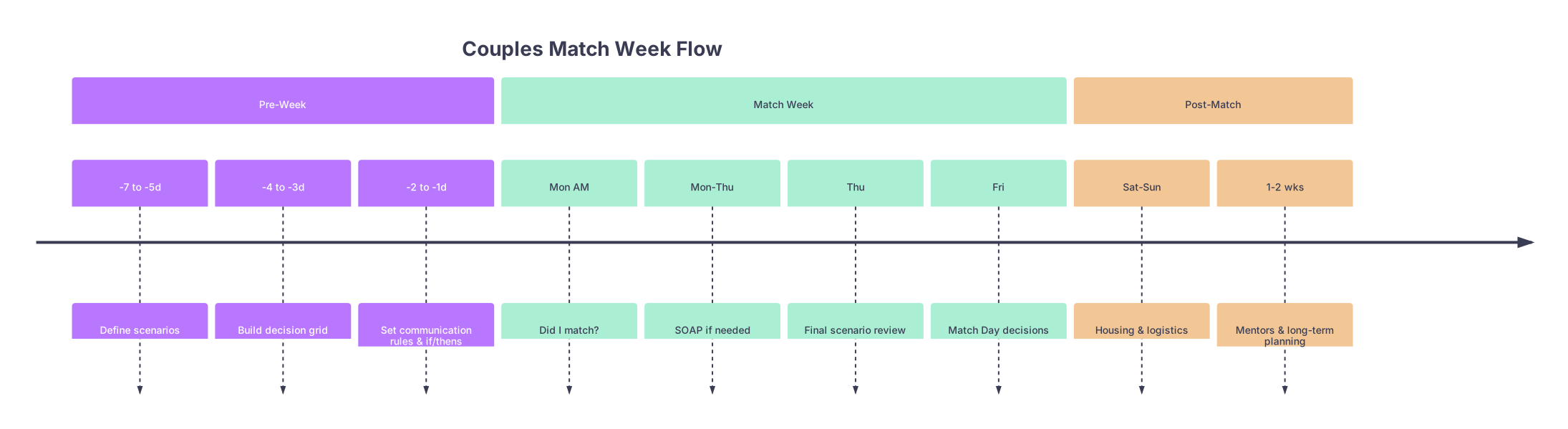
- One week before Match Week
- Match Week: day‑by‑day (Monday–Friday)
- Weekend after Match
- What to do if you do not match as a couple or end up in different cities
This is geared specifically to couples with multiple realistic scenarios: different cities, different specialties, prelim vs categorical, SOAP risk, etc.
One Week Before Match Week: Lock Your Framework In
At this point you should stop “what‑iffing” and start committing.
7–5 Days Before: Define Your Scenario Map
Sit down together. No phones. No distractions. Print your rank list and a blank sheet.
Your goal: reduce chaos by naming and ranking your likely outcomes.
Create 4–6 scenario “buckets”:
- Scenario A – Dream Together:
Both match at top joint choice in same city/system. - Scenario B – Same City, Different Programs:
Both match in same metro but not same institution. - Scenario C – Commutable Distance:
1–3 hours apart by car/train. - Scenario D – Long Distance:
Flights involved, different states/regions. - Scenario E – One Matches, One Does Not:
One gets a spot, the other is in SOAP or unmatched. - Scenario F – Both Do Not Match (or one in SOAP, one prelim only):
Worst‑case.
Now, for each scenario, answer three questions in writing:
- Will we physically live together, partially, or do long‑distance?
- Who is the primary driver of location (whose program is objectively harder to re‑enter/transfer from)?
- What are our non‑negotiables? (Example: “We will not do long‑distance for more than 2 years,” or “We won’t sacrifice her integrated plastics match to keep his borderline IM spot in a less desired city.”)
If you don’t write this down now, you’ll argue about it in tears on Thursday.
4–3 Days Before: Build Your Decision Grid
At this point you should turn vague preferences into a concrete comparison.
Make a simple comparison table for your top 4–6 likely city/program combinations.
| Location/Program Pair | Training Quality Priority | Cost of Living | Family Support Nearby | Commute Between Programs | Long-Term Fit (5+ yrs) |
|---|---|---|---|---|---|
| City A – Both Matched | High | Medium | Strong | 15 min | Excellent |
| City B – Same City | High | High | Weak | 40 min | Good |
| City C – 2 Hours Apart | Medium | Low | Medium | 2 hrs | Fair |
| City D – Long Distance | High (one partner) | Medium | Weak | Flight | Poor |
| City E – One Unmatched | Varies | Low | Strong | N/A | Uncertain |
Rank each row together. Force a numerical ranking: 1, 2, 3, etc. No ties.
Then define your tie‑break rule in one sentence:
- Example: “If we have to choose between both being matched in different cities vs one being unmatched but same city, we choose: _______.”
You’ll hate filling that blank. Do it anyway. That’s the whole point.
2 Days Before: Decide Your Communication Rules
By now, you should stop changing the actual rank list and start planning how you’ll handle the week.
Agree on:
- Where you’ll be when you open emails (together / separate rooms / with friends / alone).
- Who you’ll tell first (parents, siblings, no one until Friday, etc.).
- Rules for social media (no posts until both feel stable, no sharing details about the other’s outcome).
- How you’ll communicate under stress
- Code words like: “I need a 10‑minute break before we talk logistics.”
- No big life ultimatums in the first 24 hours after bad news.
You’re not being dramatic. I’ve watched couples implode on Thursday because one partner started texting parents before they’d even discussed long‑distance.
1 Day Before Match Week (Sunday): Script Your “If/Then”s
At this point you should turn your scenario buckets into if/then decisions.
Write this out, literally:
- If we both match in City A → Then we:
- Move there together July 1.
- Start apartment search by Sunday night.
- Tell families Monday after we get confirmation.
- If we both match but in different cities in same region → Then we:
- Decide primary home base in City X.
- Plan alternating weekends with a set schedule.
- Reassess after intern year.
- If one matches, one doesn’t → Then we:
- The unmatched partner does SOAP and focuses on these 2–3 specialties.
- Matched partner still attends orientation and starts residency on time.
- We do not withdraw a secured categorical spot unless both of us agree in writing and after speaking with mentors/PDs.
Stick this on your fridge or desk. You need a visible anchor when your brain goes offline from adrenaline.
Match Week: Day‑by‑Day Plan for Couples
Now we walk through Monday to Friday.
Monday: “Did I Match?” Email
At this point you should only be answering one question: matched vs unmatched. Not “Where?” Not “How do we fix long‑distance?”
7–8 AM (local time):
NRMP sends “Did I Match?” emails.
Plan:
- Be in the same physical space if you can.
- Open at the same time. No “I’ll look first and soften the blow” nonsense. It backfires.
- Have a notepad ready.
There are only a few combinations:
- You both matched
- Write: “We both matched – location TBD.”
- Emotion: relief, but do not start making housing decisions. Just breathe.
- One matched, one did not
- Immediately separate outcomes:
- Matched partner: stable, no action today.
- Unmatched partner: SOAP is now your full‑time job.
- Say out loud: “We’re on the same team. Today we focus on getting you options.”
- Immediately separate outcomes:
- Neither matched
- Brutal, but you gain flexibility.
- Decide quickly: are you both entering SOAP? Are either of you considering a research year?
- Message trusted advisors that morning, not “later this week.”
Monday Midday–Evening: If SOAP Is In Play
If either of you is unmatched:
- Pull up NRMP SOAP list and filter by:
- Specialty
- Region
- Categorical vs prelim
- For couples: prioritize clusters of programs in the same regions so you at least have a geographic shot at proximity.
You have two parallel tracks now:
- Track A: Matched Partner
- Stay available emotionally. But do not micromanage their SOAP list unless invited.
- Keep your PD or dean in the loop; they may be asked about you during SOAP calls.
- Track B: Unmatched Partner
- Draft a short, honest email template to programs emphasizing:
- Clinical strengths
- Flexibility on location
- Existing ties to region if any
- Update CV today, not tomorrow.
- Draft a short, honest email template to programs emphasizing:
You don’t need all the answers on Monday, but you do need momentum.
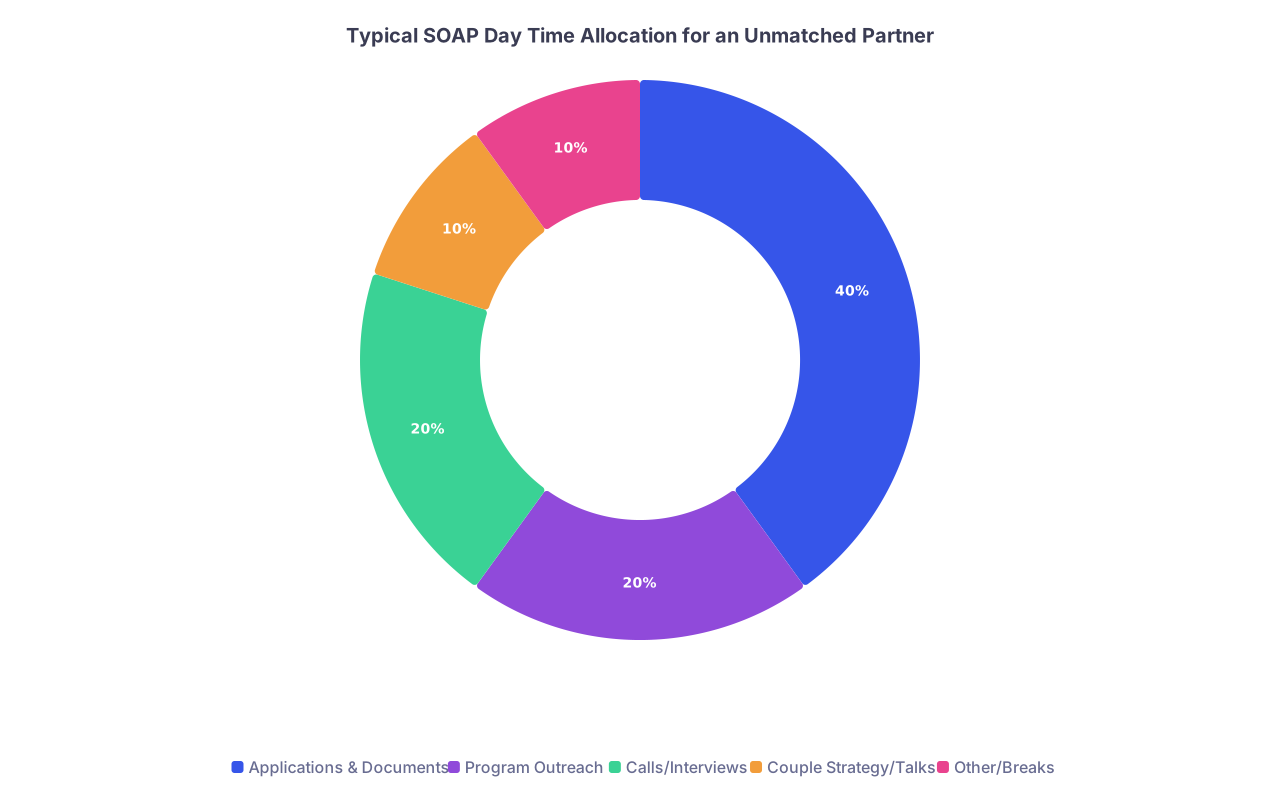
Tuesday–Thursday (SOAP): Tight Coordination, Zero Panic
At this point you should time‑box couples discussions so you don’t derail SOAP work.
Structure your day in blocks:
- Morning: SOAP applications/updates
- Midday: Quick 15‑minute couples check‑in
- Afternoon: Calls/emails from programs
- Evening: Debrief + strategy adjustment
| Category | Value |
|---|---|
| Applications & Documents | 40 |
| Program Outreach | 20 |
| Calls/Interviews | 20 |
| Couple Strategy/Talks | 10 |
| Other/Breaks | 10 |
Your couples checklist during SOAP:
- Confirm: are you both still committed to being in the same city if possible this year, or has that changed?
- Decide: if an amazing SOAP spot comes up far away from the matched partner, is it acceptable or not?
- Update your scenario map nightly based on realistic offers and conversations.
Do not promise a PD you’ll definitely come if they offer without first aligning with your partner. I’ve heard PDs say, “I could hear them whispering to their spouse mid‑call.” It doesn’t inspire confidence.
Thursday Morning: Rank List Lock (SOAP) & Mental Rehearsal
If SOAP is involved, Thursday is about finalizing SOAP preferences.
At this point you should:
- Sit together and review:
- SOAP rank lists
- Geographic implications
- Your original if/then rules from Sunday
- Ask: “If we land on this combination tomorrow, are we willing to live with it for at least one year?”
If you’re both already matched from Monday (no SOAP):
- Re‑pull your scenario sheet.
- Walk through each of the top 3 likely outcomes:
- “If we are in City A together…”
- “If we are in City B apart…”
- “If one of us is prelim only…”
This is rehearsal. Athletes do it. Surgeons do it. You should too. When the email hits Friday, it’ll feel familiar, not like ambush.
Friday Morning: Match Day – The Reveal
This is the big one: actual program/location.
Before opening results:
- Decide: Are you reading just the city/program or analyzing every detail immediately? I recommend:
- Phase 1 (first 10 minutes): What city / what program / together or apart.
- Phase 2 (later): Schedule, call rooms, fellowships, etc.
Open results. There are a few main patterns for couples:
Both matched to same city, compatible schedules
- Celebrate for real.
- Then confirm: is this still your top ranked scenario mentally?
- Decide who you’ll text and what you’ll say (“We both matched in Chicago!” is enough for now).
Both matched, different cities, 1–3 hours apart
- Go straight back to your scenario sheet. Don’t spiral.
- Answer three questions in the first hour:
- Where is the primary home base?
- How often will you see each other in person (2x/month, weekly, etc.)?
- When will you reassess (after intern year? after Step 3?)?
Both matched, long‑distance (flights involved)
- This is where couples either overreact or freeze.
- First 24 hours: accept this is reality for PGY‑1. Don’t start, “Should I resign?” conversations yet.
- Commit to a specific communication structure:
- Nightly check‑ins (even 10 minutes)
- Standing weekend plan once you see call schedules
One matched, one SOAPed into a different location
- Treat this almost like a long‑distance relationship between strong jobs.
- Identify the partner with the more time‑flexible specialty (often outpatient‑heavy fields) as the one doing more of the traveling.
- Don’t let guilt decide your travel schedule. Look at vacation policies, call frequency, and actual finances.
Only one partner matched (other remains unmatched)
- First: validate that the matched partner’s achievement is still real. You are allowed to feel both proud and sad.
- Second: shift the unmatched partner’s mindset from “failed” to “delayed.”
- Third: start a 72‑hour plan for the unmatched partner (see below).
| Period | Event |
|---|---|
| Pre-Week - -7 to -5d | Define scenarios |
| Pre-Week - -4 to -3d | Build decision grid |
| Pre-Week - -2 to -1d | Set communication rules & if/thens |
| Match Week - Mon AM | Did I match? |
| Match Week - Mon-Thu | SOAP if needed |
| Match Week - Thu | Final scenario review |
| Match Week - Fri | Match Day decisions |
| Post-Match - Sat-Sun | Housing & logistics |
| Post-Match - 1-2 wks | Mentors & long-term planning |
Weekend After Match: Turn Outcomes Into Actual Plans
Now you know where you’re going. Time to operationalize it.
If You Matched in the Same City
At this point you should immediately line up the unsexy logistics:
- Create a shared spreadsheet for:
- Start dates
- Orientation week
- Sign‑on / relocation stipends
- Required HR documents
- Housing plan (48‑hour target to at least define the search scope):
- Max commute time for each of you
- Budget range
- Non‑negotiables (parking, in‑unit laundry, 2 bedrooms if you need space)

Do not wait months to look at neighborhoods thinking “we have time.” Everyone else is moving too.
If You’re in Different Cities (Driving Distance)
Your weekend plan is different:
- Get rough ideas of both call schedules (even just average expectations for your specialties).
- Set one standing weekly in‑person time:
- Example: “We see each other every other weekend, alternating cities.”
- Decide who travels more:
- Not “we’ll split it evenly.” Actually look at:
- ICU months vs clinic months
- Night float distributions
- Whether one of you has family support in your city
- Not “we’ll split it evenly.” Actually look at:
I’ve seen couples where the EM resident did all the traveling because their schedule had bigger blocks of days off, even though their city technically had the cheaper rent. That worked because they planned it early.
If You’re Truly Long‑Distance
Define duration limits and escape hatches now, not in PGY‑2.
Ask:
- Is this for 1 year, 3 years, or open‑ended?
- Are either of you willing to apply for PGY‑2 transfer?
- Are either of you headed toward a fellowship that could realign geography?
Then build a baseline:
- Daily contact expectation (text, call, video).
- Minimum in‑person visits (e.g., once every 4–6 weeks).
- Clear money plan: travel is not cheap on resident salaries.
If One or Both of You Did Not Match: 72‑Hour Response Plan
This is where couples blow up if they don’t have a timeline. You’re already emotional. You’re tempted to make sacrifices you’ll regret.
Here’s how to manage the first 3 days.
First 24 Hours
At this point you should avoid big decisions and focus on information gathering.
Unmatched partner:
- Talk to:
- Your dean’s office
- At least one mentor in your specialty of interest
- Someone who’s actually been through SOAP or a reapplication year
- Map out your realistic options:
- SOAP PGY‑1 spot
- Research year in geographic proximity to matched partner
- Preliminary year + categorical reapplication
Matched partner:
- Commit to starting residency regardless.
- You do not “Give up your only categorical IM spot so we stay together in this city” without serious external input.
- Show up. Be present. But do not try to “fix” everything.
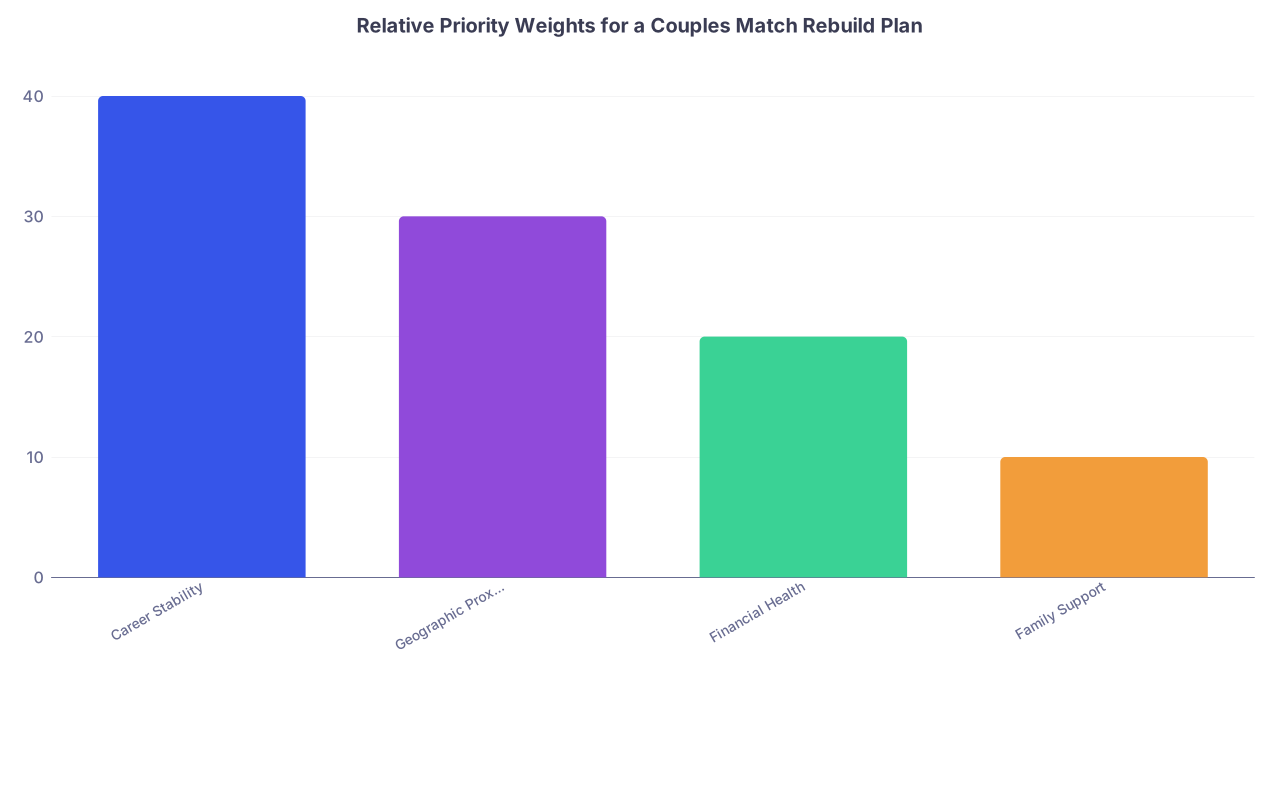
24–72 Hours
Now you’re allowed to think strategically.
- Rank your joint priorities:
- Career trajectory
- Geographic proximity
- Financial stability
- Build a 1‑year plan and a 3‑year plan:
- Year 1: where does each person physically live and work?
- Year 3: what outcome would you be satisfied with? Same city? Different but stable careers?
| Category | Value |
|---|---|
| Career Stability | 40 |
| Geographic Proximity | 30 |
| Financial Health | 20 |
| Family Support | 10 |
You’re not solving everything in three days. You’re choosing a direction and stopping the free‑fall.
Two Weeks After Match: Clean-Up and Long Game
Match Day chaos fades. Now you focus on making smart medium‑term moves.
At this point you should:
- Schedule dedicated mentor meetings (separately and together if possible) to reality‑check any thoughts about transferring, reapplying, or switching specialties.
- Revisit your if/then sheet and revise it with actual data (rotations, finances, family stuff).
- Decide what you’ll not do:
- “We will not apply to 40 random PGY‑2 positions in April out of panic.”
- “We will not threaten to quit residencies in arguments.”

This is where couples quietly become resilient or quietly drift apart. It’s not about how “perfect” your match outcome was. It’s how intentional you are after the emails.
The Core Things You Actually Need to Remember
- Decide before you decide. Your scenario map and if/then rules built the week before Match are what keep you from making panic moves on Friday.
- Separate emotion from logistics by time. Feel everything in the first few hours; make structural decisions over days, not minutes.
- Protect both careers and the relationship. That means refusing the false choice of “my dream specialty vs our relationship” and instead planning timelines, transfers, and compromises like adults, not martyrs.


