

The worst timing mistake couples make in the Match is pretending they’re on the same schedule when they’re not.
If one of you is thinking about a gap year or research year, the timing will either quietly save your relationship and your careers—or quietly wreck both. There’s no middle ground.
I’m going to walk you through, step by step, how to time a gap or research year for one partner so your Couples Match actually works. Not in vague “communicate early” terms, but in concrete: month-by-month, what you should be deciding, discussing, and doing.
Big-Picture Timing: The Three Main Configurations
Before we go month-by-month, you need to know which timeline scenario you’re in. Everything else hangs on this.
| Scenario | Partner A | Partner B | Application Year Sync? |
|---|---|---|---|
| 1 | Regular 4-year | Regular 4-year | Same year |
| 2 | Gap/Research year | Regular 4-year | A is 1 year behind B |
| 3 | Regular 4-year | Gap/Research year | B is 1 year behind A |
| 4 | Both take year | Both delayed | Same year again |
You’re reading this because you’re in Scenario 2 or 3: only one partner is taking a year.
Key question:
Do you want to apply in the same Match year or in different Match years?
- Same Match year → the non-gap partner likely needs to delay as well (or do a chief year, extra research, or other bridge).
- Different Match years → you’ll live apart for at least one year, then potentially use fellowship or later training to re-align.
Most couples who “accidentally” get burned never actually answer that question early. You will.
Phase 0: 18–24 Months Before Intended Match – Decide the Basic Plan
At this point you should be late MS2 / early MS3 (for the partner on the traditional schedule). This is when the idea of a research or gap year usually pops up.
Month 0–2: Clarify Why the Gap/Research Year Is on the Table
You don’t time a research year around vibes. You time it around goals.
The partner considering the year needs to answer—on paper—three questions:
What do I need this year to accomplish?
- More research for derm, ortho, plastics, neurosurg, ENT, etc.
- Time for Step/Level retake to stay competitive.
- Strengthen clinical evaluations or get a letter from a specific department.
- Personal reasons: visa delays, health, family, burnout.
What specialty am I realistically targeting?
- Hyper-competitive (derm, ortho, ENT, plastics, neurosurg, IR): a research year often makes sense.
- Moderately competitive (EM, anesthesia, radiology, OB, gen surg): a research year can help, but bad timing can hurt more than no research.
- Less competitive (FM, psych, peds, IM categorical in many places): a full year might not be worth the disruption unless scores/grades are a serious concern.
How will this change my application profile?
- From “no chance” → “realistic” or just from “good” → “slightly better”?
If you can’t clearly answer those by the end of Month 2, you’re not ready to lock in a year.
Month 2–4: Put Your Two Timelines Side by Side
Now you sit down together. One page, two vertical columns:
- Partner A: MS years / exams / planned Match year
- Partner B: MS years / exams / planned Match year
At this point you should answer:
- Are we okay Matching in different years?
- If not, who is adjusting and how?
Concrete options:
One takes a research year; the other also delays
- Example: Partner A (ortho) takes a research year between MS3–MS4. Partner B (IM) does a funded research year, MPH, chief year, or extra degree to end up applying together.
One takes a research year; the other goes straight through → different Match years
- Example: Partner A matches into psych in 2028. Partner B does a derm research year and applies for 2029. You live apart for at least a year.
Coordinate the research year earlier
- If you’re early enough, one partner can insert a research year after MS2, the other after MS3, and you reconverge for the same Match year. Messy but doable.
Do not skip this. This is the “we’ll figure it out later” trap that destroys Couples Matches.
Phase 1: 12–18 Months Before Intended Match – Lock the Match Year and Structure the Year
At this point you should be mid–late MS3 for the non-gap partner, and either late MS3 or just before the research year for the gap-year partner.
This is where timing decisions become expensive to reverse.
Month 0: Commit to a Match Year (Same or Different)
You need a yes/no decision:
- “We are Couples Matching in 20XX.”
or - “We are not Couples Matching in residency; we’ll think about fellowship later.”
Hand-waving here is how you end up with:
- One partner scrambling to add programs in a random location.
- One partner with a great offer in City A, the other stuck only getting interviews in City B.
If you are Couples Matching, at this point you should:
- Inform your dean’s office or advising office you’re planning to Couples Match with staggered training.
- Ask explicitly: “How have prior couples at this school timed research/gap years when only one partner took a year?”
Month 1–3: Design the Research/Gap Year Backward from ERAS
The research year partner needs to structure the year around ERAS season, not around “when the lab’s funding starts.”
Key dates working backward:
- ERAS opens for editing: June
- ERAS submission: September
- Interview season: October–January
- Rank list deadline: late February–early March
- Match Day: mid-March
For a research year that feeds directly into an application:
At this point you should:
- Start the research year no later than the preceding July–August if you want meaningful output (abstracts, posters, a couple manuscripts) by ERAS time.
- Aim to have:
- At least 1–2 abstracts accepted by spring before ERAS.
- 1–2 manuscripts submitted by summer (published vs submitted both count; just be honest).
If the research year ends after ERAS (for example, you start in January and go through the following January), build that into your personal statement and letters:
- “Currently completing a dedicated research year in X; expected end date Month/Year.”
Phase 2: 6–12 Months Before ERAS – Align Rotations, Location, and Output
This is where timing gets nuanced, especially if you’re aiming to land in the same city.
At this point you should be:
- Non-gap partner: late MS3 / early MS4.
- Gap partner: midway through research year or final clinical months before the year.
Month 0–2: Align Geographic Strategy
You can’t Couples Match effectively if you haven’t picked your geographic priority tiers.
At this point you should:
- Identify your Tier 1 cities/regions (top priority)
- Tier 2 acceptable regions
- Tier 3 “only if necessary”
Then:
- Research year partner: aim your research at institutions in your Tier 1 cities if possible.
- Example: if both of you want Boston, do research at MGH, Brigham, BIDMC, or a Harvard affiliate.
- Non-gap partner: schedule audition/sub-I rotations in the same Tier 1 locations.
If you ignore this and one of you does research in City A while the other rotates in City B, you’ve just cut your overlap chances in half.
Month 2–4: Ensure the Research Year Generates Actual, Visible Output
Programs don’t give points for “I did a research year.” They care about what came out of it by September.
At this point the research-year partner should:
- Have regular (weekly/biweekly) meetings with PI focused on:
- Abstract deadlines (national society meetings by specialty).
- Manuscript timelines.
- Know exactly which projects will hit:
- Conference submissions by winter/spring.
- Manuscript submission by late spring/summer.
If by Month 4 into the research year, you have:
- No abstracts submitted,
- No clear manuscript plan,
- No clear role in a project with your name early in the author list,
you need to course-correct. Hard. Switch projects, negotiate more responsibility, or consider supplemental work (case reports, quality improvement) that can be done quickly.
Phase 3: January–July Before ERAS – The “Don’t Blow It” Window
This is roughly January–July of the application year.
Non-gap partner is on sub-Is.
Gap-year partner is deep into research or just wrapping third year.
At this point you should be ruthlessly practical.
January–March: Finalize Specialty + Couples Match Strategy
You cannot Couples Match effectively if one of you is “maybe derm, maybe IM” in March. Decide.
At this point you should:
- Each lock in a primary specialty.
- Decide if either of you will apply to a backup specialty in the SAME geographic regions.
Example:
- Partner A: Ortho + backup prelim surgery in same cities.
- Partner B: IM categorical in those same cities.
This is where coordination matters. Don’t have Partner A’s backup in random cities that don’t overlap with Partner B’s IM list.
March–May: Build ERAS With the Staggered Timelines in Mind
At this point you should:
Research-year partner:
- Compile:
- All research outputs (submitted, accepted, in-progress).
- Roles clearly labeled: “First author”, “Data analyst”, etc.
- Ask your PI for a strong, concrete letter emphasizing:
- Reliability, work ethic, independence.
- Fit for your specialty.
- How the year changed your trajectory.
Non-gap partner:
- Tighten clinical letters, especially from:
- Sub-Is in your chosen specialty.
- Medicine or surgery core clerkships if relevant.
Together:
- Draft your personal statements with subtle alignment:
- Both mention long-term goals that could reasonably exist in the same region (academic careers, similar patient populations, etc.).
- Avoid copy-pasted “we are a couple” paragraphs; that’s what the Couples Match designation is for.
Phase 4: ERAS Through Rank Lists – Month-by-Month
Now we’re at the part where the timing of the gap/research year actually shows up on the scoreboard.
June–July: ERAS Opens
At this point you should:
- Register as a couple in ERAS as soon as you can.
- Double-check:
- Anticipated graduation dates (these may differ if only one of you took a year).
- That both of you list “Couples Matching with [full name, AAMC ID]”.
Red flag I’ve seen: one partner forgets to click the Couples Match box at registration. Fixable, but it triggers unnecessary panic.
August–September: ERAS Submission
You don’t submit in a vacuum anymore. You submit as a unit.
At this point you should:
Build a shared programs spreadsheet, with columns:
- Institution
- City
- Partner A program (specialty)
- Partner B program (specialty)
- Tier (1–3)
- Backup combos (e.g., A gets ortho, B gets prelim; B gets IM, A gets prelim)
Coordinate program lists:
- Your lists should overlap heavily in cities, not just in “famous programs.”
- It’s better to both apply to more mid-tier programs in the same city than to each chase name-brand programs in different cities.
Be honest about risk:
- If the research year partner is still weaker than average for a hyper-competitive specialty, they need a grounded application strategy (wider geographic net, backups, etc.).
October–January: Interview Season
If the timing of the gap year was smart, the research-year partner will now:
- Have at least a few interviews explicitly mentioning their research.
- Be perceived as:
- More mature.
- More focused.
- Less rushed than the straight-through classmates.
At this point you should:
Together:
- Track interviews in that shared spreadsheet:
- Which dates overlap?
- Where can you both attend interviews in the same city to save money and sanity?
- Start early conversations with programs where one of you has an interview and the other does not:
- Short, respectful emails to PDs noting you’re Couples Matching and your partner’s interest in the same institution/area.
Don’t spam. But do advocate.
January–February: Rank List Construction
This is where the staggered timing because of a gap or research year can either pay off or expose gaps in your planning.
At this point you should:
Build your rank list grid as a couple:
- Rows: Partner A ranks (Program A1, A2, A3…)
- Columns: Partner B ranks (Program B1, B2, B3…)
- Cells: Whether that pair is acceptable.
Be clear about “deal-breaker” vs “less ideal”:
- Are there scenarios where one of you matches and the other doesn’t that you’re willing to accept?
- Or is “both or none” truly your line? For most couples, “both in same general region, even at different-level programs” ends up more realistic than “same hospital or bust.”
Account for different graduation years if you chose different Match years:
- If only one of you is actually participating in the Match this year, this is more about long-term city choices and less about rank grids right now. Don’t pretend you’re Couples Matching when you aren’t.
Special Case: Using a Gap/Research Year to Re-Sync Timelines
Sometimes the problem isn’t the research year; it’s that med school start dates or MD/PhD/triple-degree timelines are already off.
Smart couples use a gap year to re-align.
Here’s what that can look like:
- Partner A: MD only, standard 4 years.
- Partner B: MD/MPH, 5-year track, graduating one year later.
To Couples Match:
- Partner A:
- Takes a research or chief year after MS4 while Partner B finishes MS4.
- Applies to residency the same year as Partner B.
At this point you should, for Partner A’s bridge year:
- Line up something that:
- Keeps you clinically relevant (clinical research, chief year, teaching).
- Provides letters that are recent for ERAS (within 1–2 years).
- Avoid “dead” gap years where you neither see patients nor contribute academically. Programs don’t love to see unexplained inactivity.
Visual Timeline: One Partner Taking a Research Year Between MS3–MS4
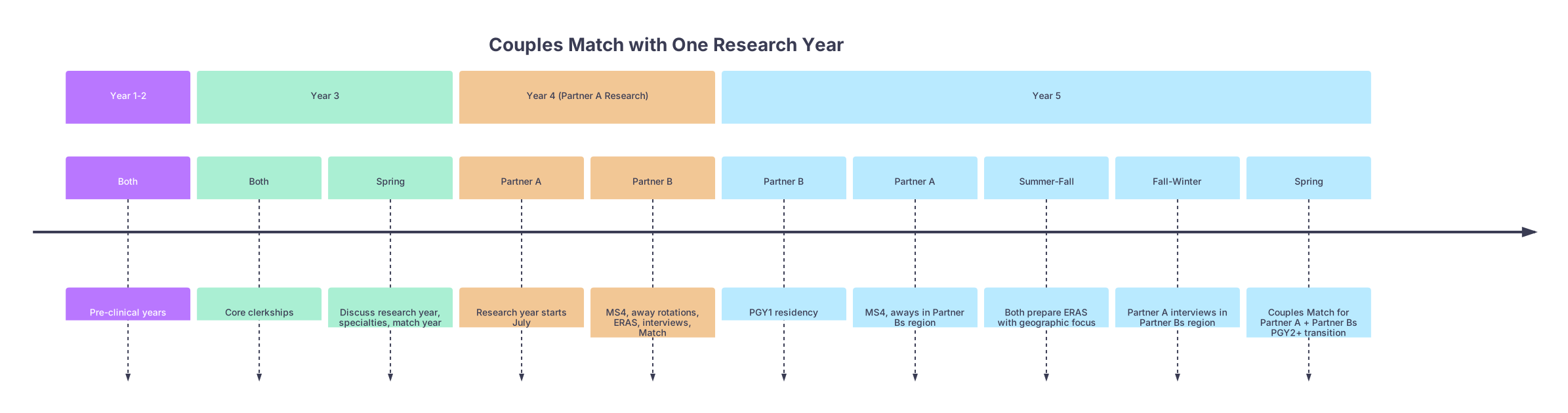
| Period | Event |
|---|---|
| Year 1-2 - Both | Pre-clinical years |
| Year 3 - Both | Core clerkships |
| Year 3 - Spring | Discuss research year, specialties, match year |
| Year 4 (Partner A Research) - Partner A | Research year starts July |
| Year 4 (Partner A Research) - Partner B | MS4, away rotations, ERAS, interviews, Match |
| Year 5 - Partner B | PGY1 residency |
| Year 5 - Partner A | MS4, aways in Partner Bs region |
| Year 5 - Summer-Fall | Both prepare ERAS with geographic focus |
| Year 5 - Fall-Winter | Partner A interviews in Partner Bs region |
| Year 5 - Spring | Couples Match for Partner A + Partner Bs PGY2+ transition |
This is one of the cleaner ways to do it if you’re okay with one year of long-distance.
Small but Critical Timing Details People Forget
Two quick clusters that regularly trip up couples when only one partner takes a year.
Visas and Licensing
If either partner is an IMG or on a visa:
At this point you should, a year before application:
- Check:
- How a research year impacts visa status (F1 to J1, etc.).
- Whether a non-clinical research year counts as U.S. clinical experience (usually it does not).
- Confirm you won’t age-out of Step/Level score validity windows if your school or state has them (some states/programs have 5–7 year limits).
Money and Logistics
Research years are often poorly paid. Some are unpaid.
At this point you should, before committing:
- Make a basic 12-month budget:
- Income from research year (if any).
- Loan deferment vs capitalization.
- Cost of potentially living in a different city than your partner for that year.
If your financial reality means you’ll be resentful the entire year, you’ll undermine both the relationship and the productivity you’re supposed to be getting out of the research.
When a Gap/Research Year Is the Wrong Move for a Couples Match
I’ll be blunt. There are scenarios where taking a year is the wrong play for the relationship and barely helpful for the career.
Red flags that a research year is mistimed for a Couples Match:
- You’re late MS4 and thinking about a research year after not matching, but you still insist on Couples Matching in the next cycle with the other partner. That’s usually too rushed.
- The partner taking the year can’t point to a specific specialty demand (e.g., derm, ortho research expectations) or a clear deficit (low scores, late switch).
- You’re trying to use a research year to “fix” being two years off in training. That’s too big a gap; you’re better planning to realign at fellowship.
Use a research year when it changes the math on your application, not when it’s functioning as an avoidance strategy for tough conversations.
Two Quick Visuals: Effort vs. Payoff and Application Volume
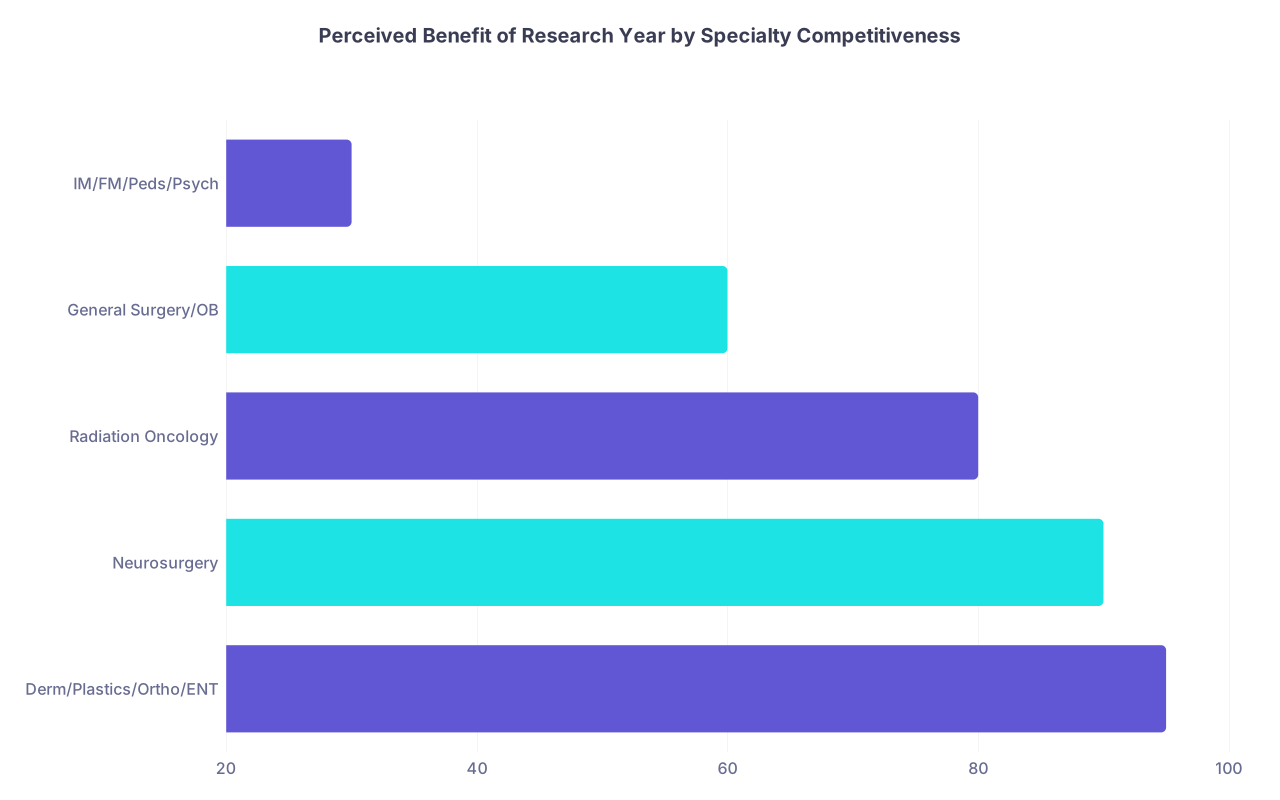
| Category | Value |
|---|---|
| Derm/Plastics/Ortho/ENT | 95 |
| Neurosurgery | 90 |
| Radiation Oncology | 80 |
| General Surgery/OB | 60 |
| IM/FM/Peds/Psych | 30 |
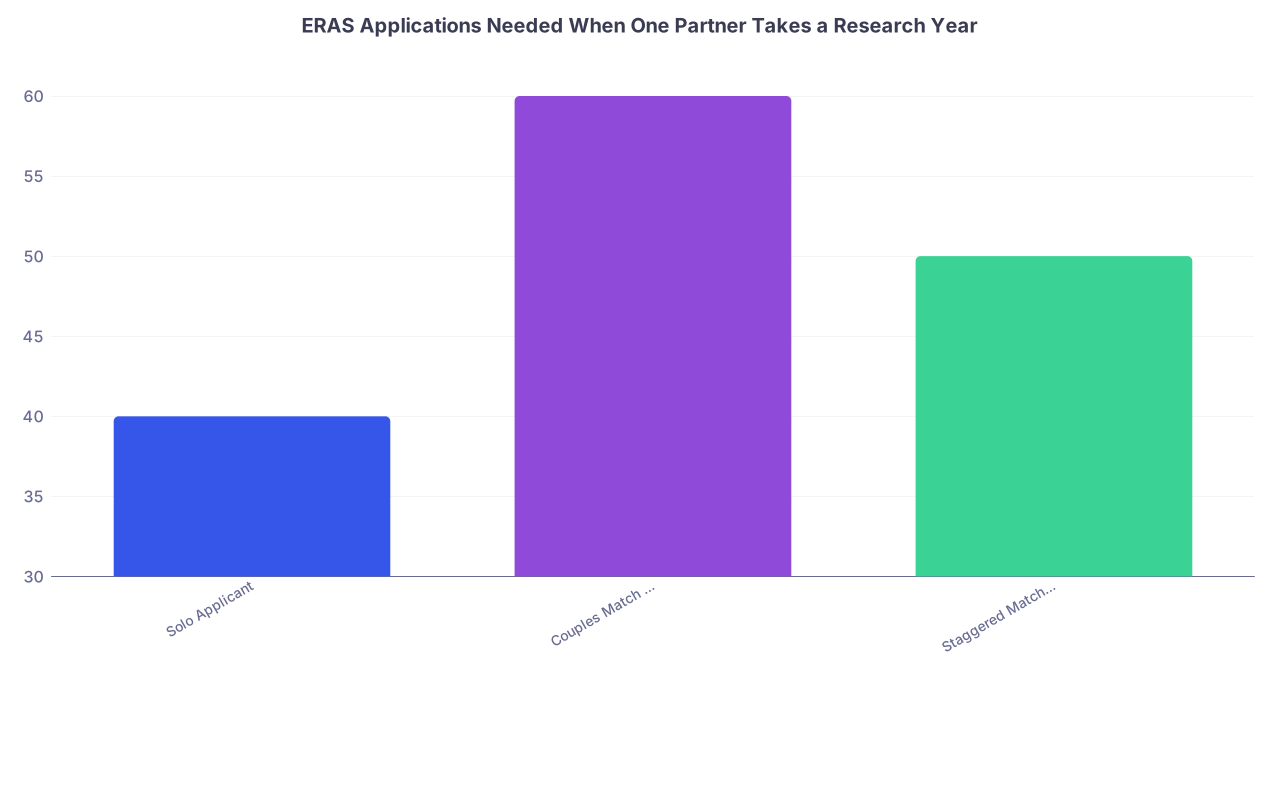
| Category | Value |
|---|---|
| Solo Applicant | 40 |
| Couples Match Same Year | 60 |
| Staggered Match Years | 50 |
These aren’t exact numbers, obviously, but they capture reality: research years help the most where the bar is highest, and Couples Matching usually means applying more broadly.
Bottom Line: What Actually Matters
Let me cut it down to the essentials.
Decide the Match year early and build backward. Do not let one partner quietly drift into a research year while the other moves straight through without a shared plan.
Structure the research/gap year around ERAS and geography, not just “doing research.” Start early enough, get concrete output, and—if you care about being together—do it where you want to end up.
Treat your applications as one unit, even if only one of you took a year. Align cities, program lists, backup plans, and rank lists like your futures depend on it—because they do.


