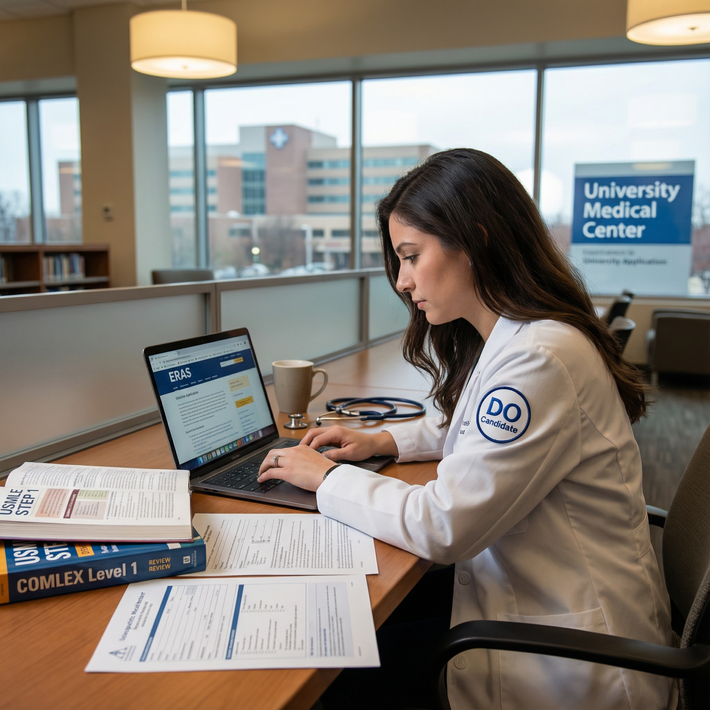
One misstep can derail your entire residency application. I've seen brilliant osteopathic medical students tank their Match chances because they tried to hide a past remediation or bury an honor code violation. Big mistake. Bigger red flag.
Disclosure isn't about confession. It's about narrative control. When a Program Director (PD) sees a disciplinary action on your ERAS application, they aren't necessarily looking for a saint. They are looking for an adult who can handle failure, take accountability, and grow. Your approach to past academic missteps reveals your character far more than the misstep itself.
If you have a blemish on your record, you need a protocol. This guide gives you 7 concrete, actionable strategies to turn a potential liability into a definitive demonstration of your professional growth.
1. Understand What Actually Constitutes an Academic Disciplinary Action
Not every academic stumble is a "disciplinary action." You need to know the exact distinction before you start panicking. Failing a shelf exam or getting a low COMLEX score is an academic concern. Academic probation, an honor code violation, or a formal remediation requirement is a disciplinary action.
ERAS specifically asks if you have ever been subject to disciplinary action. If the answer is yes, you must disclose it. Attempting to play semantic games here will get your application revoked if the PD finds out.
Here is how to categorize your history:
Your immediate fix: Go to your student affairs office today. Request your official student file. Do not rely on your memory of what the disciplinary committee said three years ago. Read the exact language your school used. That exact language dictates your disclosure strategy.
2. Lead with Full Transparency in Your MSPR Request
Your Medical Student Performance Evaluation (MSPR) is the primary source of truth for PDs. If your school's MSPR mentions the incident and your ERAS application doesn't, you look deceptive. If your ERAS mentions it and the MSPR doesn't, the PD will wonder what else your school is hiding.
You need to get ahead of the MSPR narrative.
- Request a pre-MSPR meeting: Sit down with your Dean or the MSPR author before they draft the letter.
- Provide context: Bring a one-page summary of the incident. Explain what happened, what you learned, and the concrete steps you took to change.
- Align your narrative: Ensure the MSPR language matches the addendum you plan to submit. If your school's MSPR is overly punitive or lacks context, you will need to rely heavily on your personal addendum to balance the scales.

3. Use Contextual Letters of Recommendation Strategically
A generic letter of recommendation won't save you if a PD is skeptical about your professionalism. You need letter writers who can actively vouch for your character transformation.
Don't just pick the highest-ranking attending. Pick the attendings who observed your post-incident growth.
The Protocol for LORs:
- Select the right writers: Choose 2-3 attendings who worked with you after the disciplinary event.
- Brief them properly: Give them a factual, unemotional summary of the situation. Don't make them guess. Tell them exactly what happened and how you corrected it.
- Ask for specific advocacy: Ask them to explicitly address your professionalism, maturity, and receptiveness to feedback in their letter.
Notice what programs actually care about. They don't want your letter writer to re-litigate the incident. They want the writer to confirm that you learned from it and are currently competent.
4. Craft Your Personal Statement Without Overexplaining
I see this mistake constantly: a student spends 80% of their personal statement apologizing for a failed COMLEX Level 1 attempt or a professionalism citation. Stop bleeding on the page. Your personal statement is a marketing document, not a diary entry.
Use the 10% Rule. Dedicate roughly 10% of your personal statement to the issue. Spend the other 90% on your passion, your strengths, and why you are an exceptional candidate for osteopathic residency.
How to structure it:
When you hit that 10% section, use the STAR method (Situation, Task, Action, Result).
- Situation: "During my second year, I was placed on academic probation due to poor time management."
- Task: "I needed to overhaul my study habits to pass my boards."
- Action: "I implemented a strict spaced-repetition schedule and sought mentorship from the academic success center."
- Result: "I passed COMLEX Level 2 on the first attempt with a 650 and developed resilience that now serves me well on the wards."
Address it directly. Keep it brief. Pivot immediately to your strengths.
5. Contact Programs Directly With a Professional Addendum
ERAS gives you limited space to explain complex situations. A separate, well-crafted addendum is not just acceptable; it is often expected. This is your chance to control the narrative without cluttering your main application.
The Addendum Protocol:
- Keep it to one page. No one wants to read a three-page essay on why you failed a rotation.
- Use a three-part structure: What happened (facts only, no excuses), what you learned (insight), and what you are doing now (action).
- Format professionally. Use your medical school letterhead if permitted, or a clean, formal personal letterhead.
- Distribute proactively. Upload it to ERAS in the "Other" document section, and email it directly to the program coordinators of your top choices once interview invitations are extended.

Sending this proactively shows initiative. It tells the PD, "I know this is on my record, I own it, and I respect your time enough to explain it clearly."
6. Time Your Applications Strategically Based on Interview Season
Timing changes how your disclosure is received. If you wait until the interview to bring it up, you look like you were trying to hide it. If you send it too early to programs that haven't reviewed your file, it gets lost in the shuffle.
Here is the strategic timeline for pushing your addendum and narrative:
- Early Season (Sept-Oct): Your initial ERAS submission should include the addendum in the document section. This gets ahead of any rumors and frames the MSPR before they read it.
- Mid Season (Nov-Dec): As you get interview invites, email the addendum directly to the program coordinator to ensure it's in the interview day packet.
- Pre-Interview: Review your talking points. Know exactly how you will answer if asked.
- Post-Interview: If asked directly during the interview, answer honestly and briefly. Do not ramble. Give the 30-second version, then pivot back to your clinical skills.
7. Build a Compelling Overall Application That Overshadows the Issue
The best defense is a strong offense. A disciplinary action is a hurdle, but it is not the entire race. If the rest of your application is stellar, PDs will forgive a past mistake. If your application is borderline, that same mistake will be the excuse they use to reject you.
You must overshadow the issue with undeniable competence.
How to overshadow the blemish:
- Crush your remaining boards. A high COMLEX Level 2 score proves the academic issue is in the past.
- Excel in clinical rotations. Get honors. Be the student the residents actually want to work with.
- Nail the interview. Preparation, maturity, and a polished demeanor impress far more than a flawless record. Show them you understand their program's mission and values.
Your entire package matters most. Make the disciplinary action the least interesting thing about you.
Summary: Your Action Plan for Disclosure Success
Transparency combined with strategy equals Program Director trust. Do not let one bad semester or one poor decision define your entire medical career. You are more than your worst day. Show them who you have become since then.
Your Immediate Action Plan:
- Start early: Request your official file and schedule an MSPR meeting with your Dean before application season opens.
- Draft your addendum: Write a factual, one-page explanation focusing on growth and current competence.
- Brief your letter writers: Ensure your LORs actively speak to your professionalism and maturity.
- Apply the 10% rule: Keep your personal statement focused on your strengths, addressing the issue only briefly.
- Execute flawlessly: Submit early, distribute your addendum strategically, and let your clinical excellence overshadow the past.

Apply these 7 approaches systematically. Control your narrative, own your history, and go match into the residency you deserve.