
The usual advice about “DO‑friendly” programs is lazy, outdated, or flat‑out wrong.
If you’re a DO student trying to identify ACGME programs that are actually friendly to DOs, you can’t just Google “DO friendly IM programs” and call it a day. Half those lists were written pre‑single accreditation and the other half are based on vibes, not data.
Let me walk you through how to do this properly, with a real framework you can actually use.
Step 1: Stop Asking “Is It DO-Friendly?” and Ask These Instead
“DO-friendly” is too vague. What you really care about is:
- Do they consistently train DOs?
- Do DOs match there recently, not 10 years ago?
- Do DOs succeed there (not just barely survive as the token osteopathic resident)?
So your job isn’t finding some magical list. Your job is to answer four concrete questions for each program:
- Have they interviewed and ranked DOs in the last 3–5 years?
- Is there at least one DO resident per year, on average?
- Are there DOs on faculty or leadership?
- Does their public language (website, social, PD quotes) sound inclusive or dismissive of DOs?
If you can get three “yes” answers, that’s functionally a DO-friendly program. If you get zero or one, proceed with caution.
Step 2: Use Match Data Like a Detective, Not a Tourist
You don’t need secret insider spreadsheets. Most of what you need is sitting in plain sight if you know where to look.
A. Start with NRMP / Specialty Reports
For each specialty you’re targeting, pull the NRMP Charting Outcomes in the Match (DO and MD versions) and the Program Director Survey.
Look for:
- Average Step 2 scores for matched DOs vs MDs
- % of programs “often/always interview” DO applicants
- Whether programs require Step 2 or have cutoffs
This doesn’t tell you which exact programs are friendly, but it tells you how uphill your battle is by specialty.
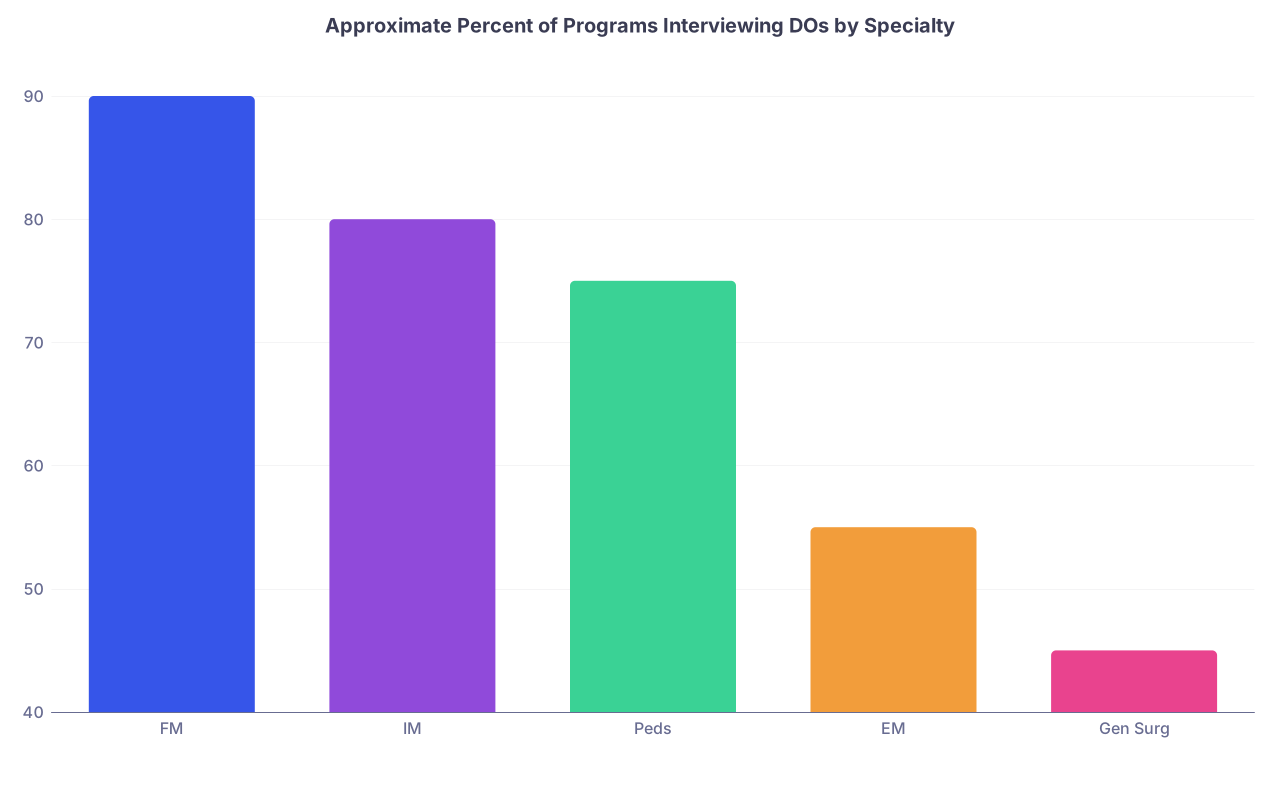
| Category | Value |
|---|---|
| FM | 90 |
| IM | 80 |
| Peds | 75 |
| EM | 55 |
| Gen Surg | 45 |
Rough rule of thumb based on recent years:
- Family med, internal med, peds: large majority open to DOs
- EM, gen surg, anesthesia, psych: mixed – program‑specific
- Derm, ortho, plastics, ENT, neurosurg: highly selective – you must be strategic
B. Scrutinize Program Rosters Year by Year
This is where most people are lazy. Don’t be.
Go to each program’s website. You want a resident roster with med school names. Then:
- Scan each PGY level
- Count the number of DOs per class
- Note whether this pattern is consistent (not just one random DO five years ago)
If a three‑year IM program has:
- PGY‑1: 3 DOs
- PGY‑2: 2 DOs
- PGY‑3: 2 DOs
That’s a solid green flag. They’re not just “open” to DOs – they’re actively taking them.
If a program has:
- Total residents: 36
- DOs: 0
That’s either:
- Implicit bias, or
- They only take their own affiliated MD med school.
Either way, it’s a red flag for you unless you’re a ridiculously strong applicant.

Step 3: Use Residency Explorer and FREIDA the Right Way
Most students click around Residency Explorer like they’re browsing Netflix. You need to use it like a scalpel.
A. Residency Explorer Filters That Actually Matter
Go to Residency Explorer (for specialties that support it) and focus on:
Medical School Type of Matched Applicants
Look for: >15–20% of matched residents from DO schools in recent years.Applicant Type
Check that DOs are actually in the matched group, not only “interviewed” or “considered.”US vs International
A program that happily takes DOs but never takes IMGs is still DO-friendly. Don’t confuse the two.
If you consistently see 0–1 DOs over 5+ years: that program is not DO-friendly, regardless of what Reddit says.
B. FREIDA: Not Perfect, Still Useful
FREIDA (AMA’s database) sometimes lists “Accepts DO” or shows resident backgrounds. It’s incomplete, but it’s a decent cross‑check.
What I look for:
- Residents with DO degrees on the “Current Residents” tab
- “Type of applicants accepted” including “U.S. DO graduates”
If FREIDA says they take DOs but the website shows zero DOs for 5 years straight? Trust the roster, not the checkbox.
Step 4: Decode Program Websites Like You’re Reading Between the Lines
Words matter. So does what’s missing.
Here’s what to look for on the website:
Strong Green Flags
- Multiple DO residents in every class
- DO faculty or leadership (PD, APD, core faculty who are DOs)
- Explicit language like:
- “We welcome applicants from both MD and DO schools.”
- “Our residents come from osteopathic and allopathic backgrounds.”
- Prior AOA/osteopathic program status pre‑merger (they usually remain very DO‑friendly)
| Signal Type | Green Flag Example |
|---|---|
| Resident mix | ≥1 DO per PGY class |
| Faculty | At least 1–2 DOs on faculty/leadership |
| History | Former AOA or dual-accredited program |
| Language | Explicitly mentions DOs as welcome |
| Match pattern | DOs matched consistently 3–5 years |
Yellow Flags
- Only 1 DO in the entire program
- DOs appear only in prelim or transitional years
- Website hasn’t been updated since 2019 (you can’t trust old rosters)
Red Flags
- “We do not accept DO applicants” (yes, a few still say this)
- All residents from a single MD school or one specific allopathic pipeline
- Zero DOs in 4–5 years despite a decent class size
Step 5: Use Old AOA Heritage to Your Advantage
This is still one of the easiest shortcuts.
Programs that were AOA or dually accredited before the single accreditation system almost always remain DO‑friendly. Many of their leaders trained in osteopathic systems and they’re used to DO applicants.
Where to find them:
- Old lists from AOA archives (via Wayback Machine), SDN threads, or state osteopathic associations
- Specialty-specific DO organizations (ACOFP, ACOI, ACEM, etc.)
Programs that absorbed former osteopathic residencies often have:
- A visible cluster of DO residents
- Rotation relationships with DO schools
- PDs who are DOs
If you’re pressed for time, start with these. They’re often your highest-yield targets per application fee.
Step 6: Leverage Your School’s Knowledge (Quietly but Aggressively)
Your own DO school is sitting on gold: historical match lists. Use them.
Here’s how to mine that data:
Get 3–5 years of match lists from your dean’s office or career advisor.
For each specialty you care about, build a quick spreadsheet:
- Program name
- Specialty
- Year matched
- DOs from your school
- Multiple matches? (Y/N)
Identify:
- Programs that have taken multiple DOs from your school over multiple years
- Programs that have never taken anyone from your school despite plenty of applicants
Those first programs are your core list. Reach out to alumni there. Ask blunt questions:
- “How does your program view DOs?”
- “Did you feel you had to ‘prove yourself’ more?”
- “Would you recommend DOs apply broadly here?”
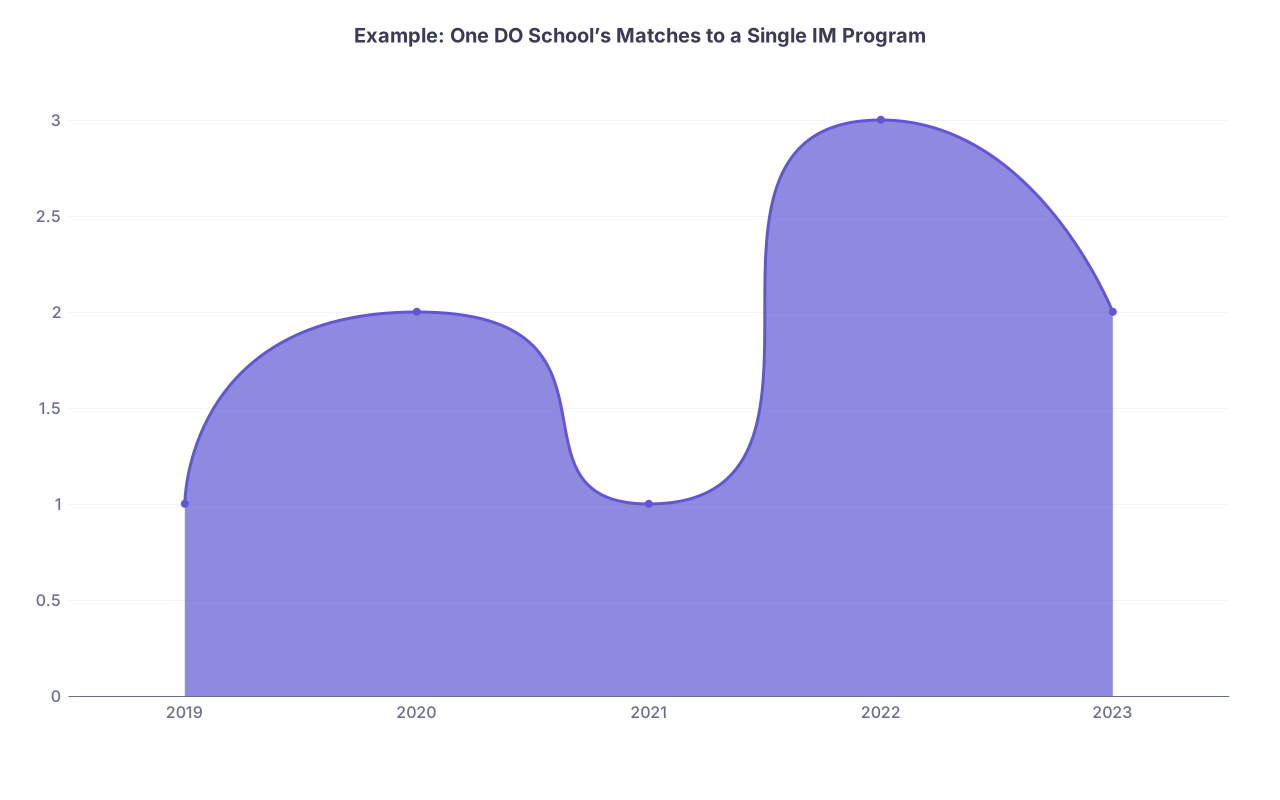
| Category | Value |
|---|---|
| 2019 | 1 |
| 2020 | 2 |
| 2021 | 1 |
| 2022 | 3 |
| 2023 | 2 |
Consistent DO matches like that? That’s your greenest of green flags.
Step 7: Use Away Rotations and Visiting Students Wisely
If a program regularly hosts DO students for rotations, that’s another positive sign.
Look for:
- “We accept visiting students from LCME- and COCA-accredited schools” on their VSLO listing or website.
- Photos of rotators that include DO schools in the captions.
- Residents casually saying things like: “Yeah, we get a lot of DO rotators from X school.”
If they explicitly say “We do not accept DO visiting students” – that’s a problem. They’re telling you they don’t want to invest time in DOs even as students.
Step 8: Email and Ask – But Don’t Sound Desperate
You can absolutely email coordinators or PDs, but the way most students phrase it is terrible.
Terrible:
“Hi, I’m a DO student, does your program accept DOs? Will I be at a disadvantage?”
Better:
- Ask whether recent DO residents have matched there.
- Ask whether DO students are eligible to rotate.
- Ask if they consider COMLEX alone or require USMLE.
Example email:
Dear [Coordinator/PD],
I’m a 4th-year student at [Your DO School] interested in [Specialty]. I noticed your website doesn’t list medical schools for current residents.
Could you share whether DO graduates have matched into your program in recent years, and whether you consider DO applicants who have taken only COMLEX, or if USMLE is required?
Thank you for your time,
[Name]
Straightforward. Professional. And you get actionable data.
Step 9: Factor in Exam Expectations (COMLEX vs USMLE)
Programs differ wildly here, and it matters.
Use this mental framework:
- Tier 1 DO-friendly:
- Explicitly state COMLEX‑only is fine
- Have multiple DOs without USMLE
- Tier 2:
- “COMLEX accepted, USMLE preferred”
- Many DOs took USMLE anyway
- Tier 3:
- “USMLE required”
- Historically more MD-heavy, DOs mostly those with strong Step 2 scores
You’re not just asking “DO-friendly?” You’re asking “Is this DO-friendly for a COMLEX-only applicant like me?” or “for a DO with Step 2 240?” etc.
Step 10: Build a Smart Apply List, Not a Fantasy One
Once you have all this, segment your programs:
Green (Apply strongly)
- Consistent DO residents
- DO faculty or leadership
- Former AOA / dual-accredited or clear DO history
Yellow (Apply selectively)
- Some DOs, but not many
- No explicit anti-DO language
- Your metrics well above their average
Red (Skip unless you’re an outlier)
- Zero DOs, no visiting DOs, or explicit DO exclusion
- Ultra‑competitive academic programs with no history of osteopathic grads
For most mid‑competitive specialties (IM, peds, psych), a DO applicant should aim for something like:
- ⅓ green
- ⅓ yellow
- ⅓ realistic reaches
And yes, there’s still randomness. But this dramatically tilts the odds in your favor.

| Step | Description |
|---|---|
| Step 1 | Start |
| Step 2 | Check resident rosters |
| Step 3 | Low priority or skip |
| Step 4 | Check DO faculty & history |
| Step 5 | Review Residency Explorer data |
| Step 6 | Check COMLEX/USMLE policy |
| Step 7 | Ask school/alumni about program |
| Step 8 | Classify Green/Yellow/Red list |
| Step 9 | Consistent DOs? |
FAQ (Exactly 6 Questions)
1. Is there a master list of “DO-friendly” ACGME programs I can just use?
No, and you shouldn’t trust any that claim to be definitive. The landscape changed a lot after the single accreditation transition. Use those lists only as a starting point, then verify each program’s current roster, match trends, and DO representation yourself.
2. If a program has only one DO in the entire residency, is it still worth applying?
Maybe, but don’t call that “DO-friendly.” One DO could be an internal candidate, a fluke year, or someone with exceptional metrics. If everything else about the program is perfect for you and your metrics are strong, sure, throw an app. But it should probably sit in your yellow/reach category, not your core list.
3. How heavily should I weigh having a DO PD or APD?
It’s a strong positive, but not a guarantee. I’ve seen DO PDs at programs that still primarily take MDs because of institutional habits or feeder med schools. Treat a DO in leadership as a strong green flag, but still verify the actual resident mix over multiple years.
4. Are university programs automatically worse for DOs than community programs?
Not automatically. Plenty of university‑affiliated IM, peds, EM, and psych programs are very DO-friendly. What matters is history and behavior, not label. That said, the most DO-hostile programs tend to be big-name, university‑based, ultra‑research-heavy residencies, especially in competitive specialties.
5. If a program doesn’t show resident med schools on their website, should I assume they don’t take DOs?
No, but you lose an easy data source. In that case, check: FREIDA, Residency Explorer, your school’s match list, and ask alumni. If you still can’t find evidence of DOs, email the coordinator to ask specifically whether DOs have matched there recently and whether they accept COMLEX.
6. If I’m a DO who took only COMLEX, do I need to avoid programs that say “USMLE preferred”?
Not automatically. “Preferred” isn’t “required.” But be realistic: at those programs, you’re competing with MDs and DOs who have USMLE scores. For a COMLEX‑only applicant, prioritize programs that explicitly accept COMLEX alone and have a track record of taking DOs without USMLE. Treat “USMLE preferred” programs as possible, but not your backbone.
Key points to keep in your head:
- Don’t chase vague “DO-friendly” vibes – look at hard evidence: resident rosters, DO faculty, prior AOA status, and match trends.
- Build your list with data from multiple sources (website, Residency Explorer, school match lists, alumni), then sort into green/yellow/red.
- Programs that consistently train DOs now are what matter. Not what someone’s cousin matched into in 2012.