
The blanket advice that “every DO must take USMLE” is wrong. But pretending you can skip it in 2026 and be totally fine is also fantasy.
Here’s the real answer:
Most DO students should strongly consider taking USMLE Step 2 in addition to COMLEX — but not everyone, and not in every situation.
I’ll walk you through exactly who should take it, when to take it, and when it’s actually safe to skip. No fluff.
The Core Question: Do ACGME Programs Require USMLE for DOs?
Let’s cut through the myths.
ACGME (MD) residencies fall into four buckets for DOs:
| Program Type | USMLE Expectation | COMLEX-Only Friendly? |
|---|---|---|
| Historically MD, very competitive | Strongly preferred / expected | Rarely |
| Mid-tier academic | Preferred but not always required | Sometimes |
| Community-based, DO-friendly | Optional | Often yes |
| Former AOA / DO-heavy programs | Usually optional | Commonly yes |
Here’s what’s actually happening on the ground:
- Many PDs openly admit: they don’t know how to interpret COMLEX scores as well as USMLE.
- Applicant screening software is often built around USMLE filters.
- A lot of places use “USMLE required for DOs” as a soft filter, even if it’s not written on the website.
So no, USMLE isn’t technically required for all ACGME residencies.
But for certain specialties and programs, not having it is an automatic disadvantage. Sometimes a deal-breaker.
Start with This: What Specialty Are You Aiming For?
Your target specialty is the single biggest factor.
1. If you’re aiming for a competitive specialty
Think:
Derm, ortho, ENT, plastics, neurosurgery, urology, IR, radiation oncology, EM at strong academic centers, and often anesthesia.
My opinion:
If you’re a DO and you want any of these, you should take USMLE unless you have a very unusual, very well-connected situation.
Why? Because:
- Most applicants in these fields have USMLE.
- Many top programs either:
- Say they “prefer” USMLE but really mean “expect it”
- Or simply filter DOs without USMLE out in the first pass.
- Faculty know how to compare 240 vs 260. They don’t know how to compare 560 vs 640 as easily.
If you skip USMLE here, you’re choosing to close a big chunk of doors.
You might still match. But you’ll be fighting uphill, with a handicap you could’ve avoided.
2. If you’re going for moderately competitive specialties
Internal medicine, general surgery, EM (at community/DO-friendly programs), OB/GYN, pediatrics at mid-tier or academic centers.
Here the answer is more nuanced:
USMLE is not absolutely required, but it’s often:
- A differentiator
- A way to get past lazy or automated filters
- A way to show “I can compete with MDs on the same test”
If you want:
- A strong academic IM program (think GI, cards, heme/onc fellowships later)
- Mid–high tier surgery
- OB/GYN at a big-name institution
Then I’d still lean hard toward taking USMLE Step 2.
If you’re thinking:
- Community IM
- Community peds
- Community OB
- DO-heavy or former AOA programs
You may be fine without USMLE if the rest of your app is strong (COMLEX scores good, clinical grades solid, some research, good letters).
3. If you’re targeting less competitive or very DO-friendly specialties
FM, psych (at many programs), PM&R at DO-heavy places, pathology in many locations, some community-based IM and peds.
Here’s where COMLEX-only can realistically work.
Programs in these fields often:
- Have lots of DO residents already
- Are familiar with COMLEX scoring
- Explicitly accept COMLEX-only applicants and mean it
For these, USMLE is often nice-to-have rather than need-to-have.
But even here, a strong USMLE Step 2 can upgrade where you match and how many interviews you get.
The Step 1 Pass/Fail Shift: Does That Change Things for DOs?
Yes, and not in your favor.
Before Step 1 became pass/fail:
- DOs could sometimes skip USMLE, ride strong COMLEX scores, and still look competitive.
Now:
- Programs lean harder on numeric exams that still exist — that’s Step 2 for MDs, Level 2-CE for DOs.
- Problem: most PDs understand Step 2. Far fewer intuitively understand Level 2.
So for DOs:
- USMLE Step 2 is now “the” score that matters most for cross-comparison.
- Not having it makes you harder to compare, which often means easier to screen out.
So no, Step 1 going P/F did not make USMLE irrelevant for you. It probably made Step 2 more important.
Should You Take Step 1 or Just Step 2 as a DO?
Given timing and cost, here’s the realistic breakdown now:
- USMLE Step 1: pass/fail, more basic science, overlap with Level 1.
- USMLE Step 2: numeric score, huge for residency decisions, more clinical, overlaps with Level 2.
For most current DO students, I’d say:
If you’re still pre–Level 1 and planning ahead:
- Some people take USMLE Step 1 + COMLEX Level 1 to double-dip studying while basic science is fresh.
- But the big career impact comes from Step 2.
If you’re already past Level 1:
- Don’t bother going backward for Step 1.
- Focus on USMLE Step 2 + COMLEX Level 2.
If you can only afford the time/energy for one USMLE exam, make it Step 2.
When It’s a Bad Idea to Add USMLE
Let me be blunt: taking USMLE is not always smart.
You probably shouldn’t take USMLE if:
- Your COMLEX performance is already weak or borderline
If you’re scoring barely passing or just above, adding USMLE often:- Eats more time
- Risks a low USMLE score
- Gives PDs two mediocre data points instead of one
Weak plus more weak is not a strategy.
- You’re already clearly committed to:
- Family medicine
- Psych at DO-friendly programs
- Community peds or IM in your home region
- Former AOA/osteopathic programs that explicitly don’t care about USMLE
In those cases, your time is often better spent:
- On clinical excellence
- On building relationships at target programs
- On meaningful research or QI (even small projects)
- You’re late and scrambling
If you’re:
- Behind on Level 2 prep
- Short on rotations, letters, or your personal statement is a mess
Then adding USMLE just to “check a box” can hurt more than help, because everything else in your app suffers.
How Programs Actually Screen DO Applicants
Here’s what I’ve heard directly from PDs and residents in ACGME programs:
- “We set an initial screen: MDs with Step 2 above X, DOs with either Step 2 above X or COMLEX above Y.”
- “If a DO doesn’t have USMLE, I look them up individually, but only if I’m not already drowning in apps.”
- “I prefer DOs who took USMLE because it tells me they wanted to compete on the same field.”
- “COMLEX-only isn’t a no, but I need a reason to spend extra time evaluating them.”
And the ugly part:
If a program gets 1,500 apps, no one is doing deep conversions on every COMLEX-only DO.
So USMLE is basically a way of saying:
- “You don’t have to work to figure me out. Here’s a number you understand.”
That convenience factor alone is powerful.
Practical Decision Framework: Should YOU Take USMLE?
Let’s build this like a quick decision tree.
Step 1: What’s your target specialty and program type?
- Competitive specialty or academic-heavy goal → Strong push toward USMLE Step 2
- Mid-tier or academic IM/surgery/OB → Leaning toward USMLE Step 2
- Community FM/psych/peds/IM with DO-heavy presence → USMLE optional but helpful
Step 2: What are your current COMLEX practice scores?
Use honest practice scores, not wishful thinking.
If you’re scoring well above average on COMSAEs/NBMEs equivalents:
- You’re a good USMLE candidate. You might shine.
If you’re barely passing:
- Fix your foundation first.
- Consider whether an additional exam helps or just exposes weakness.
Step 3: What’s your timeline?
6+ months before Level 2 with room to prep:
Dual-plan: COMLEX Level 2 + USMLE Step 2 with integrated studying.1–3 months before Level 2, stressed and behind:
Probably focus on crushing Level 2 first. You can optionally sit for Step 2 shortly after if your core is strong and you can recover quickly.
Step 4: What’s your real capacity?
Be honest about:
- Burnout
- Financial strain
- Personal obligations
If adding USMLE will tank your Level 2 performance, that’s a bad trade. Program directors would rather see one strong score than two mediocre ones.
How to Study Efficiently If You Do Take Both
If you decide to go for USMLE + COMLEX, don’t study in two totally separate silos. That’s how you waste time.
High-yield setup:
- Use one main QBANK that’s USMLE-style (UWorld, AMBOSS).
- Add a modest amount of COMLEX-style questions (COMBANK, COMQUEST) to:
- Practice OMM
- Get used to COMLEX’s weird question style and length
Then:
- Take NBMEs for USMLE Step 2 readiness.
- Use COMSAEs or COMLEX practice tools for Level 2 readiness.
- Aim to sit for USMLE Step 2 first, then COMLEX Level 2 within 1–3 weeks, or vice versa based on your school’s requirement timing.
Another visual way to think about overlapping prep:
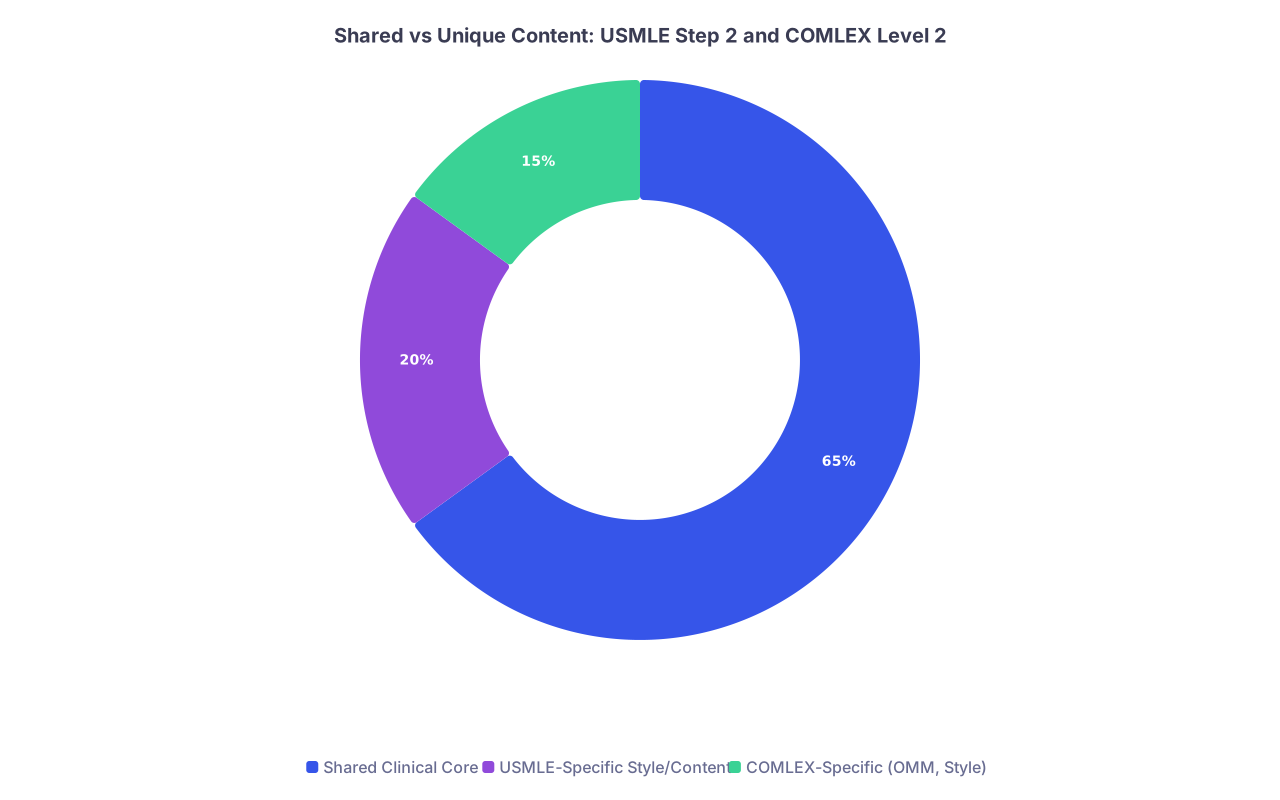
| Category | Value |
|---|---|
| Shared Clinical Core | 65 |
| USMLE-Specific Style/Content | 20 |
| COMLEX-Specific (OMM, Style) | 15 |
Most of your studying is shared material. The extra work is smaller than people fear, as long as you’re strategic.
Timeline: When to Decide About USMLE as a DO
Here’s a simple planning view.
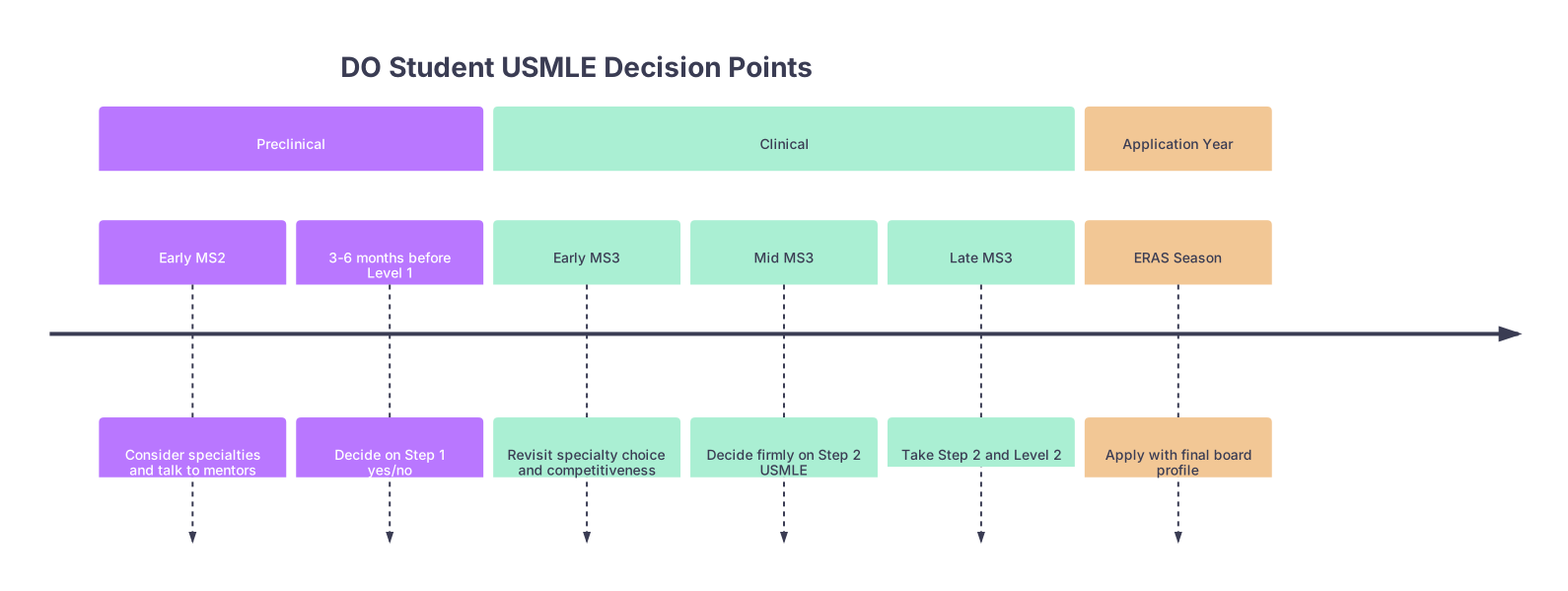
| Period | Event |
|---|---|
| Preclinical - Early MS2 | Consider specialties and talk to mentors |
| Preclinical - 3-6 months before Level 1 | Decide on Step 1 yes/no |
| Clinical - Early MS3 | Revisit specialty choice and competitiveness |
| Clinical - Mid MS3 | Decide firmly on Step 2 USMLE |
| Clinical - Late MS3 | Take Step 2 and Level 2 |
| Application Year - ERAS Season | Apply with final board profile |
Bottom line:
Don’t wait until July of your ERAS year to suddenly panic about USMLE. Decide early enough to actually prepare properly.
The One-Sentence Answer
If you remember nothing else, remember this:
If you’re a DO aiming at competitive specialties or strong academic ACGME programs, you should almost certainly take USMLE Step 2 in addition to COMLEX; if you’re targeting community or DO-heavy programs in less competitive fields, you may safely match with COMLEX only, as long as the rest of your application is strong.

FAQs
1. Will not taking USMLE automatically prevent me from matching as a DO?
No. Plenty of DOs match every year with COMLEX only, especially into:
- Family medicine
- Psych (at many places)
- Community IM and peds
- DO-heavy or former AOA programs
But skipping USMLE does usually:
- Shrink the number of programs that will seriously consider you
- Make some competitive and academic programs effectively off-limits
It’s not an automatic rejection, but it is a self-imposed limitation.
2. Can I convert my COMLEX score to a “USMLE equivalent” for programs?
There are unofficial conversion tools and old papers that try to correlate scores. Program directors know they’re rough at best.
Some PDs glance at them. Many don’t trust them.
If a program really wants a USMLE number, a converted COMLEX score will not fully substitute. It might help in gray-zone decisions, but it doesn’t replace an actual USMLE score.
3. If I do poorly on USMLE but okay on COMLEX, which score matters more?
Programs will see both if you report both.
You can’t selectively hide a bad USMLE while showing only COMLEX to ACGME programs. If they require USMLE, they’ll see it.
In general:
- A strong COMLEX and weak USMLE confuses people and raises questions.
- A moderate COMLEX and strong USMLE often helps you.
- Two weak scores hurt you more than one.
That’s why I say: don’t take USMLE if your foundation is clearly shaky and you’re unlikely to do better there than on COMLEX.
4. Is USMLE Step 1 still worth it for DOs now that it’s pass/fail?
Sometimes, but it’s no longer the main play.
Reasons it might be worth it:
- You’re early MS2 and already studying heavily for Level 1.
- You want the practice of sitting a high-stakes exam in USMLE format.
- Some very selective programs still like to see Step 1 pass along with Step 2.
But purely for residency competitiveness, Step 2 is the big one. If you can’t or don’t want to do both, prioritize Step 2.
5. How do I find out if a specific program accepts COMLEX-only DOs?
Don’t guess. Do this:
- Check the program’s website and FREIDA profile:
- Look for “Exam requirements for DOs”
- Look at current residents:
- How many DOs?
- Any DOs from schools similar to yours?
- Email the program coordinator briefly:
- “Do you accept DO applicants with COMLEX only, or do you require USMLE scores?”
If they say “prefer USMLE,” read that as: COMLEX-only is possible but you’re at a disadvantage.
6. I’m an OMS-1/2 and have no idea what specialty I want. Should I plan on USMLE?
If you’re undecided, keep your options open.
You don’t need to register tomorrow, but:
- Study during preclinical in a way that prepares you for both USMLE and COMLEX (resources like Boards & Beyond, Sketchy, UWorld, etc.).
- Plan as if you might take USMLE Step 2 later.
- As third year starts and you get a feel for specialties, revisit the decision.
The worst spot to be in is OMS-4 suddenly wanting ortho or derm with no USMLE on board. Planning for flexibility early is much cheaper than scrambling late.
Key takeaways:
- USMLE is not “required for all DOs,” but it’s absolutely expected or strongly preferred in many competitive and academic ACGME programs.
- If you’re aiming high or you’re undecided, taking USMLE Step 2 in addition to COMLEX keeps more doors open.
- If you’re targeting DO-friendly, less competitive fields and your app is otherwise strong, you can safely match with COMLEX only—but that’s a strategic choice, not an accident.