
Most ACGME program directors don’t truly understand COMLEX scores—and pretending they do is how DO applicants get burned.
That’s the blunt answer. But the reality is more nuanced, and you need that nuance to decide whether to take USMLE, how to target programs, and how to explain your scores.
Let me walk you through what actually happens on the PD side of the screen.
The Real State of COMLEX Understanding Among ACGME PDs
Here’s the truth that rarely makes it into official statements:
Most program directors can read a COMLEX transcript. Very few can interpret it with the same comfort and precision they have for USMLE.
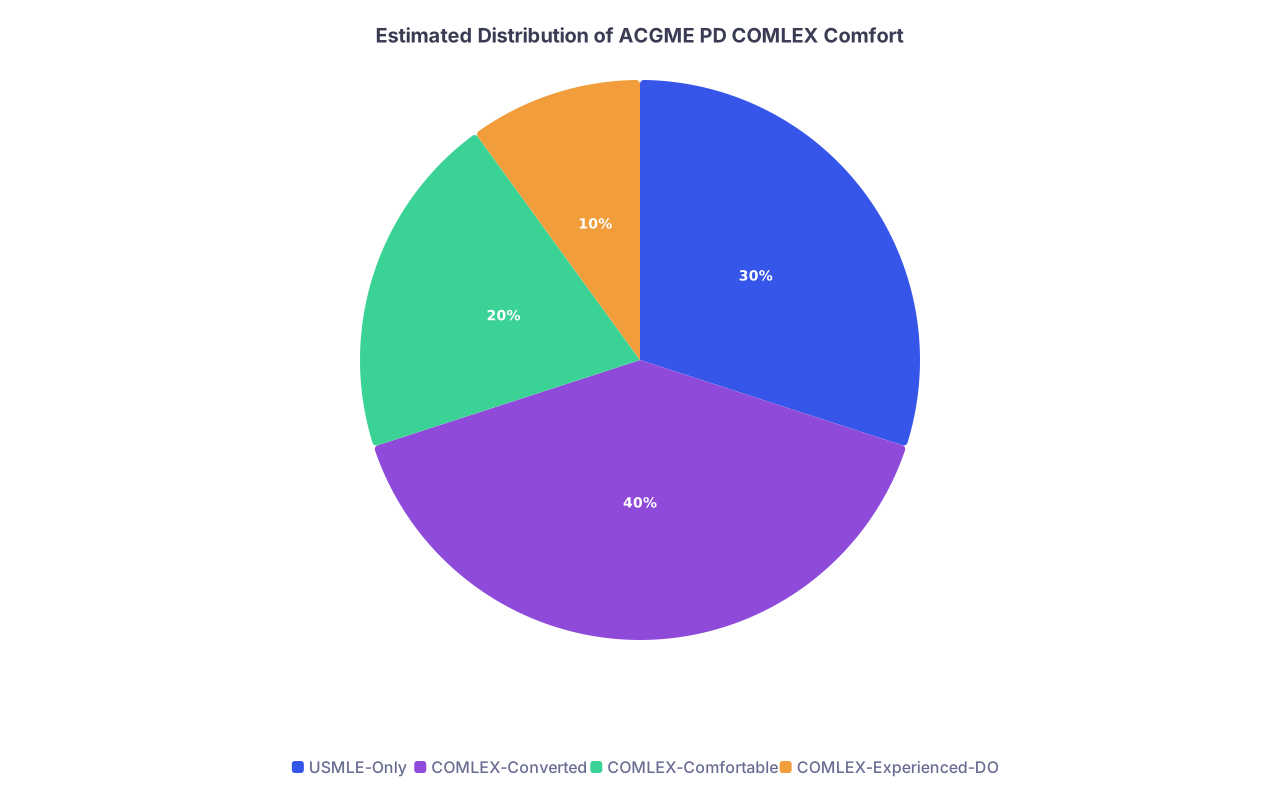
There are roughly four types of PDs when it comes to COMLEX:
| PD Type | How They Use COMLEX |
|---|---|
| 1. USMLE-Only | Won't consider without USMLE, COMLEX ignored |
| 2. COMLEX-Converted | Uses unofficial COMLEX→USMLE charts |
| 3. COMLEX-Comfortable | Uses COMLEX percentiles/means directly |
| 4. COMLEX-Experienced-DO | Truly fluent in both exams |
Let’s translate that into what it means for you:
USMLE-Only programs
These are still common in competitive specialties (derm, ortho, ENT, plastics, neurosurgery) and some university IM/EM programs.
What they actually do:- State “USMLE required” or “USMLE strongly preferred” in their materials
- Filter in ERAS by USMLE score fields
- Barely look at COMLEX-only applicants, even if they say they “accept COMLEX”
COMLEX-Converted PDs
This is probably the largest group. They’ve seen COMLEX before but don’t trust their gut on it. So they:- Use random online “COMLEX to USMLE” calculators or internal cheat sheets
- Try to map your score to a USMLE equivalent
- Often misinterpret what’s a strong vs average COMLEX
COMLEX-Comfortable PDs
These are the folks at historically DO-heavy programs or places that have had DOs in every class for years.
They:- Actually know COMLEX means/SDs and use percentiles
- Have an intuitive sense of what a 500 vs 600 means
- Often don’t care as much whether you took USMLE if your COMLEX is strong
COMLEX-Experienced-DO PDs
Usually DO PDs or MDs who’ve trained tons of DOs and actually looked at NBs, score reports, and performance across cohorts.
This is the group that really “gets” COMLEX.
But they’re a minority.
So, do PDs really understand COMLEX?
Some do. Many don’t. And you can’t tell which one you’re dealing with just from the website blurb.
Why COMLEX Is So Often Misunderstood
Here’s why COMLEX trips people up:
Different scale and “feel”
USMLE Step 1/2 score language is burned into MD brains:- 190s = barely passing
- 220–240 = solid
- 250+ = strong/elite depending on specialty
COMLEX with its 400/500/600 framework isn’t intuitive to them. They see a 520 and think “mid-200s? maybe?” and just feel uneasy.
Percentiles aren’t front-and-center
COMLEX reports historically made it weird to see or use percentiles. Many PDs don’t know where to find or how to interpret them.
So they default to raw score comparisons or bad conversion charts.No official, validated conversion
There is no NBOME–NBME sanctioned, peer-reviewed score converter.
But PDs still use:- Old NRMP Program Director Survey tables
- Third-party “converters” built from sketchy self-reported data
- Their own made-up mental mapping (“500 is about 230, right?”)
Legacy bias from the old ACGME–AOA divide
Many older attendings and PDs grew up in a world where:- USMLE = default
- COMLEX = “that other exam DOs take”
That mindset doesn’t vanish just because the match unified.
ERAS structure reinforces USMLE thinking
- USMLE fields are front and center in ERAS filters
- Many programs built their screening rules around USMLE cutoffs
- COMLEX-only filters are less standardized, so they’re used inconsistently
So when you ask “do PDs understand COMLEX?” what you’re actually asking is:
Can they place your COMLEX score in context quickly, confidently, and fairly?
For a huge chunk of programs, the answer is no.
How PDs Actually Screen COMLEX-Only DO Applicants
Let’s go behind the curtain a bit. I’ve seen this happen in real screening meetings.
Here’s a simplified version of what happens at many ACGME programs:
They apply a USMLE filter
Example: “Show me all applicants with Step 2 ≥ 235.”
If you don’t have a USMLE score, you literally don’t show up in that initial screen.Someone asks about DOs
Coordinator or faculty: “What about the DOs who only took COMLEX?”
Response depends on PD type:- USMLE-only PD: “We’re too competitive; they need USMLE.”
- COMLEX-converted PD: “Let’s use our conversion chart.”
- COMLEX-comfortable PD: “Let’s look at their COMLEX percentiles.”
The informal “conversion” happens
For COMLEX-converted PDs, it’s something like:- “We said COMLEX-2 550 ≈ Step 2 240 for our purposes.”
- “Below 500 is probably under 230, so we’ll screen those out.”
That’s not rigor. That’s vibes with a spreadsheet.
They sanity-check against past residents
If they’ve had DOs before, they might say:- “Our DO last year had a 580; she was great.”
- “That 620 applicant did really well; let’s aim for similar scores.”
So your fate often hinges less on what your COMLEX score actually means, and more on what that particular PD thinks it means based on limited data.
To visualize how uneven this is:
| Category | Value |
|---|---|
| USMLE-Only | 30 |
| COMLEX-Converted | 40 |
| COMLEX-Comfortable | 20 |
| COMLEX-Experienced-DO | 10 |
Is this exact? No. But it’s close to what DOs actually experience across programs.
Should You Take USMLE in Addition to COMLEX?
This is the real decision you care about.
Let me give you a clear framework instead of the usual hand-wavy “it depends.”
Step 1: Look at your target specialties
If you’re aiming for:
- Dermatology
- Orthopedic surgery
- ENT
- Plastic surgery
- Neurosurgery
- Radiology (especially IR or at big academic centers)
- Competitive EM or anesthesia at top university programs
Then:
You should almost always plan to take USMLE Step 2 (and historically Step 1 when it was scored). Some of these programs quietly or openly demand it.
If you’re aiming for:
- Community internal medicine
- Family medicine
- Psych (non-elite programs)
- Pediatrics (many but not all programs)
- Transitional year / prelim IM at smaller hospitals
Then:
A strong COMLEX alone can absolutely be enough—if you target the right programs.
Step 2: Check actual program policies, not just rumors
Don’t guess. Go program by program:
- Read their website FAQ and “Requirements” section
- Check FREIDA and program social media
- Email the coordinator with a very direct question:
- “Do you require USMLE for DO applicants, or will strong COMLEX-only applicants be fully considered without disadvantage?”
Pay attention to the wording of the response. “We accept COMLEX” is not the same as “COMLEX-only DOs are considered on equal footing.”
Step 3: Use your existing performance to decide
If your COMLEX Level 1/2 is:
- Below ~450: USMLE probably won’t rescue you; focus on fit, rotations, and applying broadly.
- 450–520: USMLE can help if you think you can outperform your COMLEX percentile.
- 520–580: You’re competitive at many places. USMLE may expand options but isn’t mandatory for less competitive fields.
- 580+: You’re in strong territory. USMLE is optional for a lot of specialties but still helpful for the top-tier or USMLE-obsessed programs.
Do not take USMLE “just because everyone else is.”
Take it when it meaningfully changes your program list or competitiveness.
How to Make COMLEX Scores Easier for PDs to Understand
You can’t control how much they know, but you can make your application easier to read.
Here’s how to tilt things in your favor:
Use percentiles whenever possible
On your CV, personal website, or in communications (not in ERAS text fields obviously, but in supplemental materials or conversations), translate your score:- “COMLEX Level 2: 582 (approx. 75th percentile)”
That gives PDs an immediate anchor.
- “COMLEX Level 2: 582 (approx. 75th percentile)”
Don’t volunteer sketchy conversions
Avoid putting “approximate USMLE equivalent” numbers in writing. PDs know these converters are unofficial. It can look insecure or misleading. Stick to percentiles.Leverage advisor letters
If your school advisor or chair knows your cohort’s performance, they can write things like:- “Her COMLEX scores are in the top 10–15% of our students.”
That’s gold. PDs understand “top 10%” much better than “573.”
- “Her COMLEX scores are in the top 10–15% of our students.”
Choose away rotations wisely
Programs that know DOs well will interpret COMLEX well.
Doing an away at a DO-friendly or DO-led program lets them see your clinical performance, which heavily outweighs some confusion about test metrics.Be ready to explain COMLEX on interview day
Don’t give a lecture. But if someone says, “I’m less familiar with COMLEX,” you can quickly explain:- Passing threshold
- National mean (typically ~500)
- Your approximate percentile
Then move on. Confidence, not defensiveness.
When COMLEX Alone Is Genuinely Enough
Let’s be clear: there is a large swath of programs where COMLEX is fully accepted and understood enough to match you fairly.
Good bets for COMLEX-only:
- Programs with DO PDs or APDs
- Community-based residencies
- Former AOA/osteopathic programs that transitioned into ACGME
- Places where current residents include multiple DOs who didn’t take USMLE
If you want a residency that has historically valued DO training and doesn’t fetishize USMLE, COMLEX-only can work very well—especially with strong clinical grades and solid letters.
You don’t have to turn your entire life into a standardized test arms race if your target is a solid, DO-friendly program.
Hard Truths You Should Plan Around
Let me be uncomfortably honest for a second:
“We accept COMLEX” is sometimes marketing, not reality
I’ve seen programs list that line publicly, then privately apply USMLE filters and barely interview COMLEX-only DOs. You have to watch their actual behavior: look at current residents’ backgrounds.PD education about COMLEX is improving, but slowly
National organizations like ACGME, NRMP, and specialty societies talk a lot about parity. On the ground, change lags behind the press releases.The risk is highest in competitive, image-conscious specialties
If you want a very competitive field and you skip USMLE, you’re not “making a statement.” You’re just giving busy PDs a reason to slide past your file.A high USMLE can neutralize COMLEX confusion
Most PDs default to what they know. Show them a strong Step 2, and all the mental COMLEX gymnastics disappear. That’s the unfair but real advantage of taking USMLE.
Practical Game Plan for DO Applicants
Here’s how I’d boil it down into a decision tree for you.

| Step | Description |
|---|---|
| Step 1 | DO Student Planning to Apply |
| Step 2 | Plan to Take USMLE Step 2 |
| Step 3 | Study with USMLE-Style Qbanks |
| Step 4 | Strong COMLEX May Be Enough |
| Step 5 | Consider USMLE to Broaden Options |
| Step 6 | Competitive Specialty? |
| Step 7 | Target DO-Friendly Programs? |
If I were advising you one-on-one, I’d ask three questions:
- What are your top 1–2 specialty choices?
- Are you aiming for big-name academic centers or solid training regardless of name brand?
- How did you perform on COMLEX so far, and did you feel maxed out or like you left points on the table?
Your answers decide whether COMLEX-only is fine—or whether skipping USMLE is quietly boxing you into a corner.
FAQs
1. Is there an official COMLEX to USMLE conversion that PDs use?
No. There is no officially sanctioned conversion table from NBOME or NBME. PDs who “convert” are using home-grown estimates, NRMP survey snippets, or third-party calculators built from self-reported data. You should not rely on any PD perfectly “converting” your score behind the scenes.
2. If a program says they “accept COMLEX,” does that mean I don’t need USMLE?
Not necessarily. “Accept COMLEX” might mean: they won’t delete your application on sight. It doesn’t guarantee equal consideration, nor does it mean they don’t screen by USMLE cutoffs in practice. The only way to know is to ask directly whether COMLEX-only DOs are fully considered without disadvantage—and then look at their current residents.
3. Is a 500 on COMLEX considered good by PDs?
A 500 is around the national mean, so it’s “okay,” not “strong.” Some PDs see it as roughly equivalent to a low-220s Step 2. For competitive specialties or big-name academic programs, you generally want a significantly higher COMLEX (or a solid USMLE) to stand out. For many community programs, 500 can be acceptable if the rest of your app is strong.
4. Can a strong USMLE compensate for a mediocre COMLEX?
To a point, yes. Many PDs weigh USMLE more heavily simply because they understand it better and use it for MD applicants. A clearly stronger USMLE Step 2 than your COMLEX Level 2 can reassure them. But huge discrepancies raise questions if they actually look closely. They’ll wonder why your performance differs so much across exams.
5. Do DO-friendly programs actually care about USMLE at all?
Plenty of DO-heavy and DO-led programs truly don’t care about USMLE if your COMLEX is strong. They’re used to COMLEX, they trust it, and many of their current residents never took USMLE. These are the programs where a high COMLEX-only application can go very far. This is where you have the most scoring “parity.”
6. If I already have mid-range COMLEX scores, is it too late to take USMLE?
It’s not “too late,” but it may or may not be smart. Ask yourself: can you realistically outperform your COMLEX percentile on USMLE with the time you have? If yes, a good Step 2 can open doors, especially in more competitive or USMLE-focused programs. If not, your effort might be better spent on rotations, letters, and applying strategically to DO-friendly programs.
Bottom line: Most ACGME PDs don’t deeply understand COMLEX, and many still default to USMLE thinking. Your job isn’t to fix the system. It’s to decide, based on your specialty goals and current performance, whether taking USMLE gives you enough leverage to be worth the pain—and to present your COMLEX in a way that any reasonably fair PD can interpret without mental gymnastics.